
Entries with Categories Global Affairs and tag .

▲ Shanghai night view [Pixabay].
COMMENT / Jimena Puga
China's new Foreign Investment Law, which came into force on January 1, 2020, is aimed goal accelerating the country's economic policy reforms to open up the domestic market and eliminate obstacles and contradictions of the previous law. As statement by the President of the People's Republic, the new rule aims to build a market based on stability, transparency, predictability and fair skill for foreign investors. Moreover, the Chinese authorities claim that this new law represents a fundamental part of the State's policy to open up to the world and attract more foreign direct investment.
The draft rule, drafted in 2015, created high expectations among Chinese reformers and foreign investors for a change in the country's foreign investment policy regime. And its publication in 2019, the year at the end of which the President of the United States and the President of the People's Republic agreed to a hiatus in the trade war in which both are protagonists, signaled a breakthrough in this change.
However, the reality is different. Beijing's stance on foreign investment remains significantly different compared to the existing conception of investment in the international arena, but part of the reformist sector of society knows that the government cannot afford to miss the opportunity for improvement following the gradual slowdown of domestic investment in the Chinese market over the past decade.
On the contrary, and taking into account the image that the Empire of the Center has wanted to project to the world since the opening of the regime, it could be thought that President Xi Jinping and the leaders of the Communist Party would have seized the opportunity to give a facelift to a new policy which, compared to the labyrinthine and previous law, would be systematic and perceived in a more friendly way by the investor countries, as a means to revive the decreasing rates of economic progress. The Asian power's new approach to the free market is therefore a smokescreen based on the establishment of protocols that vaguely define the limits of the rights enjoyed by foreign investors.
As a complement to the content of the foreign investment law, the regulation highlights its promotion and protection and details the necessary measures to ensure its effective implementation. It promotes investment by protecting the rights and interests of investors, standardizing the administration of foreign investment, improving the environment of commercial establishments, as well as promoting the advancement of market opening with a broader scope.
Specifically, the provision stipulates that foreign-invested enterprises shall enjoy the same favorable policies as domestic companies. In addition, it details measures to protect business confidentiality and improve the mechanism for the presentation suggestions from foreign firms to the authorities.
It also sets out and clarifies the implementation of a foreign investment negative list mechanism and details the registration and notification system for this investment subject Finally, it also regulates the investment policies for companies established in Hong Kong, Macao and Taiwan, and the legal responsibilities for violations of these regulations.
From a strictly legal point of view, article 2 of the precept defines the concept of foreign investment as "activity of investing directly or indirectly carried out by foreign individuals, companies or other foreign organizations", and also contemplates four circumstances that are considered part of this subject of investment:
-
Who establishes a business in the Chinese territory either alone or with another investor
-
Whoever acquires participations, shares... or other rights and interests of a business in the territory of China
-
Who invests in any new project in China, either alone or with another investor
-
Whoever invests in any other manner stipulated by law, administrative regulations or State committee provisions
The term "foreign-investedbusiness " refers to a business incorporated in the Chinese territory under Chinese law and with all or part of its investment financed by a foreign investor.
However, as mentioned above, despite the important innovations of this law, many questions remain unanswered. For example, it does not specify what indirect investment is. Nor does it specify the scope of "foreign natural person": what about Chinese who acquire another nationality, and what about foreigners who acquire Chinese citizenship? In addition, the legislator does not clarify whether investment from Hong Kong, Macao or Taiwan will be considered foreign investment.
Articles 4 and 28 of the new law state that China will adopt the management system of pre-establishment of national treatment (a principle that guarantees foreign investors and their investments access to markets without disadvantages, and therefore under the same conditions as domestic investors). And the Negative List system for foreign investment, which consists of special administrative measures for foreign investment access to certain fields. In other words, the government will treat all foreign investments outside the Negative List as domestic.
This Negative List system was first tested in the Shanghai SEZ and expanded throughout the country in 2018. Both article 4 and 28 clarify that the new Negative List will be promulgated upon agreement of the State committee . This means that neither ministers nor local governments will be able to set restrictions on foreign investment. What's missing? If investors want to access the sectors restricted under the Negative List, they must receive authorization from the Ministry of Commerce, a procedure that the legislator does not include in the rules and regulations
On the other hand, articles 34 and 37 of the new law establish the system of communication on the establishment of new investments for their management and organization.
agreement with these items, foreign investors are obliged to communicate all relevant information to the trading department regulated by the Registration System business or the Credit Information advertising System business . Penalties for non-compliance are also included in these articles. But once again, in this field there is a lack of formal requirements as to how and what content is required for the communication of information to the trading department .
This new turn in economic policy translates, once again, into a strategy by which Beijing intends to project itself on the international scene as a powerful and innovative economic power, trying to hide the slowdown of its domestic market and the damage suffered by the trade war against Washington. However, taking into account the loopholes analyzed in the aforementioned articles and their vague and ambiguous wording, foreign companies will have to wait to determine what this reform really entails after its implementation internship

▲Flags of the United States and Japan at a ceremony welcoming the U.S. vice president in Tokyo in February 2018 [White House].
COMMENTARY / Gabriel de Lange [English version].
In recent decades, China has grown in economic and political strength. The inclusion of the document "Xi Jinping's Thought on Socialism with Chinese Characteristics for a New Era" in the Constitution of the Chinese Communist Party (CCP), carried out during the 19th congress of that party in October 2017, and the amendment of the country's Constitution to eliminate the limit of two consecutive presidential terms, approved by the plenary session of the Executive Council the People's Congress of China in March 2018, have meant the consolidation of power of the current Chinese leader.
For its part, the United States has been criticized on multiple fronts for its relations in Asia. Authors critical of the Trump Administration believe that its policies toward North Korea, China and the region in general are "damaging US interests" in the Asia-Pacific. Withdrawal from the Trans-Pacific agreement (TPP)has"undermined the influence" of the U.S. to shape the regional future, giving China the opportunity to do so on its own terms. The withdrawal from the TPP has left many Asian countries wondering what Washington brings to the table in economic terms and looking to China to fill the void.
One of the main factors that lead Asian countries to maintain a certain distance from China and closer proximity to the United States are the problems in the South China Sea. As in the case of the Philippines with the Spratly Islands or Vietnam with the Paracel Islands. The concern of those countries about Chinese intentions has pushed them to a rapprochement with the US. Unfortunately for Washington, that rapprochement depends on China's own decision whether or not to insist on its claims to particular islands. The Xi Administration may decide that the benefits of stronger relations with its neighbors are more important than these disputed territories.
The question now is: who will the other Asian countries, especially the members of ASEANassociation of Southeast Asian Nations), look to as a political ally? With signs of steady, stable and enduring power under the consolidated authority of Xi Jinping, compared to a seemingly unpredictable, divided and internationally criticized Trump Administration, no one can be surprised that regional neighbors may lean more towards China in the near future.
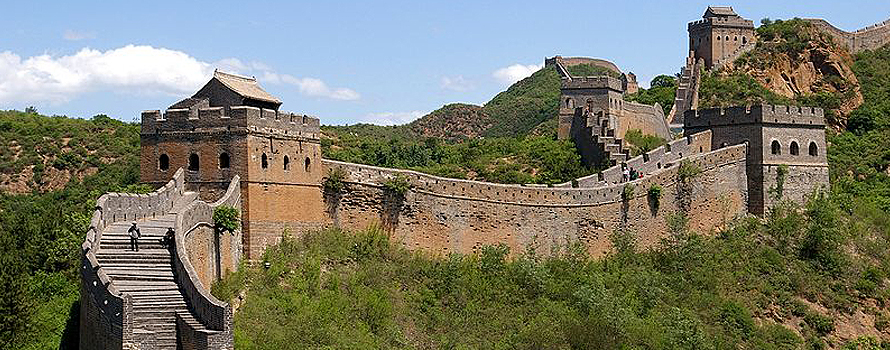
▲Great Wall of China, near Jinshanling [Jakub Halin-Wikimedia Commons].
COMMENTARY / Paulina Briz Aceves
The Great Wall of China was completed after decades of successive efforts by different dynasties, not only as a defensive line, but also as a sign of the Chinese attitude towards the outside world. Although this wall currently has no use, other than as a tourist attraction, it has been an example for the creation of another great wall, which although not physical, has the same effects as the original: to isolate the Chinese community from the outside world and to protect itself from attacks against its sovereignty.
The "Great Firewall of China" - the government's online surveillance and censorship effort - monitors all traffic in Chinese cyberspace and allows authorities to both deny access to a variety of selected websites and disconnect all Chinese networks from the global Internet. In addition to the Great Firewall, the Chinese government has also created a domestic surveillance system called "Golden Shield," which is administered by the Ministry of Public Security and other government Departments and local agencies. The Chinese government understands how valuable and powerful technology, innovation and the Internet are, so it is cautious about information disseminated on Chinese soil, due to its constant fear of a possible challenge to the Communist Party and disruption of China's political order.
China's cyber policies and strategies are hardly known in the international world, but what is known is that China's network security priorities are motivated by the Communist Party's primary goal of staying in power. China's rulers understand that cyber is now fully integrated into society. Therefore, they consider that in order to maintain political stability they must keep an eye on their citizens and control them, leaving them in the shadows by censoring not only general information, but also sensitive issues such as the Tiananmenplace massacre or the Umbrella Revolution in Hong Kong.
The filters that control what citizens see on the web have become more sophisticated. In addition, the government has employee about 100,000 people to monitor the Chinese Internet, to control information not only from the West, but even that generated in China itself. It is true that this meddling in the media has undoubtedly made the Chinese government assert its power over society, because it is clear that he who has the information definitely has the power.