
From Iranian strategic perspective, the Sunni-Shi'a divide is only part of its larger objective of exporting its revolution.
![Military scene from a high relief from ancient Persia [Pixabay]](/documents/10174/16849987/ancient-iran-blog.jpg "Military scene from a high relief from ancient Persia [Pixabay]")
▲ Military scene from a high relief from ancient Persia [Pixabay]
ESSAY / Helena Pompeii
At a first glance it may seem that the most important factor shaping the dynamics in the region is the Sunni-Shi'a divide materialized in the struggle between Saudi Arabia and Iran over becoming the main hegemonic power in the region. Nonetheless, from the strategic perspective of Iran this divide is only part of its larger objective of exporting its revolution.
This short essay will analyze three paths of action or policies Iran has been relying on in order to exert and expand its influence in the MENA region: i) it's anti-imperialistic foreign policy; (ii) the Sunni-Shi'a divide; and (iii) opportunism. Finally, a study case of Syria will be provided to show how Iran made use of these three courses of action to its benefit within the war.
I. ANTI-IMPERIALISM
The Sunni-Shi'a division alone would not be enough to rocket Iran into an advantaged position over Saudi Arabia, being the Shi'ites only a 13% of the total of Muslims over the world (found mainly in Iran, Pakistan, India and Iraq). [1] Even though religious affiliation can gain support of a fairly big share of the population, Iran is playing its cards along the lines of its revolutionary ideology, which consists on challenging the current international world order and particularly what Iran calls US's imperialism.
Iran does not choose its strategic allies by religious affiliation but by ideological affinity: opposition to the US and Israel. Proof of this is the fact that Iran has provided military and financial support to Hamas and the Islamic Jihad in Palestine, both of them Sunni, in their struggle versus Israel. [2] Iran's competition against Saudi Arabia could be understood as an elongation of its anti-US foreign policy, the Saudi kingdom being the other great ally of the West in the MENA region along with Israel.
II. SUNNI-SHI'A DIVIDE
Despite the religious divide not being the main reason behind the hegemonic competition among both regional powers Saudi Arabia (Sunni) and Iran (Shi'a), both states are exploiting this narrative to transcend territorial barriers and exert their influence in neighbouring countries. This rivalry materializes itself along two main paths of action: i) development of neopatrimonial and clientelistic networks, as it shows in Lebanon and Bahrain[3]; ii) and in violent proxy wars, namely Yemen and Syria.
to. Lebanon
Sectarian difference has been an inherent characteristic of Lebanon all throughout its history, finally erupting into a civil war in 1975. The Taif accords, which put an end to the strife attempted to create a power-sharing agreement that gave each group a political voice. These differences were incorporated into the political dynamics and development of blocs which are not necessarily loyal to the Lebanese state alone.
Regional dynamics of the Middle East are characterised by the blurred limits between internal and external, this reflects in the case of Lebanon, whose blocs provide space for other actors to penetrate the Lebanese political sphere. This is the case of Iran through the Shi'ite political and paramilitary organization of Hezbollah. This organization was created in 1982 as a response to Israeli intervention and has been trained, organized and provisioned by Iran ever since. Through the empowerment of Iran and its political support for Shi'a groups across Lebanon, Hezbollah has emerged as a regional power.
Once aware of the increasing Iranian influence in the region, Saudi Arabia stepped into it to counterbalance the Shi'a empowerment by supporting a range of Salafi groups across the country.
Both Riyadh and Tehran have thus established clientelistic networks through political and economic support which feed upon sectarian segmentation, furthering factionalism. Economic inflows in order to influence the region have helped developed the area between Ras Beirut and Ain al Mraiseh through investments by Riyadh, whilst Iranian economic aid has been allocated in the Dahiyeh and southern region of the country. [4]
b. Bahrain
Bahrain is also a hot spot in the fight for supremacy over the region, although it seems that Saudi Arabia is the leading power over this island of the Persian Gulf. The state is a constitutional monarchy headed by the King, Shaikh Hamad bin Isa Al Khalifa, of the Sunni branch of Islam, and it is connected to Saudi Arabia by the King Fahd Causeway, a passage designed and built to prevent Iranian expansionism after the revolution. Albeit being ruled by Sunni elite, the majority of the country's citizens are Shia, and have in many cases complaint about political and economic repression. In 2011 protests erupted in Bahrain led by the Shi'a community, Saudi Arabia and United Arab Emirates stepped in to suppress the revolt. Nonetheless, no links between Iran and the ignition of this manifestation have been found, despite accusations by the previously mentioned Sunni states.
The opposition of both hegemonic powers has ultimately materialized itself in the involvement on proxy wars as are the examples of Syria, Yemen, Iraq and possibly in the future Afghanistan.
c. Yemen
Yemen, in the southeast of the Arabian Peninsula, is a failed state in which a proxy war fueled mainly by the interests of Saudi Arabia and Iran is taking place since the 25th of March 2015. On that date, Saudi Arabia leading an Arab coalition against the Houthis bombarded Yemen.
The ignition of the conflict began in November 2011 when President Ali Abdullah Saleh was forced to hand over his power to his deputy and current president Abdrabbuh Mansour Hadi (both Sunni) due to the uprisings product of the Arab Spring. [5]
The turmoil within the nation, including here al-Qaeda attacks, a separatist rising in the south, divided loyalties in the military, corruption, unemployment and lack of food, led to a coup d'état in January 2015 led by Houthi rebels. The Houthis, Shi'ite Muslims backed by Iran, seized control of a large territory in Yemen including here the capital Sana'a. A coalition led by Saudi Arabia and other Sunni-majority nations are supporting the government.
Yemen is a clear representation of dispute over regional sovereignty. This particular conflict puts the Wahhabi kingdom in great distress as it is happening right at its front door. Thus, Saudi interests in the region consist on avoiding a Shi'ite state in the Arabian Peninsula as well as facilitating a kindred government to retrieve its function as state. Controlling Yemen guarantees Saudi Arabia's influence over the Gulf of Aden and the Strait of Baab al Mandeb, thus avoiding Hormuz Strait, which is currently under Iran's reach.
On the other hand, Iran is soon to be freed from intensive intervention in the Syrian war, and thus it could send in more military and economic support into the region. Establishing a Shi'ite government in Yemen would pose an inflexion point in regional dynamics, reinforcing Iran's power and becoming a direct threat to Saudi Arabia right at its frontier. Nonetheless, Hadi's government is internationally recognized and the Sunni struggle is currently gaining support from the UK and the US.
III. OPPORTUNISM
The Golf Cooperation Council (GCC) is a political and economic alliance of six countries in the Arabian Peninsula which fail to have an aligned strategy for the region and could be roughly divided into two main groups in the face of political interests: i) those more aligned to Saudi Arabia, namely Bahrain and UAE; ii) and those who reject the full integration, being these Oman, Kuwait and Qatar.
Fragmentation within the GCC has provided Iran with an opportunity to buffer against calls for its economic and political isolation. Iran's ties to smaller Gulf countries have provided Tehran with limited economic, political and strategic opportunities for diversification that have simultaneously helped to buffer against sanctions and to weaken Riyadh. [6]
to. Oman
Oman in overall terms has a foreign policy of good relations with all of its neighbours. Furthermore, it has long resisted pressure to align its Iran policies with those of Saudi Arabia. Among its policies, it refused the idea of a GCC union and a single currency for the region introduced by the Saudi kingdom. Furthermore, in 2017 with the Qatar crisis, it opposed the marginalization of Qatar by Saudi Arabia and the UAE and stood as the only State which did not cut relations with Iran.
Furthermore, the war in Yemen is spreading along Oman's border, and it's in its best interest to bring Saudi Arabia and the Houthis into talks, believing that engagement with the later is necessary to put an end to the conflict. [7] Oman has denied transport of military equipment to Yemeni Houthis through its territory. [8]
b. Kuwait
A key aspect of Kuwait's regional policy is its active role in trying to balance and reduce regional sectarian tensions, and has often been a bridge for mediation among countries, leading the mediation effort in January 2017 to promote dialogue and cooperation between Iran and the Gulf states that was well received in Tehran. [9]
c. Qatar
It has always been in both state's interest to maintain a good relationship due to their proximity and shared ownership of the North/South Pars natural gas field. Despite having opposing interests in some areas as are the case of Syria (Qatar supports the opposition), and Qatar's attempts to drive Hamas away from Tehran. In 2017 Qatar suffered a blockade by the GCC countries due to its support for Islamist groups such as the Muslim Brotherhood and militant groups linked to al-Qaeda or ISIS. During this crisis, Iran proved a good ally into which to turn.. Iran offered Qatar to use its airspace and supplied food to prevent any shortages resulting from the blockade. [10] However as it can be deduced from previous ambitious foreign policies, Qatar seeks to diversify its allies in order to protect its interests, so it would not rely solely on Iran.
Iran is well aware of the intra-Arab tensions among the Gulf States and takes advantage of these convenient openings to bolster its regional position, bringing itself out of its isolationism through the establishment of bilateral relations with smaller GCC states, especially since the outbreak of the Qatar crisis in 2017.
IV. SYRIA
Iran is increasingly standing out as a regional winner in the Syrian conflict. This necessarily creates unrest both for Israel and Saudi Arabia, especially after the withdrawal of US troops from Syria. The drawdown of the US has also originated a vacuum of power which is currently being fought over by the supporters of al-Assad: Iran, Turkey and Russia.
Despite the crisis involving the incident with the Israeli F-16 jets, Jerusalem is attempting to convince the Russian Federation not to leave Syria completely under the sphere of Iranian influence.
Israel initially intervened in the war in face of increasing presence of Hezbollah in the region, especially in its positions near the Golan Heights, Kiswah and Hafa. Anti-Zionism is one of Iran's main objectives in its foreign policy, thus it is likely that tensions between Hezbollah and Israel will escalate leading to open missile conflict. Nonetheless, an open war for territory is unlikely to happen, since this will bring the UyS back in the region in defense for Israel, and Saudi Arabia would make use of this opportunity to wipe off Hezbollah.
On other matters, the axis joining Iran, Russia and Turkey is strengthening, while they gain control over the de-escalation zones.
Both Iran and Russia have economic interests in the region. Before the outbreak of the war, Syria was one of the top exporting countries of phosphates, and in all likelihood, current reserves (estimated on over 2 billion tons) will be spoils of war for al-Assad's allies. [11]
The Islamic Revolutionary Guard Corps took control of Palmira in 2015, where the largest production area of phosphates is present. Furthermore, Syria also signed an agreement on phosphates with Russia.
Iran has great plans for Syria as its zone of influence, and is planning to establish a seaport in the Mediterranean through which to export its petroleum by a pipeline crossing through Iraq and Syria, both under its tutelage[12]. This pipeline would secure the Shi'ite bow from Tehran to Beirut, thus weakening Saudi Arabia's position in the region. Furthermore, it would allow direct oil exports to Europe.
In relation to Russia and Turkey, despite starting in opposite bands they are now siding together. Turkey is particularly interested in avoiding a Kurdish independent state in the region, this necessarily positions the former ottoman empire against the U.S a key supporter of the Kurdish people due to their success on debilitating the Islamic State. Russia will make use of this distancing to its own benefits. It is in Russia's interest to have Turkey as an ally in Syria in order to break NATO's Middle East strategy and have a strong army operating in Syrian territory, thus reducing its own engagement and military cost. [13]
Despite things being in favour of Iran, Saudi Arabia could still take advantage of recent developments of the conflict to damage Iran's internal stability.
Ethnic and sectarian segmentation are also part of Iran's fabric, and the Government's repression against minorities within the territory –namely Kurds, Arabs and Baluchis- have caused insurgencies before. Saudi Arabia and other Gulf States aligned with its foreign policy, such as the UAE are likely to exploit resentment of the minorities in order to destabilized Iran's internal politics.
The problem does not end there for Iran. Although ISIS being wiped off the Syrian territory, after falling its last citadel in Baguz[14], this is not the end of the terrorist group. Iran's active role in fighting Sunni jihadists through Hezbollah and Shi'ite militias in Syria and Iraq has given Islamist organization a motivation to defy Tehran.
Returning foreign fighters could scatter over the region creating cells and even cooperating with Sunni separatist movements in Ahwaz, Kurdistan or Balochistan. Saudi Arabia is well aware of this and could exploit the Wahhabi narrative and exert Sunni influence in the region through a behind-the-scenes financing of these groups.
[1] Mapping the Global Muslim Population, Pew Research Center, 2009
[2] The Collapse of the Status Quo in OM: Iran's Security Strategies and AS, David Poza Cano, January 2017.
[3] Saudi Arabia, Iran and the Struggle for Supremacy in Lebanon and Bahrain, Simon Mabon, LSE 2018
[4] Ibid.
[5] Proxy war: What is the Yemen War about, is there a famine, why is Saudi Arabia involved and how many people have died? Guy Birchall, November 2018.
[6] Iran and the GCC Hedging, Pragmatism and Opportunism, Sanam Vakil, September 2018
[7] Reuters 'Yemen's Houthis and Saudi Arabia in secret talks to end war', 15 March, 2018
[8] Bayoumy, Y. (2016), 'Iran steps up weapons supply to Yemen's Houthis via Oman', Reuters, 30 October.
[9] Coates Ulrichsen, K., 'Walking the tightrope: Kuwait, Iran relations in the aftermath of the Abdali affair', Gulf States Analytics, 9 August, 2017
[10] Kamrava, M. 'Iran-Qatar Relations', in Bahgat, Ehteshami and Quilliam (2017), Security and Bilateral Issues Between Iran and Its Neighbours.
[11] The current situation in Syria, Giancarlo Elia Valori, Modern Diplomacy, January 2019
[12] Iran in the Era of the Trump Administration, Beatriz Yubero Parro, IEEE, 2017
[13] The current situation in Syria, Giancarlo Elia Valori, Modern Diplomacy, January 2019
[14] In Syria, the total defeat of the group ISIS terrorist, Clarín Mundo. March 23, 2019
The need for labour has traditionally led Sweden to welcome waves of immigrants; Sectors of society today experience it as a problem
![Oresund Bridge, between Denmark and Sweden, seen from Swedish territory [Wikipedia]](/documents/10174/16849987/suecia-migracion-blog.jpg "Oresund Bridge, between Denmark and Sweden, seen from Swedish territory [Wikipedia]")
▲ Oresund Bridge, between Denmark and Sweden, seen from Swedish territory [Wikipedia]
ANALYSIS / Jokin de Carlos
Sweden has had a reputation, since World War II, for being a country open to immigrants and for developing tolerant and open social policies. However, the increase in issue The slow cultural adaptation of some of these new communities, especially the Muslims, and the problems of violence generated in areas of greater vulnerability have led to an intense discussion in Swedish society. The view that a generous migration policy may be destroying Swedish identity and making life more difficult for native Swedes has fuelled the vote of some civil service examination The Social Democrats last year revalidated public support for a government that maintains traditional policies with a certain greater emphasis on the expulsion of those whose application has been rejected.
Migration policy
One of Sweden's historical problems has been its leave By the 1960s, the fertility rate had fallen to the threshold of 2.1 children per woman needed for population replacement. That was something that threatened Sweden's notorious welfare state, because of the need for tax revenues to maintain generous public services, so the country promoted the influx of immigrants. At the same time, the need for manpower was also raised by the development of the national industry.
Sweden emerged from World War II in good condition. It did not suffer the destruction of other nations, as it remained territorially on the margins of the conflict, and it was able to consolidate a metallurgical industry that, thanks to the production of its iron mines, had benefited from selling to both sides in the war. That development required a great deal of work that the leave The concentration of the population on the coast and in the south, outside the industrial centres, made it difficult to gather. In addition, Sweden's welfare state and continued decades of peace created a class average that he did not want to work in the new industry because of the low wages it offered to be competitive.
To solve the labor shortage and thus maintain economic progress, Sweden turned to immigration since the 1950s. The government first opened the border to asylum seekers or work and then built clusters of dwellings, usually of leave near industrial areas where newcomers could find jobs without any language. When the cultural impact of these additions was too great in some areas, the government proceeded to close the borders, restricting immigration. When new workers were needed, the government reopened the border.
This system helped to advance economically, but it also isolated many social groups, who were stuck in low-income areas with little possibility of development or social integration.
development historical
Both during and after World War II, Sweden was an important destination for people from Norway, Denmark, Poland, Finland and the Baltic Republics escaping war or the destruction it created; It was also a neutral destination for many Jews. In 1944, there were more than 40,000 refugees in Sweden; While many returned to their countries after the war, a group A considerable number of them remained, mainly Estonians, Latvians and Lithuanians, whose home nations were incorporated into the USSR.
In 1952, Sweden, Denmark and Norway formed the committee Nordic, creating a area of free trade and freedom of movement, which Finland joined in 1955. With this, thousands of migrants went to Sweden to work in the industry, mainly from Finland but also from Norway, which had not yet discovered its oil reserves. This increased the percentage of the immigrant population from 2% in 1945 to 7% in 1970. All this helped Tage Erlander (Prime Minister of Sweden from 1946 to 1969) to create the project "Strong Society", aimed at increasing the public sector and the welfare state. However, this influx of labour began to harm native Swedish workers, and consequently, in 1967, trade unions began to pressure Erlander to limit labour immigration to the Nordic countries.
In 1969, Erlander resigned from the position and was replaced by his protégé, Olof Palme. Palme was a member of the most radical wing of the Social Democrats and wanted to further increase the welfare state, continuing the project of its predecessor on a larger scale.
In order to attract a larger workforce without angering unions, Palme began using pro-refugee rhetoric, opening Sweden's borders to people escaping dictatorships and war. At the same time, these people would be moved to industrial neighborhoods, built especially for them in nearby industrial areas where they would work. At the same time, Palme sought to make Sweden an attractive country for immigrants through assimilation policies in favor of multiculturalism.
During this period, people of many nationalities began to arrive in the country: from those fleeing conflict in Yugoslavia or martial law in Poland to those fleeing the Middle East and Latin America. These new populations settled far from native Swedish demographics; Because of this, many neighborhoods in the class They became isolated ghettos. In 1986, Palme was assassinated and his successor, Ingvar Carlsson, changed immigration policy and began accepting only those they configured as refugees from the United States. agreement with United Nations standards.
During the 1990s, increased conflicts in places like Somalia, Yugoslavia, and several African nations increased the flow of war refugees, with many of them going to Sweden. The Ministry of Migration and Asylum Policy was established in 1996. However, the two largest movements of people from foreign countries would occur in the wake of the subsequent conflicts in Iraq and Syria. The conservative government of Fredrik Reinfeldt began taking in a large volume of Iraqi refugees, who in 2006 became the country's second-largest minority, after the Finns. In 2015, the Social Democratic government of Stefan Löfven opened the border to Syrian refugees, who arrived en masse, fleeing the Syrian Civil War and the push of Daesh.
This succession of waves of immigrants from the Middle East aggravated some problems: in many neighborhoods, outsiders don't feel like they're in Sweden, mainly because they were built to "not be Sweden"; In addition, difficult integration and low-paying jobs fuel gangs and organized crime. All of this led Löfven to implement a stricter migration policy in 2017, accepting fewer asylum seekers and beginning to expel those whose asylum claims had been denied.
As you can see, the trend in Sweden is to open borders to immigration when it is needed and to close them when it starts to cause social tensions.
Origins of the Immigrant Population
Sweden has become a very ethnically diverse society, where almost 22% of the population has a foreign background. Until 2015, the largest ethnic minority in the country were Finns, who numbered more than 200,000 at the end of the last century. In the wake of the war in Iraq and the Syrian migration crisis, people from the Middle East have become the largest group.
Currently, 8% of the inhabitants of Sweden come from a country with a Muslim majority – mainly from Syria and Iraq, but also from Iran – although only 1.4% of the population practices the Muslim religion (around 140,000 people in 2017), as there are also immigrants from these countries with other religious affiliations. such as Christians, Druze, Yazidis or Zoroastrians. These numbers may have increased slightly, though not to cause very drastic changes in demographics.
Despite not being particularly numerous, the Muslim community has generated media attention as a result of various controversies. In 2006, Mahmoud Aldebe, a member of the committee A Muslim from Sweden, he put forward in a letter to the political parties of the Riksdag and the Swedish government especially controversial demands, such as the right to specific Islamic holidays, special public funding for the construction of mosques, that all divorces between Muslim couples be approved by an imam, and that imams be allowed to teach Islam to Muslim children in public schools. These demands were rejected by the authorities and the class Sweden's politics. It has also been the case that some Muslim associations or mosques have invited radical preachers, such as Haitham al-Haddad or Said Rageahs, whose lectures were eventually banned.
Vulnerable Areas and Organized Crime
The Swedish government has designated some neighbourhoods as Vulnerable Areas (Utsatt Område). They are not strictly "No-Go Zones", because they can be entered by police officers, health services or the media. These are areas of lower security that require greater attention from the authorities.
Some of them are located in Malmö, the city with the highest crime rate in the country, mainly due to its location. Malmö is located on the other side of the Oresund Bridge, which connects Denmark to Sweden and is the only overland route between Sweden and the mainland without having to go around the Baltic. There, various gangs and mafias participate in drug and human trafficking, while at the same time confronting each other in a struggle for control of space. Groups of this subject they also operate in Rotterdam, in relation to the activity generated by its important port.
Despite the impression given by certain anti-immigration messages, crime in Sweden is at levels similar to those of 2006. After that year, the issue crime prices fell, only to rise again in 2010 and 2012. A link could be made between this rise and the economic crisis, which led to an increase in unemployment, but its link to immigration records is less clear. The arrival of Iraqis in 2005 did not lead to greater insecurity on the streets of Sweden, nor has the reception of Syrians in recent years. Sweden's homicide rate is 1.1 per 100,000 inhabitants – below many other European countries – and there are more crimes recorded by native Swedes than by foreigners, according to the committee Swedish National Crime Prevention.
However, the mafias operating in Sweden are mostly made up of certain ethnic groups. His training it stemmed especially from the influx of people from Yugoslavia, both workers in the 1970s and refugees from the Balkan wars of the 1990s. Chief among these groups, known as the Yugo Mafia, is today led by Milan Ševo, nicknamed "The Godfather of Stockholm." Other groups include K-Falangen and Naserligan, composed of Albanians; the Werefolf Legion, made up of South Americans, and the Gangsters, originally made up of the Assyrians (Syria's Christian minority). However, one of the largest is Brödraskapet or the Brotherhood, founded in 1995, with more than 700 members who are all native Swedes and with a large presence in Swedish prisons.
![Migratory movements in Sweden between 1850 and 2007. In red, arrival of immigrants; in blue, departure of emigrants [Wikipedia-Koyos]](/documents/10174/16849987/sueci-migracion-tabla.png "Migratory movements in Sweden between 1850 and 2007. In red, arrival of immigrants; in blue, departure of emigrants [Wikipedia-Koyos]")
Migratory movements in Sweden between 1850 and 2007. In red, arrival of immigrants; in blue, departure of emigrants [Wikipedia-Koyos]
Terrorism
Since 2011 there have been three terrorist attacks in Sweden; A fourth attack could have been avoided as its preparation was detected in time. The first was made by Anton Lundin Pettersson, a Swedish neo-Nazi who in 2015 attacked the Trollhättan School, killing four people, all of them immigrants. The next was perpetrated by the Nordic Resistance Movement, a neo-Nazi organization, which acted against a refugee center and the café of a left-wing organization; Only one person was injured in the attack. The third, the most well-known, was perpetrated in 2017 by a man from Uzbekistan apparently recruited by Daesh, who rammed a truck into pedestrians in central Stockholm, killing five people and injuring fourteen.
Of the three attacks, only one was jihadist-motivated, unlike the weight that Islamist terrorism has had in other European countries with larger Muslim populations. In any case, the segregation experienced in some communities and the radical indoctrination that takes place in them led young Swedish Muslims to go to Syria to join Daesh and the authorities are closely monitoring their possible return.
Hits and misses
For a long time, the European left held up Sweden as an example of model successful social democrat; Now, from certain right-wing groups, he is held up as an example of failed multiculturalism. Both statements are probably an exaggeration for partisan purposes. However, the truth is that Sweden has a generous well-being that is difficult to maintain, and that in its also generous opening of borders it has made mistakes that have not facilitated the integration of the new population. Everything seems to indicate that Löfven continues the path he began in 2017 and there has been an increase in police presence on the streets as well as a hardening of immigration policies, in turn following the policies made in Denmark.
Time will have to pass to see what results these policies will have in a future Sweden.
In Norse mythology, Valhalla is a huge, majestic hall that, in the afterlife, heroes aspire to enter
The upcoming gas self-sufficiency of its two major buying neighbors forces the Bolivian government to look for alternative markets
![Yacimientos Pretrolíferos Fiscales Bolivianos (YPFB) gas plant [Corporación YPFB].](/documents/10174/16849987/bolivia-gasnatural-blog.jpg "Yacimientos Pretrolíferos Fiscales Bolivianos (YPFB) gas plant [Corporación YPFB].")
▲ Yacimientos Pretrolíferos Fiscales Bolivianos (YPFB) gas plant [Corporación YPFB].
ANALYSIS / Ignacio Urbasos Arbeloa
Bolivia, under Evo Morales, is the only economic success story of all the Latin American countries that embraced left-wing populism at the beginning of this century. Together with Panama and the Dominican Republic, Bolivia has achieved the highest GDP growth in the region in the last five years, and all this in a difficult context of decline on the part of its main trading partners: Argentina and Brazil[1]. The political stability brought by Evo Morales since 2006, coupled with prudent counter-cyclical macroeconomic policies and a new hydrocarbons management are part of the formula for this success. Nevertheless, there are enormous economic and political risks for Bolivia. On the one hand, natural gas accounts for 30% of exports and its destination is exclusively Brazil and Argentina, countries that are close to gas self-sufficiency. Finding alternative routes is not an easy task for a landlocked state, with a diplomatic conflict with Chile and separated by the Andes Mountains from Peru. Moreover, the Bolivian government's bid to exploit lithium through national companies that integrate its processing to favor industrialization is a risky strategy that could leave the country out of the growing world lithium market. Finally, Evo Morales and the MAS have followed a growing authoritarian trend, allowing the reelection of the president, undermining the separation of powers and the recent 2009 constitution. The new Bolivia faces in the next decade the challenge of reorienting its natural gas exports, diversifying its Economics and consolidating a real democracy that will allow a sustained growth of its Economics and its role as a regional actor.
Natural Gas: at the center of the 21st century political discussion
During the failed oil explorations in the Chaco in the 1960's, abundant natural gas reserves of great economic potential were found at finding . Although it was a resource of lesser value than crude oil, an incipient gas industry was soon developed by foreign companies, mainly American, such as Standard Oil. In 1972 a first nationalization took place, with the emergence of YPFB as the state-owned business in charge of the exploration, production, transportation and refining of Bolivian energy resources in partnership with foreign companies. That same year, the first export gas pipeline to Argentina was built. By 1999, Bolivia will export natural gas to Brazil through the Santa Cruz-Sao Paulo pipeline, whose project took more than eight years of negotiations and construction work and introduced Petrobras as an important player in the sector. Thus, Bolivia enters the 21st century with a growing gas industry, mostly privatized by the first government of Gonzalo Sánchez de Lozada, and boosted by a very favorable fiscal model for foreign companies[2].
The year 2001 marks the beginning of a convulsive political stage in Bolivia with the so-called Water War. A wave of protests arose from the privatization of municipal water services in the framework of financial negotiations between the IMF and the government of Hugo Banzer. At the nerve center of these protests in Cochabamba emerged the figure of Evo Morales, a coca growers' leader who will increase his popularity unstoppably. Gas became the protagonist in 2003, with a new wave of protests against the construction of a natural gas pipeline from Tarija to Mejillones (Chile) for consumption by the Chilean mining industry and export to Mexico and the USA in the form of LNG. The civil service examination at project argued the historical incoherence of contributing Bolivian resources to the exploitation of the mining region lost to Chile in the War of the Pacific (1879-1883) and which deprived Bolivia of an outlet to the sea. In addition, an alternative, more costly gas pipeline through Peru was proposed, but which would supposedly benefit the northern region of Bolivia and would not be a national humiliation. The protests took a nationalist and indigenist turn and became a real revolution that blocked La Paz, the international airport and plunged the whole country into violence and shortages. President Lozada resigned and most of his government fled abroad, while the project was cancelled and buried forever.
The new president Mesa comes to power with the promise to call for a binding referendum on gas, the establishment of a Constituent Assembly and a reform of the Hydrocarbons Law, including a review of the privatization processes. The referendum ended up giving the victory to Carlos Mesa's proposals, although with a leave participation and a confusing essay of the questions. President Mesa, unable to capitalize on the legitimacy granted by the plebiscite Withdrawal to position and called early presidential elections in 2005, which brought to power the first indigenous president in the history of Bolivia, Evo Morales, with an absolute majority. Natural gas thus became the main catalyst for political change in Bolivia.
Hydrocarbon reform
The arrival of Evo Morales brought about a profound change in the hydrocarbons legal framework . In 2006 the new hydrocarbons law "Heroes del Chaco" was enacted, nationalizing Bolivia's energy resources, expropriating 51% of the shares of companies involved in the sector and establishing a direct tax on hydrocarbons of 50% subject to an extra royalty of 32% to YPFB in those fields with more than 100 mcf of annual production[3]. This legislation, in the words of Evo Morales "turned the tables, going from 18% to 82% of the State's income on hydrocarbons"[4]. The legislation, although adorned with a radical revolutionary rhetoric, has proven to be moderate and viable in the medium term, since it allows in the internship much less burdensome tax formulas for energy multinationals and did not imply large expropriations of assets. As can be seen in the graph below, tax revenues from natural gas have grown enormously since 2005, the year of the reform, without dramatically affecting natural gas production. Moreover, this reform was accompanied by record highs in the price of raw materials in 2006, 2007 and 2008, cushioning the percentage reduction in foreign companies' revenues. In 2009 Bolivia included in article 362 the primacy of oil service contracts, a formula in which multinationals do not obtain any rights over the hydrocarbons extracted, but are remunerated for the services rendered.
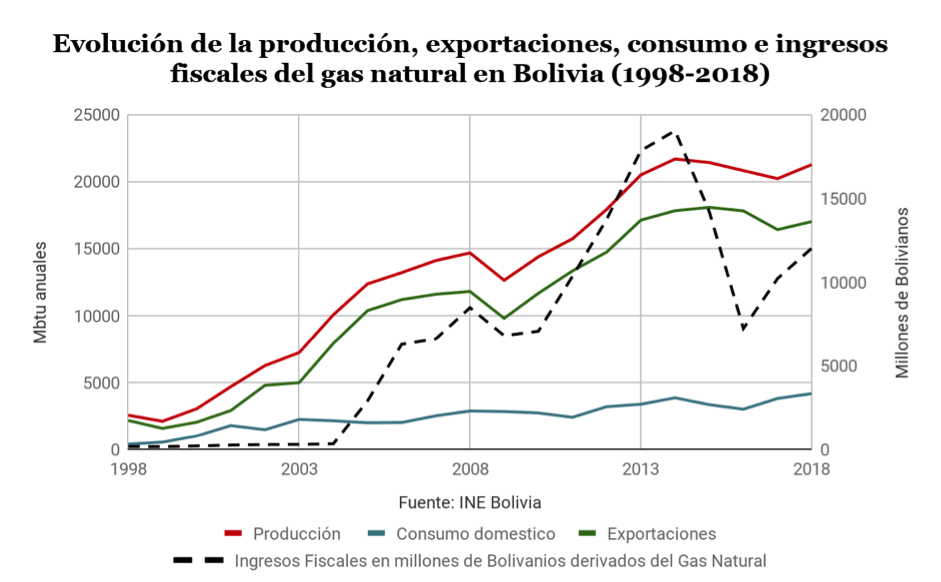
Since the reform, exports have been relatively stable, buoyed by growing demand in both Brazil and Argentina. The most controversial case occurred in the particularly cold winter of 2016, when Bolivia halted exports due to maintenance work at the Margarita field. This event unmasked a stubborn reality about Bolivia's proven natural gas reserves and the need to increase exploration and drilling work in the country. Bolivia's current reserves amount to 283 bcm (10 tcf), enough for only 10 years of export activity at the current rate. Aware of this status limit, the YPFB corporation has launched an investment campaign for 2019 amounting to 1.45 billion dollars, of which 450 million dollars will be dedicated to exploration work[5]. Much of the investment in the sector in recent years has been aimed at industrializing natural gas production instead of exploration work, building refining plants such as the Bulo Bulo ammonia and urea plant[6]. Total, Shell, Repsol and Petrobras are currently working in exploration and production[7]. This effort is intended to answer the IMF's report , which considered Bolivia's natural gas reserves to be too scarce to turn the country into a regional energy center, Evo Morales' greatest aspiration[8]. For YPFB, there are probable reserves of 850 bcm (35 tfc) that would guarantee a long life for the gas sector, but it should rethink its fiscal policy in order to attract foreign companies, which currently account for only 20% of total investment[9].
The future of Bolivian natural gas
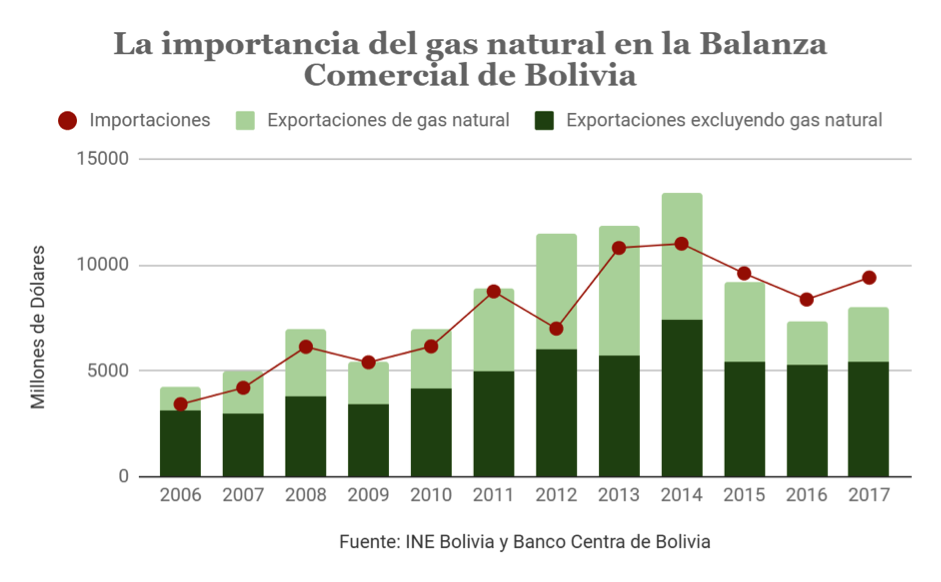
From agreement with the contracts signed with Brazil (1999) and Argentina (2005) export prices are indexed to a basket of hydrocarbons, which in general has guaranteed Bolivia a very favorable price, higher than the Henry Hub, but which makes the country equally dependent on fluctuations in international commodity prices. However, the revolution of non-conventional technology and new forms of transportation, now more economical, such as LNG, are transforming the reality of the natural gas market in the Southern Cone. This new situation, linked to the end of the contracts with Brazil in 2019 and Argentina in 2026, puts in check the future of the main asset of the Bolivian Economics .
As shown in the graph sample , the Bolivian trade balance and its fiscal stability depend on the exported volumes of natural gas and its international price. The survival of the current Bolivian economic model and the presidency of Evo Morales depend to a great extent on the income derived from this hydrocarbon, being a fundamental factor for the future of the Plurinational Republic of Bolivia.
Brazil
Since 1999, Brazil has become the main destination for natural gas exports, being Bolivia's only client in the 2001-2005 period. This position allowed the entrance of Petrobras as the main investor in the sector until the year of the nationalization, which meant an important diplomatic friction between both countries. It was the complicity between Morales and Lula, as well as the importance of maintaining harmony between the leftist governments in the region, which allowed avoiding a major confrontation between the two countries. Despite the words of Petrobras' president in 2006, Sergio Gabrielli, announcing the end forever of the company in Bolivia, it has continued to be an important investor due to the profitability of its activities and the strategic importance of Bolivian gas for Brazil.
It seems clear that natural gas will play an important role in Brazil's future, since the main source source of electricity in the country, hydroelectric power, requires other sources to replace it when there is a shortage of rainfall, as occurred between 2012 and 2014. This context favored the entrance of natural gas in the electricity mix, which went from 5% in 2011 to 25% by 2015[10]. However, Brazil started a decade ago with the revolutionary pre-salt hydrocarbon exploitations, which have allowed the country to increase its crude oil production from 1.8 mbd in 2008 to 2.6 mbd in 2018. Natural gas production associated with these fields is expected to enter the Brazilian market as the necessary infrastructure connecting the off-shore fields to the still insufficient network of gas pipelines is built, something that is expected to improve with the entrance of private players to the sector following the 2016 energy reform. Likewise, Brazil already has 3 plants to import LNG, allowing it to diversify its imports, as it did during 2018 when Bolivia was unable to supply the 26 million cubic meters per day agreed in 1999. All this puts Petrobras and Bolsonaro, located in the ideological antipodes of Morales, in a privileged position for negotiation, and who could bet on increasing imports of the increasingly cheaper North American LNG and reducing the volume of Bolivian gas. In any case, due to certain non-compliances in the supply of gas from Bolivia, the contract will be extended for at least two more years until the pending volumes of submit , which Brazil has already paid for, are reached.
Argentina
The other natural gas market for Bolivia is also undergoing profound transformations, in this case derived from unconventional shale and tight oil techniques. The Vaca Muerta field, considered one of the largest shale deposits in the world, has begun to produce the first returns after years of investments by YPF and other multinationals. Despite Argentina's economic instability and the fiscal reforms demanded by the IMF that will delay the total development of this giant field[11], it is expected that by 2022 its production will cover approximately 80% of Bolivian imports, returning to the path of self-sufficiency achieved in much of the 1990s and 2000s[12]. For the time being, Argentina has already managed to renegotiate the volumes of natural gas imported in summer and winter in a way that is more favorable to domestic demand[13]. In addition, Argentina authorized natural gas exports to Chile after 12 years of interruption[14] and made its first LNG export in May 2019[15], which are early signs of growing domestic production.
It seems clear that the Argentine market will not have a long run for Bolivian natural gas and will probably put an end to its imports when the contract ends in 2026. Other options are to use the complete network of Argentine pipelines as transit to other destinations via LNG or to neighbors such as Uruguay, Paraguay or even Chile.
Peru
For some months now, Bolivia has been engaged in a public diplomacy campaign to extend a gas export pipeline to Puno, a Peruvian city located on Lake Titikaka. Although Peru has significant natural gas production in Camisea that allows it to export large quantities of LNG, the country launched a program known as Siete Regiones (Seven Regions) to universalize access to natural gas. Southern Peru can be supplied more economically through Bolivian imports due to the proximity of the La Paz pipeline, but there is reluctance, especially in the pro-Fujimori civil service examination , to import a surplus good in the country. This formula would be integrated into a plan to export liquefied petroleum gas from Bolivia to the same area, while Peru would build a gas pipeline to import oil and derivatives from the Pacific port of Ilo to La Paz. For Bolivia, the Peruvian market may be a temporary solution while exports continue to diversify, but it will have an early expiration date given the Peruvian natural gas reserves, double the Bolivian reserves, and the logical trend towards greater domestic production to cover the demand of the entire country. Likewise, it seems sensible to think that the Peruvian coast will in the future be one of the points through which Bolivia could export its natural gas in the form of LNG if the regional market is saturated.
Chile
From an economic point of view, Chile is the most attractive country for Bolivian exports. It lacks natural gas reserves and its mining area, with high energy demand, is located in an area relatively close to Bolivia's gas pipelines and fields network . However, the now century-old dispute over Bolivia's original territories annexed by Chile in the War of the Pacific (1879-1883) has been an insurmountable obstacle in the present century. It is worth mentioning that during the 50's and 60's Bolivia exported oil to Chile and the USA through the Sica Sica-Arica pipeline; that is to say, the refusal to export natural gas to Chile has been a flag used by Evo Morales and not a historical tradition in the relationship between these countries.
After the huge mobilizations caused by the Gas War, Evo Morales was able to catalyze popular fervor and use the territorial dispute to increase his popularity. In fact, a good part of his efforts in the previous legislature were focused on achieving the longed-for exit to the sea through the International Court of Justice in The Hague. In 2018 this court ruled favorably for Chile, ruling that this country has no duty to negotiate with Bolivia a territorial settlement. Morales' refusal to export natural gas to Chile looks set to continue for the duration of his presidency.
However, the 1904 Treaty of Peace and Friendship signed by both states grants Bolivia full customs autonomy in the Chilean ports of Arica and Antofagasta and the right to keep goods in transit for 12 months, with free storage for its imports, and 60 days of free storage for its exports. These conditions seem ideal for the construction of an LNG plant in Arica or Antofagasta to export natural gas by sea while supplying the Chilean north, in need of cheap natural gas to displace coal. The difficult political relations between both countries complicate the viability of this project, which should not be discarded when Morales leaves the presidency and there is greater harmony, as happened with Pinochet and Banzer in power.
Domestic consumption
Domestic consumption of natural gas in Bolivia has grown at an annual rate of 4.5% in the 2008-2018 period driven by subsidized prices for consumption and the implementation of state projects that aim to provide added value natural gas extraction such as the Bulo Bulo urea plant or the Mutun steel industry. It is expected that per capita income in Bolivia and electricity consumption will continue to increase over the next decade. If the volume of natural gas subsidies grows similarly while export revenues decline, Bolivia's delicate fiscal balance could take a similar path to that of Argentina. The process of domestic industrialization through natural gas does not seem far-fetched either, as long as it is based on market rules and not at the expense of public finances. The country has already achieved self-sufficiency in fertilizers and is already a growing exporter, an example of the economic diversification pursued by the Morales government.
The question: Is there a market for everyone?
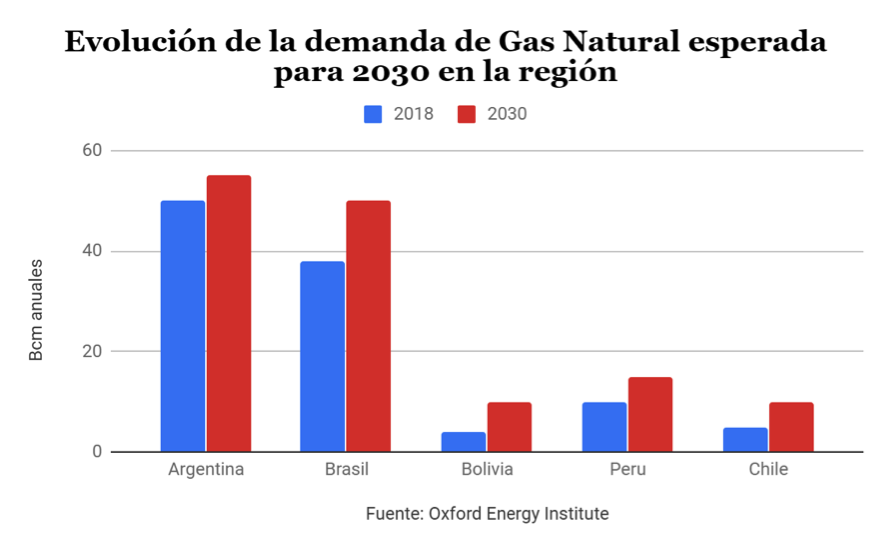
After reviewing the regional context, it may appear that the natural gas market in South America will be saturated by future oversupply. As can be seen in the graph, natural gas demand in the Bolivian neighborhood will increase from 107 bcm to 140 bcm per year by 2030. Peru, Argentina and Brazil are likely to increase their production and may reach self-sufficiency during the 2020s. This complicates the commercialization of Bolivian gas, but does not make it impossible. In the first place, the geographical reality of South America makes certain cross-border projects more economical than other internal ones, as in the case of southern Peru. Likewise, the increasingly lower costs of exporting gas by sea make it possible to find a market for surplus regional production, as in the case of Peru, which concentrates its gas exports to Spain. In a context of increasing energy interconnection, Bolivia will be able to continue exporting natural gas, albeit from a less privileged position and having to invest in export infrastructure. The major challenges are focused on increasing exploration activities by attracting more foreign and private investment, as well as the search for new markets, with the Chilean issue being a central element in this discussion.
[2] http://www.realinstitutoelcano.org/wps/portal/rielcano_en/content?WCM_GLOBAL_CONTEXT=/elcano/elcano_en/zones_en/ARI%20130-2006
[5] https://www.efe.com/efe/english/business/bolivia-to-spend-450-mn-in-2019-exploring-for-natural-gas/50000265-3881056
[6] https://www.ypfb.gob.bo/es/14-noticias/332-planta-de-amoniaco-y-urea-registra-avance-del-64.html
[7] https://www.petroleum-economist.com/articles/midstream-downstream/pipelines/2018/weighing-bolivias-gas-export-options
[9] https://www.petroleum-economist.com/articles/politics-economics/south-central-america/2017/bolivia-another-strike-from-the-resources-curse
[11] http://ieefa.org/wp-content/uploads/2019/03/Financial-Risks-Cloud-Development-of-Vaca-Muerta_March-2019.pdf
[13] https://www.reuters.com/article/us-argentina-energy-gas/argentina-renegotiates-key-gas-supply-contract-with-bolivia-idUSKCN1Q402O
Iran Country Risk Report (June 2019)
After some months of implementation, the re-imposed US sanctions against Iran are seriously affecting Iranian economy and forcing disputed political and even military reactions. The present report attempts to provide an analysis of Iran by addressing: the consequences of sanctions, the current and future state of its energy sector, the internal situation of the country, and the future prospect of the Iran-US relations.
C. Asiáin, M. Morrás, I. Urbasos
 Report [pdf. 14,1MB] [pdf. 14,1MB
EXECUTIVE SUMMARY
The US unilateral withdrawal from the JCPOA on May 8, 2018, reshaped the Iranian domestic and international reality. On the one hand, the JCPOA enabled Iran to increase its GDP above 7% in the period of 2016-2018, more than double its oil exports and maintained President Rouhani in office after the 2017 elections. On the other hand, the US reimposition of the previously lifted sanctions demonstrated the deep vulnerabilities of the Iranian economy and its huge diplomatic isolation.
US sanctions will affect the whole of Iran's foreign relations due to its extraterritorial nature. The EU will try to avoid its effect through legal protection of its companies and citizens with mechanisms such as the SPV, whose scope and effectivity is yet to be proved. China, as it is less exposed to the US financial and political influence, will be able to better circumvent sanctions but still far from being totally unaffected. Other countries such as India, Turkey or Russia will find difficulties to handle secondary sanctions, but will be able to maintain a certain degree of trade with the Islamic Republic. Japan or South Korea will have to follow US demands because of its strategic alliance in the Asia-Pacific region and resume energy imports and investments.
The Iranian economy is expected to enter into recession during 2019, GDP growth is expected to be -4.5% and unemployment rate will increase to the 15.4%. This economic hardship will concentrate the political discussion in the 2020 legislative and 2021 presidential elections, whose outcome will determine if a moderate or hardliner political faction seizes power. Social unrest from ethnic minorities and opposition is expected to rise if the economic conditions do not improve, challenging the current political equilibrium of the country.
The energy sector will be deeply affected by US sanctions as it banned all countries from investing and purchasing Iran's energy products. Sanctions are expected to reduce Iran oil exports to 1million barrels a day from the 2017 levels of 2.4 mbdp, decreasing governmental revenues drastically and freezing most foreign investments. The lack of FDI and technology will aggravate the problems of the Iranian energy sector with possible irreversible effects depending on the sanctions duration.
US-Iran relations are expected to worsen at least until the US 2020 Presidential elections, when a more dialoguing candidate could substitute the hawkish Trump administration. The United States is expected to maintain its current strategic alliances with Saudi Arabia and Israel, whose common goal of pressuring Iran can have unexpected consequences for the Middle East. Domestic politics in Iran, US, Israel and Saudi Arabia will play a major role in the evolution of the events.
[Winston Lord, Kissinger on Kissinger. Reflections on Diplomacy, Grand Strategy, and Leadership. All Points Books. New York, 2019. 147 p.]
review / Emili J. Blasco
 |
At 96 years old, Henry Kissinger sees the publication of another book largely his own: the transcription of a series of long interviews related to the main foreign actions of the Nixon Administration, in which he served as national security adviser and secretary of state. Although he himself has already written extensively about those moments and has provided documentation for others to write about – as in the case of the biography of Niall Ferguson, whose first volume appeared in 2015 – Kissinger wanted to return to that period of 1969-1974 to offer a synthesis of the strategic principles that motivated the decisions taken at the time. There are no new developments, but there are details that may be of interest to historians of that time.
The work does not respond to Kissinger's last-minute desire to influence a particular reading of his work. bequest. In fact, the initiative to maintain the dialogues transcribed here did not come from him. It is, however, part of a wave of vindication of the presidency of Richard Nixon, whose strategic vision in international politics was tarnished by Watergate. The Nixon Foundation promoted the making of a series of videos, including various interviews with Kissinger, carried out throughout 2016. These were led by Winston Lord, partner during his time in the White House and in the department of State, together with K. T. McFarland, would then be a civil servant under him (and, for a few months, issue two of the committee of Homeland Security under Donald Trump). More than two years later, that conversation with Kissinger is now published in a small-format and short work. His last books had been "China" (2011) and "World Order" (2014).
Kissinger's oral history here deals with a few issues that focused his activity as a great architect of American foreign policy: the opening to China, the détente with Russia, the end of the Vietnam War, and the greater involvement in the Middle East. Although the conversation goes into detail and provides various anecdotes, what is substantial is what can be extracted beyond these specifics: they are the "reflections on diplomacy, grand strategy and leadership" indicated by the subtitle of the book. It might be tiresome to re-read the intra-history of a diplomatic action about which the protagonist himself has already been prolific, but on this occasion reflections are offered that transcend the specific historical period, which for many may already be very far away, as well as interesting recommendations on the decision-making processes in leadership positions.
Kissinger provides some clues, for example, on why the United States has consolidated the committee of National Security as an instrument of the president's foreign action, with an autonomous – and sometimes conflictive – life with respect to the department of State. The Nixon Administration was its great promoter, following the suggestion of Eisenhower, for whom Nixon had been vice president: interdepartmental coordination in foreign policy could hardly be done from a single point of view. department –the administrative office of state, but had to be carried out from the White House itself. While the National Security Adviser can concentrate on those actions that are most in the president's interest, the Secretary of State is obliged to disperse further, having to attend to a multitude of fronts. Moreover, unlike the greater promptness of the department in support of the Commander-in-Chief, the department The State of State, accustomed to elaborating multiple alternatives for each international issue, may take time to fully assume the direction imposed by the White House.
In terms of negotiating strategy, Kissinger rejects the idea of privately setting a maximum goal and then trim it little by little, like slices of a salami, as you reach the end of the negotiation. Instead, he proposes to set from the beginning the basic goals that one would like to achieve – perhaps adding 5% because something will have to be given – and to spend a lot of time explaining them to the other party, with the idea of reaching a conceptual understanding. Kissinger advises a good understanding of what motivates the other party and what their own objectives are, because "if you impose your interests, without linking them to the interests of others, you will not be able to sustain your efforts," since at the end of the negotiation the parties have to be willing to support what has been achieved.
As on other occasions, Kissinger does not take sole credit for the Nixon Administration's diplomatic successes. While the press and a certain part of academia have given greater recognition to the former Harvard professor, Kissinger himself has insisted that it was Nixon who decisively set the policies, the maturation of which had previously been carried out separately, before collaborating in the White House. However, it is perhaps in this book that Kissinger's words most praise the former president, perhaps because he was made in the framework of an initiative born from the Nixon Foundation.
"Nixon's fundamental contribution was to establish a patron saint of foreign policy thinking, which is seminal," Kissinger says. According to him, the traditional way of approaching U.S. foreign action had been to segment issues in order to try to solve them as individuated problems, making their resolution the question itself. "Nixon was – apart from the Founding Fathers and, I would say, Teddy Roosevelt – the American president who thought of foreign policy as grand strategy. For him, foreign policy was the structural improvement of the relationship between countries so that the balance of their self-interests promoted global peace and the security of the United States. And he thought about this in terms of relative long-range."
Those who have little sympathy for Kissinger – a character of passionate defenders but also staunch critics – will see in this work another exercise in self-congratulation and self-aggrandizement typical of the former adviser. To stay at that stage would be to waste a work that contains interesting reflections and I think that it completes well the thought of someone of such relevance in the history of international relations. What Affirmation staff Rather, the publication refers to Winston Lord, who here claims to be Kissinger's right-hand man at the time: in the first pages the complete photo of the interview between Nixon and Mao appears, the margins of which were cut off at the time by the White House so that Lord's presence would not disturb the secretary of state. who was not invited to the historic trip to Beijing.
How Russia, China, India and the Gulf Cooperation Council countries react to the new US sanctions against Iran
![Presidents Putin and Rouhani during a meeting in Tehran, in September 2018 [Wikipedia]](/documents/10174/16849987/iran-regional-blog.jpg "Presidents Putin and Rouhani during a meeting in Tehran, in September 2018 [Wikipedia]")
▲ Presidents Putin and Rouhani during a meeting in Tehran, in September 2018 [Wikipedia]
ANALYSIS / Alfonso Carvajal
As US-Iranian relations continue to deteriorate, the balance of power and regional alliances will be prone to shifting and changing. Iranians will likely feel increasingly more marginalised as time passes and will seek to remedy their state of international isolation. Here, the main factors to look out for will be the nations seeking to achieve great power status, and how they will try to attract Iran towards them while pushing the Islamic Republic further away from the United States.
China and Russia's response
Russia's relations with Iran have historically been complicated. While at some points, the two countries have faced each other as rivals in war, other times have seen them enjoy peace and cooperation. Russia has been an important actor in Iranian international relations since at least the Sixteenth Century and will most likely retain its importance in the long run. Since the fall of the USSR, Russian-Iranian relations have improved, as many issues that had caused tensions suddenly disappeared. These issues where mainly caused by their ideological incompatibility, as the USSR's atheism was looked upon with suspicion by Khomeini, and its support given to Iraq in the Iran-Iraq war.
Recently, both countries have found themselves facing international, mainly US, economic sanctions. This is a factor that is important to acknowledge, and that will shape their future relations. As Russia and Iran struggle to defuse the effects of sanctions, they will seek trade elsewhere. This means that they have found in each other a way to make for their isolation, and their ties are likely to only grow. Militarily, cooperation has already been cemented by years of sanctions in Iran.
Whereas once the Iranian Armed Forces boasted of having the most advanced Western-built fighter jets and other military material in the region, Iran now often uses Russian and Chinese aircraft and military gear, coupled with its own native military industry that was independently developed as a result of its isolation. Iran is also said to cooperate with Russia in certain industrial sectors close to the military such as drones. However, due to the latest international sanctions, Russia is less keen to continue to cooperate on military sales and technology transfers. For this reason, Russia has shown reluctance towards helping the Iranian nuclear program, although it is in favour of reaching a deal with Iran along with the international community.
A cornerstone in Russian-Iranian relations has always been their mutual distrust towards Turkey. In the age of the Ottoman Empire, relations between Persians and Russians would often consist in an alignment against the Ottoman Turks. Nowadays, their relationship also has this component, as Turkey and Iran are increasingly competing in the Middle East to decide who will lead the reconstruction of the region, whilst Russia and Turkey find themselves at odds in the Black Sea, where Russia's ambition of naval dominance is being challenged.
While it may seem that Russia and Iran should be close allies, there are a series of reasons to explain why cooperation is not likely to see a fully fledged alliance. First of all, there are far too many differences between both regimes, as they have different geopolitical imperatives and ambitions in the Caucasus and the Middle east. The second issue is Israel. As Russia moves further into the Levant, it tries to maintain good relations with Israel, Iran's archenemy, also called little Satan by Iran's first supreme leader, Ayatollah Khomeini. As the conflict in Syria dies down in the following years, Russia will be forced to choose between who to support. This is likely to mean a withdrawal of support towards Iran's position in Syria, as it sees its meddling in the region increasingly unproductive, and would favour its retreat. Iran, however, has said it is there to stay.
Russian-Iranian cooperation has recently been developed in one important country of the region: Afghanistan. As the US seems to lose interest in the Middle East and pivots towards East Asia, Russia and Iran have moved into the war-torn country, as they back different factions aiming to end the decades-long conflict. Russia has previously backed the Taliban, because it wants to ensure that they are a part of the peace negotiations. Iran has backed both the government and the Taliban, as it wants to fight the rising influence of ISIS in Afghanistan, as well as keep good relations with the Taliban to maintain a degree of stability and control over Afghanistan's west, so that the conflict does not spill over. Although Russia and Iran might have different objectives, they are united in wanting to push the US of the region.
The other geopolitical giant that is slowly encroaching on the region is the People's Republic of China, albeit with a different stance altogether. Like Russia, China has welcomed business with Iran and currently supports the nuclear deal, the JCPOA, which the US recently left. Chinese-Iranian ties are more solid than the Russian's, as they don't have as many overlapping hegemonic ambitions. In a certain way, the relations between these two countries arose as a way to contain the USSR's expansive influence during the 1970's after the Sino-Soviet split, and predate the current Iranian regime. Both countries see their relation as part of the past, as great empires of antiquity, the present, and see each other as important partners for future and ongoing projects, such as the One Road One Belt initiative. However, as does Russia, China sometimes tries to play down its support towards Iran so as not to antagonize its relations with the West and the US in particular.
The Chinese have cooperated with the Islamic Republic since its conception in the 80's, as the Iranian isolation led them towards the few markets they could access. The main theme of this cooperation has been undoubtedly based on hydrocarbons. Iran is one of the most important producers of both crude petroleum and natural gas. China is Iran's largest trade partner, as 31% of Iran's exports go to China, whose imports represent 37% of Iran's in 2017. Military cooperation between these two countries has also been very important, a large part of Iran's non-indigenous military material is of Chinese origin. The Chinese have historically been the main providers of arms to the Iranian regime, as can be seen by much of the equipment currently used by the IRGC.
Both regimes feel a certain closeness as some parts of their ideologies are similar. Both share an anti-imperialist worldview and are sceptical of Western attitudes, an attitude best perceived among their unelected leaders. They are countries that are emerging from the misery left behind by Western imperialism, according to their own narrative. Both see each other as the heirs of some of the world's oldest cultures—the Chinese often talk of 20 centuries of cooperation between both states—, and thus feel a historical, civilizational and anti-imperialist connection in this sense. Iranians admire the great leaps that the PRC has taken towards development, and the great successes they have brought to the Chinese people and State. They also value the Chinese mindset of not meddling or criticizing the internal affairs of other States, and treating them all in the same way independent of their government.
On the other hand, the Chinese are happy to work with a Muslim country that doesn't stir the restive North-Western Xinjiang region, where the majority of China's Uighur Muslims live. In fact, Iran is seen by the Chinese as an important factor on the stability of Central Asia. More recently, they also see in Iran a key part of the pharaonic One Belt One Road infrastructure project, as Iran sits in the crossroads between East and West. It is understood that Beijing has high expectations of cooperation with Tehran.
However, not all of it is positive. Iranians and Chinese have different ideological foundations. China has shown that it will not be able to form an all-fledged alliance with Iran, as it fears Western backlash. In 2010 China voted a UNSC resolution in favour of sanctions towards Iran. Even though these were largely ignored by China later, Tehran understood the message. As a result of these sanctions, the only nations willing to trade with Iran where Russia and China. The latter became an increasingly important trade partner as a consequence of the lack of Western competition and began to flood the Iranian market with low-quality goods, which was unpopular among the Iranians. Resentment toward China only grew as the Chinese firms that became established in Iran brought their own workers from China and unemployment remained at high levels despite the increased economic activity. As discontent rose, Iranians of all backgrounds saw the negotiations with the West with great expectations. If successful, negotiations could provide a diversification of providers and a counterbalance against Chinese influence.
As negotiations have broken down under the Trump administration, China's role in Iran is likely to only intensify. While the Europeans fight to save the nuclear deal, Iran is set to count on China as its main trade partner. Chinese firms, although now more vulnerable to pressure from the US than in 2010, still have strong interests in Iran, and are unlikely to leave what will be a competition-free market once most foreign firms are deterred by US sanctions. The Chinese will seek to keep the nuclear provisions of the JCPOA agreement and will cooperate in the development of the Arak Heavy Water Reactor, probably displacing the Russians, which have historically led the Iranian nuclear program. Chinese involvement in the Iranian nuclear industry will likely prevent the development of a bomb, as China does not want to encourage nuclear arms proliferation.
While China moves into South Asia, alarms go off in New Delhi. India sees itself as the dominant power in the region and its traditional enmity towards China is causing a change in its foreign policy. India's PM, Narendra Modi, is following a policy of "Neighbourhood first" in the face of a growing Chinese presence. China has already expanded its reach to countries like Sri Lanka, where it has secured the port of Hambantota for a 99-year lease. In the latest years, Pakistan, India's other arch-enemy, has become one of China's closest partners. The relation between both countries stems from their rivalry towards India, although cooperation has reached new levels. The Chinese- Pakistan Economic Corridor runs from the Chinese city of Kashgar through the entire length of the country of Pakistan and ends in the developing port of Gwadar. The project has caused a rush of much needed capital in the financially unstable Pakistan, with Chinese and Saudi bonds keeping it afloat. In the face of China's new projects and its New Silk Road, New Delhi sees itself more and more surrounded, and has accused China of scheming to isolate it.
To face China's new stance, India has taken a more active role. Its prime minister made many State visits to the neighbouring countries in a bid to weaken Chinese influence. In this effort to impose itself on what it sees as its region, India is developing a deep-sea port in the coast of Iran, past the strait of Hormuz in the Indian ocean. Iran will be an important piece in the designs of the Indian political elite.
The development of the deep-sea port of Chabahar is a joint Indian, Iranian and Afghan project to improve the connectivity of the region and has more than one reason of being. It is effectively a port to connect Central Asia, a growing 65-million people market, through a series of rail and road networks which are also part of the project, to the Indian Ocean. Another reason for this port is the development of war-torn Afghanistan, which also serves the purpose of reducing Pakistan's influence there. Pakistan holds a firm grip in Afghanistan and sees it as its back yard. Pakistan is said to harbour Taliban guerrillas, who use the country to launch attacks against Afghanistan, as it did against the USSR in the 80's. The most important feature of all for India is that the port would allow it to bypass what is an effective land blockade from Pakistan, and will permit it to reach and trade with Afghanistan. The Chabahar port will essentially compete with the Chinese-built Gwadar port in nearby Pakistan, in the two superpowers' race for influence and domination of the ocean's oil-carrying sea lanes.
India's usual approach is to keep a neutral stance around world conflicts in order to be able to talk and deal with all parties. This is part of its non-commitment policy. For example, India has relations with both Israel and Palestine, or Iran and Saudi Arabia. This means that India is very unlikely to make any serious statement in favour of Iran against the United States if Iranian-US relations were to badly break down, as it might be seen as picking sides by some countries. It does not mean, however, that it will abandon Iran. India has already invested greatly in infrastructure projects and is unlikely to simply withdraw them. Far more importantly, India is one of Iran's biggest petroleum purchasers, and losing such an important market and provider is not a choice the Indian government is eager to make.
India calls its relationship with Iran a "strategic partnership", in terms of cooperation in energy and trade activities. The Indian government is likely to take a cautious stance while acting with principles of Realpolitik. They will try to sort out sanctions if they can and will discourage this sort of activity while trying to maintain their interests in the region. As said before, New Delhi will shy away from committing strongly from any project likely to keep its hands tied.
The Syrian War
In 2011, the Middle East and North Africa region was shaken by what would soon be called the Arab Spring. While the citizens of many Arab countries where chanting pro- democratic slogans and protesting outside dictators' palaces and in the squares of Middle Eastern capitals, outside observers began to say that the once dictatorship- riddled region was about to adopt Western liberal democracy in what would become an era of freedom never paralleled in such countries. What came later could hardly be further from that reality. The region was struck by great waves civil unrest, as one by one, from West to East, the waves of revolution spread. The most authoritarian regimes attacked their own citizens with brutal repression, and what seemed like democratic transitions rapidly turned out to fall back into authoritarianism. Such was the case in Egypt, among others. However, some countries where struck harder than others. The more serious cases became civil wars. Some of the countries that had enjoyed relative long-term stability, like Libya and Syria burst into civil war. Yemen too, was struck by sectarian conflict.
The longest of these conflicts, the Syrian Civil War, is on its 8th year already. For a long time, it has drawn many international and regional actors, turning its countryside into a patchwork of pro-government militias, rebel guerrillas, Islamist extremism, transnational nationalist movements and others. The ruling class, the Al-Assad alawite family, under an authoritarian and secularist regime, has held on to power through every means possible, using foreign support as a crucial part of its survival strategy. To his side, Bashar Al-Assad has drawn the support of Vladimir Putin's Russian Federation, as well as the Islamic Republic of Iran and its Lebanese ally, Hezbollah. Each of these players has brought their own forces to the battlefield, as Russia has helped give Syria the necessary aerial capabilities it lacked, while Iran provides it with Shia militias, material, volunteers, and the presence of Hezbollah.
The regime faces many groups, who often fight against each other, and have different international backing, if any. For example, the Free Syrian Army is said to be backed by Turkey and is made from Sunni Arab and Turkmen militias. Other groups such as the Islamic State or Al Qaeda affiliated organizations also fight for survival, or to implement their ideal society. Another important group, perhaps the most important one is the YPG, or People's Protection Unit, largely a Kurdish force, which holds much of Northern Syria, the Kurdish region called Rojava. The YPG and the Syrian government of Al-Assad seem to have come to an understanding and try not to enter into hostilities amongst each other, focusing on the Islamic State, or ISIL. YPG international backing comes mainly from the US, but with President Donald Trump having said that the US will soon leave Syria, their future is uncertain.
With Bashar Al-Assad's position having become dominant in the Syrian battlefield, it is expected that the conflict will enter a new stage. Israel has shown its growing discomfort in what it sees as Iranian expansionism, and has launched aerial offensives against Iranian positions, permitted by Russia, who currently controls much of Syria's aerial defences. This might spell the loosening of Al-Assad's coalition.
As Iranian-backed forces draw closer to the southwest of Syria, Israel becomes more and more nervous. The implication of Israel in the Syrian conflict would most likely be a disaster for all parties involved. If Israel comes to point of fearing for its territorial integrity, or its existence, it has previously shown, in many occasions, that it will not doubt to take action and use all of its military might in the process if needed.
This is why Hezbollah is unlikely to make a serious move towards the Golan Heights. Hezbollah now boasts of the greatest amount of power it has ever had in its domestic scene. It is an influential actor in the Syrian War and at home it has achieved serious political power, forming a coalition with various other Shia and Christian groups. A war with Israel, in which it was identified as the aggressor, would be disastrous to its image as a protector of the Lebanese, as it has always taken a stance of resistance. It would put all of Hezbollah's political achievements in jeopardy. Whatever the case, Israel boasts of significantly more modern and powerful armed forces, which would force Hezbollah to be on the defensive, thus making an offensive into Israel extremely unlikely. Hezbollah must then try to restrain Iran, although, amongst the myriad of Iranian-backed militias, it has lost leverage in its relations with Iran and the IRGC.
For Bashar Al-Assad, war with Israel might prove an existential threat, as it bears the potential to cause a great deal of damage in Syria, undermining any effort to consolidate power and end the war in his favour. If war with Israel broke out, even if it was just against Iranian-backed objectives, Al-Assad would never be able to obtain the reconstruction funds it so badly needs to rebuild the country. Israel's powerful and advanced army would, without a doubt, pose the patchwork of battle-hardened militias a very big challenge. Thus, it is very unlikely for Al-Assad to permit a war might cause his downfall.
Russia, wishing to end the war and keep its military instructions and prestige in the process, would no doubt discourage any sort of posturing against Israel from its allies in Syria. Moscow seeks to maintain good relations with Israel and wouldn't be very upset about an Iranian exit. It is already trying to prevent Iran and Hezbollah from coming too close to the Israeli and Jordanian borders and has opened the Syrian airspace to Israeli aerial attacks towards Iranian targets located in its vicinity. Russia would welcome a quick and impressive end to the war to consolidate its status as a global power and become a power broker in the region.
Reaching a deal with the US to end hostilities in exchange for the recognition of Al-Assad is not outside the realms of possibility, as chances of regime change get slimmer, the US will be forced to recognize that Al-Assad is there to stay. It is necessary to acknowledge that a Russian-US deal will be incomplete, and quite unfruitful. The US is very likely to demand that Iran leave Syria and stops occupying Iraq with is Quds Force. Russia does not possess the leverage to send Iran back home. It would also be unfavourable for Russia as it has chosen to help Assad to regain its status as a great power in the world and has become a major power broker in the Middle East. This means their position relies on their status, which would be compromised, were Iran to openly confront Russia. The Iranians have already said that they would not leave unless Bashar Al-Assad specifically asked them to. Russia could pressure on Al-Assad, but the Iranians are likely to have more leverage, as they have a larger ground force in the region, and where the first to help the Syrian regime.
If the US wants to achieve any sort of meaningful peace negotiations, it must come into dialogue with the Iranians. Any sort of negotiation that does not include Iran would be pointless, as the amount of influence it has acquired in the region these last years makes it a key player. Iran is determined to stay in Syria and the IRGC is committed to force the government to keep its presence abroad.
In any case, the retreat of US troops in Syria would mark a turning point in the war. Currently the US provides air support, has 2,000 ground troops and provides an vital amount of equipment to the YPG Kurdish forces. Its retreat would be a blow to American credibility as an international ally, as it abandons the Kurds in a decisive moment where all tables could turn against them. Turkey has committed forces towards fighting the Kurds, which it sees as a threat to its national integrity, as large numbers of Kurds live inside Turkey and are hostile to it. The main reason for Turkish entry into the Syrian war was to stop the YPG from uniting a long stretch of land along the Turkish
border towards the Mediterranean Sea and to prevent the establishment of a Kurdish state. It is therefore a possibility that, whether through its Syrian proxies, or with its own army, the Turks will ally with Al-Assad against the Kurds, if these two don't reach an agreement and begin hostilities. This alliance is more than likely, as Turkish animosity towards Kurdish forces will cause them to jump at the occasion, if Al-Assad asks for help. Al-Assad might seek in this way to balance Iranian influence by integrating another player, which would cause tensions between Iran and Turkey to rise, as both countries aspire to obtain regional hegemony, and would give Syria more margin to manoeuvre.
![Saudi Arabian soldier from the First Airborne Brigade with a UAE soldier, 2016 [Saudi88hawk-Wikipedia]](/documents/10174/16849987/iran-regional-blog-2.jpg "Saudi Arabian soldier from the First Airborne Brigade with a UAE soldier, 2016 [Saudi88hawk-Wikipedia]")
Saudi Arabian soldier from the First Airborne Brigade with a UAE soldier, 2016 [Saudi88hawk-Wikipedia]
Saudi-Iranian rivalry
The struggle for dominance in the region is expected to continue indeterminately. As long as the ideological argument between the Islamic Republic and the Kingdom of Saudi Arabia (KSA) exists, it will take geopolitical dimensions, as both states seek to ensure their legitimacy in the face of the other. The Iran-Iraq War shaped the Islamic Republic's sense of geopolitical isolation, giving the more entrenched sectors of its political elite a fierce will to prevent any further isolation as was done in the past. Chemical weapons, often provided by the US were used against it, without any action taken from the international community. Therefore, the Iranian elites believe that Iran will have to stand by itself, and knows it will have few allies.
For the moment, Iran seems to be winning the confrontation. With a the possibility of a consolidated Syria, Iran's influence would be unparalleled. Iraq, Syria, Lebanon will provide Iran the reach and the potential to expand its influence even in the Mediterranean Sea. The war in Yemen is proving as costly as it is ineffective to Saudi Arabia and its allies, with a minimum cost from Iran. It can be expected that Iran keeps its strong grip over these countries, as its presence has become necessary for the survival of some of these states. It will not be without difficulty, as local forces are likely to reject the imposition of Iranian authority. This has been shown before in the burning of the Iranian consulate in Basra [4], by local Sunni Arabs who resent the degree of influence its neighbour has in their country. The recently struck commercial deals with Iraq during Rouhani's visit to the country might cause more Iraqis to take a more confrontational stance, as they are seen to benefit Iran more than Iraq. Both counties have pledged to increase their trade up to 20 billion dollars, but it will be hard to determine how they will affect Iraq. With this degree of Iranian involvement, the KSA's influence diminishes.
The Yemeni war is likely to drag on for years, and if the Saudis are to win, the shall have to keep paying a high toll, which will require strong political will to overcome the adversities. The expense of this war is not only material, it has primarily taken a great diplomatic cost, as it loses credibility to its allies, like the US, which see the ineffectiveness of the Saudi military. At home, their western allies struggle to explain their partnership with a country that has proven too much to handle for certain political groups and the civil society in general, with its lack of human rights considerations and sharia-based laws that seem outdated to Westerners. The cruel Yemeni war further alienates the Saudi Kingdom from them.
The conflict for Middle Eastern hegemony might be about to attract a new player. As Pakistan tries to deal with its ongoing crisis, its new president, Imran Khan, has looked to the Gulf States for funding. The Saudis and the UAE have already pledged many billion dollars. For now, the economic woes make Pakistan an unlikely actor, but there is evidence of a change of direction in Islamabad, as Khan seems to part ways from his predecessor's foreign policy regarding its western neighbour. Cooperation with Iran has significantly been reduced, especially in terms of security and anti-terrorism, as in March 2019 Baluchi ethno-nationalists once again attacked Iranian positions from the Pakistani border. Tehran seems alarmed by these developments and has explicitly warned Pakistan that an approach towards Saudi Arabia and participation in the so called Middle Eastern Cold War will have severe consequences for Pakistan. It is right in fearing Pakistan, which has shown that it can play the same game as Iran, making use of foreign militias and having an impressive intelligence service, on top of the nuclear bomb. If Iran where to cause conflict in Pakistan, it might find itself in severe disadvantage, as it would be harder to use subversive activities in the predominantly Sunni country. It might also come to odds with China, who will view any menace to its infrastructure projects with great suspicion. Iran would have difficult time finding a serious counterbalance to Pakistan in India, as India would decline to strike a serious alliance due to its many interests in the Gulf States.
Iran, however, still holds many cards it can use if the conflict were to escalate. Bahrain, whose predominantly Shia population contrast to its powerful Sunni ruling family, which will find itself fighting to maintain control in the case of an Iranian- backed coup similar to the one in 1981, or a pro-democracy uprising with significant Shia elements such as the one of 2011. For the latter, had the Gulf states not intervened in Bahrain in support of its ruling family, Bahrain would now likely be part of the Iranian regional system, which would be extremely troublesome for the KSA, given its proximity. It can also be expected for Iran to influence the oppressed Shia Arabs along Saudi Arabia's Persian Gulf coast. These Shia Arabs lie just above most of KSA's petrol wells and reserves, and if stirred to open rebellion, and properly armed, would cause immense trouble in the Monarchy.
The other option open to Iran will be to exploit the current Gulf crisis between the KSA and UAE against Qatar, whose blockade has lasted almost two years. Iran will seek to build up stronger ties with Qatar, who has found itself isolated by most Arab nations. Currently, Turkey is the key ally to Qatar in the crisis, and their partnership is seen to have strategic importance by both parties.
Qatar has traditionally had better ties to Iran than most other Gulf states, also due to the fact that they share the South-Pars/North Dome natural gas field, the largest in the world, and rely on cooperation to exploit its resources and wealth. This is largely a product of its independent foreign policy. This means that Iran is likely to use the crisis to drive a wedge between the members of the GCC and take advantage of their disunity in favour of Qatar and in detriment to the KSA. It will be difficult for the Iranians and the Qataris form a significant partnership, since there are still too many obstacles to this. First of all, Qatar is a Sunni Arab state, and it is the main exporter of the Muslim Brotherhood's ideas, which would not fit Iran's tendency toward Shia countries. Secondly, a partnership with Iran would make the Gulf Cooperation Council's crisis permanently irreparable, which is not desired by Qatar. Finally, this would turn Qatar into the main objective of the Saudi-led coalition and would unnecessarily put it in harm's way.
One key factor could change everything in a highly unlikely scenario, also known as a 'black swan'. This is the disappearance of ISIS from the Levant, and its relocation to Khorasan, a term used for Central Asia, Northern Iran and Afghanistan. This would change the balance of power in the middle East as it would bring conflict to the very borders of Iran. It would allow for Iran's enemies to arm this extremely anti-Shia group, following a parallel of the Yemen's Houthi rebels for Saudi Arabia. These rebels are banking on the opportunity that, following peace in Afghanistan with the Taliban, the Taliban's followers will become disenchanted by its leadership dealings with the US and would thus join the newly founded group. They would acquire the battle-hardened Taliban troops, which would provide a formidable foe for Iran.
ESSAY / Albert Vidal
What once achieved great successes oftentimes seems to lose its momentum and, sometimes, it even can become obsolete forever. When this occurs, there are usually two options: one can either try to reform it and save it, or adapt to the changes and play resiliently. But taking that decision involves sacrifices, and there will always be victims, no matter what one chooses. We can see this happening today with the World Trade Organization (WTO), particularly in regards to its function as a forum for the multilateral liberalization of trade.
In this essay, I argue that the WTO has lost its function as a forum for the multilateral liberalization of trade; rather, its only function is now to settle disputes through the Dispute Settlement Mechanism (DSM).
I have developed three main arguments to support my opinion. First, the failure of the Doha Round has marked an inflection point. With tariffs in its lowest point ever, states decided to abandon the WTO structure due to its slowness and resort to other mechanisms such as Free Trade Agreements (FTAs) and Regional Trade Agreements (RTAs) to liberalize the remaining barriers. The WTO has been deprived of one of its core functions, which could be toxic for smaller economies. Second, the uniqueness and effectiveness of the WTO's DSM has conquered many hearts in the international arena and most states rely on it to solve its disputes. It has functioned so well, that it is now dealing with some disputes that had previously been part of trade liberalization negotiations. Third, the WTO does not have a clear mandate to decide on today's most significant trade barriers: behind-the-border barriers. Most FTAs and RTAs deal with them in a more effective way than the WTO. Let's now develop these reasons.
Toward a system of elites
The first argument that supports my thesis has to do with the failure of the Doha Round and its consequences. If we look back to the average tariff rates of the past decades, we see how they went down from 22% in 1947, to 15% in 1965 and to less than 5% after the Uruguay Round[1]. In 2004, the average tariff rate was less than 3.8%, and global tariffs remained highest in the least developed regions of the planet. The Doha Round, which began in 2001, was thought to address the remaining agricultural subsidies and other minor tariffs that still were in place. But in 2008, talks collapsed due to a lack of commitment by many parties[2]: lobbies in Western countries pushed hard to maintain the agricultural subsidies, while developing economies demanded more protection for farmers.
Suddenly, some countries (in particular the biggest economies) realized that engaging in negotiations within the WTO framework wasn't worth it, since reaching consensus for such sensitive issues would be an almost impossible task. Besides, very few tariffs actually remained in place. Thus, they decided to resort to other channels, such as Free Trade Agreements (FTAs) and Regional Trade Agreements (RTAs). What were the consequences of such drift?
Since 2001, more than 900 FTAs[3 ] and 291 RTAs[4] have been signed: there has been a true explosion. They are attractive, because they deal with areas where the WTO has failed[5] (e.g., non-tariff barriers and investment). FTAs and RTAs are technically allowed by the WTO, but they are problematic, because the members of such trade agreements end up forming their own blocs to trade freely, which excludes other minor countries. Consequently, FTAs and RTAs are now undermining the multilateral trading system[6], because them being preferential provokes trade diversion and increased costs. Besides, they reduce the value of a potential outcome from the Doha Round and, by abandoning the WTO framework, it is easier for bigger economies to use their bargaining power.
In short, powerful and rich members have removed the function of freeing trade from the WTO by engaging in FTAs and RTAs. They once came together to give this organization a role in liberalizing trade; now, following the functionalist theory, they have come together again to remove such function. One might ask, what will then happen with the WTO? Actually, not everything is lost.
What remains of the WTO: the most effective international tribunal
A second reason is that the WTO's DSM has functioned so well, that it has even absorbed some of the issues that were previously dealt with in negotiations. The DSM was created with the aim of resolving trade disputes among members, being one of the two initial functions of the WTO. Since 1995[7], members have filled more than 570 disputes and over 350 rulings have been issued, most of which have been complied with (compared to less than 80 rulings of the International Court of Justice in a longer span of time). Almost 100 cases have been settled by a mutually agreed solution before advancing to litigation. Such figures make it the most widely used and effective international tribunal in existence.
One might wonder how this is possible. The secret rests in its five features: first, its procedure is extremely quick (it should take just one year to settle a dispute without appeal); second, it allows for Alternative Dispute Resolution mechanisms and encourages diplomacy before going for the judicial option; third, it allows for appeal; fourth, its panel is made by experts; fifth, it allows for retaliation.
Some may object by pointing out to the paralysis that the DSM is suffering due to Trump's blockage of nominations to seats on the appellate body, which could leave the system inoperable[8]. My answer to that is that Trump is the exception to the rule, and everything should be going back to normal with the coming administration.
The increasing number of active disputes (Appendix B) does not necessarily mean that law is being broken more often; rather, it is a reflection of the growing faith countries have in the DSM. In fact, the lack of progress in the Doha Round has pushed some countries toward the WTO's DSM to solve disputes that should have been part of trade liberalization negotiations[9] (e.g., agricultural subsidies).
Non-tariff barriers are better dealt with outside the WTO
A third reason to justify why the WTO no longer functions as a forum for multilateral trade liberalization is that the unclarity of the extent to which the WTO can decide on non-tariff barriers makes states uneasy when it comes to negotiating such issues within the WTO framework. I may also remind that most of the barriers still in place today are non-tariff ones, and the WTO has not yet developed universally recognized rules on them.
Again, solving issues like the harmonization of standards through the required-consensus of the WTO's rounds is incredibly complex. This means that states prefer either to simply bring them to the WTO's DSM or to deal with those challenges bilaterally and through regional deals.
That is why, in my opinion, the WTO needs to undertake certain reforms to regain its lost function: it should promote non-litigious dialogue outside the official frameworks[10]. Simultaneously, it should develop relationships with the existing FTAs and clarify the extent to which it will decide on behind-the-border measures.
Final reflection
To put it briefly, the WTO has lost one of its two core functions due to three main factors. The most important one is that many countries are tired of the rigid WTO structure for trade negotiations, and have decided to work toward the same direction but with different methods. At the same time, the DSM has earned a tremendous reputation for almost two and a half decades and, although it is now going through difficult situation, it has a bright future ahead. Lastly, the bulk of barriers to trade that remain standing are so complex, that the WTO cannot effectively address them.
I would like to end by referring to the reflection with which I began this essay. It seems to me that we can still save the WTO as a forum to liberalize trade multilaterally, but we cannot pretend for it to be as it was in the past. It will never again be the central and unique leader of the process. Instead, it will have to develop relationships with existing FTAs, RTAs, and other functioning partnerships and agreements. But at least, we can try to reform it and soften the damaging consequences that are affecting countries outside these elite clubs.
[1] Tariff rate, applied, weighted mean, all products (%). (2017). Retrieved from
[2] How to rescue the WTO. (2018). The Economist. Retrieved from
[3] Ibid
[4] Regional Trade Agreements. (n.d.). Retrieved from
[5]Jackson, K., & Shepotylo, O. (2018). No deal? Seven reasons why a WTO-only Brexit would be bad for Britain. Retrieved February 21, 2019, from
[6] Meltzer, J. (2011). The Challenges to the World Trade Organization: It's All About Legitimacy. Washington DC. Retrieved from
[7] McBride, J. (2018). What's Next for the WTO. Retrieved April 26, 2019, from
[8] America holds the World Trade Organisation hostageTitle. (2017). The Economist. Retrieved from
[9] Meltzer, Op. cit., p. 4.
[10] Low, P. (2009). Potential Future Functions of the World Trade Organization. Global Governance, 15, 327–334.
▲ Special forces (Pixabay)
ESSAY / Roberto Ramírez and Albert Vidal
During the Cold War, Offensive Realism, a theory elaborated by John Mearsheimer, appeared to fit perfectly the international system (Pashakhanlou, 2018). Thirty years after the fall of the Soviet Union, this does not seem to be the case anymore. From the constructivist point of view, Offensive Realism makes certain assumptions about the international system which deserve to be questioned (Wendt, 2008). The purpose of this paper is thus to make a critique of Mearsheimer's concept of anarchy in the international system. The development of this idea by Mearsheimer can be found in the second chapter of his book 'The Tragedy of Great Power Politics'.
The essay will begin with a brief summary of the core tenets of the said chapter and how they relate to Offensive Realism more generally. Afterwards, the constructivist theory proposed by Alexander Wendt will be presented. Then, it will be argued from a constructivist approach that the international sphere is the result of a construction and it does not necessarily lead to war. Next, the different types of anarchies that Wendt presents will be described, as an argument against the single and uniform international system that is presented by Neorealists. Lastly, the essay will make a case for the importance of shared values and ideologies, and how this is oftentimes underestimated by offensive realists.
Mearsheimer's work and Offensive Realism
'The Tragedy of Great Power Politics' has become one of the most decisive books in the field of International Relations after the Cold War and has developed the theory of offensive realism to an unprecedented extent. In this work, Mearsheimer enumerates the five assumptions on which offensive realism rests (Mearsheimer, 2014):
1. The international system is anarchic. Mearsheimer understand anarchy as an ordering principle that comprises independent states which have no central authority above them. There is no "government over governments".
2. Great powers inherently possess offensive military capabilities; which means that there will always be a possibility of mutual destruction. Thus, every state could be a potential enemy.
3. States are never certain of other states' intentions. All states may be benign, but states could never be sure about that, since their intention could change all of a sudden.
4. Survival is the primary goal of great powers and it dominates other motives. Once a state is conquered, any chances to achieve other goals disappear.
5. Great powers are rational actors, because when it comes to international policies, they consider how their behavior could affect other's behavior and vice versa.
The problem is, according to Mearsheimer, that when those five assumptions come together, they create strong motivations for great powers to behave offensively, and three patterns of behavior originate (Mearsheimer, 2007).
First, great powers fear each other, which is a motivating force in world politics. States look with suspicion to each other in a system with little room for trust. Second, states aim to self-help actions, as they tend to see themselves as vulnerable and lonely. Thus, the best way to survive in this self-help world is to be selfish. Alliances are only temporary marriages of convenience because states are not willing to subordinate their interest to international community. Lastly, power maximization is the best way to ensure survival. The stronger a state is compared to their enemies, the less likely it is to be attacked by them. But, how much power is it necessary to amass, so that a state will not be attacked by others? As that is something very difficult to know, the only goal can be to achieve hegemony.
A Glimpse of Constructivism, by Alexander Wendt
According to Alexander Wendt, one of the main constructivist authors, there are two main tenets that will help understand this approach:
The first one goes as follows: "The identities and interests of purposive actors are constructed by these shared ideas rather than given by nature" (Wendt, 2014). Constructivism has two main referent objects: the individual and the state. This theory looks into the identity of the individuals of a nation to understand the interests of a state. That is why there is a need to understand what identity and interests are, according to constructivism, and what are they used for.
i. Identity is understood by constructivism as the social interactions that people of a nation have with each other, which shape their ideas. Constructivism tries to understand the identity of a group or a nation through its historical record, cultural things and sociology. (McDonald, 2012).
ii. A state's interest is a cultural construction and it has to do with the cultural identity of its citizens. For example, when we see that a state is attacking our state's liberal values, we consider it a major threat; however, when it comes to buglers or thieves, we don't get alarmed that much because they are part of our culture. Therefore, when it comes to international security, what may seem as a threat for a state may not be considered such for another (McDonald, 2012).
The second tenet says that "the structures of human association are determined primarily by shared ideas rather than material forces". Once that constructivism has analyzed the individuals of a nation and knows the interest of the state, it is able to examine how interests can reshape the international system (Wendt, 2014). But, is the international system dynamic? This may be answered by dividing the international system in three elements:
a) States, according to constructivism, are composed by a material structure and an idealist structure. Any modification in the material structure changes the ideal one, and vice versa. Thus, the interest of a state will differ from those of other states, according to their identity (Theys, 2018).
b) Power, understood as military capabilities, is totally variable. Such variation may occur in quantitative terms or in the meaning given to such military capabilities by the idealist structure (Finnemore, 2017). For instance, the friendly relationship between the United States (US) and the United Kingdom is different from the one between the US and North Korea, because there is an intersubjectivity factor to be considered (Theys, 2018).
c) International anarchy, according to Wendt, does not exist as an "ordering principle" but it is "what states make of it" (Wendt, 1995). Therefore, the anarchical system is mutable.
The international system and power competition: a wrong assumption?
The first argument will revolve around the following neorealist assumption: the international system is anarchic by nature and leads to power competition, and this cannot be changed. To this we add the fact that states are understood as units without content, being qualitatively equal.
What would constructivists answer to those statements? Let's begin with an example that illustrates the weakness of the neorealist argument: to think of states as blank units is problematic. North Korea spends around $10 billion in its military (Craw, 2019), and a similar amount is spent by Taiwan. But the former is perceived as a dangerous threat while the latter isn't. According to Mearsheimer, we should consider both countries equally powerful and thus equally dangerous, and we should assume that both will do whatever necessary to increase their power. But in reality, we do not think as such: there is a strong consensus on the threat that North Korea represents, while Taiwan isn't considered a serious threat to anyone (it might have tense relations with China, but that is another issue).
The key to this puzzle is identity. And constructivism looks on culture, traditions and identity to better understand what goes on. The history of North Korea, the wars it has suffered, the Japanese attitude during the Second World War, the Juche ideology, and the way they have been educated enlightens us, and helps us grasp why North Korea's attitude in the international arena is aggressive according to our standards. One could scrutinize Taiwan's past in the same manner, to see why has it evolved in such way and is now a flourishing and open society; a world leader in technology and good governance. Nobody would see Taiwan as a serious threat to its national security (with the exception of China, but that is different).
This example could be brought to a bigger scale and it could be said that International Relations are historically and socially constructed, instead of being the inevitable consequence of human nature. It is the states the ones that decide how to behave, and whether to be a good ally or a traitor. And thus the maxim 'anarchy is what states make of it', which is better understood in the following fragment (Copeland, 2000; p.188):
'Anarchy has no determinant "logic," only different cultural instantiations. Because each actor's conception of self (its interests and identity) is a product of the others' diplomatic gestures, states can reshape structure by process; through new gestures, they can reconstitute interests and identities toward more other-regarding and peaceful means and ends.'
We have seen Europe succumb under bloody wars for centuries, but we have also witnessed more than 70 years of peace in that same region, after a serious commitment of certain states to pursue a different goal. Europe has decided to do something else with the anarchy that it was given: it has constructed a completely different ecosystem, which could potentially expand to the rest of the international system and change the way we understand international relations. This could obviously change for the better or for the worse, but what matters is that it has been proven how the cycle of inter-state conflict and mutual distrust is not inevitable. States can decide to behave otherwise and trust in their neighbors; by altering the culture that constitutes the system, they can set the foundations for non-egoistic mind-sets that will bring peace (Copeland, 2000). It will certainly not be easy to change, but it is perfectly possible.
As it was said before, constructivism does not deny an initial state of anarchy in the international system; it simply affirms that it is an empty vessel which does not inevitably lead to power competition. Wendt affirms that whether a system is conflictive or peaceful is not decided by anarchy and power, but by the shared culture that is created through interaction (Copeland, 2000).
Three different 'anarchies'
Alexander Wendt describes in his book 'Social Theory of International Politics' the three cultures of anarchy that have embedded the international system for the past centuries (Wendt, 1999). Each of these cultures has been constructed by the states, thanks to their interaction and acceptance of behavioral norms. Such norms continuously shape states' interests and identities.
Firstly, the Hobbesian culture dominated the international system until the 17th century; where the states saw each other as dangerous enemies that competed for the acquisition of power. Violence was used as a common tool to resolve disputes. Then, the Lockean culture emerged with the Treaty of Westphalia (1648): here states became rivals, and violence was still used, but with certain restrains. Lastly, the Kantian culture has appeared with the spread of democracies. In this culture of anarchy, states cooperate and avoid using force to solve disputes (Copeland, 2000). The three examples that have been presented show how the Neorealist assumption that anarchy is of one sort, and that it drives toward power competition cannot be sustained. According to Copeland (2000; p.198-199), '[...] if states fall into such conflicts, it is a result of their own social practices, which reproduce egoistic and military mind-sets. If states can transcend their past realpolitik mindset, hope for the future can be restored.'
Ideal structures are more relevant than what you think
One of the common assertions of Offensive Realism is that "[...] the desire for security and fear of betrayal will always override shared values and ideologies" (Seitz, 2016). Constructivism opposes such assertion, and brands it as too simplistic. In reality, it has been repeatedly proven wrong. A common history, shared values, and even friendship among states are some things that Offensive Realism purposefully ignores and does not contemplate.
Let's illustrate it with an example. Country A has presumed power strength of 7. Country B has a power strength of 15. Offensive Realism would say that country A is under the threat of an attack by country B, which is much more powerful and if it has the chance, it will conquer country A. No other variables or structures are taken into account, and that will happen inexorably. Such assertion, under today's dynamics is considered quite absurd. Let's put a counter-example: who in earth thinks that the US is dying to conquer Canada and will do so when the first opportunity comes up? Why doesn't France invade Luxembourg, if one take into account how easy and lucrative this enterprise might be? Certainly, there are other aspects such as identities and interests that offensive realism has ignored, but are key in shaping states' behavior in the international system.
That is how shared values (an ideal structure) oftentimes overrides power concerns (a material structure) when two countries that are asymmetrically powerful become allies and decide to cooperate.
Conclusion
After deepening into the understanding that offensive realists have of anarchy in the international system, this essay has covered the different arguments that constructivists employ to face such conception. To put it briefly, it has been argued that the international system is the result of a construction, and it is shared culture that decides whether anarchy will lead to conflict or peace. To prove such argument, the three different types of anarchies that have existed in the relatively recent times have been described. Finally, a case has been made for the importance of shared values and ideologies over material structures, which is generally dismissed by offensive realists.
Although this has not been an exhaustive critique of Offensive Realism, the previous insights may have provided certain key ideas that will contribute to the conversation. Our understanding of the theory of constructivism will certainly shape the way we tackle crisis and the way we conceive international relations. It is then tremendously important that one knows in which cases it ought to be applied, so that we do not rely completely on a particular theory which becomes our new object of veneration; since this may have dreadful consequences.
REFERENCES
Copeland, D. C. (2000). The Constructivist Challenge to Structural Realism: A Review Essay. The MIT Press, 25, 287–212. Retrieved from http://www.jstor.org/stable/2626757
Craw, V. (2019). North Korea military spending: Country spends 22 per cent of GDP. Retrieved from https://www.news.com.au/world/asia/north-korea-spends-whopping-22-per-cent-of-gdp-on-military-despite-blackouts-and-starving-population/news-story/c09c12d43700f28d389997ee733286d2
D. Williams, P. (2012). Security Studies: An Introduction. (Routledge, Ed.) (2nd ed.).
Finnemore, M. (2017). National Interests in International Society (pp. 6 - 7).
McDonald, M. (2012). Security, the environment and emancipation (pp. 48 - 59). New York: Routledge.
Mearsheimer, J. (2014). The Tragedy of Great Power Politics. (W.W. Norton & Co, Ed.). New York.
Mearsheimer. (2007). Tragedy of great power politics (pp. 29 - 54). [Place of publication not identified]: Academic Internet Pub Inc.
Pashakhanlou, A. (2018). Realism and fear in international relations. [Place of publication not identified]: Palgrave Macmillan.
Seitz, S. (2016). A Critique of Offensive Realism. Retrieved March 2, 2019, from https://politicstheorypractice.com/2016/03/06/a-critique-of-offensive-realism/
Theys, S. (2018). Introducing Constructivism in International Relations Theory. Retrieved from https://www.e-ir.info/2018/02/23/introducing-constructivism-in-international-relations-theory/
Walt, S. M. (1987). The Origins of Alliances. (C. U. Press, Ed.). Ithaca.
Wendt, A. (1995). Constructing international politics. Cambridge, MA: MIT Press.
Wendt, A. (2008). Anarchy is what States make of it (pp. 399 - 403). Farnham: Ashgate.
Wendt, A. (2014). Social theory of international politics (p. 1). Cambridge: Cambridge University Press.
Wendt, A. (2014). Social theory of international politics (p. 29 - 33). Cambridge: Cambridge University Press.
Why Tehran has decided to openly confront US sanctions and how the crisis could develop from now
![Persian chess-game [Pixabay]](/documents/10174/16849987/iran-crisis-nuclear-blog.jpg "Persian chess-game [Pixabay]")
▲ Persian chess-game [Pixabay]
ANALYSIS / Baltasar Martos
It is now time to suggest a possible future-oriented course of action for Iran in response to the US unilateral exit from the nuclear deal1. The strategy employed to this end will be that of the network-hat analysis, capitalizing on cultural comprehension and adopting the Iranian regime's perspective to better understand the way in which it perceives the various threats and opportunities ahead, hence always considering situational factors.
A SWOT analysis will be provided beforehand by way of introduction, focusing just in one of the most important (1) strengths: high proportion of young people; (2) weaknesses: the intricate political system; (3) opportunities: a closer relationship with leading European countries, and (4) threats: joint pressure by the US, Israel and Saudi Arabia. This will surely enable a more in-depth approach to Iranian views and positions.
A simplified SWOT
1. First and foremost, Iran is home for more than 80 million people, 43% of which are less than 40 years old. This large young population is very much tuned to Western trends and habits of consumption. They embrace technology virtually as much as in any other Western nation. The most striking fact about Iranian youngsters is the amount of university students among them. The country is well known for hosting a highly qualified population and labor force that acquired superior education at any of the numerous universities in the major cities.
2. In second place, Iran owns a very complex, intricate political system that renders the hierarchy of the decision-making process very difficult to understand. Its current institutions are a product of the 1979 Islamic Revolution, which ousted the Shah and reformed the whole previous power network. The political system of the country then turned from an authoritarian Monarchy into a constitutional theocracy with a multipolar power structure. The religious figure of the Supreme Leader or Ayatollah is the ultimate responsible for setting both domestic and foreign policy. The main issue here is that this institution holds views that are deeply rooted in the old days and endeavors to influence the private lives of the citizens. Decisions are self-explanatorily not made according to economic efficiency or political experience, or even less to satisfy population's demands. Instead, they aim to preserve and safeguard the regime and ensure its survival. The primary concern of the ruling political elites is thus to last in power, not to introduce reforms or think prospectively.
3. In the third place, Iran has now the chance to strengthen ties with its traditional powerful trade partners in the European Union, such as France, England or Italy. Provided their opposition vis-à-vis the US reimposition of sanctions, Iran can utilize this opportunity to begin a rapprochement towards them and express its best desire to cooperate under certain established conditions that prove beneficial to both parts.
4. Finally, Iran should not disregard the warnings coming from the White House. The main threat Iran is likely to face is an aggressive diplomatic strategy at the initiative of the US with the aggregated—but separated—efforts of Israel and Saudi Arabia. This would definitely jeopardize Iran's current position as one of the dominant powers in the region and would force the nation to find an alternative solution.
network Hat exercise
Tehran's interpretation of Washington's 2018 diplomatic shift quite evidently differs from that of the Trump administration2. In the words of Ayatollah Khamenei, the ultimate reason for this new move lies in the US's perverse ambition to progressively weaken and undermine the partner-political structure built after decades of arduous work by the Islamic Revolution. Khamenei claims that Washington's intention is to overturn a popular, legitimate government in favor of a puppet regime completely subjected to its will.
In their public speeches, the Iranian political elites constantly refer to the US's boundless ambition to regain total control of the region, oppress civil society and submit individuals to their corrupted dogmas and doctrines, as they did decades ago. They very often evoke the glorious past of their millenary civilization and emphasise that it is precisely its longevity what makes it worthy of the most careful preservation and promotion. Once a major empire, they say, Iran has developed a unique identity different from that of its closest neighbors.
In the Iranian collective mindset, especially that of the most orthodox Shia and the very influential clerics, the nation enjoys the highest dignity for having conquered other territories and peoples but also endured invasions and dominations from enemies and rivals, yet always remaining true and loyal to its ancient traditions and foundations. More recently, Iran owes its independence to the innumerable efforts made by the leaders of the Revolution to free the nation from the clutches of the American imperialism embodied in the Pahlavi dynasty. The country's civilisational pride is therefore deeply ingrained in the people's minds and very often put forward in the political discourse. Furthermore, its foreign policy is soaked by a traditional 'regional fear', for Iran sees itself as the guardian of true Shi'a values amidst a region dominated by Shi'a-adverse powers with superior military capabilities.
The strong resentment and hatred against the Western world in general, and the demonization of the United States in particular, appear very often in Iranian politics. Such an anti-Western narrative is very often used to cover up the regime's economic mismanagement over the last decades, instead blaming the West for all the struggles, ills and evils of society. We must remember that, for Iranians—at least for the most religious sector of the society—the Islamic Revolution is a path that leads believers into Paradise and salvation as understood by the Shi'a. The revolution purports to redeem the peoples from the national humiliation suffered during Western dominance in the times of the Shah. Therefore, martyrdom, resistance and endurance are considered three most valuable virtues that will guarantee all kinds of enjoyments to those cultivating them throughout their lifetime.
Iran presumably decided to start a nuclear program based off several historical reasons. On one hand, in face of a strong isolation experienced during the bloody war waged against Iraq—an opponent which used chemical weapons against both combatants and civilians alike—Iran began its works with the aim of further intensifying its nuclear technology developments as a means to guard against a future surprise of similar characteristics.
On the other hand we shall recall the Revolution's need to constantly legitimate itself and maintain its status in front of the international community, thus preserving Iran's independence from outside influence or external intervention while restoring its former greatness as a center of scientific progress. Moreover, Tehran has long claimed its need to promote a solid nuclear energy plan to ensure energy security at home and satisfy the needs of its huge domestic demand in peaceful civilian, energy and medical terms. The government emphasizes the right to develop, research, produce and use nuclear energy as endowed by Iran's membership in the Non-Proliferation treaty.
However, the most pressing issue for Iran's security is undoubtedly the fact that five of the world's nine nuclear powers are located nearby or directly on its borders. The theocracy claims to have substantial grounds for feeling victim of the foreign arrogance of the outside world, which has allegedly endeavored to restrict Iran's rights to freely develop its nuclear activities by having it sign the Non-proliferation Treaty, unlike other neigboring nuclear-armed states such as Pakistan, Israel or India. This brings us to the conclusion that, even if the regime vehemently denies any interest in developing nucler weapons and rather uses the need to supply its domestic market with much needed energy resources as an excuse to keep its works running, some evidence found in recent discoveries of covert facilities and nuclear plants can confirm the vital importance for some of the regime leaders to obtain weapons in the short or medium term.
Scenarios ahead
The Persian nation is now standing on a crossroads with three different paths ahead, each one leading to a very different place. We will place them in an order, ranging from the most likely scenario to the least plausible one: (A) prolongation of diplomatic stalemate with minor tensions; (B) quick escalation of tensions and direct military confrontation, and (C) bring back the so-called '12 conditions' to the bargaining table and stick to them.
A. The most likely: Diplomatic stalemate
On May 8, exactly a year after Donald Trump's announcement of US exit from the JCPOA, President Rouhani announced that Iran would cease to perform parts of its commitments under the nuclear deal, namely the observance of the limit for its stockpile of low-enriched uranium and the compliance with the limit of heavy water reserves. Its statement included a 60-day ultimatum, addressing specifically the European State parties to the treaty and urging them to find a diplomatic solution via economic packages to ease the current oil and banking restrictions. Should they prove unable to fulfill this conditions, Rouhani warned, Iran will continue with its intended pullout from the accord through a 'multi-phased approach'.
Europeans have recently been employing a rhetoric that has resulted in ambiguous and confusing promises to Iran, mainly due to the innumerable efforts they need to make in order to balance out a strong willingness to save the deal and the fear of a further detachment from an everyday more hostile American partner. On his side, President Rouhani has remained true to his bet on 'strategic patience' in the style of the Moderation and Development Party, to which he belongs, during all this time.
Nevertheless, it seems that the patience of the Iranian leadership is coming to an end with each passing day. The political elites have harshly critized its European counterparts for making lots of empty promises throughout this last year without achieving any substantial or practical outcome, especially after the U.S. decision on April 22 to put an end to the waivers on oil imports from third countries in an attempt to 'bring oil trade to zero'. This will no longer exempt any customer engaging in oil transactions with Iran from the US-led second wave of sanctions. Moreover, Rouhani has called on the Europeans to allow Iran to repatriate its money sitting in European bank accounts, which still remain blocked as part of previous sanctions.
Without disregarding the vital importance of the E3 for Iran's national economy and the pivotal role they play in the political scenario surrounding the country in the Middle East, it is also true that there are other strategic partners involved in this game whose existence as credible alternatives to the E3 is precisely the cause that pushes the Iranian leadership to discard a complete withdrawal and rather remain adhered to the nuclear accord. At the front of this group of Iranian oil importers are China and India, which will self-evidently ignore the effects of the recent termination of the US waivers and prosecute their purchases to satisfy their huge domestic demand. Although with weaker currencies and perhaps using more rudimentary instruments, both China and India will manage to secure those transactions in an orderly manner and will most likely help other purchasers to do the same. In fact, some voices speak of a possibility of performing oil-swap arrangements via Russia to lock oil prices and protect their finances from the high volatility of global energy prices.
Following this logic, Iran will then go ahead with its ongoing business while persuading and encouraging importers to keep buying Iranian oil despite the inability of European counterparts to meet the aforementioned ultimatum as set by President Rouhani. In parallel to this, Iran will probably threaten the remaining parts and especially the Americans with a further development of its nuclear capacities, but this will only add to a strategy that seeks to prolong the current state of affairs until the next U.S. presidential elections in 2020 take place.
B. The apocalyptic, yet no the least plausible scenario
The most apocalyptic—yet not the least plausible—scenario can be inferred from the most recent moves of US military assets after the government's official designation of the Iran Revolutionary Guard Corps as a 'Foreign Terrorist Organization' on April 8. Fist, on May 6, the Pentagon announced the deployment of the aircraft carrier USS Abraham Lincoln and a bomber task force on the Persian Gulf. Four days later, the Pentagon confirmed that it had sent some warships, the USS Arlington amphibious transport dock and a Patriot missile defense battery to the same region as a deterrent to Iran. Lastly, on May 12, two Saudi oil tankers and four additional Emirati ships off the coast of the Persian Gulf were sabotaged. President Trump blamed Iran for malicious behaviour targeting maritim traffic along the Gulf. More recently, Washington officials have announced a new deployment of some fighter jets and additional troops to the same territory in what they have called a 'mostly protective measure'. This suddenly heightened tensions might result in the outbreak of renewed hostilities in the coming months.
The American public opinion does not discard a military confrontation in a close future. In fact, a poll conducted in the US between May 17 and May 20 disclosed surprising results3: more than half of the American citizens consider Iran as a 'worrying' or even 'imminent' threat. Roughly the same percentage assumes their country will go to war against Iran in the coming years. Very few civilians believe that a preemptive attack should be conducted on Iranian military interests, but roughly 80% of them are convinced that the US should respond to an attack from the side of Iranian via airstrikes or even ground troop invasions.
An undeniable fact is that there are differing views inside the White House. The National Security Advisor John Bolton and in some way also the Secretary of State Mike Pompeo have always shown a maximalist approach that seeks to overthrow the mullahs' regime in Tehran. Apparently, none of them would hesitate to enter into a dire military confrontation if the situation so required. Bolton himself had already declared his intentions even before substituting his predecessor in office, Herbert McMaster. On the other hand, President Trump has used his recent meeting with the Japanese Prime Minister Shinzo Abe to affirm the following: 'Iran has a tremendous economic potential. [...] It has a chance to be a great country with the same leadership. We are not looking for a regime change. I just want to make that clear. We are just looking for no nuclear weapons'4. This somehow spaces out his view from that of his hawkish aides. In the words of Karim Sadjadpour, a well renowned Iranian-American policy analyst, 'What Trump articulated in Japan was another reminder that his main problem with the Iranian nuclear deal was that it was signed by Obama. Given Trump's eagerness for a public summit and deal with Tehran, it is conceivable that Iran's leaders could sign a more favorable deal with Trump than they did with Obama. But the pride and mistrust of Iran's supreme leader makes him more inclined to subject his population to another year of sanctions and economic malaise rather than do a deal with Trump'.
C. The unlikely back to the negotiating table
On May 12, 2018, four days after President Trump made public his intention of withdrawal from the JCPOA, Pompeo set out a list of twelve conditions under which Washington would agree to a new agreement with Tehran. Besides addressing the termination of Iran's participation in different conflicts throughout the Middle East, it explicitly called on Tehran to 'stop enriching its uranium and plutonium reserves, grant IAEA unrestricted access to all sites throughout the entire country and end proliferation and testing of ballistic missiles'.
It should be noted that Trump never presented explicit and clear evidence that Iran was failing to comply with its obligation. Instead, he merely denounced the treaty as far from being minimally advantageous for American interests, once again reinforcing the idea that the Obama Administration resoundingly failed to negotiate a deal that could benefit both parts. The three European State parties also emphasized that Iranians had remained faithful to their commitment and that had been officially attested by international inspectors supervising the nuclear facilities. That was the main piece of evidence supporting Iran's thesis of not being in a state of violation of any provision of the deal, but instead strictly observing every single aspect as they were agreed upon.
Having all this in mind, there are other aspects we should look at. The war in Syria is slowly coming to an end and Al-Assad owes his victory to the strong and uninterrupted financial and logistic aid from Tehran. There is no doubt that the regime will hold him accountable for all the support provided throughout the conflict and will seek to consolidate positions around the war-torn territory, thus expanding the influences of Shia islamist ideology as promoted by the Supreme Leader and the most prominent clerics. Moreover, not only is Iran-backed Hezbollah movement present in Syria, but also it enjoys a very prominent position inside the Lebanese parliament and holds an enormous influence in the country in general terms.
All this together, in addition to the round success Tehran is enjoying in his efforts to back Houthi rebels as compared to the exorbitant cost Saudi Arabia is paying to counter the rebellion, suffices to conclude that Iran is by no means willing to get back to the conditions advanced by Pompeo in order to renegotiate a new treaty that would thwart all the efforts already made along the way. This would signify an absolute humiliation for the regime. Iran has already come too far and it would now only accept to resume negotiations if it was granted the chance to depart from a dominant diplomatic position.
![Representatives from the P5+1 countries in 2015, weeks before reaching the JCPOA, the nuclear agreement [US State Department]](/documents/10174/16849987/iran-crisis-nuclear-3.jpg "Representatives from the P5+1 countries in 2015, weeks before reaching the JCPOA, the nuclear agreement [US State Department]")
Representatives from the P5+1 countries in 2015, weeks before reaching the JCPOA, the nuclear agreement [US State Department]
What the EU is doing
Among all the State parties involved in the JCPOA, the E3 are likely to be the most severely affected by the US reinforcement of sanctions given the big stake they have in the region in form of finances and investments in the oil sector, and their unwillingness to go undercover. As a result of this new decision by Washington, companies and banks doing business in Iran could see their access to the American market cut off. Among other collateral effects, the re-imposition of sanctions will cause a negative impact on the region's trade flows, energy supplies, connectivity, security and stability. Indeed, sanctions present a special conundrum for the European counterparts: either they decide to carry on with their economic activities in Iran or they remain inside the US-led international financial circuit. They need to solve this jigsaw puzzle if they still want to secure their economic interests.
In order to do so, following the US exit, the High Representative of the European Union Federica Mogherini issued a statement bitterly regretting the US retaliation and expressing the EU's strong commitment to enact an updated blocking statute that would enter into force on August 7. This blocking statute refers to the 'Council Regulation (EC) No 2271/96 of November 1996 protecting against the effects of the extra-territorial application of legislation adopted by a third country, and actions based thereon or resulting therefrom'5. It basically 'allows EU operators to recover damages arising from US extraterritorial sanctions and nullifies the effect, in the EU, of any foreign court rulings. It also forbids EU persons form complying with those sanctions'6. In a nutshell, this statute acts as a shield against trade wars and mitigates the impact of those sanctions on the interests of European companies doing legitimate business with Iran, thus keeping Iran's oil and investments flowing.
The European Union considers that its Member States' business decisions should not be determined by any kind of foreign legislation. It would never recognize such legislation applicable to European operators. However, the EU still holds to the commitment of pursuing a continued, full and effective implementation of the treaty as long as Iran also plays its part by refraining from acquiring further equipment to develop a nuclear weapon and enables monitored verification of its uranium-235 enrichment activities. The E3 considers that the agreement is delivering on its goal so far and ensuring the peaceful nature of the nuclear program.
It is hence no surprise that the three European Member States involved in the deal are determined to preserve and implement it, insisting upon the numerous benefits it entails for Iran, the Middle East and the rest of the international community. Acting on behalf of the E3, the EU has recently endeavored to take several measures in order to offset the US withdrawal of the JCPOA7.
i) In the first place, they seek to extend the European Investment Bank lending mandates, allowing the bank to decide strictly under the EU budget to what extent and under which conditions it will finance commercial activities in Iran.
ii) Secondly, they also attempt to encourage and promote activities by Small and Medium Enterprises (SMEs) willing to undertake operations in Iran.
iii) Thirdly, they purport to accelerate the activation of the Instrument In Support of Trade Exchanges (INSTEX). This is a 'Special Purpose Vehicle' acting as a clearing house or barter arrangement for Iran to conduct trade with European companies outside of the SWIFT mechanism. This mechanism was officially registered by France, Germany and the United Kingdom on January 31, 2019. It works as an alternative payment channel that facilitates legitimate trade and investment between the EU and Iran despite sanctions. It is led by the EU3 and self-evidently euro-denominated. The entity originally focused only on trade in non-sanctionable essential goods, namely medical and humanitarian, and not so much on oil-related transactions so far. It mainly addresses SMEs whose total trade volume is usually small. In principle, it has not been designed to circumvent or bypass US sanctions but rather to fight money laundering and counter the financing of illicit terrorist activities. These last aspects reinforce the European efforts to voice its disagreements on Iran's declared support for Al-Assad in Syria and the promotion of terrorism region-wide, its multiple human rights abuses and its development of ballistic missiles.
However, in view of the technical complexities resulting in a long delay to set in motion this mechanism as well as the more immediate challenges the Union has to face in the first instance, it is very unlikely that the E.U. finds enough resources and time to effectively give a definite impulse to this apparatus before the deadline of 60 days from May 8 set by Iranians eventually expires.
(1) Sanger, D. et al. "U.S. Issues New Sanctions as Iran Warms It Will Step Back from Nuclear Deal," The New York Times, May 8, 2019
https://www.nytimes.com/2019/05/08/us/politics/iran-nuclear-deal.html
(2) Chubin, Sharam. "The Politics of Iran's Nuclear Program", The Iran Primer, US Institute for Peace, 2010 (updated 2015)
http://iranprimer.usip.org/resource/politics-irans-nuclear-program
(3) Ipsos/Reuters Poll Data, Iran Poll 05.20.19 https://fingfx.thomsonreuters.com/gfx/mkt/12/658/652/2019%20Reuters%20Tracking%20-%20Iran%20Poll%2005%2020%202019.pdf
(4) Kranish, Michael. "Trumps Says He Is Not Seeking 'Regime Change' in Iran." The Washington Post, May 27, 2019
https://www.washingtonpost.com/world/national-security/trump-says-he-is-not-seeking-regime-change-in-iran/2019/05/27/94d3053a-808d-11e9-933d-7501070ee669_story.html?utm_term=.9005a7a98ec8
(7) Geranmayeh, Ellie. "60 days to save the JCPOA". European Council on Foreign Relations. May 9, 2019
https://www.ecfr.eu/article/commentary_60_days_to_save_the_jcpoa_iran_nuclear_deal
Iran Country Risk Report (May 2019)
The sanctions that the United States is implementing against the Islamic Republic of Iran since November 2018 are the toughest sanctions ever imposed on Iran. They threaten to cut off foreign countries and companies dealing with Iran from the US financial system in order to deter business with Iran so to curtail the impact of proxy groups on the Middle East's security and stability. The aim of this country report is to provide the most recent analysis of the Iran's economic and political situation, and estimate its evolution in the short and medium term. It presents an overlook of specific clues about matters related to political risk, as well as the effect that sanctions may have on the Iranian economy, and the prospects for political stability all over the region.
Alona Sainetska
 Report [pdf. 13,5MB] [pdf. 13,5MB
EXECUTIVE SUMMARY
Effects of sanctions
The re-imposition of US sanctions will maintain the Iranian economy in recession during the remaining months of 2019. Notwithstanding the foregoing, the economic meltdown will be very unlikely to happen, as the volume of oil exports is still significant, crude prices are going to continue to rise and other major powers' opinion will still differ from the US's. The multinational companies dependent on US financial system will continue leaving the Iranian market, partially leading to declining of the foreign investment, but SMEs will be almost unaffected and new forms of trading are likely to emerge soon.
Iran is likely to build stronger economic and political ties with India, China and Russia, thus giving them more power and openness to new trading opportunities, basically due to lack of any other possible partner on the horizon in the mid-term.
The prices are likely to keep growing up in the following months reaching the average inflation of 31.2% in 2019-20; still the risk of hyperinflation is discarded due to the fact that Iran is able to meet a significant share of local demand through local production.
Backed by support from the EU, Iran is promised to obtain in the mid-term a special mechanism of payments (Special Purpose Vehicle) for its oil and other exports (possibly through a barter system) in order to conduct trading outside of the competence of the US sanctions. This is likely to create some tensions between Europe and the US but they will not be powerful enough to split the long-lasting alliance between the two.
Oil and gas
The Iran's production of oil will probably continue to decrease affecting the world's oil price.
Five from the eight initial major buyers (Italy, Greece and Taiwan have already stopped their purchases from Iran) are and will be buying Iranian oil now that the waivers have been extended for the following 90 days. Thereby, the Iranian oil will still remain in demand during the following years, and Iran's government is likely to find solutions for its selling and exportation, even though illegally, in the mid and long-term. Thus, the United States is unlikely to meet its earlier target of driving Iranian oil exports to zero.
Iraq will continue to buy natural gas from Iran in order to use it in the production of electricity, becoming the second largest customer. Taking into account the fact that there is a sort of competence between US and Iran for the influence over Iraq, it can fuel a further deterioration of their relations. It is also plausible that more buyers will emerge if some new forms of trading, which do not rely on dollar, appear soon.
Even though the modest production growth is likely to continue, Iran won't be able to unilaterally monetise its natural gas resources due to lack of financial partners and investment, especially from the West. However, it will be able to fulfil its domestic demand and sustain trade with Turkey.
Iran's ability to increase production and exports of natural gas will be almost improbable, unless the relations with the United States are improved or support from international partners in defiance of sanctions is reinforced. Nevertheless, if Iran manages to accomplish current development projects, its export pipeline capacity will increase from 46.4 bcm/year in 2018, to 119.7 bcm/year to the regional and global markets in a long run. China, India and Pakistan will play a significant role in Iran's natural gas sector.
The domestic scene
Iran will continue demonstrating considerable resilience in coping with US sanctions, and is likely to continue to fully implement the commitments of JCPOA as long as China, Russia, or countries which are non-members of the deal, such as India, continue to trade with it, and if EU continues maintaining its constructive attitude. In this case, even a greater international support and United Nations diplomatic intervention is expected in the mid-term. However, on a longer run, the JCPOA future will depend upon the economic situation and complex political battles between moderates and hardliners in Tehran.
The current deterioration of the economic conditions in Iran, the rial devaluation and growing inflation, together with already-high unemployment will provoke a further popular discontent which is likely to maintain the protests but without any considerable probability to threaten the Iranian political stability or lead to leadership's rupture during the upcoming years.
The sanctions are likely to produce some adverse effects on the local political scene over the longer term, as Iranian hardliners may take advantage of them and the popular frustration and obtain the victory in the coming 2020 parliamentary elections and the 2021 presidential poll. As a result, any possibility for future cooperation with US will equal zero.