
The group reaches 2,000 members, including demobilized elements returning to arms and new recruits.
-
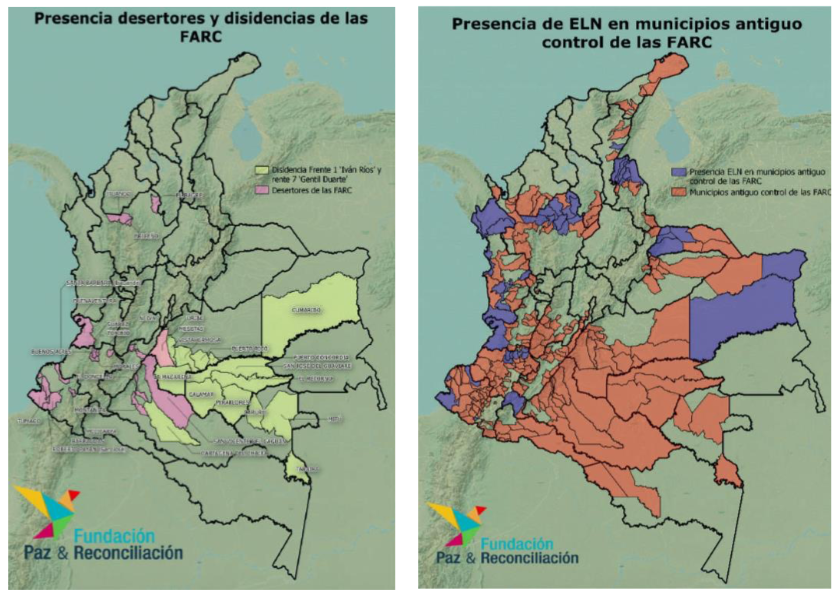
Coordination between FARC remnants and ELN detected, with participation of "demobilized" members of the old guerrilla leadership such as Iván Márquez.
-
Iván Duque's government reacts to U.S. pressure with committed eradication of 70,000 hectares of coca crops
-
The highest concentration of coca production on the border with Ecuador pours violence on this country, where throughout 2018 "El Guacho", ex-FARC, was active.
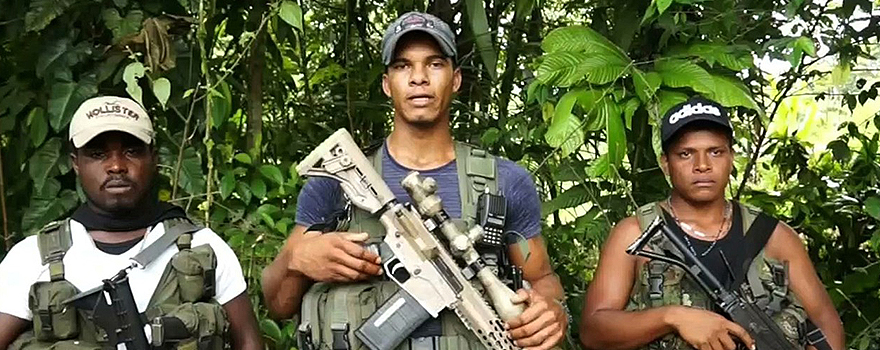
▲ Walter Patricio Arizala, alias "el Guacho", before falling in a Colombian Army operation.
report SRA 2019 / María Gabriela Fajardo[PDF Version].
The doubt that existed when in December 2016 the Colombian peace agreement was signed, about whether the dissidence of the FARC (Revolutionary Armed Forces of Colombia) would be something residual or rather would reach a certain entity, assuming a clear security problem, has been cleared. The dissidents have been growing in issue progressively and throughout 2018 they have consolidated in their criminal activity.
In the first half of 2017, some 6,800 FARC guerrillas were demobilized following the submission of nearly 9,000 weapons. The government estimated that of the total number of FARC troops, some 400 fighters (a residual 5%) would likely refuse to follow the instructions of the guerrilla leadership. In November 2017, on the first anniversary of the signature of the Havana agreement , the Peace and Reconciliation Foundation published a report estimating that the dissidence had reached around 700 members. In February 2018 the Ideas for Peace Foundation raised the figure to between 1,000 and 1,500. At the end of 2018 two intelligence reports, both disseminated by Colombian media that claimed to have had access to their contents, placed the dissident bulk between 1,750 and 3,000 troops.
The maximum figure in this range was established by a report released in October, of which hardly any details were given, while the lowest was provided by an alleged document from the Defense department sent to congress and revealed in December. The latter fixed the issue number of members of all illegal groups in the country at 7,260, of which 2,206 belonged to the ELN (National Liberal Army, the last guerrilla as such still active in Colombia), 1,749 to the FARC dissidence and 1,600 to the Clan del Golfo, an organized crime group . If both estimates on the size of the dissidence really come from government agencies, we would be facing a lack of contrasted information on the part of the State, although everything could be due to the fact that the reports were elaborated at different times, besides not corresponding to the time of their diffusion in the media.
In view of the evolution of the phenomenon, it would probably not be wrong to think that at the beginning of 2019 the issue number of FARC dissidents may be around 2,000. This volume includes both people who never demobilized, as well as former combatants who took up arms again in the face of the difficulties encountered in the transition to civilian life and also new recruits.
Reorganization
With the political banner transferred to the new Revolutionary Alternative Force of the Commons (which thus maintains the FARC acronym), the dissidents no longer have the narrative of social struggle that previously accompanied the activities they continue to carry out: drug trafficking, smuggling, extortion and other illicit businesses. So they have become another example of organized crime, articulated in different groups that, although they are converging, do not have the hierarchical structure of the old guerrilla leadership.
The leadership could be strengthened if some of the leaders who have expressed disagreement with the implementation of the peace process and have disappeared for some time, such as Iván Márquez, return to the guerrillas. For the moment, in any case, what is being observed is rather an organizational confluence with the ELN. Thus, several media outlets published in December 2018 about that coordination, aimed especially at getting cocaine shipments out through Venezuela, a country where the ELN has increased its activity. Army commanders have confirmed this cooperation. A high-level meeting would have involved, in addition to Iván Márquez, other FARC leaders who had supposedly laid down their arms, such as El Paisa and Romaña.
These contacts took place after the talks between the government and the ELN, opened on Ecuadorian soil to explore a peace agreement , were suspended in September by decision of President Iván Duque when no progress was made and it was understood that, in reality, the ELN were getting stronger, occupying territories formerly controlled by the FARC. The dialogue was broken off following the ELN attack against the General Santander National Police Cadet School in Bogota on January 17, 2019, which left 21 dead and 80 wounded.
On the other hand, the demobilization of the FARC, although incomplete as we can see, has given rise to the presence in Colombia of Mexican cartels, which are thus trying to extend their dominance to cocaine production sites as well, something that has been highlighted by the Attorney General of the nation.
|
Map 1: yellow, FARC front that did not accept the agreement peace agreement; pink, deserters who did not join agreement. Map 2: blue, ELN presence in municipalities formerly controlled by FARC; red, municipalities formerly controlled by FARC. |
Coca and domain disputes
Among the priorities of the new government of Iván Duque, who became position president of the country in August 2018, has been to try to reduce the high production of coca leaf and cocaine, which in recent years has seen a sharp increase. Between 2013 and 2017, the issue of hectares with coca bush rose from 48,000 to 171,000 hectares, according to The United Nations Office on Drugs and Crime. The United States makes those estimates up ward for the same period: from 80,500 to 209,000 hectares (the latter figures would have meant a jump in potential cocaine production from 235 to 921 tons).
The outgoing government of Juan Manuel Santos committed in March 2018 to the eradication guide of 70,000 hectares of coca bush over the course of the year (compared to the 52,000 that, according to Colombian authorities, were eradicated in 2017), in the framework of a five-year plan agreed with the United States, whose Administration had complained about the substantial increase in cocaine production in the country in recent years. The Colombian Ministry of Defense announced that as of June 2018, 42,000 hectares had been voluntarily replaced, according to the latest report of the United Nations Office on Drugs and Crime, which, for its part, certified that between May 2018 and January 2019, almost 35,000 hectares had been eradicated. These figures represent over 90% compliance with the Comprehensive National Program for the Substitution of Illicitly Used Crops (PNIS) at various Departments. However, the urgency to achieve the objectives of reducing production space could be leading to forced eradication, not followed by other plantings, which in the medium term deadline could mean a return to coca cultivation.
In 2018, the murders of social leaders and human rights defenders continued to increase, amounting to a record issue of 164. According to the Ombudsman's Office, from the beginning of 2016 to the end of 2018, more than 420 activists who developed a leadership role in different communities in the country were killed. This violence is related to the territorial reorganization of criminal groups. There was particular incidence in some Departments of access to the Pacific, such as Cauca and Nariño, where a higher concentration of cocaine production and the initial demobilization of the FARC caused tensions between criminal organizations to ensure dominance of the territory. These frictions caused casualties among community leaders who wanted to free themselves from the control that cartels and criminal groups had been exerting. Meanwhile, a total of 85 former FARC members were killed since the signature of the peace agreement , as recorded in the 2018report of the United Nations High Commissioner for Human Rights in Colombia.
Increased criminal activity in the border area with Ecuador, with a cocaine export hub in the port of Tumaco, has led to violence spilling over to the other side of the border. In early 2018 several attacks on Ecuadorian police and army installations, as well as several kidnappings, were attributed to FARC dissidents led by "el Guacho." Colombia and Ecuador proceeded to increase the deployment of soldiers along the border to address status. In December 2018 "el Guacho" was killed in Nariño by a Colombian Army unit.
The change of government and its stricter vision have slowed down the implementation of agreement, but it is making progress in its application.
The implementation of the agreement peace agreement in Colombia is proceeding more slowly than those who signed it two years ago expected, but there has not been the paralysis or even the crisis predicted by those who opposed the election of Iván Duque as president of the country. The latest estimate speaks of a compliance with the stipulations of the peace agreement agreement close to 70%, although the remaining 30% is already not being complied with.
![Colombian President Iván Duque at a public event [Efraín Herrera-Presidencia].](/documents/10174/16849987/colombia-paz-blog.jpg "Colombian President Iván Duque at a public event [Efraín Herrera-Presidencia].")
▲ Colombian President Iván Duque at a public event [Efraín Herrera-Presidencia].
article / María Gabriela Fajardo
Iván Duque arrived at the Casa de Nariño - the seat of the Colombian presidency - with the slogan "Peace with Legality", degree scroll that synthesized his commitment to implement the peace agreement , signed in November 2017, but reducing the margins of impunity that in his opinion and that of his party, the Democratic Center, existed for the former combatants of the Revolutionary Armed Forces of Colombia (FARC). One year after his election as president, it is worth analyzing how the implementation of the peace agreement agreement is going.
agreement About 70% of the provisions of agreement have already been fulfilled, totally or partially, or will be fulfilled within the stipulated time, according to the estimate of high school Kroc, in charge of making the official estimate of the implementation of the peace process. According to its third report, published in April, 23% of the commitments have been completely fulfilled, 35% have reached advanced levels of implementation, and 12% are expected to be completely fulfilled by the stipulated time. However, almost 31% of the content of the agreement has not yet begun to be implemented, when it should have been underway.
The United Nations, to which the agreement grants a supervisory role, has underlined the efforts made by the new Government to activate the various instances provided for in the text. In his report to committee Security, the University Secretary of the UN, António Guterres, highlighted at the end of 2018 the launching of the Commission for the Follow-up, Promotion and Verification of the Implementation of the Final agreement (CSIVI) and of the committee National Commission for Reincorporation (CNR).
As indicated by Raúl Rosende, chief of staff of the UN Verification mission statement in Colombia, Guterres' report positively estimated that it had "obtained the approval of 20 collective projects and 29 individual projects of ex-combatants in the process of reincorporation, valued at 3.7 million dollars and which will benefit a total of 1,340 ex-combatants, including 366 women". These projects have involved the participation of the governments of Antioquia, Chocó, Cauca, goal, Santander, Sucre and Valle del Cauca, which have facilitated departmental reincorporation roundtables to coordinate local and regional efforts, thus involving Colombian civil society to a greater extent.
The UN has also expressed some concerns, shared by Colombian civil society. The main one has to do with security in some of the historical conflict zones where a high issue number of social leaders have been killed. The murders have been concentrated in Antioquia, Cauca, Caquetá, Nariño and Norte de Santander. Thus, throughout 2018 at least 226 social leaders and Human Rights defenders were killed, according to data of the high school of programs of study for development and Peace(Indepaz). The Ombudsman's Office put the figure at 164.
In addition, as Rosende has recalled, many of the indigenous communities have suffered assassinations, threats and forced displacement. This has occurred in ethnic territories of the Awá, Embera Chamí and Nasa peoples in Caldas, Cauca, Chocó, Nariño and Valle del Cauca.
Along with the successes and concerns, the UN also points to a series of challenges that lie ahead in the post-conflict period. On the one hand, there is the challenge of guaranteeing former combatants the necessary legal security, generating confidence and producing real progress in terms of social and political reintegration. Another great challenge is to achieve the autonomous and effective functioning of mechanisms core topic such as the Special Jurisdiction for Peace (JEP) and the Commission for the Clarification of Truth, Coexistence and Non-Repetition or Truth Commission. In addition, there is also the social challenge to attend to the communities affected by the conflict, which demand security, Education, health, land, infrastructure and viable alternatives against illegal economies.
Controversial aspects
Issues related to the SJP have been the focus of Duque's most controversial actions. In March, the president presented formal objections to the law regulating the SJP, which he wants to modify six points of its 159 articles. Two of them refer to the extradition of former combatants, something that is not contemplated now if they collaborate with the transitional justice system, especially in the case of crimes committed after the signature of agreement. Duque also proposes a constitutional reform that excludes sexual crimes against minors from the JEP, determines the loss of all benefits if there is recidivism in a crime and transfers to the ordinary justice system the cases of illegal conducts started before the agreement and continued after. The objections were rejected in April by the House of Representatives and also by the Senate, although the validity of the result in the latter was left in question, thus lengthening the discussion.
A new controversy may arise when the Territorial Spaces of training and Reincorporation (ETCR) are to be closed in August. Around 5,000 ex-combatants are still in or around them. The High Counselor for the Post-Conflict, Emilio Archila, has stated that by that time, with the financial aid of the FARC (the political party that succeeded the guerrilla) and the Government, the ex-combatants must have work, be clear about what their residency program will be and be prepared for reincorporation into civilian life.
Within the reincorporation process, the lack of compliance by FARC leaders with their commitment, stipulated in the peace agreement agreement , to remain until the end in the ETCRs in order to contribute with their leadership to the smooth running of the process, is a cause for concern. However, in recent months, several leaders have left these territories, among them "El Paisa", who has not presented himself before the JEP, which has demanded his capture.
Nor is former ringleader Ivan Marquez cooperating with the transitional justice system, successively delaying his appearance before the JEP citing security concerns. Márquez has cited the murder of 85 former guerrillas since the signature of the peace agreement , and has accused the government of serious failures to comply.
There is also the case of Jesús Santrich, who like Márquez had acquired a seat in the congress thanks to the implementation of the peace process. Santrich has been detained since April 2018 based on an Interpol red notice at the request of the United States, which accuses him of the shipment of 10 tons of cocaine made after the signature of the agreement peace .
A topic quite addressed from the time of the negotiations has to do with forced eradication and crop spraying. The illicit crop substitution program began to yield results in 2018, resulting in thousands of peasant families agreeing with the government to replace their coca crops with other licit crops. Although in some Departments such as Guaviare there was voluntary crop eradication, this was not enough to offset the increase in plantings in 2016 and 2017. In 2018, close to 100,000 families - responsible for just over 51,000 hectares of coca - signed substitution agreements and this issue is expected to continue to increase throughout 2019. According to the Colombian government, citing figures from the U.S. State Department's department , more than 209,000 hectares of coca leaf have been planted, far more than in the era of Pablo Escobar, according to figures presented by President Iván Duque last month before the Constitutional Court.
The benefits of peace are indisputable and much remains to be done to consolidate it. It is a task that cannot be left in the hands of the Government alone, but requires the support of former combatants, their former leaders and civil society. The great challenge is to accelerate the implementation of agreement and reduce political polarization, all in the search for national reconciliation.
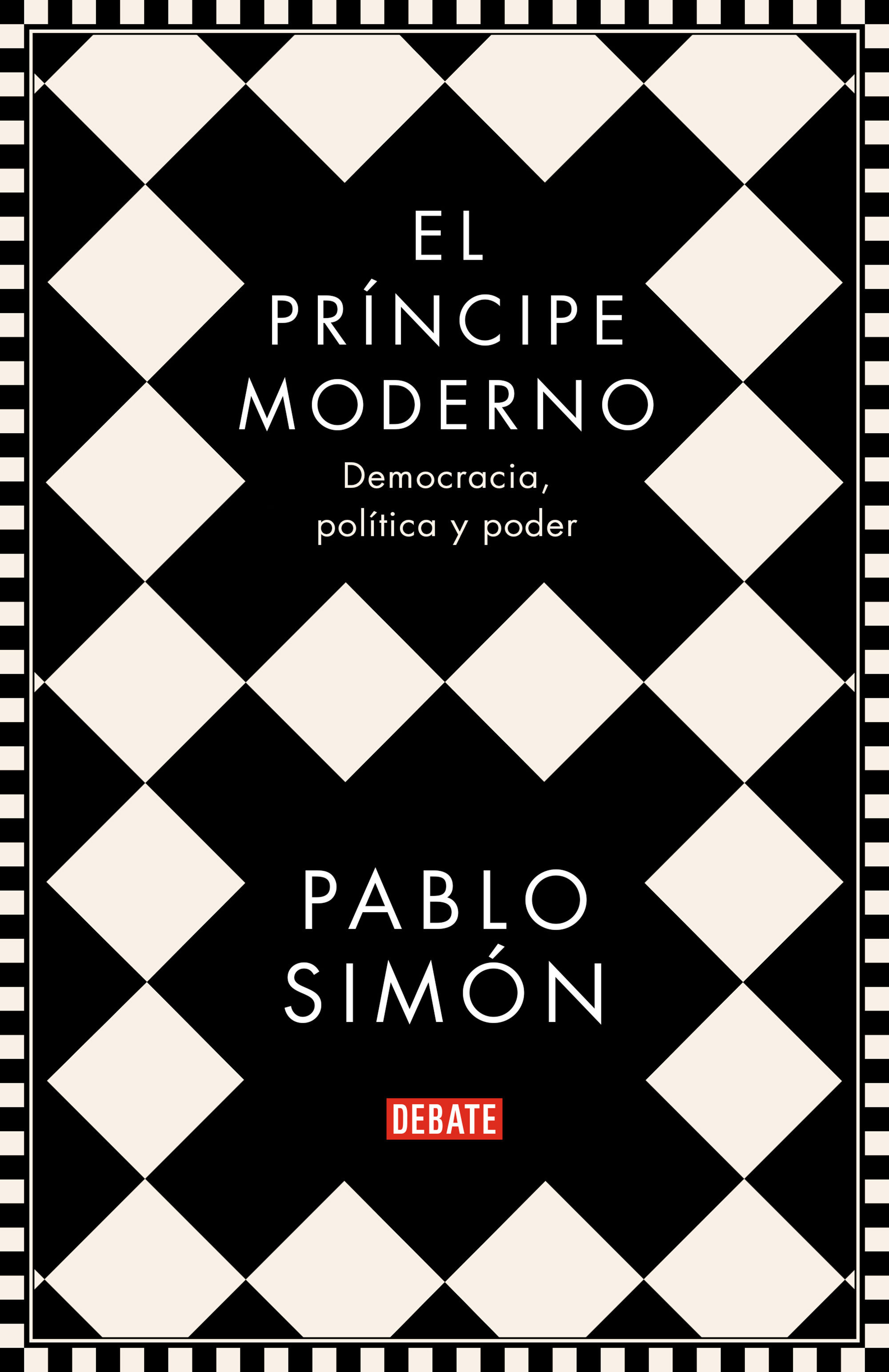
[Pablo Simón, The modern prince: Democracy, politics and power. discussion, Barcelona 2018, 272 pages]
review / Alejandro Palacios
 |
The International Office are guided in each State by a series of leaders and, indirectly, by political parties that are elected more or less democratically by the citizens. Therefore, the high volatility of the vote that we see spreading today in our societies has indirect repercussions on the drift of the international system. This book attempts to review the political systems of some countries to try to explain, in essence, how citizens interact within each political system. The relevance of the book is therefore more than justified.
In fact, by understanding the voting tendencies of citizens, shaped by social divisions and the political system they face, we can get an idea of why such politically radical leaders as Trump or Bolsonaro have emerged. For example, voting in a majoritarian system is not the same as voting in a proportional system. Nor do young people and adults, city dwellers and country dwellers, or men and women vote the same (divisions known as the triple electoral gap).
The author of the book, the Spanish political scientist Pablo Simón, takes as a starting point the Great Recession of 2008, a moment in which new political options began to emerge, encouraged in part by the loss of confidence in both traditional political parties and in the system itself. At the same time, the work attempts to vindicate the importance of the existence of a political science that, as such, is capable of taking a popular assertion about a relevant topic , contrast it empirically and draw mostly general conclusions that help to confirm or disprove that belief.
Pablo Simón also combines the practical analysis of real cases in different countries with theoretical clarifications. This financial aid makes it easy for less familiar readers to follow the explanations of the phenomena he explains reference letter, thus making this book accessible to the general public and not only to an audience specialized in political theory and analysis.
The comparison that the author makes of the different political systems of several countries (he talks about Spain, but also about France, Belgium and the United States, among others) makes this book an excellent guide of enquiry for all those who, without being specifically dedicated to it, want to have a global idea of the party systems in the rest of the world and of the reason for the current political dynamics.
As a counterpoint to the effort of knowledge dissemination there is logically a lesser depth in certain aspects addressed. But it is precisely this informative approach that makes the text pleasant to read, both for the clarity and conciseness of its content (not excessively technical and with theoretical clarifications) and for its length (barely 275 pages). In final, a book which constitutes the perfect guide for all those interested in the functioning of politics in a broad sense, its causes and effects.
Moscow strengthens its relationship with Venezuela, Cuba and Nicaragua, in the 'near abroad' of the U.S.
-
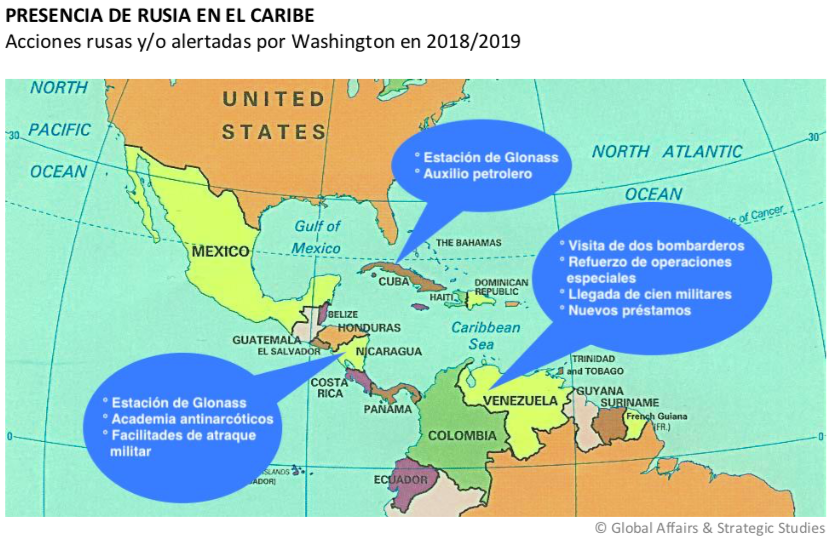
Putin's military display in Caracas: sending bombers (December 2018), special forces (January 2019) and a hundred military personnel (March 2019).
-
The head of the US Southern Command denounces "not benign" purposes of the Police School opened by Russia in Managua for the training Central American agents.
-
The agreement to install a Glonass station in Cuba revives suspicions that the Russians may again use the island for spying on the US as in the Cold War.
![Venezuelan defense minister's reception of two Russian bombers at Maiquetia airport, December 2018 [RT broadcast].](/documents/10174/16849987/sra-rusia-blog.jpg "Venezuelan defense minister's reception of two Russian bombers at Maiquetia airport, December 2018 [RT broadcast].")
▲ Venezuelan defense minister's reception of two Russian bombers at Maiquetia airport, December 2018 [RT broadcast].
report SRA 2019 / Irene Isabel Maspons [PDF Version].
In recent years Latin America has become an increasingly strategic arena for Vladimir Putin's Russia. Although it is not the main focus of the Kremlin's attention area , its calculated moves in the area allow it to gain influence on the southern flank of the United States. Since 2006 Russia has increased its interests in the region, taking as an incentive the lesser attention of the US towards the rest of the continent due to the change of priorities implied by 9/11 in 2001 and taking advantage of the appearance since then of leftist populist governments, in a political cycle inaugurated with the arrival of Hugo Chavez to power.
Russia's relationship has been special with the ALBA (Bolivarian Alliance for the Peoples of Our America) countries -Venezuela, Nicaragua, Cuba and Bolivia-, particularly with the first three, as this allows it to geopolitically confront the United States in the Caribbean, as the USSR did in its day. Being one of the main arms producing countries, Russia has also sold arms to other Latin American countries, but in addition to a commercial attention , in the case of Venezuela, Nicaragua and Cuba a strategic relationship has been established.
The ties with these three nations have grown closer in the last year: the latest major crisis in Venezuela has made this country even more dependent on Moscow; the presidential and constitutional change in Cuba has led Havana to secure the Russian sponsorship in this time of complicated transition, while Russia's activity in Nicaragua has raised the Pentagon's public alert.
The fact that since last fall the United States has been referring to Venezuela, Cuba and Nicaragua as the "axis of evil" in the Western Hemisphere is precisely due to the perception in Washington of increased Russian activity in the region. If the last decade marked the "return" of Russia to the Caribbean, 2018 saw the "return" of the United States to a policy of priority attention to what is happening in that geographical area, precisely because of the increased activity of Russia, and also of China. Moscow is showing the US (and its allies) that it can be reciprocal in the face of the pressure it is receiving in its own near abroad, as highlighted by a recent report of high school Elcano, and Washington has begun to answer those moves.
On the other hand, 2018 was an election year in a good issue of countries. The White House warned of the possibility that Moscow wanted to interfere especially in Mexico, to propitiate the election of Andres Manuel Lopez Obrador, considering him uncomfortable for the US. Although in small volumes, Mexico is Russia's second largest commercial partner in Latin America, after Brazil, and the second largest buyer of Russian arms, far behind Venezuela (the third country is Peru). However, there was no evidence of particular Russian activity in these or other Latin American elections. There is evidence, however, that Russian capabilities for the dissemination of fake news in the Spanish-speaking globosphere have counted on the financial aid of Venezuelan networks.
Venezuela
Russia's influence in Venezuela in the last year has been visible in various aspects. To follow a temporal order, it is worth mentioning the launch of the Petro cryptocurrency, presented in February 2018 as a form of digital cash supposedly linked to the value of Venezuela's oil reserves. A research conducted by Time magazine revealed that Russian businessmen had acted as advisors to the Government of Nicolás Maduro for the launch of the Petro, although the Russian Ministry of Finance denied that Moscow authorities were involved in the initiative. With the creation of this virtual currency, Maduro hoped to have a mechanism to evade the sanctions decreed by the United States against Venezuelan bonds and PDVSA. If there was a Russian interest, it could have been to take advantage of the Petro to evade some of the sanctions imposed on Russia by the US and the European Union, although the Petro soon proved to be of little use as a financial vehicle.
With the worsening of the status in Venezuela -from the presidential elections advanced to May 2018, whose result was not recognized by a large issue of countries, to the consequences of the swearing-in of Juan Guairó in January 2019 as legitimate president of the country-, Russian military elements have staged a show of support for Maduro. In December, two Tupolev-160 strategic bombers landed at Maiquetia airport as part of alleged joint maneuvers between the two countries. The following month, Reuters reported the presence in Venezuela of private military contractors arrived from Russia, belonging to the private company Wagner, which has provided various services to the Kremlin. In March 2019, two cargo planes of the Russian Ministry of Defense unloaded in Maiquetia a hundred military personnel, with General Vasily Tonkoshkurov, head of staff of the Army, at the head and 35 tons of various unspecified military equipment, which allegedly could have been destined for the implementation of the anti-aircraft protection of the area of Caracas.
In 2018 Russia continued, with its credit policy, to take positions in the Venezuelan oil and mining sectors. Although the $17 billion that Russia has given in credit to Venezuela since 2006 - mostly for the purchase of Russian armaments - lag far behind the $67.2 million granted by China since 2007 in exchange for oil in the future, the fact is that the Kremlin has become in the last couple of years a major supporter of the Maduro regime: in 2016 China lowered to $2.200 million dollars its loans to Venezuela and granted none in 2017; only at the end of 2018 it returned to previous volumes, with a credit of 5 billion dollars. In contrast Russia has been very actively aiding the Venezuelan energy sector through Rosneft, which in 2016 took as collateral for a loan with 49% of the shares of Citgo, PDVSA's subsidiary and one of the Venezuelan state-owned company's major assets. In 2017 Russia agreed to refinance US$3.15 billion of the debt contracted by Venezuela, delaying almost all payments until 2023.
The last commitment took place in the meeting that Putin and Maduro held in December in Novo Ogaryovo, the Russian presidential residency program on the outskirts of Moscow. At its conclusion, Maduro announced that meeting had "guaranteed" an oil investment of more than 5 billion dollars and contracts for more than 1 billion dollars for the exploitation of gold", thus expanding the portfolio of Russian interests in the Caribbean country to that precious metal as well.
On the other hand, in March 2019 Maduro ordered the transfer of PDVSA's office for Europe from Lisbon to Moscow, with the goal to avoid its confiscation in view of the recognition progressively obtained by Juan Guaidó as president in European countries.
Nicaragua
Part of the U.S. warning expressed in the last year about Russia's increasing activity in the region ran to position from the Pentagon. In his February 2018 appearance before the congress , the then head of the Southern Command, Admiral Kurt W. Tidd, already conveyed U.S. concern about the increased presence of Russia and China in areas of the Americas of strategic interest to Washington. That complaint took on greater specificity in the following annual appearance on Capitol Hill by his successor, Admiral Craig S. Faller, who in his February 2019 speech indicated that Russia is using the region "to disseminate information, gather intelligence on the United States and project power." In an interview then granted to Voice of America, Faller referred, among other specifics, to several Russian initiatives in Nicaragua.
The Southern Command chief placed special emphasis on the training Professional Police Center that Russia has built and runs in Nicaragua, inaugurated in October 2017 and intended for the training of Central American police officers in the fight against drugs and organized crime. "I don't know what other purposes that center might serve, but I'm sure they are not all naive and benign," Faller said.
Already in 2017 it was reported that around two hundred Russian military personnel rotate their presence in Nicaragua, garrisoned mostly at the Puerto Sandino military facility on the Pacific coast, which for all practical purposes functions as a Russian base.
Faller's warnings about intelligence gathering in the region by Russia have to do to some extent with a satellite station installed by Russia in Managua, a short distance from the U.S. Embassy. Since 2013, Russia has stationed four stations of its Glonass positioning system in Latin America: four stations are in Brazil and in 2017 one Nicaragua was installed. Unlike the stations in Brazil, which are managed with transparency and easy access, the one built in Managua is surrounded by secrecy and this has generated doubts about its real use, and it could be an installation intended for eavesdropping.
In May 2018, the scientific industrial corporation High Precision Equipment Manufacturing Systems (SPP, for its acronym in Russian) reported having signed a contract to locate a measurement station for the Glonass navigation system in Cuba.
 |
Cuba
That last advertisement gave rise to new rumors about the possibility of Russia reactivating the Lourdes base in Cuba, which during the Cold War had great resources as a signals intelligence center for U.S. espionage. Moscow has so far denied that there are any such projects. On the other hand, it has expressed the desire to have a military base in Cuba, Venezuela or Nicaragua, as the Russian Ministry of Defense itself has suggested on some occasions, but these plans have not been officially put into practice.
In 2018, relations between Havana and Moscow became institutionally closer, with the first visit of a Cuban president to Russia in almost a decade. The replacement of Raúl Castro by Miguel Díaz-Canel led both countries to stage their mutual commitment in the face of Western expectations about political changes on the island. A few months before that visit, both countries signed several agreements for the partnership in areas such as the steel industry, sports and customs services, while betting on strengthening the bilateral partnership , trade and investments of the Eurasian country in the island.
As a result of the serious Venezuelan crisis, in May 2017 Russia resumed the submission of significant quantities of oil to Cuba, as it had done decades ago, in order now to compensate for the reduction of crude oil sent by Venezuela. In a first agreement, Rosneft committed to supply 250,000 tons of oil and refined products, although it is not stated for how long and it was possibly a temporary or intermittent aid.
The Caribbean country, with only 2 million inhabitants and barely 100,000 Muslims, sent proportionally the most fighters to Syria: a total of 130 fighters.
-
Authorities in Trinidad and Tobago arrested four suspected jihadists on Feb. 8, 2018 for planning an attack on Carnival in Port of Spain
-
The U.S. Treasury department sanctioned two Trinidadian nationals in September for participating in Islamic State financing activities.
-
The insular government developed a new counterterrorism strategy in 2018, urged by White House fears of easy export of extremists to the U.S.
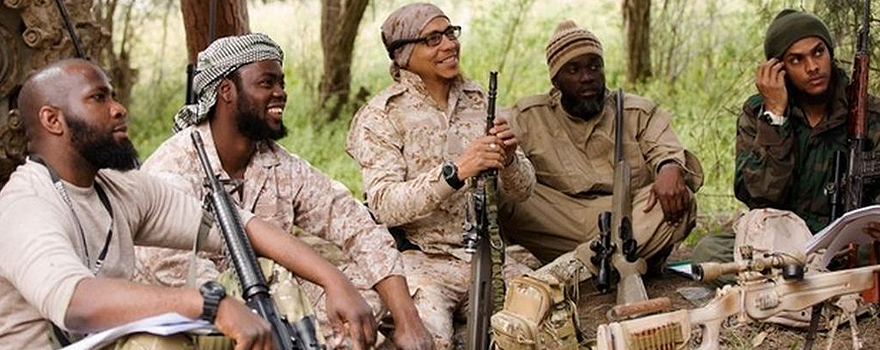
▲ T&T jihadists in Syria, in an image released by ISIS's Dabiq magazine.
report SRA 2019 / Ignacio Yárnoz[PDF Version].
Amidst Western concern over the unleashing of jihadists that is being brought about by the pacification of Syria, where radicalized elements from many other countries went to fight, the United States is taking a close look at a small neighbor. On February 8, 2018, four men were arrested in Mohammedville on suspicion of planning to commit a terrorist act. The place where the alleged attack was to happen may come as a surprise: the Caribbean carnival in the city of Port of Spain. Indeed, we are talking about a Caribbean nation that is also a victim - and exporter - of the globalized phenomenon of jihadist terrorism: Trinidad and Tobago. In recent years, Trinidad and Tobago has set off alarm bells among Western analysts, especially in the United States because of its geographic proximity to these islands and the possibility that this phenomenon could destabilize its backyard, the Caribbean.
The phenomenon of Islamist radicalism in Trinidad and Tobago is not new, considering that in 1990 there were already radical groups such as Jamaat Al Muslimeen, which even attempted to overthrow the government through a coup d'état. In addition, there were also known terrorists from this country such as Kareem Ibrahim, who in 2012 was sentenced to life imprisonment in the United States for planning an attack at JFK International Airport in New York.
However, the terrorist phenomenon on the island escalated in 2014 and 2015 with the rise of the self-proclaimed Islamic State (al-Dawla al-Islamiya al-Iraq al-Sham, or Daesh for its acronym in Arabic). This small Caribbean country contributed at least 130 fighters to the jihadist cause, from agreement with its own authorities, according to data also endorsed by the yearbook anti-terrorist department of the US State Department. This makes Trinidad and Tobago the country that proportionally sent proportionally more fighters to Syria to join the Islamic State (the Trinidadian Muslim community is only 104,000 faithful, 5% of a population that can reach 2 million inhabitants, although the official census is 1.3 million). Although it is estimated that some 300 fighters joined ISIS from the USA and Canada, the per capita figure is higher in the case of Trinidad and Tobago, a country which in absolute numbers also contributed more jihadists than other Latin American and Caribbean nations.
According to a research by Simon Cottee, Professor of Criminology at the University of Kent. Of these 130 Trinidadians, 34% were male, 23% female, 9% teenagers and the remaining 34% under the age of 13. This indicates that it was not just young people, but entire families who traveled to the Islamic State.
Reaction and surveillance
These data alarmed the Government of Port of Spain as well as that of Washington and other neighboring nations. The very fact that Trinidad and Tobago had no law prohibiting travel to the "Caliphate" to join the holy war was considered by the United States as a threat to its own security, considering that a Trinidadian citizen could cross the entire Caribbean without a visa to the Bahamas and be only a hop, skip and a jump away from Florida.
Within a month of becoming U.S. president, Donald Trump reached out in February 2017 to Trinidad and Tobago Prime Minister Keith Rowley, with whom he met at the White House. Rowley committed to greater measures to combat the threat posed by the departure of so many Trinidadians to jihad.
First, an amendment to the Anti-Terrorism Act was passed unanimously to improve the legal tools to detect, prevent and prosecute terrorism and its sources in Trinidad and Tobago. The measures also included a procedure called assessment, Comparison and Identification System staff (staff Identification Secure Comparison and Evaluation System, PISCES), agreed with the US and implemented at entrance posts in Trinidad and Tobago. Added to legislative action, in November 2017, the Trinidadian National Security committee approved a comprehensive counter-terrorism strategy aimed at stopping those who support terrorism or glorify it. This strategy encourages close partnership between UK, Israeli and US intelligence agencies for information sharing.
As a fruit of that determined action and of the special partnership with Washington, in September 2018, the US Treasurydepartment placed sanctions on two Trinidadian nationals on the grounds that they were involved in procuring funding for the "Caliphate". In addition, the national authorities are vigilant about the return of fighters. The Supreme Court has authorized repatriating and taking custody of some minors.
Many of the fighters have died in battle and the few who have wanted to return have been arrested or placed under surveillance, but the threat is still latent. Also because with their return they can encourage a new radicalization of Trinidadian citizens who, given the impossibility of traveling to Syria due to the current status debacle of the Islamic State, decide to act within their borders or in neighboring countries. It should be noted that this has been the strategy of the Islamic State during the last few years, encouraging its followers in the West to commit "low cost" attacks with vehicles or with a knife.
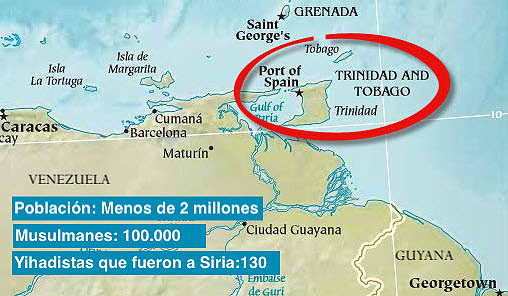 |
Recruitment
What makes the status of Trinidad and Tobago an exceptional status is that there has not been a clear patron saint of recruitment, but rather in recent years there have been several different situations.
On page 64 of No. 15 of Dabiq, the propaganda magazine of the Islamic State, there was an extensive interview with a fighter of the "Caliphate" named Abu Sa'ad at-Trinidadi. This soldier of the "Caliphate", whose real name is Shane Crawford, was one of the first soldiers from Trinidad and Tobago to come to Daesh's call. It is curious that Dabiq dedicated several pages to him, but the fact is that the Trinidadian fighters were a valuable treasure for this organization, for two reasons:
-First, by speaking English, which improved the organization's outreach radius. As former U.S. Ambassador to Trinidad and Tobago John L. Estrada told the New York Times, "Trinidadians do very well in ISIS. They are very high up in their ranks, they are well respected, and they speak English."
-Secondly, they are an attraction for young Caribbean people who are disenchanted with society, regardless of their religion.
As much as Dabiq magazine insists on the testimony of Sa'ad at-Trinidadi - a young man supposedly disenchanted with the Christian religion, who discovered in Islam the true answer to his questions - religion was not in fact the fundamental motive that led the young Trinidadians to join the "Caliphate". As Simon Cottee points out in the research cited above, most of the 130 enlisted Trinidadians had been born into Muslim families of class average Indo-Eastern origin.
The motives that may have affected the young men recruited in Trinidad and Tobago probably had more to do with the sociological need to belong to a group or gang. As Dylan Kerrigan of the University of the West Indiesresearcher told the British newspaper The Guardian, "A gang provides a family, male role models, a social order, and promises access to what many young men think they want: money, power, women, respect. One imam told me that, rather than joining a local gang, some see the trip to the Middle East as joining another gang." Likewise, joining Daesh provided a means of escape for those facing judicial charges. In fact, the idealized Sa'ad at-Trinidadi (Shane Crawford) had already been arrested several times by the authorities and the two companions with whom he traveled to Syria had spent time in jail.
Young people in Trinidad and Tobago could have been radicalized through their visits to local mosques, not forgetting that, as elsewhere in the world, radicalization could also have occurred through online propaganda, the "Cybercaliphate". As for possible agents of radicalization in the first place is who Sa'ad at-Trinidadi mentions as his mentor, Shaykh Ashmead Choate. This man was the head of the conspiracy that in 2011 planned the assassination of the prime minister and other authorities and was ultimately written request foiled. Ashmead Choate studied natural sciences in his native country, but later studied hadith (the behaviors stemming from Muhammad's teachings; they are one of the fundamental pillars of the Sunna) at the Islamic University of Medina in Saudi Arabia. It is estimated that he left the country in 2013 to join the ranks of Daesh, as Sa'ad at-Trinidadi mentions in his interview, "He made the hegira to the Islamic State and found martyrdom fighting in Ramadi." The reasons for his radicalization are not known, but they could be related to his trip to Saudi Arabia, where he might have been attracted by a more Salafist version of Islam.
Similarly, there are indications pointing in other directions. One of the names that surface is that of Yasin Abu Bakr, former leader of the group Jamaat Al Muslimeen, who, having been the precursor of violence in the 1990s and the author of the coup, may have indirectly created a model to follow, although today he does not broadcast a clear call for violence. Likewise, the Boos mosque in Rio Claro, south of Trinidad, run by Imam Nazim Mohammed, was a stopover for many of those who later went on to fight in the ranks of ISIS, such as Shane Crawford and Fareed Mustapha. In an interview with Al Jazeera, the imam himself denied being a precursor of the Daesh cause, although fifteen members of his family have emigrated to Syria and several witnesses to his sermons state that he has on occasion praised the Islamic State.
Also to be taken into account is Abdullah Al-Faisal, originally from Jamaica, who via the internet and social networks had engaged in Islamic State propaganda through Facebook groups and blogs such as Authentic Tauheed, where he distributed propaganda and posted videos of his sermons. His activity is suspected to have ranged from contact with Jesse Morton, an American citizen who worked with Zachary Chesser for apply for the murder of the South Park television show editors to the radicalization of Germaine Lindsay, one of the four Britons who perpetrated the July 7, 2007 London subway bombing. In September 2014, Faisal joined Mohammed Mizanur Rahman and other Islamist propagandists on an online platform where they urged their followers to join the ranks of ISIS. The U.S. government has linked Faisal to other terrorists such as Umar Farouk Abdulmutallab and suspects that he may also have been one of the instigators of radicalization in Trinidad and Tobago.
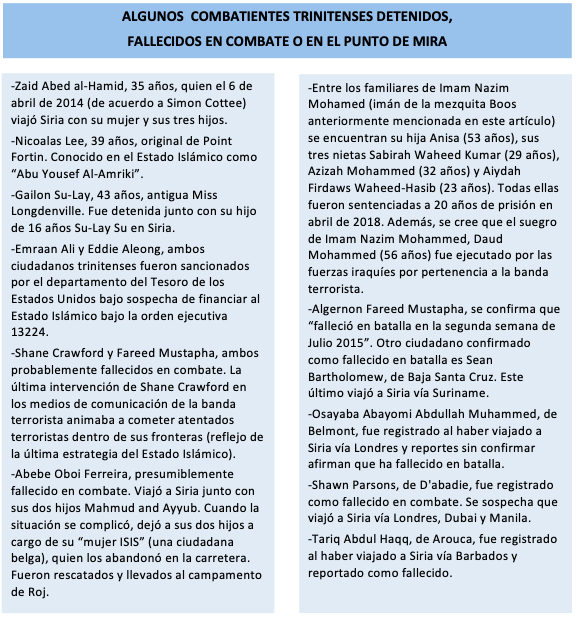
|
List compiled from the US Treasury's department sanctions and information from the British newspaper The Guardian and newspapers in Trinidad and Tobago. |
Interview with Ambassador Francisco Pascual de la Parte, author of "The Returning Empire. The 2014-2017 War in Ukraine"
![Francisco Pascual de la Parte, during the presentation from his book [Manuel Castells]](/documents/10174/16849987/noticia-donbass-blog.jpg "Francisco Pascual de la Parte, during the presentation from his book [Manuel Castells]")
▲ Francisco Pascual de la Parte, during the presentation from his book [Manuel Castells]
INTERVIEW / Vitaliy Stepanyuk
Few have a knowledge as direct of Russia's relations with Ukraine and other territories of the former USSR as Francisco Pascual de la Parte, who has been minister-counselor of the Spanish Embassy in Moscow, ambassador to Kazakhstan and consul general in St. Petersburg, among other destinations. He is the author of the book "The Returning Empire. The Ukraine War 2014-2017." During your presentation at the University of Navarra, Global Affairs was able to talk at length with the Spanish diplomat about the Ukrainian crisis and Russian foreign policy.
1. From the point of view of the geopolitics of the region, who are the main actors?
The main actors in the Ukrainian crisis are divided into two groups: those who are directly involved in the armed conflict and those who are not involved in it but are involved in the crisis. The main actors, obviously, are the Ukrainian government and the separatists of the self-proclaimed pro-Russian Republics of Donbass (Donetsk and Luhansk regions), backed and armed by Russia.
In a second concentric circle, the actors are Ukraine and Russia, which has annexed Crimea in response to the overthrow of pro-Russian Ukrainian President Viktor Yanukovych, and which, as I say, also supports Ukrainian separatists.
In a third concentric circle, there is the discrepancy between Russia and the European Union (EU), which considers the annexation of Crimea and the Russian intervention in the Donbass illegal, for which it has imposed economic sanctions, responded to by Russia.
In a fourth concentric circle we have a rivalry between Russia and the United States, which accuses Moscow of violating Ukraine's territorial integrity and thereby undermining security in Europe. This confrontation has consequences for the entire planet, as it generates mistrust and hostility between the two superpowers that has repercussions on their mutual relations, fundamentally on disarmament treaties and on their positions in crises such as those of Syria, North Korea, Venezuela and anywhere in the world.
Finally, there is the confrontation between Russia and NATO, which Russia blames for the hostile initiative of having spread eastwards, thereby provoking the Russian reaction when, theoretically, after the fall of the USSR, NATO had promised not to carry out its enlargement.
These are all the actors. Some participate in the first concentric circle, others in the second, and others in all.
2. In relation to the previous question, what is the main goal in this fight?
The answer to this question will depend on the actor we are focusing on. Obviously, the leaders of the rebel republics do not pursue the same thing as the Ukrainian government or the Russian government. In my opinion, the Russian regime seeks to ensure its security by regaining great power status. By controlling the post-Soviet space and promoting the Eurasian Economic Union (EEU) including Ukraine, Russia planned to strengthen its international position. But when Ukraine refuses to join the EEU and prefers a association with the EU in Brussels, Russia's plan was badly damaged. In other words, as Brzezinski, former U.S. National Security Advisor, said, Russia with Ukraine is an empire, but without Ukraine it is a normal state. But because it is not resigned to being a normal state, it does not want to lose control over Ukraine. Russia believes that this is the only way it can guarantee its security.
The purpose of the self-proclaimed Donetsk and Luhansk Republics is not very clear, because it has changed over time. First it was autonomy, then independence, then annexation to Russia, and then autonomy again. Several of the leaders who proclaimed independence have disappeared under strange circumstances, being replaced by other leaders.
At the moment the leadership of these republics is entirely under Moscow's control. Theoretically, one would have to conclude from this that the end of the Donetsk and Luhansk Republics is the same as the end of the Russian leadership. But I'm not so sure, since there were leaders in the governments of those republics who, at first, wanted another one subject of State. That is, not to be part of Ukraine, but neither to be part of Russia, even if they gave primacy to the relationship with it. A kind of state that would be autonomous from both Russia and Ukraine, but within the so-called "Russian world": a set of cultural patterns, beliefs and customs that identify the Russian people, based on the traditional values of the Russia of the tsars. Some of its most national-patriotic leaders advocated, after proclaiming secession, fidelity to orthodoxy, protection of the family, prohibition of abortions, gambling, prostitution, divorce... In short, a government that would not have found a place either in a Ukraine integrated into the EU, open, therefore, to assimilating gender ideology and other values contrary to the "Russian world", or in a Russia like the current one, which they considered to be governed by disbelieving ex-communists and former heads of the Soviet intelligence services. The first separatist leaders renamed their new state "Novorrossiya", resuming the name of Eastern Ukraine in tsarist times, whose territories had been conquered by Catherine the Great from the Turks and Ukrainian Cossacks in the 18th century.
But that plan didn't seem to suit Russia. At one point, Moscow stopped supporting the "project Novorrossiya" and brought about the replacement of the leaders who advocated it. Why? Many analysts believe that the emergence of a state like Novorossiya would have given wings to the already powerful Russian far-right nationalist current (advocated, among others, by Alexander Dugin) that accused Putin of treason for not having unceremoniously invaded all of Ukraine, and would encourage the emergence within Russia itself of similar initiatives in other territories of the Russian Federation where national-patriotic traditionalist elements had popular support. As a result, Russia appeared to choose to keep those republics inside Ukraine, but controlled by it or, in the extreme case, to proceed with a de facto annexation. Both solutions benefited him, as they prevented Ukraine from joining NATO and from having enough room for manoeuvre as a sovereign state, as it had within it the Trojan horse of those republics, controlled by leaders close to the Kremlin.
The EU's aim is stability and prosperity on its eastern border, exporting its economic and political reform programmes to the former Soviet republics. To this end, the EU launched its so-called "Eastern Partnership" programme with several of these republics. The more countries of the former Soviet Union assimilate the principles of the EU (human rights, transparent elections, equality before the law, absence of caste privileges, etc.), the more secure the eastern border will be and the more the European market will be able to extend to these countries, gradually incorporating them. In final, for the EU the aim would be the stability of the eastern border, the extension to the countries of Eastern Europe of the principles which gave rise to the EU and the extension of its power to them. area of security and prosperity.
For the U.S., the main goal it would be to prevent the USSR from rebuilding itself under another name and from once again being a factor of instability for democracies. The U.S. has seen how little by little Russian control or influence in former Soviet regions and republics has increased and how these have been regained by Moscow, one after the other. First it was Abkhazia, then Transnistria, then South Ossetia..., as well as Russian influence in Belarus, Kazakhstan, Tajikistan, Kyrgyzstan and, now, Ukraine, after the annexation of Crimea and control of the Donbass. Some analysts see this process as a reconstruction of Moscow's control over the post-Soviet space, as was the case under the USSR. In the face of this, Washington maintains that each country has the right to freely choose the international organization and the collective security system to which it wants to belong, so Russia does not have the right of veto over the free choice of a given Eastern European country to become a member of NATO, or to cease to be one. a decision to be made by its own citizens, as would be the case in Ukraine. In short, each side in this crisis is pursuing a goal different.
3. The conflict in Ukraine erupted unexpectedly. Hundreds of people took to the streets calling for better living conditions and an end to corruption. How could we explain the fact that the conflict arose so suddenly?
In reality, this is not an isolated conflict, nor did it come as a surprise, but since the dissolution of the USSR, Western chancelleries and embassies have already received up to eight warnings of what was going to happen and did not know how to interpret those warnings.
The first notice It took place in December 1986, in Kazakhstan, with a series of popular revolts that already indicated what was going to happen. Serious riots broke out there when the President of the Kazakhstan Soviet Socialist Republic, President Kunayev, resigned and was replaced by a Russian, Gennady Kolbin. At that time, young Kazakhs took to the streets to protest against Moscow's decision to appoint a president who was not ethnically Kazakh and who did not even know the language, or the particularities of the country. To this day, the issue of deaths in the repression of the KGB troops, the army and the police, who were urgently sent from Russia to crush the insurrection.
The second notice It consisted of the 1988 war in Nagorno-Karabakh (an autonomous mountainous region, populated by Armenians, of Orthodox religion, nestled in the middle of the Islamic Republic of Azerbaijan). When the inhabitants and authorities of Nagorno-Karabakh saw the USSR disintegrating, they feared that in the chaos of the disintegration they would suffer repression and settling scores from the vast Muslim majority around them. Consequently, the parliament of that autonomous region requested annexation to Russia. When this happened, the Azerbaijani authorities sent their troops to prevent secession. A war has ensued that has not yet ended.
The third notice, which occurred in 1989, was the "Tbilisi Massacre" (Georgia), when thousands of Georgians took to the streets in favor of Georgia's independence from the USSR. The Soviet army sent special troops to suppress the uprising, as had happened in Kazakhstan. Many civilians were killed there. That massacre gave rise to the Tbilisi Syndrome: no position From then on, the Soviet Union wanted to take responsibility for having given the order for the intervention. From that moment on, the army would not intervene against the people again unless it received a written order to signature of the person who decided the intervention.
The Fourth notice It dates back to 1990 with the civil war in Transnistria, an ethnic Russian-majority eastern fringe of the Romanian-majority republic of Moldova. It so happened that after Moldova's independence in 1991, the inhabitants of Transnistria feared that they would be oppressed in the new country, which was the only way to achieve it. language and mainly Romanian traditions. Therefore, they declared their own independence from Moldova, consequently starting a conflict that would leave more than 20,000 dead.
In all these cases and in others that would come later, Russia always supported the secessionists, since this was a way of keeping the republics that wanted to secede from the USSR controlled by a minority within them, which prevented their consolidation as sovereign and independent.
Next notice consisted of the failed coup attempt in Moscow in August 1991. Although it failed, this attempt opened the eyes of other republics to the danger of regression and return to the USSR and, from that moment on, the secessionist process accelerated.
The Sixth notice consisted of the referendum held in Ukraine in December 1991. Under the question "Are you agreement for Ukraine to secede from the USSR and become an independent state?", 98% of the Ukrainian population voted yes, including Crimea.
Along with these warnings, there had been other indicators, such as the separatist movement in Abkhazia (a region of northwestern Georgia), which in 1992 declared its independence from Georgia, which wanted to gain complete independence from Russia. Russia supported the separatists here as well.
The last notice took place in 2007, in South Ossetia. It followed an attempt by the Georgian government to bring the breakaway region of South Ossetia back under its control by using its army. Russia, which had peacekeeping forces stationed in Ossetia since a previous conflict, intervened on behalf of the separatists, forcing Georgia to relinquish control of the region.
4. Although the U.S. is concerned about the Ukrainian conflict, it is not as concerned as other issues. In fact, the U.S. is not acting and is only verbalizing its concern. Is it possible that he is not giving a clear answer because he thinks that it is fundamentally a European problem?
The U.S. is concerned for the simple reason that the solution to other crises in the world, mainly those in Syria, Venezuela and North Korea, depends on trust and good relations between Moscow and Washington. And there will never be if the problem is not first resolved. topic of Ukraine. What is poisoning relations is Ukraine. In fact, I very much doubt that without the war in Ukraine there would have been a Russian intervention in the war in Syria as there has been.
When the West tries to isolate Russia by imposing sanctions, Russia has to get out somewhere. Therefore, to show that it cannot be isolated and that it is a protagonist on the international stage, Russia intervenes in Syria, Venezuela or wherever it can stand up to the United States. He would be sending a message similar to this: "Even if you want to isolate me and reduce me to a second-rate regional power, I can show you that without me there is no solution to any world crisis. What's more, if I want to, I'll provoke other crises for you."
5. What do Russian citizens themselves think about the annexation of the Crimean peninsula?
The intervention and consequent annexation of Crimea by Russia, within the Ukrainian conflict, is the point that most poisons relations between Russia and the West, but also has an impact on Russian public opinion.
Because, of course, Russia has a GDP the size of Italy's and is maintaining interventions abroad that cost it a lot of money. Their hospitals are in a pitiful condition, the teaching It is going through a great lack of resources and a decline in quality, pensions are very low, the retirement age has been delayed... Many in Russia are disgusted that, under these circumstances, enormous resources are devoted to subsidize Crimea. Because Crimea does not stand on its own. Before, when she was at peace and thanks to tourism, she could sustain herself. But now, who goes to Crimea? Who invests in Crimea? Everything is subsidized by the Russian government. That would be within the reach of a country with a gigantic GDP, but hardly a country that has a GDP like that of Italy or Spain and that dedicates, directly or indirectly, a third of its GDP to its armed forces and police. In addition to having to subsidize Crimea, Russia has to subsidize Abkhazia, Transnistria, Ossetia and the Donbass. For this reason, there are those in Russia who are already wondering whether the annexation of Crimea was not a mistake, such as, for example, one of its most influential newspapers, "Vedomosti".
On the other hand, a major reason why the Russian leadership does not look favorably on discussing this issue could be Chechnya. According to some international law experts, such as Araceli Mangas Martín, professor of international law at the Complutense University, all the arguments that Russia uses to justify the secession of Crimea from Ukraine would be valid to justify a future secession of Chechnya from Russia. What would happen, some analysts ask, if in 10 or 20 years a Chechen majority were formed to demand secession from Russia in a referendum invoking the precedent of Crimea?
The topic of the legitimacy of the annexation of Crimea is a topic taboo in Russian society, for many reasons. You can't talk about it calmly. In fact, the only member of the Duma (Russian parliament) who voted against the incorporation of Crimea into Russia has had to go into exile because he has been threatened. Debates about the existence and legitimacy of the annexation of Crimea are usually not allowed on TV programmes, and when they are discussed, it must always be from the official point of view.
|
Deployment of Ukrainian troops, June 2014 [Wikipedia] |
![Deployment of Ukrainian troops, June 2014 [Wikipedia]](/documents/10174/16849987/noticia-donbass-2.jpg "Deployment of Ukrainian troops, June 2014 [Wikipedia]")
6. Do you think it is possible that Russia will end up abandoning the war in Ukraine? Also, could Crimea become part of Ukrainian territory again?
Russia has made one thing very clear: it will never allow Ukrainian rebels and separatists in the Donetsk and Luhansk Republics to be defeated by the Ukrainian army. He's not going to allow it.
The only possibility for Russia to abandon its military intervention in Ukraine would be for the secessionists to win their confrontation with the Ukrainian government and consolidate an independence from the Ukrainian government under Moscow's undisputed control.
Second, I see the return of Crimea to Ukraine as very difficult, practically impossible. Because Russia is turning Crimea into a huge military base that it considers essential in the face of an expansive NATO. It is equipping it with the most modern weapons systems: radars, rockets, a modern fleet...
7. Demographically, is the percentage of Russians in Crimea as high as claimed?
According to some analysts, the Kremlin is playing with numbers. Sometimes he speaks of ethnic Russians, sometimes of Russian speakers. Odessa or Kharkiv, for example, are large Ukrainian cities that speak Russian, but are on the side of the Kiev government. What does Russia mean by "Russian"? The Russian authorities say: "The majority of the inhabitants of Crimea legitimately voted for secession and incorporation into Russia in a referendum by an affirmative majority of around 90%, with Russians also constituting the vast majority of the population on the peninsula." Define that to me. What about the 13% of Tatars, what about the 20% of Ukrainians? And what Moscow calls Russians in Crimea, what exactly are they: ethnic Russians, Russian speakers, Russian passport holders, Russians by choice, by birth, by marriage? With what electoral documentation and with what control of the votes was the referendum made? Were troops from the Russian base in Sevastopol counted as registered voters, or were they not counted? How were the votes inside the military barracks controlled? In short, it's like saying "Spaniards" referring to any Ibero-American country. In Argentina or Cuba there may be 700,000 Spaniards. Do we accept then that in a territory of Argentina, Cuba or Venezuela, where the majority are Spanish, they organize a referendum for secession and their reincorporation into Spain and we arm them clandestinely?
The question that should concern us is: what is the difference between citizenship and nationality? In Western countries, citizenship and nationality are the same. However, this is not the case in Russia, and here we go to the heart of the problem. In the countries of the former Soviet orbit, nationality means "belonging to a group ethnic." Citizenship, on the other hand, means "submission to the political, legal and administrative regime of a given State, regardless of the ethnic group to which one belongs".
In Russia it's completely different things. So much so that on the identity cards of Russia and Ukraine, until recently, the "nationality" of the Russian and Ukrainian countries was listed as the name "nationality". group Headline ethnicity: Jewish, Tatar, Russian... That is why, when Russia annexed Crimea, the main reason President Putin gave for doing so was that he had to protect the "Russians" in Ukraine, "his" nationals in Ukraine, from the "board Fascist" in Kiev that threatened them. For a Russian, you can change citizenship; on the other hand, nationality was never lost, and Russia must protect those who held its own.
All this explains why before intervening in an ex-Soviet republic that wants to separate itself from Moscow's orbit, the first thing Russia does is to distribute Russian passports to citizens of those republics whom, from that moment on, it considers Russians, and then argues that it has to protect them.
Of the Ukrainians who lived in Crimea, many have left it. Others have remained in Crimea, of course, but without being able to question that Crimea belongs to Russia, submitting to the Russian authorities, having to, in many cases, obtain new documentation, different from the one they had before, and lending allegiance and submission to another state other than the one in which they lived until recently.
8. Could we say that Russia and the West have different interpretations of the principles that should govern international relations?
This fundamental principle for the Kremlin of militarily defending Russians wherever they are, including the territory of another ex-Soviet republic, clashes with other basic principles for the EU, the US and Western countries: the territorial integrity of the state, the sovereignty of the state and the equality of all before the law... If you want to protect Russians living in Ukraine by annexing Crimea because it has a Russian majority, you are obviously violating the principle of territorial integrity of the state. However, Russia thinks that it has respected Ukraine's territorial integrity, because territorial integrity has a different meaning for the Russian leadership than ours. For them, territorial integrity refers to the state apparatus, but not to territory. Russia gives priority to other principles, such as the protection of its nationals.
For all these reasons, this conflict is so dangerous, because neither the West nor Russia can renounce principles that they consider basic. That is why, when we talk about EU-US dialogue with Russia to resolve this conflict, we are asking for a dialogue between two parties who speak a different language, because Russia attributes a completely different meaning to the concepts than we attribute to them.
9. Russia's policy of protecting ethnic Russians may be very reminiscent, to a large extent, of Nazi Germany's policy of the 1930s of attempting to unite all ethnic Germans. Do you think that the status Is it similar?
Not only to the 1930s, but also to the time of World War I, which broke out because Serbia wanted to protect Serbs living outside Serbian territory, who considered themselves oppressed and mistreated by the authorities of the Austro-Hungarian Empire, when it annexed Bosnia-Herzegovina. One of those who felt oppressed, the student Gavrilo Princip, with the logistical help of the Serbian secret police, killed the heir to the throne of Austria-Hungary during his visit to Sarajevo, the capital of Bosnia and Herzegovina. That set off a chain reaction and a World War.
In World War II, Germany demanded that all Germans live within the same state. Unfortunately, not all Germans lived in Germany. The Nazis then decided to ensure that all Germans of the superior Aryan race were placed in a single state, led by a single Führer. To do this, they annex Austria. The Western powers are perplexed. It turned out that there were also Germans in Czechoslovakia, who were not treated well by the Czechoslovak authorities, according to the Nazis. The Führer then forces the Czechoslovaks to cede the Sudetenland to him. Then Germany annexes other territories and the Western powers give in. Later, Hitler claimed the Polish corridor and the German city of Danzig, also a territory with a German population, but located in Poland, and it was there that, definitely, England and France, who had offered guarantees to Poland, reacted.
For some Western analysts, the status it is very reminiscent of what is happening now in the former USSR. First, Russia annexes a part of another country, then settles in a part of another, with the same justification: that there are Russians in them who must be protected. In my opinion, the status It's not exactly the same, but it has alarming similarities.
10. The lesson of the 1930s is that the policy of appeasement did not prevent war, but merely postponed it and made it more difficult to fight. So what is the recommended attitude to Russian policy?
There are two fundamental tendencies: the first comprises the tendencies to appeasement and the second the tendencies to firmness. Among the tendencies towards appeasement we find, in turn, three distinct currents:
–A first group of experts draws attention to a fundamental fact: that Russia is willing to go further than the West in the conflict in Ukraine, because for Russia Ukraine is a vital issue, while for the West it is not. A territorial review would have to be carried out. We're going to give in and let Russia keep its Russians, and that's the end of the problem. We signed a agreement, and Russia has its zone of influence.
The second school of thought defends the idea of turning Ukraine into a neutral state so that Russia does not perceive a threat. This would imply a decision to freeze NATO expansion, which would no longer extend to any other country in Eastern Europe; the regions of eastern Ukraine populated mostly by Russians should be granted very broad autonomy, and Crimea should be admitted to be part of Russia in compensation for NATO's eastward expansion.
According to the third current, Russia, in annexing Crimea and intervening in eastern Ukraine, did not observe aggressive behavior. On the contrary, it was acting in self-defence, and no country can be denied self-defence. We say that because if the Maidan revolution had triumphed throughout Ukraine, including Crimea, and a Western-leaning regime had been installed throughout Ukraine, it would have been a matter of very little time before the new Ukrainian government would have applied for NATO membership. That would have meant that NATO's borders would have moved even closer to Russia, endangering the country's security. Therefore, Russia, in acting in Ukraine, is only doing so in self-defence. This third current advocates the demilitarization of the Donbass, the security of the borders to be guaranteed by a peacekeeping force under the command of the UN, and the admission of Crimea as part of Russia, in compensation for the fact that NATO has incorporated countries that formerly belonged to the USSR.
As we mentioned earlier, there is a second trend that advocates firmness: "We are not going to repeat the Munich mistake of giving in, giving in and giving in, because if we continue like this, next time we will find that Russia is trying to annex a Baltic country", where, by the way, in Estonia and Latvia it has very important minorities. The main stream of this group he thinks that we cannot repeat the mistake of Yalta, of allowing Europe to be divided into zones of influence and, above all, of imposing neutrality on a country that does not want it. On the other hand, what would be done by allowing Russia to keep all these regions is to deny Ukraine, precisely, its right to self-defense.
Other group of this tendency argues that the supporters of the appeasement strategy do not offer any solution as to how the security of the countries of Eastern Europe would then be guaranteed. Moreover, the fact of not extending NATO and of being condescending to Russia to avoid provoking Russia is a false dilemma, because Russia is already doing everything it can to annoy the West, the whole limit of provocation is already exceeded. If you want to achieve stability in Europe by turning a blind eye and allowing Russia to control areas that formerly belonged to the USSR, there is a risk that Russia will continue to occupy territories. How far do Russia's borders have to go for Russia to feel safe?
In addition to the two previous tendencies, there is a third school of thought that is striking. He says that in the case of Nazi Germany there is a differentiating fact with respect to the status Nuclear weapons did not exist at that time. At the time, it might have been a priority to stop Hitler at the cost of paying a heavy price, otherwise the consequences would have been catastrophic. It was a lesser evil in the face of a greater evil. However, now this dilemma does not exist, as now the dilemma is between reaching an understanding with Russia or a nuclear war.
The question posed by this third position is: what is our priority, to punish Russia or to achieve stability in Europe? If we choose the first option, then what we should do is arm Ukraine. However, if our priority is to restore stability in Europe, then we need to start talks with Russia. Actually, in the long run, the West is much stronger than Russia, but the drawback it has in the long run is that you don't know if in that long period of time we will all be dead. If Russia sees that it is weaker in the long run, it will obviously try to take advantage of the status while it's still going strong.
|
Troops of the self-proclaimed Donetsk People's Republic in May 2015 [Mstyslav Chernov] |
![Troops of the self-proclaimed Donetsk People's Republic in May 2015 [Mstyslav Chernov]](/documents/10174/16849987/noticia-donbass-3.jpg "Troops of the self-proclaimed Donetsk People's Republic in May 2015 [Mstyslav Chernov]")
11. There may be an interpretation that what happened in Crimea was a self-defence reaction by Russia to prevent its naval base in Sevastopol from becoming a NATO base. Russia would have interpreted that as a threat to its security and would therefore have intervened to protect its security. With this in mind, let's take the Cuban crisis of 1962 as an example. Cuba decided to buy weapons to place Soviet atomic missiles on Cuban territory. They could do it from the point of view of international law, they were two sovereign countries that could sell arms to each other. The U.S. felt attacked by the possibility of rockets in Cuba and intervened in Cuba. Hasn't the same thing happened with Crimea and the USSR? In a second scenario, let's imagine that an anti-American government enters Mexico, which feels very insecure towards the United States and decides to install nuclear missiles on the border of the Rio Grande. Would the U.S., in the interest of international law of territorial integrity, allow rocket batteries to be aimed at U.S. cities? What do you think about this?
There are similarities in those cases, but they can't be compared. The differences that I see are, first of all, that the United States imposed a blockade on Cuba, but it did not invade Cuba, as you say, nor did it annex any region of Cuba. Kennedy screwed up with his Bay of Pigs invasion, withdrew his troops from there, and publicly apologized for the initiative. I can't imagine a Russian leader publicly apologizing for the illegal invasion by the USSR or Russia of a sovereign country without a declaration of war: Finland in 1939, the Baltics in 1940, Hungary in 1956, Czechoslovakia in 1968, Afghanistan in 1979, Ukraine in 2014....
Second, the missiles installed in Cuba were very powerful offensive nuclear weapons, installed clandestinely, while the US does not install comparable offensive nuclear weapons near Russia nor has it done so clandestinely. Moscow believes that U.S. anti-missile systems in Poland and Romania can easily become offensive, but such Russian misgivings would be solved with an effective system of inspections and verification. Moreover, Russia's leadership is well aware that such systems do not constitute any effective threat to its massive nuclear arsenal. The test it is that they boast about it and consider it invulnerable, in the words of President Putin himself.
Thirdly, Mexico is political fiction. It is inconceivable that the U.S. would militarily invade Mexico to protect U.S. minorities settled in that country, as has happened with Crimea or the Donbass. On the other hand, I doubt that it would be possible for nuclear weapons to be installed in Mexico with the bilateral and regional agreements that are in force between the United States and Mexico and in the United States. framework of the free trade agreement between the United States, Mexico and Canada. Let's not forget that, although imperfect, both Mexico and the U.S. are democratic regimes. Their leaders are accountable to their constituents and to their people, and are elected by them. This is not the case of Cuba or the USSR, communist dictatorships, nor, according to some authors, of today's Russia, an authoritarian nationalist regime. Democracies don't usually wage wars with each other.
The only U.S. behavior similar to what is happening in Crimea was the invasion of the Caribbean island of Grenada. When a Marxist regime came to power in Grenada, the U.S. argued the need to protect the American students who were there to intervene, even though they were not in danger.
Another difference is that what happened in Ukraine is part of a process or trend (Kazakhstan, Transnistria...), which seems to have been perfectly planned since 1990, as we have mentioned before. It is not a one-off, surprising and improvised case, as was the reaction of the United States to the installation of missiles in Cuba in 1962.
12. What you have said above about Russia's aggressive reaction to avoid the long term is very reminiscent of the direct strategy of US containment during the Cold War. The U.S. response was precisely that it was necessary to rearm and have a sufficiently intimidating military capacity so that the USSR would not dare to act aggressively. That would be another possible conclusion: Do we have to rearm?
In fact, we're doing it. For me, Putin's biggest mistake has been to make it possible for the US to achieve in 20 days the consensus for a rearmament and strengthening of NATO that it had not achieved in 20 years. Now that they have a cohesive and organized NATO, they have secured a commitment to increased military spending by NATO allies who were previously reluctant to do so.
13. Crimea was part of Russia until Khrushchev ceded it to Ukraine in 1954. In addition, the Russian Empire had thousands of deaths for regaining that peninsula in the Crimean War. Is the fact that this territory belongs to Ukraine or Russia something that could be debatable?
First of all, the claim that Khrushchev gave away Crimea to Ukraine is, according to documented authors, one of the great falsehoods spread by Russian intelligence centers, which has been believed by almost everyone in the West. Although it is true that the resolution of the Presidium of the CPSU of 1954 made Crimea dependent on Ukraine, on the occasion of the 300th anniversary of the incorporation of Ukraine into the Russian Empire, this was not the only reason, since Crimea is a very arid area, and the supply of water, manpower, infrastructure... it's a lot easier from Ukraine than from Russia. For all practical purposes, it is much more profitable, as we are currently seeing, to hold Crimea from Ukraine than from Russia.
Second, the Taganrog region, richer and larger than Crimea, which previously belonged to Ukraine, was allocated to Russia. For this reason, some analysts think that what happened was a kind of territorial compensation, because holding Taganrog from Ukraine is very difficult as well.
Thirdly, the change of administrative boundaries between the different regions of the USSR in the time of Stalin and Khrushchev was a matter of course and frequent. If we consider Khrushchev's transfer of Crimea to Ukraine unconstitutional or illegal, we must also consider illegal dozens of similar territorial modifications that were made at that time in the USSR.
Fourth, Crimea has been part of Russia for 250 years (Cuba was Spanish about 400 years) and all of western Ukraine was Poland until 1939. Poland would then have an equal right to claim its share of Ukraine as Russia would to claim its share. If we are going to justify the annexation of territories on the basis of historical ties without respecting current international treaties, then we would have to remake the entire world map and we would provoke an escalation of war. By this rule of three, the Spaniards should reclaim Cuba tomorrow, because it was a trauma for us to lose it, thousands of Spaniards reside there and it was much longer Spanish than Russian Crimea.
Fifth, and most importantly, in the 1997 Treaty of Amity and Cooperation between Russia and Ukraine, Russia recognized the independence and territorial integrity of Ukraine, including Crimea.
We cannot be immersed in a continuous process of historical demands. To prevent this, there are international treaties that set the borders and prevent us from returning to the forest.
14. A few years ago we witnessed how the United States fought for the independence of Kosovo, which it recognized. So, could we say that the case of Kosovo constitutes a precedent that legitimizes Russia to defend the separation of Crimea?
For many analysts, the case of Kosovo and the case of Crimea have no relation to each other. First, they say, the U.S. was not seeking to annex Kosovo, unlike what Russia did with Crimea. Secondly, the recognition of Kosovo's independence came after 10 years of ethnic cleansing carried out by Serbian troops in Kosovo against the Albanian population. The topic it was taken to the UN and discussed for a long time. Nothing of the sort happened in Crimea: there was no conflict between Russians and Ukrainians, no topic to the UN, it wasn't even taken to the International Court of Justice (Kosovo was). They are completely different things. There had been no serious inter-ethnic incidents in Crimea that would justify annexation by Russia. In Kosovo, there were, with thousands of deaths.
This is, according to many authors, another success of Russian propaganda, which has led many people in the West to consider them to be similar cases. In addition, it would be necessary to see under what conditions the referendum was held in Crimea: there were no debates on television, there were no different political parties to present their positions, there were no international observers, there was no reliable census, the polling stations were taken over by the Russian army... We don't know what the majority that voted in favour looks like.
15. How can one explain Putin's enormous power and popularity in a country that is considered democratic and where there are regular elections?
One issue worth commenting on is the failure of democratic reforms in Russia. When communism disintegrated in the USSR and Russia opted for the Economics for free trade and for liberal democracy, expects to receive a model civilized of all that. What he gets, on more than one occasion, are real Western gangsters doing business, appropriating Russia's economic and cultural resources, and Russia's brains... The version of the Economics The market share that Russia receives after the implementation of liberal democracy in the country is horrific and, from that moment on, the words "democracy" and "reforms" are totally discredited in Russia. They have an idea of reform and democracy that is totally harmful and fatal. That was precisely what catapulted leaders like Vladimir Putin to power.
One thing we didn't understand in the West is that, for a Russian, stability is much more important than freedom. Above all, we did not understand a very important thing, which was the astonishing ease of the transition from communism to nationalism. It was astonishing naivety on the part of Western diplomats to think that post-communist leaders were going to build democracy on the ruins of the USSR and against their own interests.
The transition from communism to nationalism is, in fact, very easy, because its basic elements are the same: primacy of the leader over institutions, dogma over principles, loyalty over merit, slogans over reasoning, propaganda over information, virtual history over real history, etc.
|
Parade of rebel troops in Donetsk, May 2015 [Wikipedia] |
![Parade of rebel troops in Donetsk, May 2015 [Wikipedia]](/documents/10174/16849987/noticia-donbass-4.jpg "Parade of rebel troops in Donetsk, May 2015 [Wikipedia]")
16. The population of the Baltic countries has a significant Russian minority. In these countries, the status also because there has been a NATO deployment. Could Ukraine join NATO and that would stabilize the status Or would Russia never allow Ukraine to join NATO?
There was a time when Russia was proposed to join NATO. But Russia didn't want to be just another member of NATO, it didn't want to be subject to the US, it wanted to play a leading role. For its part, Ukraine is not the same as the Baltic countries. I believe that Ukraine cannot, for the time being, join NATO. However, there are already partnership between NATO and the Ukrainian government. For me, it is a consequence of President Putin's actions, because what good is it for him to win Crimea if he loses Ukraine, where, moreover, he has stirred up anti-Russian sentiment? With this policy, Russia has managed to wake up and strengthen NATO (which the US had never achieved before), and to make the majority of Ukraine have a pro-Western feeling. Quite a balance.
In my opinion, Russia will do everything possible to prevent Ukraine from joining NATO. However, if Ukraine were admitted to NATO, Russia would respond asymmetrically. In my view, the world would be on the brink of nuclear war.
17. Do you think that the Crimea issue can have a wider impact, set a precedent?
In the opinion of many analysts, including Russians, what Putin has done there is a very dangerous thing. Because the arguments he gives to justify the secession of Crimea from Ukraine would be valid, according to these experts, to justify the secession of other regions of Russia. Not now, but in the future. Russia has about 120 different ethnicities, let's imagine that one decides to apply the arguments used in the case of Crimea to justify its own secession.
There is also another issue to take into account, and that is that Russia has presented itself as the redeemer of humanity throughout history (with the fall of Constantinople, establishing itself as the third Rome and redeemer of what was left of civilization, and with the expansion of communism after the Revolution of 1917, with the redemption of the oppressed), and now Russia presents itself again for the third time as the redeemer of humanity. For Russia, the moral standards that are now part of the basic principles of our civilization in the West are inadmissible. She thinks that our society is dissolving and that it is totally corrupt. For example, gender ideology will never be allowed in Russia and is seen as a plague that is dissolving Western society. This trend, which is known as "Russian messianism", which takes different forms throughout history, is a constant to be reckoned with. Russia thinks that it is not only fighting for Ukraine and Crimea, but for the whole of civilization.
AMERICAN REGIONAL SECURITY, report 2019
The report American Regional Security (ARS) that we are launching has the purpose to address annually the most recent threats to the security of American countries. It deals with a space that is largely the security region of the United States, so that many aspects transcend the national sphere and become a geopolitical consideration. The security of the Western Hemisphere is therefore also the concern of the European Union or Spain, which have an interest in stability and prosperity on the other side of the Atlantic. Our SRA is a radar-like sweep of the most significant issues that have occurred in this field over the past year.
 Open the full PDF of the report [pdf. 19,7MB] [pdf. 19,7MB
summary EXECUTIVE[PDF version].
The present global geopolitical tension is being played out in the near abroad of the three major powers. This term applies specifically to the space that was once part of the USSR and now surrounds Russia: the Kremlin's foreign policy is aimed both at securing its influence in these areas and preventing some of them from becoming the pawns of others. But such a struggle, like the one occurring in Ukraine or the Baltic republics, is also taking place in China's near abroad: the East and South China Seas. And similarly, albeit with less drama, the geopolitical game has also reached that near abroad of the United States, which goes beyond the backyard of the Greater Caribbean and could extend at least as far as the Equator.
Over the past year the security region of states has fully entered this new phase of acute geopolitics. This is due in particular to Russia's increased presence in the region, especially in Venezuela, where economic aid has in recent months given way to a succession of military gestures that defy the US. Furthermore, the agreement signed by Cuba to install a Glonass station, the Russian satellite navigator, raises the possibility that Moscow may once again want to use the island for intelligence work, as in the Cold War. Similar suspicions exist regarding a station already opened in Managua, where a Russian-run police academy has also been viewed with suspicion by the Pentagon.
|
Donald Trump and Vladimir Putin, July 2018 [Shealah Craighead]. |
![Donald Trump and Vladimir Putin, July 2018 [Shealah Craighead].](/documents/10174/16849987/informe-sra-blog.jpg "Donald Trump and Vladimir Putin, July 2018 [Shealah Craighead].")
Alongside such Russian activity in the region, Washington sometimes places China's activity in the region. While not seeking to anger the US, as can be attributed to the Kremlin's desire to reciprocate the pressure it has received in Ukraine, Beijing's commercial moves are perceived by the Americans as unfriendly. This is especially true in Central America, where in a few years China has been displacing the peculiar influence of Taiwan, which in 2018 lost the support of El Salvador and the Dominican Republic. Throughout the year, various US authorities expressed discomfort with China's position-taking in the Panama Canal area. Moreover, after a 2016 with hardly any loans to Venezuela and a blank 2017, Beijing granted in 2018 a 5 billion dollar loan to the Chavista regime (now 67.2 billion dollars).
The Venezuelan crisis is not only generating friction between the three main powers, but is also a source of insecurity for the surrounding countries. The space that Maduro's government has continued to give to Colombian guerrillas has contributed to the fact that 2018 can be considered the year of consolidation of the criminal activity of FARC dissidents, at partnership with the ELN, a guerrilla group that is still active as such and is also increasing its radius of action in Venezuela. The last year also saw a strengthening of the ELN, which, following the failure of its negotiations with the government, carried out an attack in Bogotá in January 2019, causing 21 deaths. FARC dissidents numbered around 2,000 at the end of 2018, including demobilised elements returning to arms as well as new recruits. Their coca production activity, concentrated in southwestern Colombia, spilled over into violence across the border with Ecuador in 2018, in part because of the activity of "el Guacho", a former FARC member eventually killed by Colombian security forces.
The worsening of the Venezuelan status , on the other hand, has reduced surveillance at sea, increased corruption of maritime authorities and coastal municipalities, and pushed the inhabitants of these localities to seek livelihoods. As a result, episodes of piracy off the coasts of Venezuela and its eastern neighbours have increased markedly. In a single attack in April 2018 in Surinamese waters, fifteen Guyanese fishermen were killed, while the authorities of Trinidad and Tobago decided to create an elite air unit to combat these actions.
It is not the only special alert in Trinidad and Tobago. The outflow of ISIS jihadists that is resulting from the pacification of Syria has put both Washington and Port of Spain on guard against the possible return to the Caribbean country of those who went to fight in the Middle East. Trinidad and Tobago was the nation that sent proportionally the most fighters to Syria: a total of 130, out of a population that may reach two million, of whom barely five per cent are Muslim. Authorities arrested four suspected jihadists in February 2018 for planning an attack on the capital's carnival. Urged by the US, which fears the spread of Trinidadian extremists in the region, the island government developed a new counter-terrorism strategy in 2018.
International success in ending the ISIS 'caliphate' thus shifts the risk to other parts of the world. The Trump Administration's pressure on Iran may also be encouraging greater Hizbollah activity in certain enclaves of South America - such as the TBA - to compensate for the reduction in funding that could result from the effectiveness of US sanctions on Tehran. In any case, 2018 saw a revival of the White House's interest in disrupting the drug trafficking, money laundering and smuggling networks carried out by Hezbollah operatives in Latin America: the Justice department reconstituted a specific research unit and the State department labelled group, already classified by the US as a terrorist organisation, as a transnational criminal organisation. Last year also saw a leap in the cooperation of the three TBA countries - Argentina, Brazil and Paraguay - which led to the arrest of Assad Ahmad Barakat, a major Hizbollah financial operator, and some 15 members of his clan.
While migration issues are constantly topical in the Americas, 2018 can be described as "the year of the caravans", due to the various marches that left Honduras for the US border and which met with a harsh response from the Trump Administration. One of the controversial aspects was the denunciation of the possible use of these marches by alleged Islamic extremists in order to reach the US unnoticed. What is certain is that Washington has been paying attention to the Central American route of people from other continents.
Thus, in 2018 it agreed to help Panama increase control of the Darién crossing, a jungle region on the border with Colombia where almost 9,000 migrants were located that year, 91% of them Africans and Asians. Of these, 2,100 entered the US grade as 'persons of concern' (from Bangladesh, Eritrea, Pakistan, Yemen and Somalia, among other countries).
The region has also seen some progress, such as halting the rise in opioid overdose deaths in the United States, an epidemic that set a record high in 2017. Throughout 2018, the eradication of poppy crops in Mexico, whose B increase in heroin production had pushed up consumption in the US (mixed with the synthetic fentanyl, mostly also coming through Mexico), and greater legislative and sanitary control by the US authorities, seem to show signs that the problem has stopped growing.
![Black Blade 2016, under the EU's Helicopter Exercise Programme [European Defence Agency, Fisher Maximilian].](/documents/10174/16849987/blackblade-blog.jpg "Black Blade 2016, under the EU's Helicopter Exercise Programme [European Defence Agency, Fisher Maximilian].")
Black Blade 2016, under the EU's Helicopter Exercise Programme [European Defence Agency, Fisher Maximilian].
ESSAY / Albert Vidal
The purpose of this paper is to project a potential scenario in the European Union (EU) security and defence field around 2030. The European Commission has already developed a three-legged projection (Mogherini & Katainen, 2017), which presents alternative scenarios, the accomplishment of which will depend on the decisions the European Union and its member states take from now on. Thus, as it makes no sense to describe again the three scenarios, I will be focusing on the most ambitious one: a common security and defence.
To do so, I will begin by briefly depicting where we are today, in terms of EU security and defence. Afterwards, I will introduce the core ideas outlined in the Reflection Paper[1] and develop the 3rd scenario. A variety of issues which include funding, industry capabilities and intelligence, among others, will be tackled.
EU Security and Defence in 2019
As of 2019, the security and defence policies of the EU are embedded in the Common Security and Defence Policy (CSDP) which, although having the astronomical combined budget[2] of more than $220 billion in 2016(How much is spent on defence in the EU?, 2018), it is far from being the military superpower it ought to be. It is true that the EU Global Strategy[3] provides some guidelines for the development of EU's policies, but for now it is just a vision and hasn't yet had the time to deliver tangible results. The Permanent Structured Cooperation (PESCO), on the other hand, offers the potential to work toward the achievement of those goals.
Meanwhile, we can appreciate a costly fragmentation of resources which is embodied in the multiplicity of weapons systems in the EU (up to 178) compared to the US, which has around 30(Munich Security Report 2017, 2017). Duplication is quite pricey: since every EU Member State has to acquire a little bit of everything to cover its wide range of military necessities, we end up having repeated and useless systems and a lot of money is consequently wasted. The lack of interoperability[4] between different European armies complicates the deployments even more and brings equipment shortages. This gives a strong explanation to why less than 3% of European troops are actually deployed(Defending Europe Factsheet, 2017). Besides, the inexistence of a large fund for military operations and research in technology has hindered the development of European-made equipment and has also prevented large-scale operations. If the member states want to launch a military mission, they need to resort to different sources of funding, such as the Athena Mechanism, the African Peace Facility, the Instrument Contributing to Stability and Peace and several Trust Funds, which causes confusion and a loss of efficiency. The aforementioned examples are not thought to be exhaustive; they are just some examples of today's chaos in the field of security and defence in the EU.
How ambitious is the EU?
The 'Reflection Paper on the Future of European Defence' presents three scenarios of incremental cooperation among the EU member states, with each projection having its own principles and reach (Mogherini & Katainen, 2017).
Scenario A is characterized by the lowest degree of cooperation, which would remain voluntary and member states would not be bound to a common security and defence. The EU would only be able to deploy civilian missions and small-scale military operations; and its defence industry would remain largely fragmented.
Scenario B depicts an EU defence policy with stronger financial resources and a greater ability to project its military power. Duplication would be reduced and cooperation with NATO would increase.
Scenario C is by far the most interesting one, where a real common security and defence policy would be developed, and it would effectively balance the contributions and competencies among the member states (Bierman, 2018). Such will be the main object of analysis of the present paper.
Ten predictions
Being this section my contribution to the conversation, I hope to be creative enough without falling into vagueness and imprecision.
a) In regards to the structure, the CSDP[5] will remain as a part of the Foreign Affairs Configuration within the Council of the EU and will evolve into the communitarian decision-making-style; that is, intergovernmental decision making (which requires consensus) will become democratic (only requires majority). This inflection point will accelerate development of this field, since consensus will no longer be necessary. In regards to the material capabilities, national armies will begin their transition toward a unified European army. Right now, this may seem crazy. But Europe has taken similar steps before in other areas; and even if states have lost their national decision-making power on economic issues, no big disaster has happened.
Although member states are now fearful of transferring defence competences to the Union, I believe this will eventually occur. Many worry because member states will be losing sovereignty and control of their own army, and they will be at the mercy of the EU's will. The problem is that defence is a very dear issue to states and there will be little progress toward efficiency and interoperability unless the EU takes complete control. Europe needs to continue advancing in its integration project to face increasingly challenging crisis; staying still will be synonymous with collapse.
b) Funding will be unified under a single European defence fund that will have a dual purpose. Firstly, it will be devoted to research and development; secondly, it will finance all kinds of operations and cover its costs, be it civilian or military ones[6] (a similar idea to the European Peace Facility). Existing funds such as the Athena Mechanism or the APF would obviously disappear. Ideally, all EU member states would devote the equivalent of a 0.4% of the GDP to such fund, which would account for more than $75 billion[7].
c) Apart from that, EU member states should spend a minimum of 1.1% of their GDP in defence, which accounted for $206 billion in 2018. A superior body will coordinate the efforts to ensure that duplication doesn't take place, and that all materials that are produced, acquired and used are interoperable. Thus, member states will have to follow certain guidelines when investing their resources. If we want to avoid having too many radar stations or minesweepers, the superior body will draft a list with the quotas that each unit, vehicle or system will have and will distribute it among the member states. It will probably be the case that only certain countries will be spending on aircraft carriers, but that won't mean that such carrier belongs to the country that built it. The novelty is that all the equipment and units will be controlled by a unified European Command Center. Defence will be a policy concerning the community of member states.
d) The multiplicity of systems will be drastically reduced and the EU will only produce a small amount of tanks, battleships and aircrafts models. Such specialization and the optimized production will lower the costs of manufacture[8]. This will bring competition among the different actors in the defence industry, which will definitely produce higher quality technology and equipment. The EU could enhance its cooperation with the industries by inviting such companies to the military exercises; so that they can see which gaps they do they have and develop innovative ideas.
e) Relations with external actors will change profoundly. As the national external action will be subsumed under the CFSP, the EU will have an even stronger negotiating power when facing foreign threats, such as Russia. Its relationship with NATO will become awkward, since the EU will have its own army capable of performing high-end operations and will be perfectly fitted to deter Russia. At the same time, the EU will be able to pursue a foreign policy that might not suit the interests of the US, so NATO might become a parallel corpus which, although awkwardly separated from the EU, will maintain its ties with it. In some cases, certain countries will find themselves belonging simultaneously to both NATO and the EU CSDP. What will happen is that EU member states may change their membership status to NATO partners.
f) Other improvements will include a readjustment of the training areas and the recruitment processes[9], which will be brought to an EU scale; this will in turn improve the integration among European soldiers, since they will train jointly from the beginning. Language barriers will be broken and cultural differences will be easily overcome.
g) Nuclear weapons will also be crucial to the future of the CSDP: although it may sound naive that France will give its sovereignty over nuclear weapons to the EU, it still is a possibility that we should not ignore[10]. Maybe we could design a special mechanism on the usage of nuclear weapons by the EU, in which France would have a sort of veto. The UK, on its part, will not be included in the CSDP, and its nuclear weapons and conventional capabilities will continue under their sovereignty.
h) An emphasis will be put on cyber security, Artificial Intelligence systems, quantum technology, laser weapons and autonomous weapons. This is too wide of a topic to be developed here, but what is certain is the need to invest extensively in research. Once all funds come together, research labs and facilities should also start collaborating between them, and this should improve the return on investments.
i) A redesigned Battle Group (BG) concept will impact the way the EU understands its security. Since conflicts after the Cold War have tended to be very localised and asymmetric, it makes little sense to have only such big and numerous forces prepared for combat. What I propose is to create smaller high-readiness special operations forces, which can be deployed in less than 3 days, instead of the 15 days that it takes for Battle Groups[11]. Again, smaller units with cyber support and advanced technology will be a lot more efficient, silent and precise. War is evolving, the EU should as well.
j) Africa will change a lot in the coming years. Right now it is the EU's primary foreign policy concern and it will probably continue to be in 2030. The EU has realised how dangerous another major crisis in Northern Africa might be, because if mixed with the massive population growth and poverty it may provoke colossal migration waves, as we have never seen. To avoid it, the EU should ideally adopt a double-pronged strategy: on the one hand, it should focus on the development of the region. On the other hand, it should address one and for all the chaos present in certain Northern African countries. I am aware of how complex this is, since regional factions, terrorists and liberation groups are often mixed up. Training the police forces through capacity-building missions and strengthening the judicial system and other governmental institutions is a needed step, which should be followed by more development-focused approaches.
Conclusion
I have laid out in this paper where we are today in terms of EU Security and Defence, and I have then further developed the ideas proposed by the 3rd scenario of the Reflection Paper, the most ambitious one. But, what is the utility of projecting such scenario? Well, the EU is facing today multiple challenges that range from terrorism, to migration and a potential internal disintegration. Brexit means that the strongest European army is leaving and the EU now needs to rethink itself. This is a critical point for the future of Europe: crisis means a crucial time in which a decisive change is impending. We need to think extreme during onerous times and consider proposals that would have otherwise remained in the shade.
[1] The 'Reflection Paper on the Future of European Defence' sets the different scenarios for moving towards a security and defence union
[2] USD $220 billion is the aggregate amount that all countries participating in the CSDP spend in defence
[3] The European Union Global Strategy was adopted on 28 June 2016.
[4] Interoperability is defined as the intellectual capacity of military professionals to come together in one formation, face one common problem and try to develop solutions for it. Its biggest challenges are logistics, communication systems and a common understanding of what 'interoperability' actually means (Piatt & Leed, 2014). Today, the lack of interoperability creates an opportunity cost of $27 billion a year (Europe is starting to get serious about defence, 2017).
[5] CSDP will continue to be subsumed to the Common Foreign Security Policy (CFSP). As part of Scenario C, I also envisage the community asserting its rule over the CFSP But this is a different topic that we will not tackle here
[6] The legal restrictions on financing military activities from the EU's budget would disappear
[7] According to the GDP in 2018; in 2030 it will probably be a bigger amount.
[8] According to the European Parliament, joining up the EU defence market would save $27 billion a year (Europe is starting to get serious about defence, 2017).
[9] Another proposal is an EU military conscription, which would diminish the costs greatly
[10] Given that we are projecting Scenario C, we are aiming for a coherent CSDP
[11] Battle Groups would then be used as back-up forces for longer and bigger operations.
REFERENCES
Bierman, B. (2018). A Critical Analysis of the Future of the EU's CFSDP. Global Affairs & Strategic Studies. Retrieved March 1, 2019, from
Crisis (n.d.). Retrieved from
Defending Europe Factsheet(2017). Retrieved from
Europe is starting to get serious about defence (2017). The Economist. Retrieved from
How much is spent on defence in the EU? (2018). Retrieved from
Mogherini, F., & Katainen, J. (2017). Reflection Paper on the Future of European Defence. Brussels. Retrieved from
Munich Security Report 2017. (2017). Munich. Retrieved from
Piatt, W., & Leed, M. (2014). The Future of European Collective Defense. Washington DC: Center for Strategic & International Studies. Retrieved from
[David Alandete. Fake News: The New Weapon of Mass Destruction. publishing house Planet. Barcelona, 2019. 296 pp.]
review / Naiara Goñi Pérez
 |
The field of defence and security today is not limited only to the military field, but having acquired greater dimensions, it requires a approach global. Cybersecurity requires more attention than ever before, as it affects so many Structures as well as the civilian population (this is known as a "hybrid conflict"). The fields of information, communication and political and social sciences are equally affected; Here their threat moves under the names of fake news, disinformation, emotional truths, post-truth...
The book "Fake News: The New Weapon of Mass Destruction" is a research about the dimension and presence that disinformation has acquired in the media. The author points out in his book the lack of protection to which journalists are subjected at a time when control of the distribution of information has been lost, due, among other factors, to the proliferation of social networks. The motivation for the book itself arises from a smear campaign suffered by the author himself, who from the pages of El País, a newspaper of which he was direct attachment, denounced the presence of both Russian actors and Julian Assange, creator of Wikileaks, in the Catalan conflict.
David Alandete provides a large number of sources to support his arguments. He supports his story with numerous examples of fake news, details the methods used to spread disinformation, and reference letter programs of study that measure the impact of these practices on democracy.
Although, as stated above, the purpose The aim of the book is to document the role of fake news and disinformation around the Catalan referendum of 1-O. Alandete also addresses other examples of interference, such as Brexit, the yellow vest protests in France, the German elections...
A total of 20 chapters make up the structure of the book, with headlines taken from disinformation campaigns, such as "Tanks in the streets of Barcelona" or "No one could expect this to happen in a country as prosperous as Germany", which give an idea of what will be uncovered and denied in the following pages.
Disinformation seeks, broadly speaking and in the author's own words, to recreate an alternative reality in which the sources of information are frequently points of view or opinions and are generally manipulated. Another characteristic feature is the absence of signature, which makes it difficult to trace the veracity of a particular content and impossible to hold its author accountable. The goal The main focus behind these campaigns is to destabilize democracy, and it is carried out by "studying the fears of each country, appealing to the most deep-rooted problems in each society and publishing dubious or outright false information to create divisions." The main architects are the media that amplify the news (the growth in the employment bots); They also have as an ally a decisive factor pointed out from the beginning of the book: "Human psychology is the main reason for the success of disinformation".
The interest of the work lies in the analysis of the status Once the disinformation machinery has acted. Spain is a clear example of passivity in the face of this challenge, since, as the author points out, in the case of the illegal referendum held in Catalonia in 2018 "there was no foresight or strategy. The battle of communication was already lost." However, countries such as Germany promoted the anti-fake news law before the elections. The truth is that these measures involve a tension between freedom of expression and sanctions for disinformation. To overcome this dilemma, it is necessary to establish preventive measures in such a way as to eradicate the problem without falling into the subjugation of freedom of expression.
The great contribution of the book is, without a doubt, to illustrate this "theory of disinformation" with practical and real examples of it. In finalhis purpose to base their arguments on a research convinces the reader that fake news is indeed the new weapon of mass destruction. goal it is to destabilize democracies.
Thierry Baudet's electoral surprise and the new Dutch right wing
The Netherlands has seen in recent years not only the decline of some of the traditional parties, but even the new party of the populist Geert Wilders has been overtaken by an even newer training , led by Thierry Baudet, also markedly right-wing but somewhat more sophisticated. The political earthquake of the March regional elections could sweep away the coalition government of the liberal Mark Rutte, who has provided continuity in Dutch politics over the past nine years.
▲ Thierry Baudet, in an advertising spot for his party, Forum for Democracy (FVD).
article / Jokin de Carlos Sola
On March 20, regional elections were held in the Netherlands. The parties that make up the coalition that keeps Mark Rutte in power suffered a strong punishment in all regions, and the same happened with the party of the famous and controversial Geert Wilders. The big winner of these elections was the Forum for Democracy (FvD) party, founded and led by Thierry Baudet, 36, the new star of Dutch politics. These results sow doubts about the future of Mark Rutte's government once the composition of the Senate is renewed next May.
Since World War II, three forces have been at the center of Dutch politics: the Christian Democratic Appeal (CDA), the Labor Party (PvA) and the liberal People's Party for Freedom and Democracy (VVD). All three accounted for 83% of the Dutch electorate in 1982. Due to the Dutch system of proportional representation, no party has ever had an absolute majority, so there have always been coalition governments. The system also means that, because they are not punished, small parties always achieve representation, thus providing a great ideological variety in Parliament.
Over the years, the three main parties lost influence. In 2010, after eight years in government, the CDA went from 26% and first place in Parliament to 13% and fourth place. This fall brought the VVD to power for the first time under the leadership of Mark Rutte and triggered the entrance of Geert Wilders and his Party for Freedom (PVV), a right-wing populist training , in Dutch politics. Shortly thereafter Rutte formed a Grand Coalition with the PvA. However, this decision caused Labour to drop from 24% to 5% in the 2017 elections. These results meant that both the VVD and Rutte were left as the last element of old Dutch politics.
These 2017 elections generated even greater diversity in Parliament. In them, parties such as the Reformed Party, of Calvinist Orthodox ideology; the baptized 50+, with the goal to defend the interests of retirees, or the DENK party, created to defend the interests of the Turkish minority in the country, achieved representation. However, none of these parties would later be as relevant as the Forum for Democracy and its leader Thierry Baudet.
Forum for Democracy
The Forum for Democracy was founded as a think tank in 2016, led by 33-year-old French-Dutchman Thierry Baudet. The following year the FvD became a party, presenting itself as a conservative or national conservativetraining , and won two MPs in regional elections. Since then it has been growing, mainly at the expense of Geert Wilders and his PVV. One of the main reasons for this is that Wilders is accused of having no program other than the rejection of immigration and the exit from the European Union. As celebrated as it was controversial was the fact that PVV presented its program on only one page. On the contrary, Baudet has created a broad program in which issues such as the introduction of direct democracy, the privatization of certain sectors, the end of military cuts and a rejection of multiculturalism in general are proposed. On the other hand, Baudet has created an image of greater intellectual stature and respectability than Wilders. However, the party has also suffered declines in popularity because of certain attitudes of Baudet, such as his climate change denialism, his relationship with Jean Marie Le Pen or Filip Dewinter, and his refusal to answer whether he linked IQ to race.
Regional Elections
The Netherlands is divided into 12 regions, each region has a committee, which can have between 39 and 55 representatives. Each committee elects both the Royal Commissioner, who acts as the highest authority in the region, and the executive, usually formed through a coalition of parties. The regions have a number of powers granted to them by the central government.
In the provincial elections last March, the FvD became the leading party in 6 out of 12 regions, including North Holland and South Holland, where the cities of Amsterdam, Rotterdam and The Hague, which had been traditional VVD strongholds, are located. In addition to this, it became the party with the most representatives in the whole of the Netherlands. These gains were achieved mainly at the expense of the PVV. Although these results do not guarantee the FvD government in any region, they do give it influence and media coverage, something Baudet has been able to take advantage of.
Several media linked Baudet's victory to the murder a few days earlier in Utrecht of three Dutch nationals by a Turkish citizen, which authorities said was most likely terrorist motivated. However, the FvD had been growing and gaining ground for some time. The reasons for its rise are several: the decline of Wilders, the actions of Prime Minister Rutte in favor of Dutch companies such as Shell or Unilever (business where he previously worked), the erosion of the traditional parties, which in turn damages their allies, and the rejection of certain immigration policies that Baudet linked to the attack in Utrecht. The Dutch Greens have also experienced great growth, accumulating the young vote that previously supported Democrats 66.
|
result of the Dutch regional elections on March 20, 2019 [Wikipedia]. |
![result of the Dutch regional elections on March 20, 2019 [Wikipedia].](/documents/10174/16849987/thierry-baudet-grafico.jpg "result of the Dutch regional elections on March 20, 2019 [Wikipedia].")
Impact on Dutch Policy
The victory of the Baudet party over Rutte's party directly affects the central government, the Dutch electoral system and the prime minister himself. First of all, many media welcomed the results as a evaluation of the Dutch people on Rutte's government. The biggest punishment was for Rutte's allies, the Democrats 66 and the Christian Democratic Appeal, which lost the most support in the regions. Since coming to power in 2010, Rutte has managed to maintain the loyalty of his electorate, but all his allies have ended up being punished by their voters. Therefore, it is possible that Rutte's government will not be able to finish its mandate, if his allies end up turning their backs on him.
The result of the March regionals may have a second impact on the Senate. The Dutch do not appoint their senators directly, but the regional councils elect the senators, so the results of the regional elections have a direct effect on the composition of the upper house. It is therefore very likely that the parties that make up Rutte's government will suffer a major setback in the Senate, which will make it difficult for the Prime Minister to pass his legislative initiatives.
The third consequence directly affects Rutte himself. In 2019 Donald Tusk finishes his second term as president of the European committee and Rutte had a good chance of succeeding him, but with him being the main electoral asset of his party, his departure could sink the VVD. It could then happen as it did with Tusk's departure from Poland, which resulted in a conservative victory a year later.
Whatever the outcome, Dutch politics has in recent years shown great volatility and a lot of movement. In 2016 it was believed that Wilders would win the election and previously that D66 would wrest the Liberal leadership from the VVD. It is difficult to predict which way the wind will turn the mill.