
Entries with tag .
Pandemic reinforces value of production centres in the same sub-regions
Free trade zones in Central America and the Caribbean have been an important engine for the region's economies. Favoured by the increasing globalisation of recent decades, they could now be boosted by a phenomenon in the opposite direction: "glocalisation", the desirability of having production centres in the same sub-region, close to major markets, in order to avoid the problems in distant supply chains seen during this Covid-19 crisis that has affected transport and communications so much. The two leading Latin American free trade zone countries, the Dominican Republic and Costa Rica, offer affordable and sufficiently skilled labour at the doorstep of the United States.
![One of the Dominican Republic's free trade zones [CNZFE].](/documents/10174/16849987/zonas-francas-blog.jpg "One of the Dominican Republic's free trade zones [CNZFE].")
One of the free trade zones of the Dominican Republic [CNZFE] ▲ One of the free trade zones of the Dominican Republic [CNZFE].
article / Paola Rosenberg
The so-called free trade zones, also known in some countries as free zones, are strategic areas within a national territory that have certain tax and customs benefits. In these zones, commercial and industrial activities are carried out under special export and import rules. It is a way of boosting investment and employment, as well as production and exports, thus achieving the economic development of a part of the country or of the country as a whole.
Free trade zones are important in Latin America, and in the case of the smaller economies they are the main production and export hubs. According to agreement with the association of Free Trade Zones of the Americas (AZFA), there are some 3,500 free trade zones in the world, of which 400 are in Latin America, representing 11.4% of the total. Within this region, they are particularly important in the countries of Central America and the rest of the Caribbean basin. They are particularly important in the Dominican Republic and Costa Rica, as well as in Nicaragua, El Salvador, Colombia and Uruguay (also in Puerto Rico).
These countries benefit from having abundant (especially trained in the Costa Rican case) and low-cost labour (especially in the Nicaraguan case), and this close to the United States. For manufacturers wishing to enter the US market, it may be interesting to invest in these free trade zones, taking advantage of tax benefits and labour conditions, while their production will be geographically very close to their destination.
The latter is gaining ground in a post-Covid-19 world. The trend towards sub-regionalisation, in the face of the fractured dynamics of globalisation, has been highlighted for other areas of the American continent, as in the case of the Andean Community, but it also makes a great deal of sense for greater integration between the United States and the Greater Caribbean. Insofar as the US moves towards a certain decoupling from China, the free trade zones of this geographic area may also become more relevant.
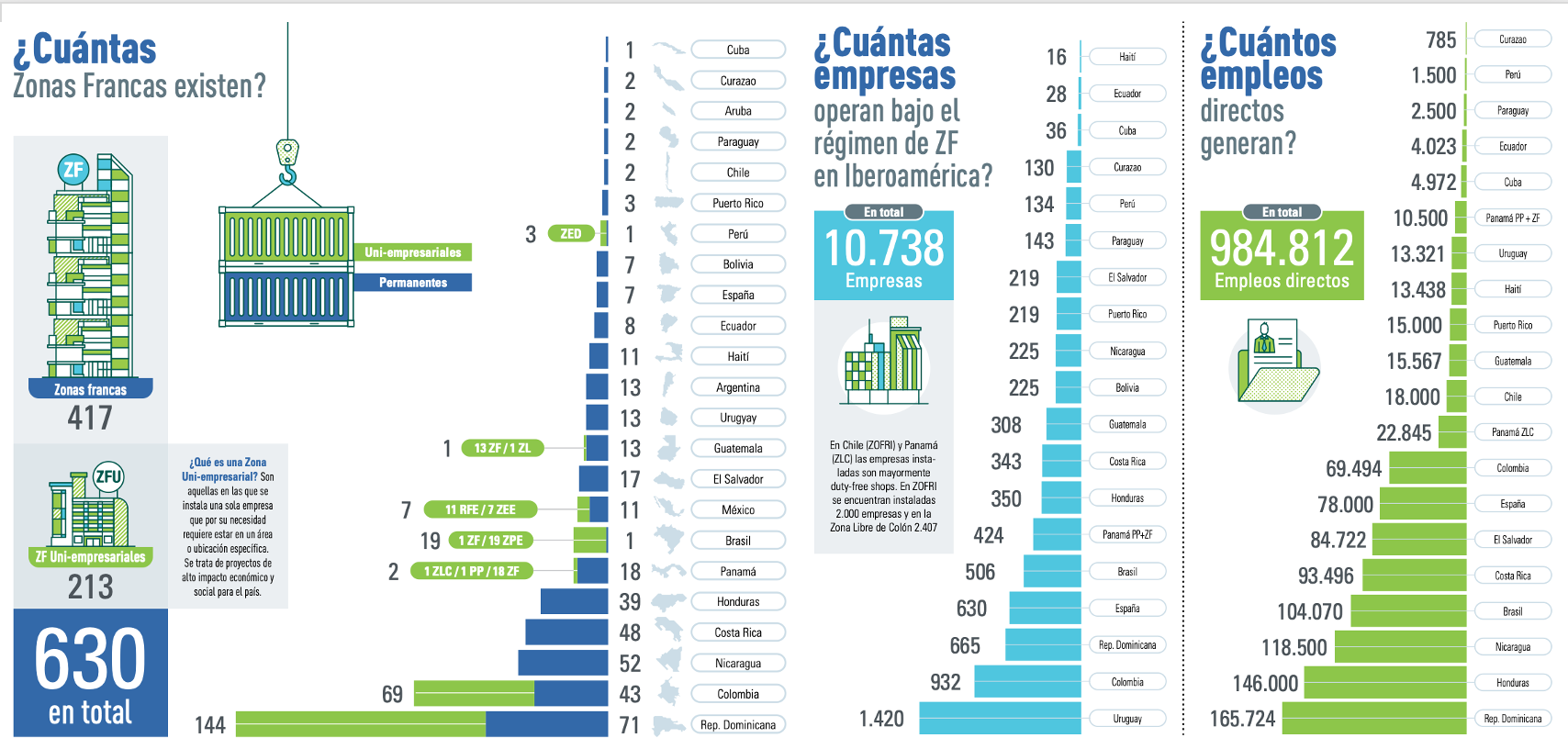
Reproduced from report graphic of the association Free Trade Zones of the Americas (AZFA), 2018
Export processing zones
Free zones can be export-oriented (external market), import substitution-oriented (internal market) or both. The former may have a high industrial component, either seeking diversification or relying on maquilas, or emphasising logistics services (in the case of Panama's free zones).
Free zones for exporting products have been particularly successful in the Dominican Republic and Costa Rica. As the AZFA indicates, of the 31,208 million dollars exported from Latin American free zones in 2018, the first place went to the Dominican Republic, with 5,695 million, and the second to Costa Rica, with 4,729 million (the third place went to Puerto Rico, with 3,000 million). Exports from the Dominican Republic's free trade zones accounted for 56% of all exports from that country; in the case of Costa Rica it was 48% (third in the ranking was Nicaragua, with 44%).
The Dominican Republic is the country with the largest issue number of free zones (71 multi-company zones) and its 665 companies generated the largest number of direct jobs (165,724). Costa Rica has 48 free zones (in third position, after Nicaragua), and its 343 companies generated 93,496 direct work jobs (in fifth position).
In terms of the profitability for the country of this economic modality , for every dollar exempted between 2010 and 2015, Costa Rica's free trade zones generated an average of 6.2 dollars and those of the Dominican Republic 5 dollars (El Salvador ranked second with 6 dollars).
As regards Costa Rica specifically, a late 2019report by the Costa Rican foreign trade promotion agency, Procomer, put the contribution of free trade zones at 7.9% of GDP, generating a total of 172,602 jobs work, both direct and indirect, with an annual growth of issue jobs averaging 10% per year between 2014 and 2018. These areas account for 12% of the country's formal private sector employment . An important fact about the contribution to development of the local Economics is that 47% of the purchases made by firms located in free trade zones were from national companies. An important social dimension is that the zones contributed 508 million dollars to the Costa Rican Social Security Fund in 2018.
The Dominican Republic's free trade zone regime is particularly applauded by the World Bank, which describes the country as a pioneer in this subject instrument of productive and commercial promotion, presenting it as "the best known success story in the western hemisphere". agreement According to the statistics of the committee National Free Trade Zones Export Zones (CNZFE), these have contributed 3.3% of GDP in recent years, thereby contributing to the significant growth of the country's Economics in recent years (one of the highest fees in the region, with an average of over 6% until the onset of the current global crisis). The geographical proximity to the United States makes its free trade zones ideal for US companies (almost 40% of investment comes from the US) or for companies from other countries that want to export to the large North American market (34% of exports go to the US).
The deterioration of recent years seems to have been corrected in several indicators on democratic health and economic environment.
Costa Rica has traditionally been a model of democratic functioning in a region with serious institutional deficits, which has earned it a mediating role in different conflicts. The increase of internal problems -strikes, citizen protests, bipartisan crisis...- have seemed to have diminished Costa Rica's international prestige in recent years. Is Costa Rica suffering from democratic and institutional deterioration?
![Facade of the National Theater of Costa Rica, in San José [Pixabay].](/documents/10174/16849987/costa-rica-deterioro-blog.jpg "Facade of the National Theater of Costa Rica, in San José [Pixabay].")
▲ Facade of the National Theater of Costa Rica, in San José [Pixabay].
article / Ramón Barba
The political unrest of recent years in Costa Rica, in a regional context of the "angry vote" and the consequent "outsider phenomenon", has given the impression of a setback in the country's institutional virtues. The goal of this article is to determine, based on different indicators on democratic health and economic and political satisfaction, if there are objective data that ratify this perception.
For this purpose we will first analyze a set of indicators, elaborated by the World Bank, the Konrad Adenauer Foundation and The Economist magazine, and then we will also take into account some results of the survey Latinobarómetro. We will compare the values recorded in 2010, 2013, 2016 and, when possible, 2018.
Indicators
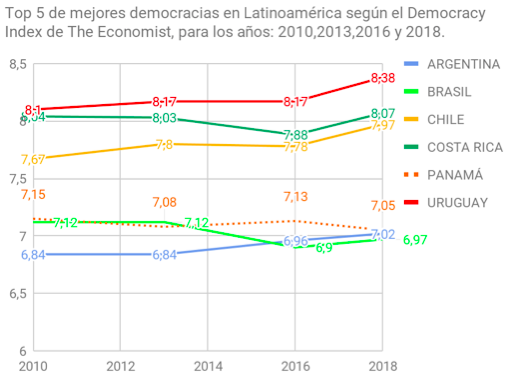
Regarding the Democracy Index elaborated by The Economist, although Costa Rica maintains its second place among Latin American democracies, behind Uruguay and ahead of Chile (these are the three countries that usually obtain better grade in the different institutional parameters of the region), in the last decade a Costa Rican democratic decline is observed, apparently overcome in the most recent report. From a score of 8.04 achieved in the 2010 Democracy Index, Costa Rica dropped to 8.03 in 2013 and 7.88 in 2016, to regain ground in 2018 with an 8.07. The country remains the best democracy in Central America, followed at a distance by a stable Panama.
 |
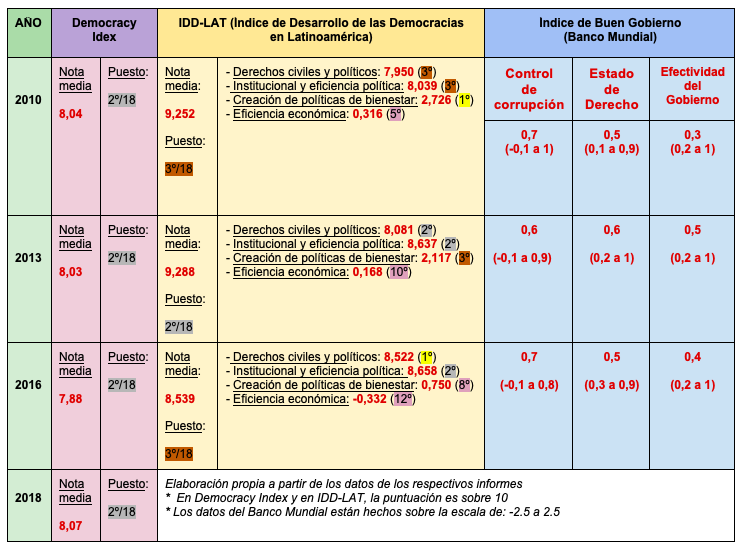
The deterioration of recent years has also been picked up by the Index of development of Democracies in Latin America (IDD-LAT), of the Konrad Adenauer Foundation, which has not yet published data referring to 2018, so this index cannot endorse whether there has been a recent recovery. In 2010, Costa Rica had a score average of 9.252; it barely varied in 2013, with a figure of 9.277, but dropped clearly in 2016, with 8.539 points. The components of the index that suffered the most were welfare policy creation and economic efficiency, where it dropped from 1st and 5th place, respectively, to 8th and 12th. The fact that Costa Rica remained between 1st and 3rd place in civil and political rights and in institutional and political efficiency in those years sample shows that the social concern of those years was more in the economic sphere than in the institutional sphere.
The World Bank's Good Governanceindicators also registera small regression in the case of Costa Rica between the years 2013 and 2016 (data more recent ones have not yet been published). Regarding the Rule of Law and Government Effectiveness scales the score dropped from 0.6 and 0.5, respectively, to 0.5 and 0.4. There has been little change in the Control of Corruption scale.
 |
evaluation citizen
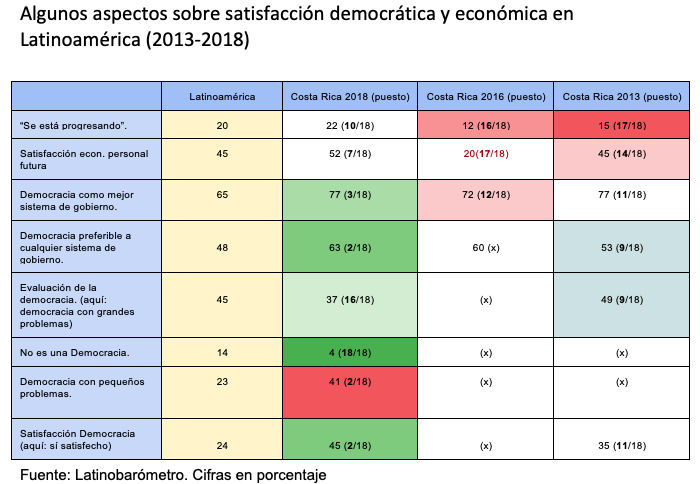
The above indicators are prepared by experts who, by applying standardized criteria, seek to offer an objective estimate. But we also wanted to take into account the opinion of the citizens themselves, as expressed in the survey Latinobarómetro. These can be useful to indicate the perception that exists among the population regarding the institutional health of the country: the satisfaction that exists regarding the government system and the economic system.
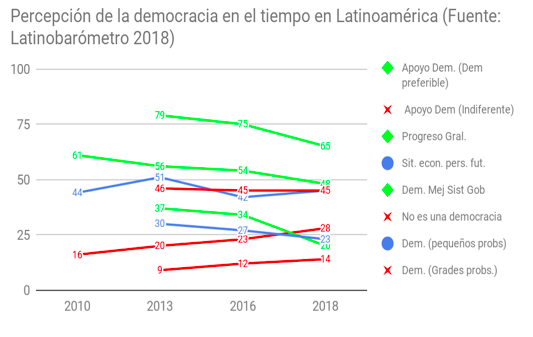 |
The value of democracy is maintained in high percentages in Costa Rica, despite a negative trend in the region as a whole. Attending to four values that Latinobarómetro has included in its surveys corresponding to the years here chosen for our comparison, we see that indeed in 2016 the citizen perception was that of a worsening of status, but in 2018 an improvement is observed, reaching even more positive levels than in 2013. As for the evaluation of democracy, its consideration as the best system of government dropped from 77% to 72% and then has risen again to 77%, while its cataloging as a preferable system has been increasing: 53%, 60% and 63%.
The perception of the economic environment, for its part, had a blip in 2013, but today it is in better condition. The statement "progress is being made" fell from 15% to 12%, but in 2018 it reached 22%, while satisfaction with future personal economic prospects fell from 45% to 20% to stand in 2018 at 52%.
Political unrest
Costa Rica is a country that retains strong institutions, although the political landscape is more divided. test of this is the end of the two-party system (1953-2014), brought about by less support for the National Liberation Party (PLN) and the Social Christian Unity Party (PUSC) and the emergence of the Citizen Action Party (PAC), to which the country's current president, Carlos Alvarado, belongs.
Corruption issues such as the "cimentazo case", the high public debt that has forced cutbacks in a country with certain well-established social benefits and a regional and international environment prone to populist solutions may be behind the political unrest observed in Costa Rica in recent years.
This occurs in a context of the "angry vote" in Latin America, which arises as a consequence of the political actions of the last twenty years in the region and a strengthening of the middle classes. Citizen dissatisfaction has led to the emergence of outsider politicians: people with relative popularity, short degree program political, without a determined strategy and with an "anti-political" speech . This is a patron saint that, although it is in the emergence of the PAC, in any case does not fully correspond to the personality of President Alvarado, who actually seems to have contributed to redirect the Costa Rican restlessness.
Conclusions
Thus, from the analysis of the data observed here, it can be concluded that there was indeed a slight deterioration in both institutional circumstances and especially in economic conditions or expectations between 2013 and 2016, but the different scales have returned in 2018 to previous values, even improving in some cases to levels of ten years ago. This is something that can be observed both in the indicators at position of experts that follow standardized objective procedures and in the surveys of subjective citizen perception.
The sample used and the temporal tastings carried out have not been exhaustive, so it is not possible to specify whether the variations noted here are circumstantial fluctuations or part of a trend pointing in a certain direction.