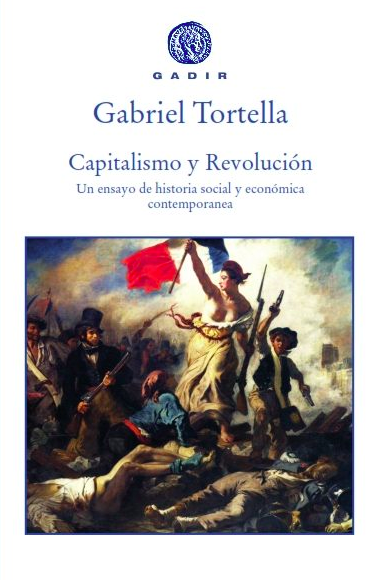
[Gabriel Tortella, Capitalism and Revolution. An essay on contemporary economic and social history. Gadir. Madrid, 2017. 550 pages]
June 5, 2018
review / Manuel Lamela Gallego
The main goal this book is to offer a comprehensive overview of contemporary history, in order to enable us to understand the marvelous, yet overwhelming, complexity of the world we live in today. In order to accomplish this task, the book takes a trulymultidisciplinary approach , with economic history as a meeting point and reference letter for the other social sciences. Consequently, the book offers an accurate economic and social analysis, but without ever forgetting the political aspect, a factor that the author considers essential for a true understanding of past events.
With this look at the past in order to, in the final chapters, observe with greater lucidity and clarity the near future, Gabriel Tortella completes, improves and nourishes with a greater issue of reflections and thoughts his previous work, "The Origins of the Twentieth Century" (2005). An economic historian of academic B and international recognition, the author presents us with an enjoyable study that will undoubtedly awaken the reader's interest in the study of contemporary history.
To do so, the author takes us by the hand to what he calls the first World Revolution (actually, the author goes back to more remote times to explain, in a brilliant chapter, the triumph of Europe and how it will lead and spearhead this process). This historical development is made up of the so-called Atlantic revolutions or bourgeois revolutions, led by England (XVII) and Holland (XVI-XVII) and followed by the rest of Europe and the American continent during the last decades of the XVIII century and almost all of the XIX century. Finally, the Industrial Revolution initiated in the British Isles during the 18th century will bring this First World Revolution to a close.
Already here, the author sample us his acuteness as a historical analyst in discerning between bourgeois revolution and industrial revolution, concluding that an evolutionary process is followed: first, a revolution of a political nature is necessary, resulting in advances at both the social and economic levels, as was the case in England, with an increase in maritime trade, development of parliamentarism, changes in agriculture.... The latter will finally lead to an Industrial Revolution where progress and improvement will be total and will cover all areas of human society. This reflection explains and crystallizes the status lived in Europe during the 18th century, where we found societies like the English, practically submerged in its industrialization, and at the same time societies like the French, still submerged in its bourgeois revolution.
 |
The author marks another turning point in the evolution of history at the end of the Belle Époque and the beginning of World War I, in 1914. As he did before, he will name the process, initiated in the first part of the twentieth century and culminating in its second half, as the Second World Revolution. When the author speaks of revolution, he is in no way referring to the Russian revolution or Bolshevik revolution that took place in 1917, nor to the series of totalitarianisms that arose during the interwar period. For Gabriel Tortella these events are nothing more than monstrous experiences destined to remain silent in the dustbin of history. When the author speaks here of revolution he is referring to the consolidation of the social-democratic State supported by the economic theory of John Maynard Keynes.
The author then makes a historical-economic review, up to the economic recession of 2008. The author concludes by explaining the reason for the triumph of capitalism: a capitalism undoubtedly renewed and shaped by the different crises that have occurred since 1945. Conclusion that we can synthesize in the phrase, almost prophetic, used by the author of: "Tomorrow Capitalism" (p. 498).
Tortella devotes the last pages of his book to reflect on the present and the time to come. In a balance of the last 250 years and far from dark futures, he sample us how humanity, after several decades of unprecedented development , is at its maximum splendor in terms of living standards and conditions. Despite this well-founded optimism, the author also warns us of serious problems that humanity will have to face in order to move forward in its progress. The overpopulation and the demographic decontrol existing in third world countries is considered by the author as the great problem of our time.