Deployment of nearly 19,000 'blue helmets' has reduced violence, but human rights violations persist
President Joseph Kabila's leverage on power and social and tribal resentment have fueled violent conflict within the Democratic Republic of Congo over the past year and a half. To date there have been 3.9 million displaced people; 3,300 deaths were recorded in 2017 alone. UN intervention has reduced the levels of violence, but the conflict in Kasai province is still alive.
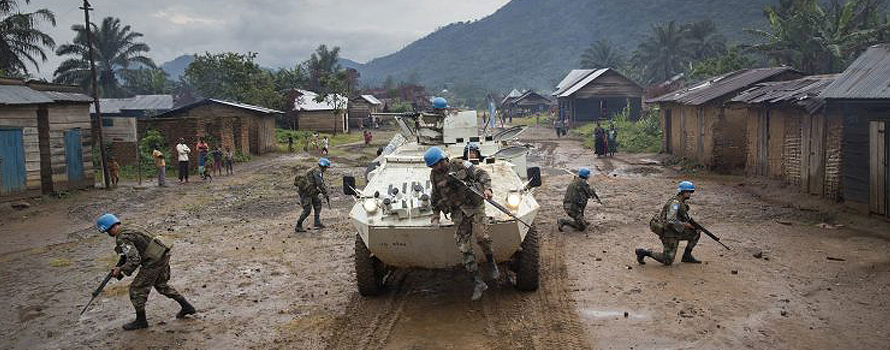
▲Forces of the UN mission statement for Stabilization in the DRC [MONUSCO/Sylvain Liechti].
April 20, 2018
article / Eduardo Villa Corta
The Democratic Republic of Congo (DRC) is in the midst of a major civil crisis that has been going on for a long time. Although the country has had numerous internal problems and conflicts, the one in the Kasai region, in the center-south of the country, stands out for the high issue of deaths and human rights violations.
The origin of this conflict dates back to 2016, when President Joseph Kabila, in power since 2001, decided to delay the elections in order to remain in power longer. The death of his main opponent, Etienne Tshisekedi, facilitated Kabila's intentions to remain in office, but since then he has had to confront an armedcivil service examination : the Kamuina Nsapu militia.
To understand the status generated, it is necessary to start from the tribal division present in the DRC. The chiefdoms and territorial divisions are administered by a traditional chief and his committee. These hereditary lines follow a succession process, which must be ratified by the Ministry of the Interior. In the case of the Kamuina Nsapu tribe, in January 2012 there was a problem with the accession to the chieftainship of Jean Pierre Nsapu Pandi, because the Ministry of the Interior (appointed by Kabila) did not recognize the new leader. After some time, he received the news that the Ministry had selected another chief from outside the tribe. This selection generated resentment that led to a revolt. From that moment on, Nsapu Pandi decided to start recruiting people in the area.
Among the reasons why this movement grew and expanded in the region is first and foremost the status of widespread poverty. Given the low living conditions and poor economic growth, the promises offered by the leader were a popular incentive. The knowledge of the local Tshilub language and Nsapu Pandi's own charismatic staff also helped him to gain supporters, so that by the end of July 2016 some 800 young people were already following him. It was then that the militia, called Kamuina Nsapu out of devotion to their leader and guide, started the revolt, with the burning of a police station 20 kilometers from the town of Tsimbulu.
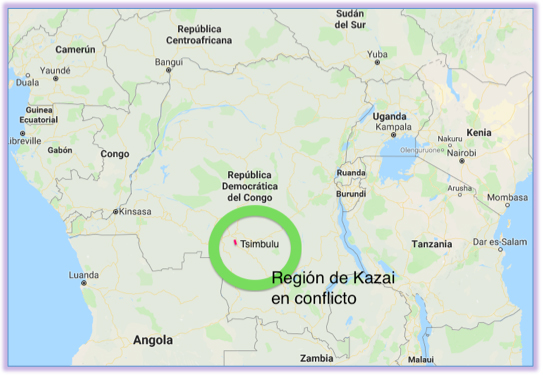 |
The conflict took a leap a few weeks later, when a clash between police and military took place in Tsimbulu. The episode ended with the order to kill Pandi in combat, given by the president himself. From that moment on, the newly formed militia joined the civil service examination to Kabila and went from being a local group to become a national one. It is now a militia at civil war with the government, in a confrontation that has devastated the Congolese population.
The Kamuina Nsapu militia and its atrocities had a rapid response from Kabila. He responded with disproportionate and disproportionate force, as in his actions against the militia the authorities caused in the first weeks about 400 deaths, both among armed elements and among the civilian population. The group has grown exponentially due to the strong civil service examination social civil service examination of Kabila, who nevertheless still holds power in Kasai. Both sides of the conflict have been involved in atrocities and serious human rights violations.
data on deaths and injuries are not easy to obtain. According to Catholic Church sources, in 2017 alone the conflict caused at least 3,300 deaths. That same year there were 1.7 million people who left their homes and moved to neighboring countries in search of asylum. To date there have been a total of 3.9 million people displaced. The conflict has exacerbated the famine in the country, which has reached 7.7 million people. Of these, 3.3 million are located in the Kasai region, which is the hardest hit by the conflict. In January 2018, the issue of malnourished children was estimated at 400,000. The numbers are only rising due to migration and the endangered status thousands of people. The DRC has asked the World Bank order 1.7 billion dollars in order to establish and help the population. But this sum has not been delivered, nor has there been any financial contribution from any international organization.
The truth is that these atrocities are the responsibility of both sides in the conflict. The involvement of both sides can be seen in the finding of mass graves (80 have been found in the area) following a United Nations initiative. It showed that everything from beheadings to mutilations had been committed and that the victims ranged from soldiers to children. The UN has sent observers and "blue helmets" to the area: a total of 19,000 troops whose mission statement is to try to maintain peace, support civilians and investigate the events. This work has so far recorded 2,800 human rights violations. At least two UN observers were beheaded in the Kasai region, which is difficult for international organizations to access due to government restrictions and the violence itself.
This conflict is based on social and tribal resentment and the struggle for control of the country. In order for the country to recover, both Kabila and the Kamuina Nsapu should reach some subject of compromise. To achieve this the international community should reiterate the pressure exerted in 2016 at the beginning of a conflict that has escalated over nearly two years. The African Union and the UN should push both disputing parties towards a ceasefire, in a mediation that is both regional and extra-continental. The solution most conducive to the stabilization of the country is the holding of free elections.