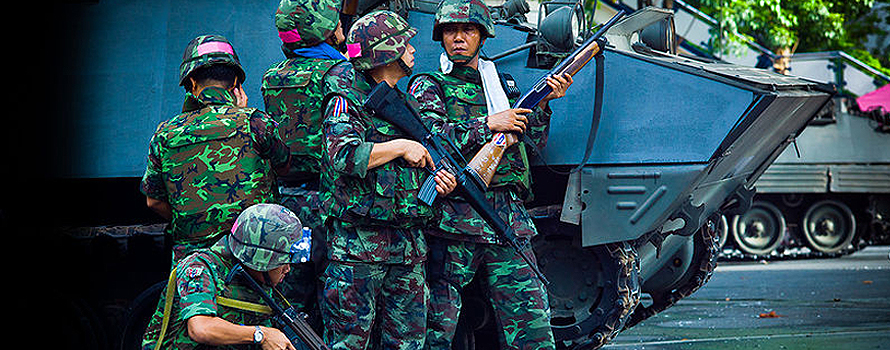
▲Mobilization of the Royal Thai Armed Forces in 2010 [Roland Dobbins-WC].
COMMENTARY / Álvaro Aramendi Baro
Terrorism is hitting Thailand harder and harder. The causes of this incipient growth are difficult to pinpoint. However, the coup d'état by the Royal Armed Forces led by General Prayuth Chan-ocha on May 22, 2014 and, obviously, the subsequent political repressions play a major role. Nor should we forget the pressure exerted by the BRN (Barisan Revolusi Nasional), which for decades has been fighting for the independence of Pattani (located in the south of Thailand) This revolutionary group is also active in northern Malaysia. This terrorist organization is currently being used by ISIS. The strategy of ISIS, as well as that of Al-Qaeda, is based on encouraging and incentivizing nationalist insurgencies in order to have easier access to the territories under its sights.
In spite of this, the jihadist influx has taken different channels from those we already know, as in Iraq or Syria. It is enough to follow the media to guess that the self-styled Islamic State prefers global media expansion to national expansion. This is not the case in Thailand. Both the targets of terrorism and its communication strategy are national and rather hidden, in the shadows. Because of this, the relationship between them is not entirely evident today.
The status is not what it should be. If there is one thing Thailand needs today, it is a period of peace in order to recover from past events. In the last century there have been at least twelve successful coups, the last one, and not counting the 2014 coup, in 2006. There is an urgent need for a quiet period in which to establish a strong foundation, and other structure, for its constitutional monarchy (similar to England's).
Perhaps the best way to resolve the conflict is to avoid falling into the mistake of other countries, such as Burma or the Philippines, and to avoid strong repression. Therefore, as Crisis Group warns, the best option would be dialogue and not the exclusion of ethnic minorities such as the Rohingya, in the case of Burma, or the Muslim community in Thailand (with a Buddhist majority). Should this happen, the terrorist pressure would become increasingly unbearable, until the pot could only explode. Annexation to groups like ISIS can occur for a variety of causes, not adding one more to the list is essential.