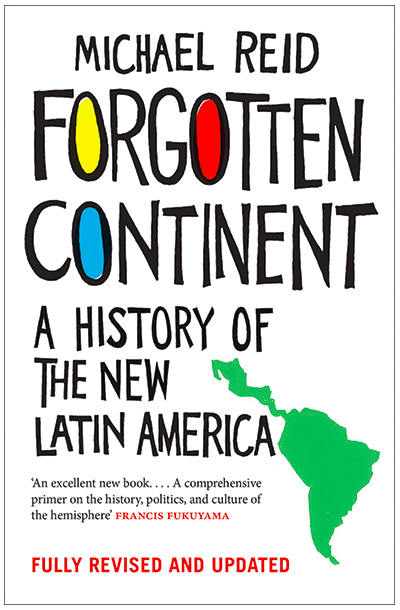
[Michael Reid, Forgotten Continent: A History of the New Latin America. Yale University Press, New Haven, 2017. 425 pages]
review / María F. Zambrano
Latin America's recent history is full of progress, even if at times only a few steps backward. In addition to the important changes that have taken place since the 1980s, when the region embraced democracy, began to overcome economic protectionism and tamed the problem of inflation, more recently there has been a period of economic acceleration - known as the golden decade, due to the boom in raw materials - which between 2002 and 2012 has meant a social B : 60 million people escaped poverty in those years, so that, although great inequalities continue to exist, at least theaverage class now extends to 50% of the population. This has generated better educated societies, which have recognized the primacy of law over the paternalism of the caudillo. But the large revenues that many states obtained in that golden decade also led to negative courses.
This moderate optimism about Latin America -without ignoring the difficulties, but without ignoring the progress made- is what is conveyed in the book Forgotten Continent: A History of the New Latin America, by Michael Reid, Latin America publisher of The Economist, where he writes the Bello column. A correspondent for almost 35 years in the region, where he has lived most of this time, Reid is one of the voices with the best knowledge of the multiple continental realities. The result of that staff experience is Forgotten Continent, which Reid published in 2007 (then with the subtitle "The Battle for the Soul of Latin America") and which he now offers again in a revised and updated edition, with extensive changes with respect to the first version.
What has happened in Latin America in the last ten years to make Reid see the need for a new presentation of his book? Although there are various elements, such as the end of the commodities boom, which has brought economic difficulties to some countries, and certain changes in political orientation (Kirschner for Macri, or Temer for Rousseff), perhaps the most notable thing is that, in democratic terms, Latin America today looks less hopeful than it did a decade ago. Ten years ago, the new left-wing populism might have seemed a mere parenthesis in the progressive democratic consolidation of Latin American societies; today, Bolivarianism has certainly already shown signs of failure, but it may have greater continuity than expected when inserted with the current of populism of various kinds that is emerging in many other parts of the world.
Reid notes the failed path taken by Chávez, also followed by other neighboring leaders of the same ilk: "There are lessons for the region in the catastrophic failure of Chavismo. An accident in history -the rise in oil prices from 2001 onwards- gave for a time spurious plausibility in some places to an alternative course to which Latin Americans seemed to have turned their backs not long ago. The 'Bolivarian alternative' was based on erroneous premises (...) In its enchantment with Bolivarianism and renewed regard for Cuba, much of the left forgot the enduring lessons of the end of the Cold War: that central planning had failed and that communism was tyranny, not liberation." In any case, the Bolivarian experience has shown that Latin America did not enter an era of assured democracy at the end of its military dictatorships, as we now see that neither did the rest of the world with the fall of the Berlin Wall, despite the perception at the time. The risk in the region is perhaps greater, due to the persistence of strong social differences: as Reid says, Chavismo is "another reminder that extreme inequality provides fertile ground for populism".
 |
| |
Challenges ahead
In a post-Chávez and post commodity price boom era, Latin America faces a series of challenges, which are certainly long-standing but in some cases more urgent. The double goal of achieving strong institutions and sustainable economic development requires solving important challenges, among which Reid highlights several.
One of them is security. Crime and violence have become an epidemic. In 2013, eight of the ten countries and 42 of the 50 most violent cities in the world, outside theaters of war, were in the region. Reid points to the need for territorial control by the armed forces, the professionalization of police forces, closer cooperation between police and judges, and clear accountability of these bodies to society.
Another challenge is the consolidation of the new class average. There has been progress in primary and secondary Education , but the preparation of both students and teachers is far below that of their peers in developed countries. In the 2015 PISA report , Latin American 15-year-old students were in the bottom third of the world ranking. If the status does not evolve favorably with an increase in the quality of public teaching , warns Reid, private entities would become the first alternative for the new social stratum, which would even be subjected to indebtedness without quality guarantees. This is a phenomenon that also occurs in health care.
In the fight against social inequality, many governments have promoted various Conditional Cash Transfer (CCT) formulas, which are social attendance programs that seek to raise attitudinal standards, such as school enrollment of children, in exchange for subsidies. Some programs have been successful in contributing to social development , but in many cases they transfer resources without achieving long-term progress, and in some countries they have become a clear cultivation of a captive vote. By having two parallel social security systems, the government is taxing the formal sector while subsidizing the informal sector.
Esperanza
To overcome these challenges, Forgotten Continent proposes the need to advance regional integration, diversify the Economics and overcome political dogmatism. Thus, true regional integration would allow for skill that would stimulate economies of scale and regional supply chains. To overcome, at least in part, the natural barriers that hinder such integration, real investment in infrastructure beyond the current 3% of GDP is needed.
Raw materials will continue to be an important economic driver in the region, but they should not be the only one. Agricultural production should provide added value, derived from the application of innovative technologies, such as the advances being made in Argentina and Brazil with "no-till farming" and "precision agriculture". This requires an increase in investment in research and development, which currently accounts for only 0.5% of GDP. Latin America also has many natural resources that are conducive to the development of tourism and the expansion of manufacturing industries.
The author proposes to break with the historical discussion between unrestricted free market and protectionism, and to stop nurturing the corporatist culture of seeing power as a staff patrimony. "To get there requires a new subject of politics: instead of the polarization and confrontation offered by populists (and sometimes by their opponents), Latin America needs consensus building, where the state, the private sector and civil society work together to set medium-term goals and hold the government accountable for their fulfillment".
These propositional elements by Reid come at the end of a book that is above all a description of the soul of Latin America. It is a continent that has not been poor or dangerous enough, nor has it grown fast enough economically, to attract international attention. Hence the degree scroll of the book. It begins by outlining the structural, geographic and cultural difficulties that the region has had to face in its attempt to establish lasting democracies and overcome its imbalances. It continues with an analysis of the political and economic cycles, from independence to the latest dictatorships. And finally concludes with a diagnosis. Although the problems of Latin America were already well diagnosed in the first edition, ten years ago, it is in this final part of the book where the author has changed more pages. His conclusion does not vary much, but the tone is slightly more somber; nevertheless, Reid prefers to end the story with the same hopeful quotation of the Argentine liberal Bautista Alberdi: "Nations, like men, have no wings; they make their journeys on foot, step by step".