
US agreements with the Northern Triangle may have had a deterrent effect before entering into force
In the first month following the extension of the Asylum Cooperation Agreements (ACA) to the three Northern Triangle countries, apprehensions at the US border have fallen below the levels of recent years. The actual reduction in migrant inflows that this evidences has to do with Mexico's increased control over its border with Guatemala, but may also be due to the deterrent effect of advertisement of the agreements, whose implementation has not yet fully begun and therefore has yet to demonstrate whether they will be directly effective.
![Honduran migrants held by Guatemalan border guards, October 2018 [Wikimedia Commons].](/documents/10174/16849987/tercer-pais-blog.jpg "Honduran migrants held by Guatemalan border guards, October 2018 [Wikimedia Commons].")
▲ Honduran migrants held by Guatemalan border guards, October 2018 [Wikimedia Commons].
article / María del Pilar Cazali
Attempts to entrance attempt to enter the United States through its border with Mexico have not only returned to the levels of the beginning of the year, before the number of migrants soared and each month set a new record high, reaching 144,116 apprehensions and inadmissions in May( USBorder Guard figures that provide an indirect assessment of migration trends), but have continued to fall to below several previous years.
In October (the first month of the US fiscal year 2020), there were 45,250 apprehensions and inadmissions at the US southern border, down from October 2018, 2015 and 2016 (but not 2017). This suggests that the total number of apprehensions and inadmissions in the new fiscal year will be well below the record of 977,509 recorded in 2019. This boom had to do with the caravans of migrants that began at the end of 2018 in the Central American Northern Triangle (Honduras, El Salvador and Guatemala), following a migratory flow that, with different intensities, began in the 1980s due to political and economic instabilities in those countries.
This migration crisis led President Trump's US administration to implement tougher deportation policies, including changing conditions for expedited deportations. In addition, the White House pressured Mexico with the threat of tariffs on its products if it did not help reduce the flow of migrants crossing Mexican soil, prompting President López Obrador to deploy the newly created National Guard to the border with Guatemala. Trump combined these measures with the negotiation of Asylum Cooperation Agreements (ACAs) with the Northern Triangle countries, which were initially improperly referred to as "safe third countries", adding to the controversy they generated.
agreement with Guatemala
Due to US threats to impose tariffs on Guatemala if it failed to reduce the issue of migrants from or through Guatemala on their way to the US, the Guatemalan government accepted the terms of a attention announced by Trump on 26 July 2019. The agreement foresees that those who apply for asylum in the US but have previously passed through Guatemala will be brought back to the US so that they can remain there as asylum seekers if they qualify. The US sees this as a safe third country agreement .
A safe third countryagreement is an international mechanism that makes it possible to host in one country those seeking asylum in another. The agreement signed in July prevents asylum seekers from receiving US protection if they passed through Guatemala and did not first apply for asylum there. The US goal is intended to prevent migrants from Honduras and El Salvador from seeking asylum in the US. Responsibility for processing protection claims will fall to Washington in only three cases: unaccompanied minors, persons with a US-issued visa or document Admissions Office , or persons who are not required to obtain a visa. Those who do not comply with requirements will be sent to Guatemala to await the resolution of their case, which could take years. On the other hand, the agreement does not prevent Guatemalan and Mexican applicants from seeking asylum in the US.
Guatemalan President Jimmy Morales had previously announced that a similar agreement could become part of the migration negotiations with the US. In Guatemala, after advertisement of what had been agreed, multiple criticisms arose, because the security conditions in both countries are incomparable. This was compounded by rumours about the true content of the agreement that Morales had signed, as it was not immediately revealed to the public. Faced with this uncertainty, Interior Minister Enrique Degenhart declared that the agreement was only for Hondurans and Salvadorans, not for nationals of other Latin American countries, and that the text did not explicitly mention the term "safe third country".
In the week following the advertisement, three appeals for amparo against the agreement were lodged with Guatemala's Constitutional Court, arguing that the country is not in a position to provide the protection it supposedly offers and that the resulting expense would undermine the economic status of the population itself. However, Degenhart defended agreement by saying that the economic repercussions would have been worse if the pact with Washington had not been reached, because with the US tariffs, half of Guatemala's exports and the jobs that accompany these sectors would be at risk.
These criticisms came not only from Guatemalan citizens, but also from public figures such as Guatemala's Human Rights Ombudsman, Jordán Rodas, citing a lack of transparency on the part of the government. Rodas insisted that Guatemala is not fit to be a safe third country because of its low indicators of production, Education, public health and security. Similar ideas have also been expressed by organisations such as Amnesty International, for whom Guatemala is not safe and cannot be considered a safe haven.
In its pronouncement, Guatemala's Constitutional Court affirmed that the Guatemalan government needs to submit the agreement to congress for it to become effective. This has been rejected by the government, which considers that international policy is skill directly the responsibility of the country's president and will therefore begin to implement what has been decided with Washington without further delay.
![Apprehensions and inadmissibilities by US Border Guard, broken down by month over the last fiscal years (FY) [Taken from CBP].](/documents/10174/16849987/tercer-pais-grafico.png "Apprehensions and inadmissibilities by US Border Guard, broken down by month over the last fiscal years (FY) [Taken from CBP].")
Apprehensions and inadmissibilities by US Border Guard, broken down by month over the last fiscal years (FY) [Taken from CBP].
Also with El Salvador and Honduras
Despite all the controversy generated since July as a result of the pact with Guatemala, the US developed similar efforts with El Salvador and Honduras. On 20 September 2019, El Salvador's president, Nayib Bukele, signed a agreement similar to the safe third country figure, although it was not explicitly called that either. It commits El Salvador to receive asylum seekers who cannot yet enter the US, similar to the agreement with Guatemala. El Salvador's agreement has the same three assumptions in which the US will have to make position of migrant protection.
The Salvadoran government has received similar criticism, including a lack of transparency in the negotiation and denial of the reality that the country is unsafe. Bukele justified signature by saying it would mean the extension of Temporary Protected Status (TPS) for the more than 190,000 Salvadorans living in the US. In October 2019, the Salvadoran Foreign Ministry said that this agreement is not a safe third country because El Salvador is not in the serious migratory situations in which Guatemala and Honduras are in terms of the flow of people, so it is only a agreement of non-violation of rights to minimise the number of migrants.
On 21 September 2019 the Honduran government also made public the advertisement of a agreement very similar to the one accepted by its two neighbours. It states that the US will be able to deport to Honduras asylum seekers who have passed through Honduras. Like the other two countries, the Honduran government was criticised as not being a safe destination for migrants as it is one of the countries with fees highest homicide rates in the world.
Despite criticism of the three agreements, in late October 2019 the Trump administration announced that it was in final preparations to begin sending asylum seekers to Guatemala. However, by the end of November, no non-Guatemalan asylum seekers had yet been sent. The inauguration in early January of President-elect Alejandro Giammattei, who announced his desire to rescind certain terms of agreement, may introduce some variation, though perhaps his purpose will be to wring some more concessions from Trump, in addition to the agricultural visas that Morales negotiated for Guatemalan seasonal workers.
[Michael E. O'Hanlon, The Senkaku Paradox: Risking Great Power War over Small Stakes. Brookings Institution Press. Washington, 2019. 272 p.]
review / Jimena Puga
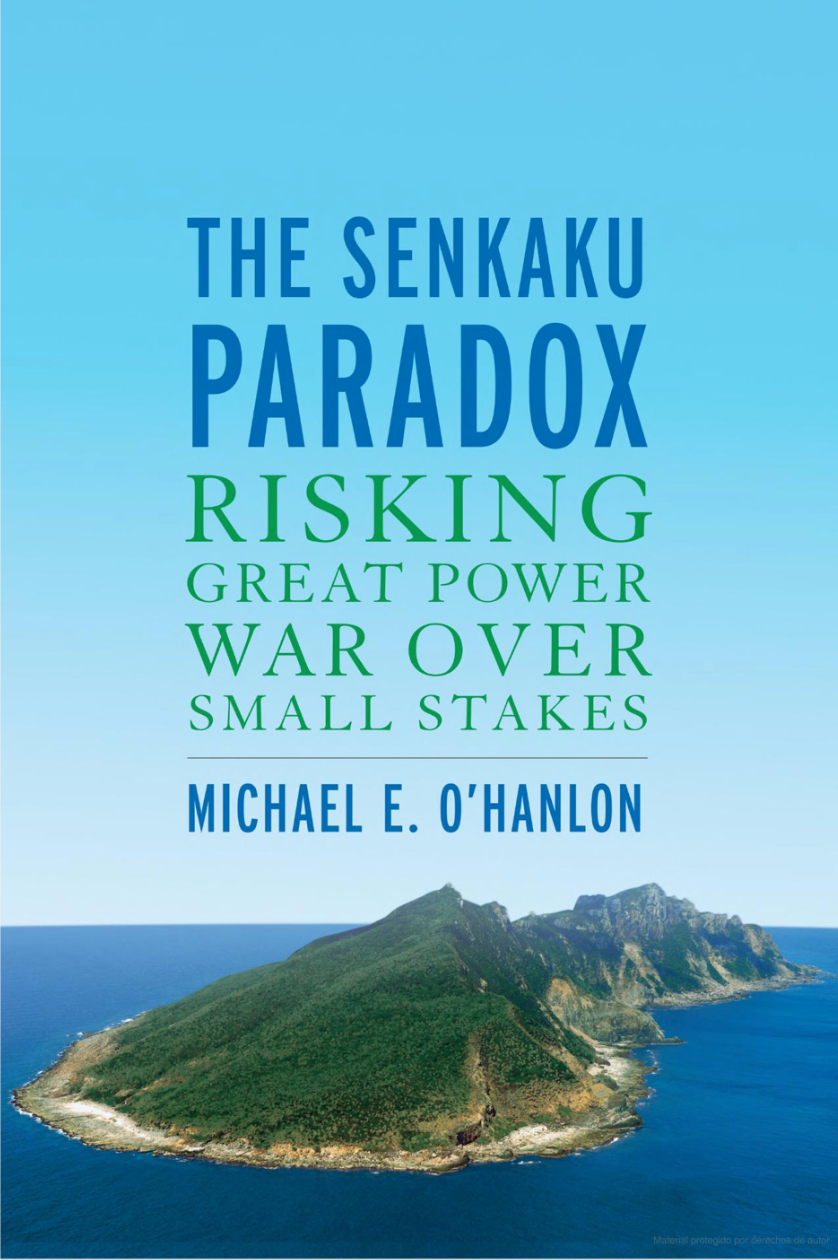 After the end of the Cold War, in which it confronted the Soviet Union bloc by defending the values of the Western order, the United States remained in the world as the hegemonic country. At present, however, it is rivaled by Russia, which despite its weakness Economics it struggles not to lose any more influence on the international stage, and for China, which, although still a regional power, aspires to replace the United States at the pinnacle of the world. The challenge it is not only for Washington, but for the entire West, as its very values are called into question by the advance of the diary of Moscow and Beijing.
The West needs to respond firmly, but how far does it need to go? When should you say enough is enough? Are you willing to go to war even if the cumulative steps taken by Russia or China are in themselves relatively minor or occur on the periphery? That's what Michael E. is asking. O'Hanlon, researcher Brookings Institution, in The Senkaku Paradox: Risking Great Power War over Small Stakes. The book addresses a number of possible scenarios in the context of global hegemonic change and competition between the world's major powers for power.
The scenarios put forward by O'Hanlon consist, on the one hand, of a possible annexation of Estonia or Latvia by Russia, without prior consent and through a military attack. And, on the other, China's military conquest of one of the largest islands that make up the Senkaku, the name given by Japan to an archipelago it administers near Taiwan and which Beijing calls Diaoyu. In both cases, it is difficult to assess which side would have a better military strategy or to predict which side would win a hypothetical war. In addition, there are many unknown variables about cyber vulnerabilities, submarine operations, or the accuracy of missile strikes on each country's strategic infrastructure.
Thus, the author wonders whether both the United States and its allies should respond directly with a military offensive, in response to an initial attack, or if they should limit themselves to an asymmetrical response, focused on preventing future attacks, combining such responses with economic retaliation and certain military actions in different scenarios. What is clear is that while remaining vigilant in the face of the possible need to strengthen their positions on the international chessboard, Western countries must remain prudent and provide proportionate responses to possible crises, aware that their values – the defence of freedom, justice and the common good – are the greatest advantages of their democratic systems.
At present, Western democratic systems are under strong populist pressure, although there is nothing to suggest that countries with well-established democracies such as France, Germany or Spain will generate conflicts between them, much less in the European Union, which has been a guarantee of peace and stability since the 1950s. For its part, it would be advisable for the Trump administration to react with greater prudence in certain situations, to avoid an escalation of diplomatic tension that would unnecessarily increase the risks of conflict, at least regionally or economically.
Neither Moscow nor Beijing today poses an immediate threat to U.S. global hegemony, but China is the fastest-growing power in fifty years. Such rapid growth could lead China to dispense with multilateralism and regional cooperation and to carry out regional influence through economic or military imposition. That would make the People's Republic a threat.
Although it is true that the United States has the best military force, it is expected that around the year 2040 there will be both military and economic parity between the Central Empire and the American country. Thus, Europe and the United States, in the face of possible aggression from China – or Russia, despite their state of gradual decline – should respond appropriately and, as the White House says, be "strategically predictable, but operationally unpredictable". And all this is done by seeking allies at the international level and by putting military pressure on the aggressor in regions that are compromised by him.
As the author argues, the White House needs better and more credible options to design an asymmetric defense based on deterrence and containment plans, which have the use of force as an option. For example, the article Article 5 of the North Atlantic Treaty is not the best deterrent weapon for the US and its allies, as it poses a danger to stability and leaves no room for action in the event of deterrence. However, with the new subject NATO member countries would not be obliged to "fire the first bullet", so there would be room for other collateral actions, without the need to resort to direct confrontation to stop a possible escalation of more serious hostilities.
What is clear, O'Hanlon argues, is that both China and Russia seek to challenge the international order by any means necessary. subject and the West must adopt strategies aimed at anticipating possible future scenarios, so that they can be prepared to deal with them with guarantees of success. These measures don't have to be just military. For example, they will have to prepare for a long and painful economic war through defensive and offensive measures, while the US stops imposing tariffs on aluminum and steel on its allies. In addition, the US has to be careful about overusing the economic sanctions applied to financial transactions, especially the prohibition of access to the SWIFT code of the banking communication system, because if not, the countries allied with Washington will end up creating alternatives to SWIFT, which would be a disadvantage and a sample of weakness vis-à-vis Moscow and Beijing.
![Operations in cyberspace can be part of a status of hybrid warfare carried out by state or non-state actors [Pixabay]](/documents/10174/16849987/guerra-hibrida-blog.jpg "Operations in cyberspace can be part of a status of hybrid warfare carried out by state or non-state actors [Pixabay]")
▲ Operations in cyberspace can be part of a status of hybrid warfare carried out by state or non-state actors [Pixabay]
essay / Ana Salas Cuevas
The hybrid threat is an all-encompassing term subject coordinated actions to influence the decision-making of States, making use of political, economic, military, civil and information means. These actions can be carried out by both state and non-state actors.
The term "Grey Zone" is used to determine the boundary between peace and war. It is a new tactic that has nothing to do with the real war that pits armies of different states against each other. Hybrid warfare is about achieving results by directly influencing society by demoralizing it. It is undoubtedly an effective tactic and much simpler for the attacking countries, since the investment, both economic and human, is lower than in real war. Resources such as propaganda, manipulation of communications, economic blockades, etc. are used. And in the absence of strong international legislation in relation to these conflicts, many countries consider this conflict to be a serious problem. subject of actions as tolerable.
Introduction: The Hybrid Threat
The term hybrid threat was popularized after the clash between Israel and Hezbollah in 2006 to designate "the integration of unconventional and irregular tactics, techniques, and procedures, mixed with terrorist acts, propaganda, and connections to organized crime."[1]
The goal Essential to the hybrid threat is to achieve results without resorting to actual war, pitting societies and not armies against each other, almost completely crumbling the distinction between combatants and citizens. The goal the military takes a back seat.
The actions carried out within this subject of conflicts focus on the employment from media such as cyberattacks, disinformation, and propaganda. They have as goal the exploitation of economic, political, technological and diplomatic vulnerabilities, breaking communities, national parties, electoral systems and producing a great effect on the energy sector. These performances are not random, they are planned and organized. These attacks are not linear in nature. They can have direct consequences in another area. For example, the drone attack on wells in Saudi Arabia in September 2019 had a direct impact on the Economics global.
Cyberspace has become a novel aspect in this scenario. Thanks in large part to the technological and information revolution, we are now facing a changing world order, in which the information provided by the media is accessible to anyone from anywhere in the world. It is no coincidence, therefore, that the Internet is one of the most important fronts when talking about hybrid warfare. In this area, the rules are not clearly established and States and non-State actors have a greater margin of action in the face of the classical power of States. Fake news, disinformation and opinion-based facts are tools at anyone's fingertips to influence public order.
Through manipulation in these areas, the hybrid enemy manages to considerably weaken one of the most important pillars of the state or community to which its actions are directed: the trust of citizens in its institutions.
Ambiguity is one of the distinguishing characteristics of cyber activity. The hybrid enemy not only exploits the inherent difficulty of the network It is not only a global approach to attributing hostile actions to a particular actor, but rather reinforcing it through the use of hybrid strategies such as synchronization.
Cyberterrorism and hacktivism
As we have just seen, cyberspace is one of the preferred domains of the hybrid enemy. In it, he will frequently resort to cyberthreat, a cross-cutting threat with a very difficult attribution of authorship. This cannot be reliably substantiated in most cases, in which there are only suspicions, making it very difficult to obtain evidence. These cyberthreats could be divided into four blocks that we will proceed to analyze one by one.
First of all, cyber espionage has as its goal the political, economic and military spheres. Numerous states routinely resort to cyber espionage. Among them, some such as China, Russia, Iran or the United States stand out. States can carry out cyberespionage actions directly, using their intelligence services, or through intermediary agents such as companies influenced by those States.
Secondly, cybercrime, in most cases carried out for profit, and whose impact on the Economics global GDP is estimated at 2% of the world's GDP. The main targets of cybercrime are information theft, fraud, money laundering, etc. It is usually carried out by terrorist organizations, organized crime, and hackers.
Thirdly, cyber-terrorism, the main objectives of which are to obtain information and everything else. subject communications to citizens. The main actors, as can be deduced, are terrorist organizations and intelligence agencies.
Cyberterrorism has a series of advantages over conventional terrorism, and that is that it guarantees greater security over anonymity, in addition, there is a greater cost-benefit ratio and in the geographical scope there is a great advantage in terms of delimitation. In Spain, there was a reform of terrorist offences through Organic Law 2/2015, in which articles 571 to 580 of the Penal Code were fully reformed. At the same time, Organic Law 1/2015 also approved the reform of the Penal Code, affecting more than 300 articles[2].
Finally, fourthly, hacktivism, whose main targets are web services, along with the theft and unauthorized publication of information. When hacktivism is used for the benefit of terrorism, it becomes terrorism. The group Islamic terrorist DAESH, for example, uses cyber means to recruit fighters into its ranks. As agents, two groups stand out, the group "Anonymus" and "Luizsec," in addition to the intelligence services themselves.
Cyberterrorism has very specific aims: to subvert the constitutional order, to seriously disrupt social peace and to destroy our model global. This is an emerging threat of leave Probability, but high impact. The main problem with all this is the lack of existing legislation in this regard, but which is gradually emerging; For example, in 2013 the starting point was given with the publication of a communication from the committee of the European Union on security – the "European Union Cybersecurity Strategy"[3] – from which the strategies must be reviewed every 5 years. This is in addition to Regulation 2019/881 of the European Parliament and the committee (EU) of 17 April 2019.
Grey Zone
The concept of the grey area has recently been coined in the field of programs of study to describe the framework of the hybrid enemy's performance. The term describes a state of tension as an alternative to war, operating in a stage of formal peace.
The conflict in the grey zone is centred on civil society. Its cost, therefore, falls directly on the population. In any case, it operates within the limits of international legality. The protagonist is usually a major international state (a power) or a non-state actor of similar influence.
The actions of an enemy operating in the gray zone are aimed at dominating certain "zones" that are of interest to them. The types of responses within what is defined as the grey area will depend on the threat faced by the country in question.
Legal point of view
If we speak from a legal point of view, it is more accurate to use the term hybrid war, only when there is an open and not covert armed conflict.
Indeed, a major problem arises from the difficulty in applying appropriate national or international legislation to hybrid threat actors. Agents involved generally deny hybrid actions and try to escape the legal consequences of their actions by taking advantage of the complexity of the legal system. They act on the edge of the box, operating in unregulated spaces and never exceeding legal thresholds.
Hybrid Threat Responses
The response to the hybrid threat can occur in different areas, not mutually exclusive. In the military sphere, a direct military confrontation can even be conceived, which can be seen as "tolerable" if it avoids confrontation with a great power such as the United States or China. In the same way, these military confrontations are respected because of the defenselessness of the occupied territories in the face of the threat that the occupying State seeks to prevent.
In the economic sphere, the answer makes it possible to impose on an enemy the costs of subject which are sometimes more direct than military responses. In this field, one way to adopt non-provocative defensive measures is through the imposition of immediate and formal economic sanctions on an aggressor.
An example of this is the economic sanctions that the United States imposed against Iran for considering it a nuclear threat. To this end, it is important to highlight the substance of this matter.
In 2015, the Joint Comprehensive Plan of Action (JCPOA) on Iran's nuclear programme was signed, committing Iran to comply with the agreement and the United States to withdraw the economic sanctions imposed. However, in 2018 Trump announced the withdrawal of the agreement and the reinstatement of sanctions. In the course of these events, several countries have spoken out about these unilateral decisions taken by the U.S. government. China and Russia, for their part, have expressed their disagreement, making official statements in favor of Iran.
Iran's case is a clear example of an economic response to the grey zone, where states use this element of power to deny the aggressor's participation in different institutions or agreements and control their zone of influence.
The United States, like many other powers, finds this status of superiority a decisive advantage in conflicts within the grey zone. Because of the importance of the financial and political power of the United States, the rest of the countries, including the European Union, cannot but accept this subject unilateral actions.
Conclusions
By way of conclusion, we can conclude that hybrid activity in the grey zone has important consequences for the society of one or more States as a whole, and produces effects that can have a global reach.
Hybrid threats fundamentally affect civil society, and can have a demoralizing effect that leads to the psychological collapse of a state. The employment This tactic is often referred to as "formal peace." Despite the fact that there is no direct confrontation between armies, this technique is much more effective since the attacking country does not need to invest as much money, time and people as in real war. In addition, the application of international law or the intervention of third countries in the conflict is minimal, as many consider this to be the case. subject of actions as "tolerable".
Undoubtedly, the gray zone and hybrid threats have become the new military technique of our era due to their effectiveness and simplicity. However, there should be tighter controls to ensure that this subject of such harmful military techniques cease to go unnoticed.
A characteristic aspect of hybrid warfare is the manipulation of communications and the use of propaganda. These actions are managed to sow citizens' distrust in their institutions, as is currently the case in the relationship between China and the United States, weighed down by US statements to the press about the plan presented by Xi Jinping in 2014 on the New Silk Road, and which denote a halt to the Degree distrust and rejection of the Middle Empire.
It is therefore appropriate for States and international institutions to establish "rules of the game" for this subject and thus maintain world order and peace.
A first essay of this text was presented as a paper at the XXVII International Defense Course held in Jaca in October 2019
Bibliography
Carlos Galán. (2018). Hybrid threats: new tools for old aspirations. 2019, from Real Instituto El Cano. Website
Lyle J. Morris, Michael J. Mazarr, Jeffrey W. Hornung, Stephanie Pezard, Anika Binnendijk, Marta Kepe. (2019). Gaining Competitive Advantage in the Grey Zone. 2019, by RAND CORPORATION. Website
Josep Barqués. (2017). Towards a definition of the "Grey Zone" concept. 2019, from Instituto Español de programs of study Strategic. Website
Javier Jordán. (2017). Hybrid Warfare: An Catch-It All Concept. 2019, from the University of Granada. Website
Javier Jordán. (2018). International Conflict in the Grey Zone: A proposal from the perspective of offensive realism. 2019, from Revista Española de Ciencia Política. Website
Javier Jordán. (2019). How to counter hybrid strategies. 2019, from the University of Granada. Website
Guillem Colom Piella. (2019). The Hybrid Threat: Myths, Legends, and Realities. 2019, from Instituto Español de programs of study Strategic. Website
Murat Caliskan. (2019). Hybrid warfare through the lens of strategic theory. 2019, from Defense & Security Analysis, 35:1, 40-58. Website
Rubén Arcos. (2019). EU and NATO confront hybrid threats in centre of excellence. 2019, from Jane's Intelligence Review. Website
Publisher: Geert Cami Senior Fellow: Jamie Shea Programme Manager: Mikaela d'Angelo Programme Assistant: Gerard Huerta publisher: Iiris André, Robert Arenella Design: Elza Lőw. (2018). HYBRID AND TRANSNATIONAL THREATS. 2019, by Friends of Europe. Website
An interview with Seyed Mohammad Marandi, University of Tehran. (2019). Iranians Will Not Forget the Hybrid War Against Iran. 2019, by Comunidad Saker Latinoamérica. Website
[1] This idea became popular among the defense community after the presentation of the essay "Conflict in the 21st Century." Guillem Colom Piella. (2019). The Hybrid Threat: Myths, Legends, and Realities. 2019, from Instituto Español de programs of study Strategic
[2] Reform of terrorism offences through Organic Law 2/2015. group of programs of study in International Security (GESI), University of Granada.
[3] Joint Communication to the European Parliament, committeeto the committee Economic and Social Wuropeo and the committee of the Regions. ̋ European Union Cybersecurity Strategy: An Open, Secure and Secure Cyberspace ̋.
With the agreement reached between the EU and Johnson and the polls favorable to Johnson in the December 12 election, a possible end to Brexit is in sight.
![Installation against Brexit, during a protest in Manchester in 2017 [Robert Mandel, Wikimedia Commons].](/documents/10174/16849987/brexit-blog.jpg "Installation against Brexit, during a protest in Manchester in 2017 [Robert Mandel, Wikimedia Commons].")
▲ Installation against Brexit, during a protest in Manchester in 2017 [Robert Mandel, Wikimedia Commons].
COMMENT / Pablo Gurbindo
Since June 23, 2016, the date on which the referendum on the United Kingdom remaining in the European Union was held, the British exit has overshadowed any other topic, such as the momentous past European elections, and has caused the British political spectrum to split between those who support remaining and those who support leaving.
The "Brexit" has also taken two prime ministers by surprise: David Cameron, after the referendum, and his successor, Theresa May, who left the position after failing to get her agreement reached with the EU to be C by the British Parliament. And it may be her successor, Boris Johnson, the controversial former Mayor of London who campaigned for the vote to leave the Union, who manages to lead his country out of these more than three years of uncertainty.
Johnson's arrival at 10 Downing Street caused great concern in European capitals. From the outset, he stated that he would get his country out of the European Union, with or without agreement , before October 31. And, in September, he did not hesitate to temporarily fail the Parliament so that the civil service examination could not veto a possible exit without agreement. This closure was declared illegal by the Supreme Court and the civil service examination managed to ensure that the hypothetical exit without agreement could only be agreed by Parliament. Despite all this, negotiations in Brussels did not stop and, on October 17, it was announced that an agreement had been reached. agreement.
The agreement reached is, to a large extent, similar to the one reached with Theresa May. The main change has been the Irish "safeguard", the section most criticized at the time by the civil service examination and by the hardest wing of the "Tories". This measure implied that, if the European Union and the United Kingdom did not reach a agreement by 2020, Northern Ireland would remain in the single market and the customs union, while the rest of the United Kingdom would leave.
This system provoked a great rejection, especially in the Democratic Unionist Party (DUP). On this Northern Irish Unionist party, May and still Johnson, depended and depend to be able to approve the agreement in the British Parliament. This concern about the new border between the two Irelands responds to the risk it poses to the Good Friday Agreements. Thanks to these agreements, peace was restored to Northern Ireland, which in the last century was at loggerheads between Catholic groups, who advocated unification with Ireland, and Protestant unionists, who advocated maintaining ties with the United Kingdom. The breakdown of these agreements could lead to the return of violence to the island.
agreement reached
This new agreement on Northern Ireland, proposed by Johnson, is based on three main elements, as indicated by the European Union's Brexit negotiator, Frenchman Michel Barnier:
(1) Northern Ireland will continue to comply with certain EU customs rules, especially those related to goods and products. But, in order to avoid any subject border with Ireland, checks will only be carried out on goods arriving at Northern Irish ports. These checks will be carried out by the British in compliance with EU rules.
(2) However, it will continue to be part of the British Customs Union, so any trade agreement reached by the United Kingdom after Brexit will include Northern Ireland. The problem is that these two elements conflict: Northern Ireland would be part of the British customs unions as well as the EU customs unions. In order to solve the problem that this "customs bicephaly" could produce, products from third countries - which will not then move to another country in the common market - will be taxed at UK rates. However, if the products are likely to enter the common market, the UK authorities will apply the EU tariffs.
(3) Finally, the agreement with Johnson will be a permanent agreement unless the Northern Ireland Assembly decides otherwise. The agreement enables this body to vote on whether to maintain or abandon the agreed status once four years have elapsed since the protocol comes into force. In the event that they ratify the agreement it will be extended by four or eight years, depending on whether it is a simple majority or whether it has majority support (with the support of the Protestant and Catholic communities). Otherwise, European laws will continue to apply for two more years, during which time the EU and the UK will have to reach a new agreement.
Extension and call for elections
After the advertisement of the agreement reached, the most complicated part remained: ratifying it in the British Parliament, and in record time, since the deadline was October 31. Johnson was forced by Parliament to ask Brussels for an extension until January 31, 2020, contrary to his wishes to keep his promise to leave on October 31. This request was not without controversy as Johnson sent two letters: one asking for the extension, which he did not sign, and another signed in which he expressed that he would see the extension as a "mistake" and that it would be "deeply corrosive" to his country.
On October 29, the European committee accepted the extension to January 31, 2020 to allow time for the ratification of the agreement Exit. The United Kingdom could leave the Union earlier, on December 1, 2019 (a date that has already passed) or on January 1, 2020 in the event of ratification of the support by both parties. This extension was unanimously approved by the 27, despite France's reluctance. France argued that this long extension should be granted only if there was certainty that there would be elections in the United Kingdom; otherwise, they advocated a shorter technical extension, to allow time to ratify the agreement Exit.
To carry out the Brexit, Johnson, faced with "parliamentary obstructionism" called for early elections to change the arithmetic of Parliament and to be able to approve the agreement reached with the EU. This call was rejected twice by Jeremy Corbyn's Labour Party, the main party of the civil service examination. But after learning that the European committee accepted the extension, it supported the call.
Conclusion
With elections scheduled for next December 12, the wind seems to be blowing in Johnson's favor. The polls favor him with a percentage of 40% of the vote. Far behind, Labour, with 29%, would lose support to Jo Swinson's Liberal Democrat Party, which would rise to 15% (from 7.4% in the previous election). This rise of the "Lib Dems" would be mainly due to their strong support for remaining in the EU, unlike Corbyn, who has maintained a neutral position despite the fact that 70% of Labour voters support remaining. On the other hand, the Conservative majority would allow the "Tories" to stop depending on the DUP to achieve sufficient parliamentary majorities.
As if that were not enough, the leader of the Brexit Party, Nigel Farage, has announced that in order to facilitate a Conservative majority, his party will not stand in the constituencies where the Conservative Party won in the previous elections. In order to ensure the exit of the United Kingdom from the Union and to avoid a new referendum.
If these polls come true Johnson would get his long-awaited majority to be able to approve the exit.
After more than three years, a plausible end to Brexit is in sight.
The avalanche of unaccompanied foreign minors suffered by the Obama administration in 2014 has been overcome in 2019 by a new immigration peak
In the summer of 2014, the United States suffered a migration crisis due to an unexpected increase in the number of unaccompanied foreign minors, mostly Central Americans, who arrived at its border with Mexico. What has happened since then? Although oscillating, the volume of this type of immigration fell, but in 2019 a new record has been registered in the wake of the recent "caravan crisis", which has increased again total apprehensions on the border.
![US Customs and Border Protection agents processing unaccompanied children, in Texas, at the border with Mexico, in 2014 [Hector Silva, USCBP-Wikimedia Commons].](/documents/10174/16849987/migracion-blog.jpg "US Customs and Border Protection agents processing unaccompanied children, in Texas, at the border with Mexico, in 2014 [Hector Silva, USCBP-Wikimedia Commons].")
▲ US Customs and Border Protection agents processing unaccompanied children, in Texas, at the border with Mexico, in 2014 [Hector Silva, USCBP-Wikimedia Commons].
ARTICLE / Marcelina Kropiwnicka [English version] [Spanishversion].
The United States hosts more immigrants than any other country in the world, with more than one million people arriving every year either as permanent legal residents, asylum-seekers and refugees, or in other immigration categories. While there is no official measure of tracking how many people successfully cross the border illegally, US Customs and Border Protection (CBP) authorities measure the changes in illicit immigration using the amount of apprehensions per fiscal year; apprehensions being an indicator of total attempts to cross the border illegally. Looking at data, it can be concluded that there have been B changes in the demographics of illegal migration on the southwest border with Mexico (or Southwest border) over the last few years.
The soaring peak of apprehensions on the Southwest border was in 2000 when 1.64 million persons were detained for trying to enter the US illegally. The figures have generally declined since. Interestingly enough, in recent years, there have been more overall seizures of non-Mexicans than Mexicans at US borders, reflecting a decline in the number of unauthorized Mexican immigrants coming to the US over the past decade. The surge, in fact, was largely due to those fleeing violence, gang activity and poverty in Guatemala, Honduras and El Salvador, known collectively as the Northern Triangle.
The nations included in the Northern Triangle are among the poorest in Latin America-a high percentage of the population still lives on less than $2 a day (the international poverty line is $1.90)-with minimal advancement occurring to reduce poverty in recent years. Within Latin America and the Caribbean, Honduras has the second-highest share with 17% of the population living below the international poverty line, after Haiti, according to the latest data from the World Bank.
Unaccompanied Alien Children
Far fewer single adults have been attempting to cross the border without authorization over the past decade, and a surge of unaccompanied alien children (UAC) crossing the Southwest border occurred. The migration of minors without an adult is not new; the novelty today is the size of this migration and the generation of policies in response to the issue. The spike of UAC apprehensions in FY2014 caused alarm and prompted average scrutiny and policy responses, and attention remained even as the number decreased; numbers dropped back down to just under 40,000 UAC apprehensions the following year.
The international community defines an unaccompanied migrant child as a person, "who is under the age of eighteen" and who is "separated from both parents and is not being cared for by an adult who by law or custom has responsibility to do so" (UNHCR 1997). Many of these unaccompanied children immediately present themselves to US-border security whereas others enter the US unnoticed and undocumented. Not only this, the children have no parent or legal guardian available to provide care or physical custody which swiftly overwhelms local border patrols.
In 2014, many of the unaccompanied children claimed they were under the false impression that the Obama Administration was granting "permits" to children who had family members in the US, as long as they arrived by June. These false claims and "sales pitches" have become more potent this past year, especially when President Trump continues to reinforce the idea of restricting migrant access to the US. Cartels have continued transporting soaring numbers of Central American migrants from their countries to the United States.
Critical moments of 2014 and 2019
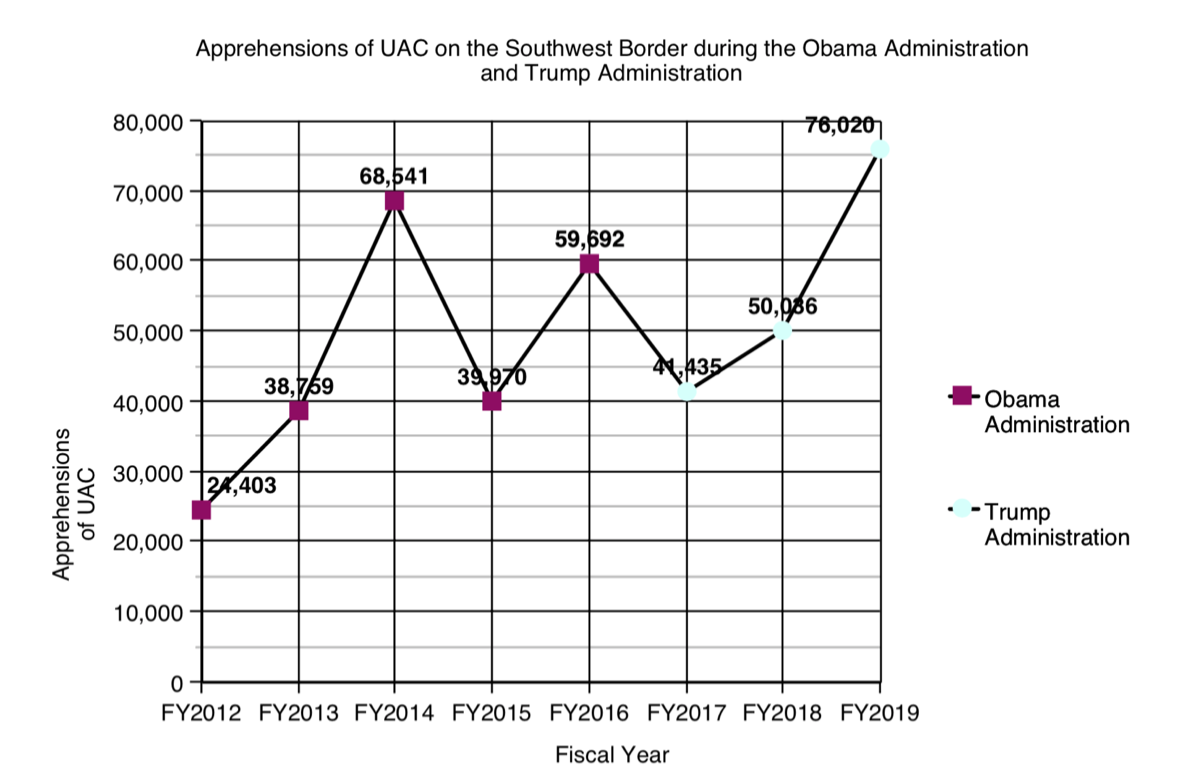
During Obama's second term, in FY2014, total apprehensions along the Southwest border reached the number of 569,237 (the figure includes "inadmissibles"), a record only surpassed now. The apprehensions soared 13% compared to FY2013, but the main increase was for UAC seizures, which surged immensely from 38,759 in FY2013 to 68,541 in FY2014, a nearly 80% increase, as well as more than four times as many UAC as in FY2011. In a year, the figure of minors from Honduras increased from 6,747 to 18,244; minors from Guatemala rose from 8,068 to 17,057, and those from El Salvador, from 5,990 to 16,404 (minors from Mexico, on the other hand, dropped from 17,240 to 15,634). Apprehensions were highest along the Southwest border in the month of May, where 17% was made up by UAC seizures.
Since FY2014, UAC apprehensions have fluctuated considerably. In FY2019, however, apprehensions of UAC reached 76,020, a level that now exceeds the peak reached in FY2014. The maximum level was registered in May; however, that month they accounted for only 9% of total apprehensions, because this time it was not properly a UAC crisis, but a remarkable peak of total apprehensions. Although overall apprehensions decreased significantly during the first six months of Trump's tenure, they rose alarmingly in FY2019, reaching a total of 851,508 (977,509 if the "inadmissibles" are added). Current data shows that seizures along the Southwest border have more than doubled from the previous FY2018. The number of overall apprehensions increased by 72% from FY2014 to FY2019 (in the case of UAC increased 11%).
 |
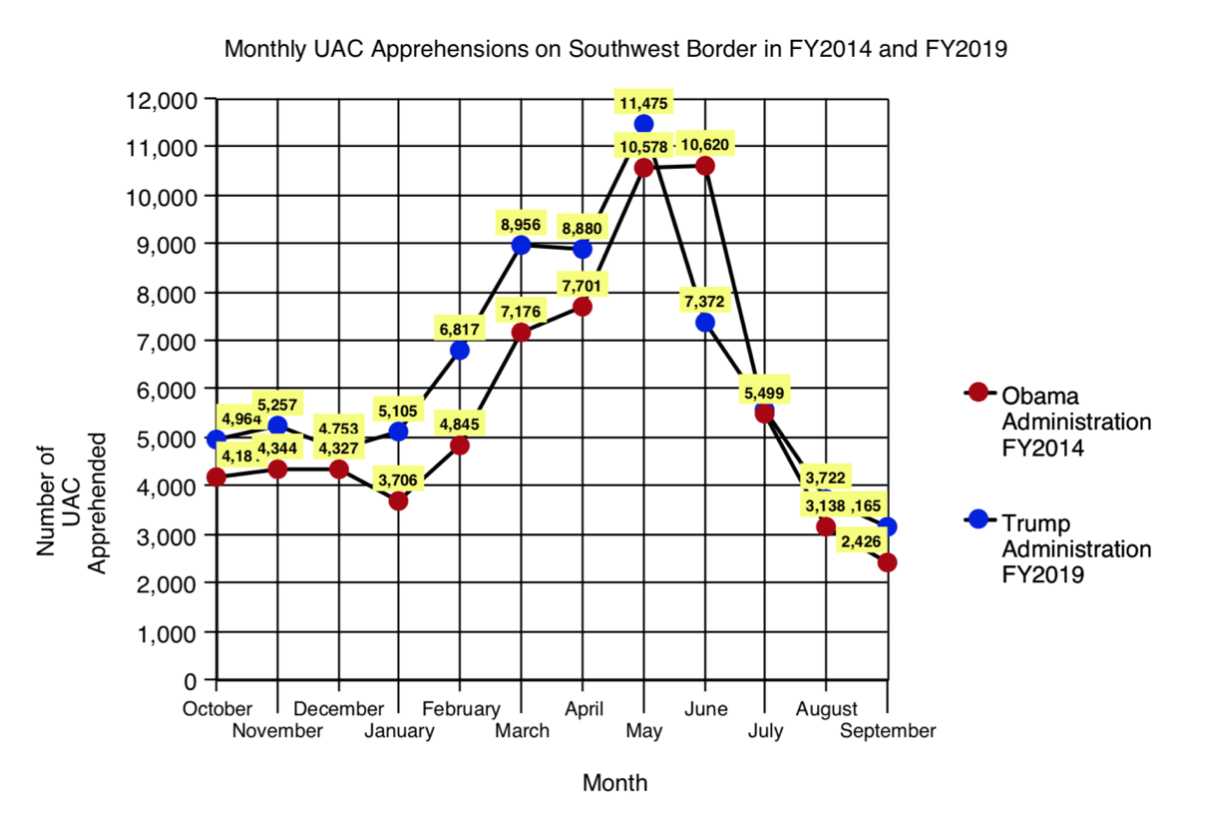 |
Apprehensions of Unaccompanied Alien Children on the US-Mexico border, between 2012 and 2019 (figure 1), and comparison between 2014 and 2019 by month (figure 2). Source: US Customs and Border Patrol.
US Policies
The US had established numerous domestic policies which dealt with the massive rise in immigration. With the overwhelming peak in 2014, however, Obama requested funding for "the repatriation and reintegration of migrants to countries in Central America and to address the root causes of migration from these countries". Though funding was fairly consistent the past years for the program, the budget for FY2018 proposed by President Trump would cut aid to these countries by approximately 30%.
While Trump's administration has made B progress in its immigration diary, from beginning the construction of the wall to enforcing new programs, the hardline policies that were promised before inauguration have thus far been unsuccessful in stopping thousands of Central American families from trekking across the Southern Border into the US. With extreme gang violence being rampant and the existence of "loopholes" in the US immigration system, the pull-factor for migrants will remain.
The avalanche of unaccompanied foreign minors suffered by the Obama Administration in 2014 has been overcome in 2019 with a new migratory peak
In the summer of 2014, the United States suffered a migration crisis due to an unexpected increase in the number of people in the country. issue of unaccompanied foreign minors, mostly Central Americans, who arrived at its border with Mexico. What has happened since then? Although oscillating, the volume of this subject Immigration prices fell, but in 2019 a new record has been recorded, hand in hand with the "caravan crisis", which has led to the rise again in total apprehensions at the border.
▲ U.S. border agents search unaccompanied minors at Texas-Mexico border in 2014 [Hector Silva, USCBP–Wikimedia Commons]
article/ Marcelina Kropiwnicka
The United States hosts more immigrants than any other country in the world, with more than a million people arriving each year, either as legal permanent residents, asylum seekers and refugees, or in other immigration categories. While there is no exact figure for how many people cross the border illegally, U.S. Customs and Border Control (U.S. Customs and Border Control) measures changes in illegal immigration based on the number of apprehensions made at the border; Such arrests serve as an indicator of the issue total number of attempts to enter the country illegally. As for the data, it can be concluded that there have been notable changes in the demographics of illegal migration at the border with Mexico (southwest border, in official U.S. terms) in recent years.
The peak of apprehensions at the U.S.-Mexico border was during 2000, when 1.64 million people were apprehended trying to enter the United States illegally. The numbers have declined, across the board, since then. In recent years, there have been more apprehensions of non-Mexicans than Mexicans at the border with the neighboring country, reflecting a decrease in issue of unauthorized Mexican immigrants who came to the U.S. in the last decade. The increase, in fact, was largely due to those fleeing violence, gang activity and poverty in Guatemala, Honduras and El Salvador, a region known as Central America's Northern Triangle.
The nations included in the Northern Triangle are among the poorest in Latin America – a high percentage of the population still lives on less than $2 a day (the international poverty line is $1.90); There has been little progress in reducing poverty in recent years. Within Latin America and the Caribbean, Honduras has the second highest percentage of the population living below the poverty line (17%), after Haiti, according to the latest data of the World Bank.
Unaccompanied Alien Minors
While fewer unaccompanied adults have attempted to cross the border without authorization over the past decade, there has instead been a surge of unaccompanied alien minors (MENAs) trying to enter the United States from Mexico. The migration of minors without accompanying adults is not new; What is new now is its volume and the need to implement policies in response to this problem. The increase in apprehensions of MENAs in FY2014 caused alarm and prompted both intense media scrutiny and the implementation of policy responses; Attention was maintained even as the phenomenon declined. The numbers dropped again to just under 40,000 apprehensions of minors the following year.
The international community defines an unaccompanied migrant minor as a person, "who is under eighteen years of age" and who is "separated from both parents and is not being cared for by an adult who by law or custom has the responsibility to do so." Many of these unaccompanied minors report immediately to U.S. border security, while others enter the country unnoticed and undocumented. Not only this, but children have no parents or legal guardians available to provide care or physical custody, which quickly overwhelms the services of local border patrols.
In 2014, many of the unaccompanied children said they were under the false impression that the Obama administration was granting "permits" to children who had relatives in the U.S., as long as they arrived no later than June. These false convictions and hoaxes were even more potent this past year, especially as President Trump continues to reinforce the idea of restricting migrants' access to the United States. The cartels have continued to transport a issue increasing number of Central American migrants from their countries to the United States.
Critical moments of 2014 and 2019
In 2014, during Obama's second term, total apprehensions along the border with Mexico reached 569,237 (this figure includes "inadmissible" people), a record only surpassed now. While the increase over the previous year was 13%, the increase was much more B regarding the arrests of MENAs; These rose from 38,759 in fiscal year 2013 to 68,541 in fiscal year 2014 (in the U.S. the fiscal year runs from October of one year to September of the next), an increase of almost 80%, more than four times those recorded in fiscal year 2011. In the case of minors from Honduras, the figure rose from 6,747 to 18,244 in one year; those of Guatemala rose from 8,068 to 17,057, and those of El Salvador, from 5,990 to 16,404 (those of Mexico, on the other hand, fell from 17,240 to 15,634). The Greatest issue The number of apprehensions occurred in May, a month in which MENA arrests accounted for 17% of total apprehensions.
Since 2014, apprehensions of unaccompanied minors, while fluctuating, have declined by issue. But in 2019 a new record has been recorded, reaching 76,020, with a maximum in the month of May. However, that month they accounted for only 9% of the total apprehensions, because this time it has not been a MENA crisis, but has been inserted into a B peak of total apprehensions. While overall apprehensions decreased significantly during the first six months of Trump's presidency, they then rose, reaching a total of 851,508 in 2019 (with the "inadmissible" the figure reached 977,509), which is more than double the number from 2018. The issue total apprehensions increased by 72% from 2014 to 2019 (in the case of MENAs the increase was 11%).
|
|
Apprehensions of unaccompanied alien minors at the U.S.-Mexico border, between 2012 and 2019 (Figure 1), and comparison of 2014 and 2019 by month (Figure 2). source: US Customs and Border Patrol.
Reaction
The U.S. had a variety of domestic policies aimed at dealing with the massive increase in immigration. However, with the overwhelming peak of 2014, Obama called for funding for a program for "the repatriation and reintegration of migrants to the countries of Central America and to address the root causes of migration from these countries." Although funding for the program has been fairly consistent over the past few years, the budget for 2018 proposed by the President Trump reduced the financial aid to these countries by approximately 30%.
The Trump Administration has made progress in implementing its diary on immigration, from the beginning of the construction of the wall on the border with Mexico to the implementation of new programs, but the hard line already promised by Trump in his degree program The U.S. government has proven ineffective in preventing thousands of Central American families from crossing the southwest border into the United States. With extreme gang violence running rampant and technicalities in the U.S. immigration system, migrants' motivation to leave their countries will remain.
[Sheila A. Smith, Japan Rearmed. The Politics of Military Power. Harvard University Press. Cambridge, 2019. 239 p.]
review / Ignacio Yárnoz
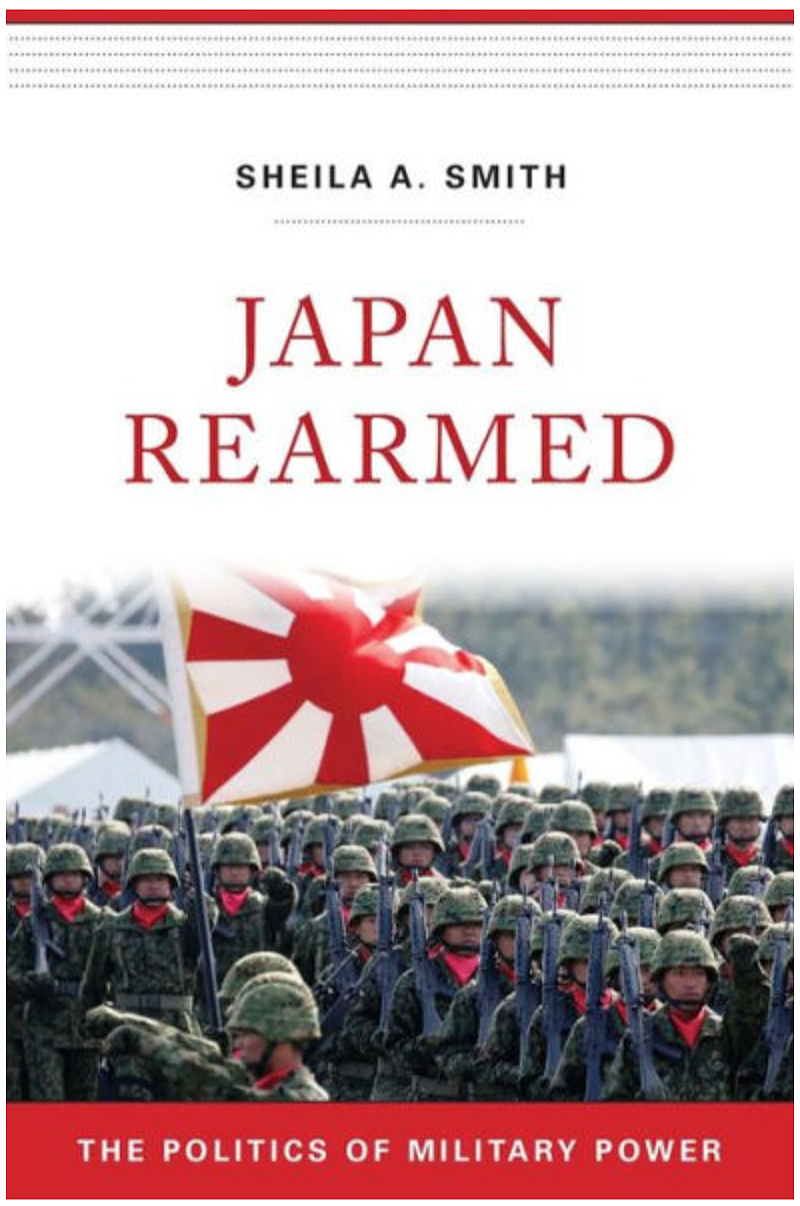 Japan is currently facing a status of sensitive national security. On the north, the country is constantly subjected to harassment by the Democratic People's Republic of Korea in the form of ballistic missile tests that often land in Japanese territorial waters. To the east and southeast, Japan's sovereignty over its territorial waters, including the disputed Senkaku Islands, is threatened by a China increasingly keen to flex its economic and military muscles.
And as if this were not enough, Japan is already questioning the security that the United States can or wants to provide in the event of a regional conflict. If in the past Japan feared being dragged into a war because of the American predisposition to use fire to solve certain situations, now what Tokyo fears is that the United States will not accompany it when it comes to defending its sovereignty.
That national security dilemma is what Japan Rearmed tackles. The Politics of Military Power, by Sheila A. Smith, a senior fellow at the Council on Foreign Relations in the United States. The book brings together the different views on this issue. The Japanese government's position is that Japan should be more confident in itself in order to maintain its own security. But this is where the biggest hurdle arises. Since its defeat in World War II and subsequent U.S. domination of the country until 1952, the national Armed Forces have been downgraded to "Self-Defense Forces." The reality is that the 1947 Constitution, specifically its article issue 9, continues to limit the functions of Japanese troops.
Introduced directly by the U.S. command, the article 9, never amended, reads: "Sincerely aspiring to an international peace based on justice and order, the Japanese people Withdrawal war as the sovereign right of the nation and the threat or use of force as a means of settling international disputes. (2) In order to carry out the wish expressed in the preceding paragraph, land, sea or air forces and any other military potential shall not be maintained in the future. The right of belligerency of the state shall not be recognized."
This article, a novelty at the time, was intended to open an era safe from warmongering tendencies, in which the project of the United Nations would be the basis for collective security and the peaceful settlement of disputes. However, history itself showed how in a matter of a few years the very architects of that Constitution called for the rearmament of Japan in the context of the Korean War; it was now too late for a rethinking of the foundational limitations of the new Japan.
Following changes in Asia's geopolitics over the past 30 years after the end of the Cold War, Japan has taken steps to regain its international presence, but even today it continues to stumble under the constraint of its constitution. As Smith rightly describes, there are many legal hurdles that the Japan Self-Defense Forces have had to overcome since 1945. Issues such as Japan's performance abroad under the flag of the United Nations, its absence from the 1st Gulf War, the discussion The debate on resilience after an attack by North Korea or Japan's performance in the 2nd Gulf War are all discussed and analyzed in this book. In addition to this, the author tries to explain the reasons and arguments in each of the debates concerning the article 9, such as self-defense, the role of the Self-Defense Forces and the relationship with the United States, issues that confront the Japanese political elite. Several generations of political leaders have tried to resolve the dilemma of guaranteeing Japan's security and interests without limiting the capabilities of its armed forces, although so far there has been no consensus to change certain constitutional budgets, in the direction in which Prime Minister Shinzo Abe is pushing.
Japan rearmed is a 360 review Degrees where the reader finds a complete analysis of the main obstacles faced by the Japan Self-Defense Forces and what their role may be. development future. In a framework More broadly, the book also addresses the role of the Armed Forces in a democracy, which must reconcile its rejection of violence with the obligation to guarantee collective defense.
[Glen E. Howard and Matthew Czekaj (Editors), Russia's military strategy and doctrine. The Jamestown Foundation. Washington DC, 2019. 444 pages]
REVIEW / Angel Martos Sáez
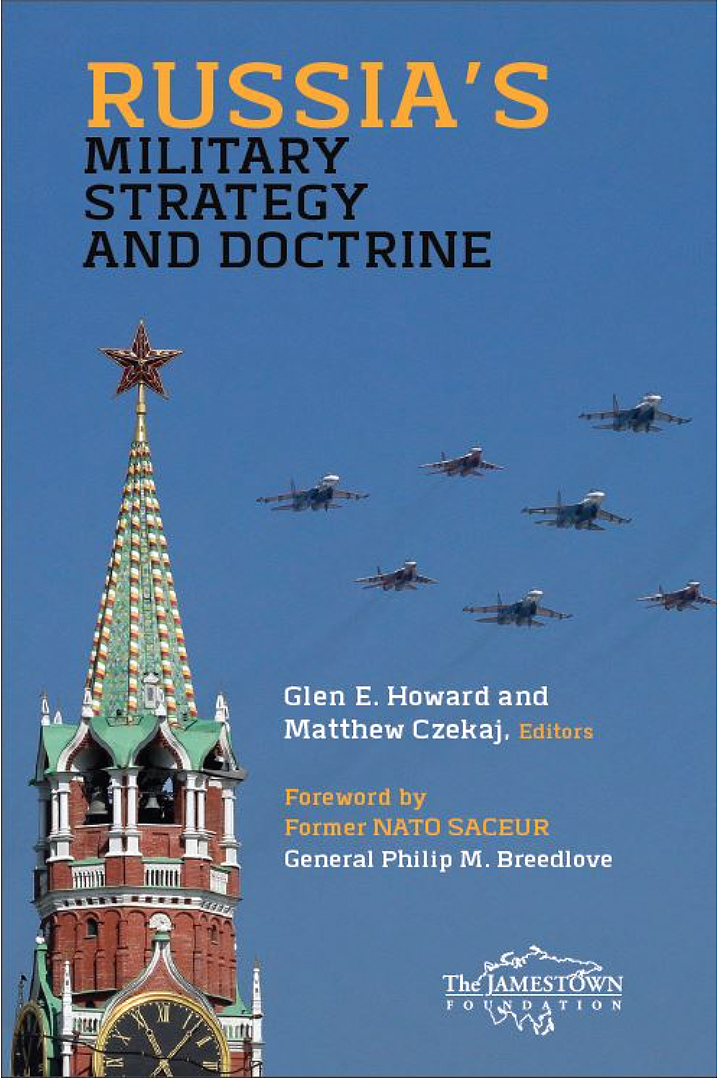 |
This exemplar acts as an answer and a guide for Western policymakers to the quandary that 21st century Russia is posing in the international arena. Western leaders, after the annexation of Crimea in February-March 2014 and the subsequent invasion of Eastern Ukraine, are struggling to come up with a definition of the aggressive strategy that Vladimir Putin's Russia is carrying out. Non-linear warfare, limited war, or "hybrid warfare" are some of the terms coined to give a name to Russia's operations below the threshold of war.
The work is divided in three sections. The first one focuses on the "geographic vectors of Russia's strategy". The authors here study the six main geographical areas in which a clear pattern has been recognized along Russia's operations: The Middle East, the Black Sea, the Mediterranean Sea, the Arctic, the Far East and the Baltic Sea.
The chapter studying Russia's strategy towards the Middle East is heavily focused on the Syrian Civil War. Russian post-USSR foreign-policymakers have realized how precious political stability in the Levant is for safeguarding their geostrategic interests. Access to warm waters of the Mediterranean or Black Sea through the Turkish straits are of key relevance, as well as securing the Tartus naval base, although to a lesser extent. A brilliant Russian military analyst, Pavel Felgenhauer, famous for his predictions about how Russia would go to war against Georgia for Abkhazia and South Ossetia in 2008, takes us deep into the gist of Putin's will to keep good relations with Bashar al-Assad's regime. Fighting at the same time Islamic terrorism and other Western-supported insurgent militias.
The Black and Mediterranean Seas areas are covered by a retired admiral of the Ukrainian Navy, Ihor Kabanenko. These two regions are merged together in one chapter because gaining access to the Ocean through warm waters is the priority for Russian leaders, be it through their "internal lake" as they like to call the Black Sea, or the Mediterranean alone. The author focuses heavily on the planning that the Federation has followed, starting with the occupation of Crimea to the utilization of area denial weaponry (A2/AD) to restrict access to the areas.
The third chapter concerning the Russia's guideline followed in the Arctic and the Far East is far more pessimistic than the formers. Pavel K. Baev stresses the crucial mistakes that the country has done in militarizing the Northern Sea Route region to monopolize the natural resource exploitation. This tool, however, has worked as a boomerang making it harder for Russia nowadays to make profit around this area. Regarding the Far East and its main threats (North Korea and China), Russia was expected a more mature stance towards these nuclear powers, other than trying to align its interests to theirs and loosing several opportunities of taking economic advantage of their projects.
Swedish defense ministry advisor Jörgen Elfving points out that the BSR (acronym for Baltic Sea Region) is of crucial relevance for Russia. The Federation's strategy is mainly based on the prevention, through all the means possible, of Sweden and Finland joining the North Atlantic Alliance (NATO). Putin has stressed out several times his mistrust on this organization, stating that Western policymakers haven't kept the promise of not extending the Alliance further Eastwards than the former German Democratic Republic's Western border. Although Russia has the military capabilities, another de facto invasion is not likely to be seen in the BSR, not even in the Baltic republics. Instead, public diplomacy campaigns towards shifting foreign public perception of Russia, the funding of Eurosceptic political parties, and most importantly taking advantage of the commercial ties (oil and natural gas) between Scandinavian countries, the Baltic republics and Russia is far more likely (and already happening).
The second section of this book continues with the task of defining precisely and enumerating the non-conventional elements that are used to carry out the strategy and doctrine followed by Russia. Jānis Bērziņš gives body to the "New Generation Warfare" doctrine, according to him a more exact term than "hybrid" warfare. The author stresses out the conscience that Russian leaders have of being the "weak party" in their war with NATO, and how they therefore work on aligning "the minds of the peoples" (the public opinion) to their goals in order to overcome the handicap they have. An "asymmetric warfare" under the threshold of total war is always preferred by them.
Chapters six and seven go deep into the nuclear weaponry that Russia might possess, its history, and how it shapes the country's policy, strategy, and doctrine. There is a reference to the turbulent years in which Gorbachev and Reagan signed several Non-Proliferation Treaties to avoid total destruction, influenced by the MAD doctrine of the time. It also studies the Intermediate-Range Nuclear Forces (IMF) Treaty and how current leaders of both countries (Presidents Trump and Putin) are withdrawing from the treaty amid non-compliance of one another. Event that has sparked past strategic tensions between the two powers.
Russian researcher Sergey Sukhankin gives us an insight on the Federation's use of information security, tracing the current customs and methods back to the Soviet times, since according to him not much has changed in Russian practices. Using data in an unscrupulously malevolent way doesn't suppose a problem for Russian current policymakers, he says. So much so that it is usually hard for "the West" to predict what Russia is going to do next, or what cyberattack it is going to perpetrate.
To conclude, the third section covers the lessons learned and the domestic implications that have followed Russia's adventures in foreign conflicts, such as the one in Ukraine (mainly in Donbas) and in Syria. The involvement in each one is different since the parties which the Kremlin supported are opposed in essence: Moscow fought for subversion in Eastern Ukraine but for governmental stability in Syria. Russian military expert Roger N. McDermott and analyst Dima Adamsky give us a brief synthesis of what experiences Russian policymakers have gained after these events in Chapters nine and eleven.
The last chapter wraps up all the research talking about the concept of mass mobilization and how it has returned to the Federation's politics, both domestically and in the foreign arena. Although we don't exactly know if the majority of the national people supports this stance, it is clear that this country is showing the world that it is ready for war in this 21st century. And this guide is here to be a reference for US and NATO defense strategists, to help overcome the military and security challenges that the Russian Federation is posing to the international community.
Some U.S. and Canadian diplomats who were in Havana between 2016 and 2018 are still not fully recovered from ailments they suffered
![U.S. Embassy building in Cuba [department de Estado] [ de Estado]](/documents/10174/16849987/ataques-sonicos-blog.jpg "U.S. Embassy building in Cuba [department de Estado] [ de Estado]")
▲ Building of the U.S. Embassy in Cuba [department de Estado].
ANALYSIS / Eduardo Villa Corta
Three years ago, staff U.S. diplomats stationed in Cuba began to feel physical discomfort supposedly caused by strange sounds to which they had apparently been exposed; Washington spoke of a "sonic attack. However, although the symptoms suffered by those affected have been determined to be anomalous, it has not been possible to establish what caused them. Was it really an attack? Who was behind it? We review here the main hypotheses and conjectures that have been made, and point out their weaknesses.
In late 2016 and early 2017, several U.S. diplomats stationed in Havana, as well as members of their families, reported suffering from dizziness, vertigo and sharp pains in their ears that could be caused by strange sounds to which they had been exposed. According to their testimonies, the sounds came from a specific direction, and they had heard them in their own residences or, in some cases, in hotel rooms, while people staying in neighboring houses or adjoining rooms had not heard any special sounds. The phenomenon also affected Canadian diplomats in the Cuban capital. In all, some forty people were treated for these symptoms.
Acoustic attack
Echoing the facts reported by its staff in Cuba, in mid-2017 the U.S. State department stated that the symptoms could have been caused by a sonic attack by the Cuban government directed against diplomats and their families. In October 2017, President Donald Trump directly accused Havana: "I believe Cuba is manager; yes, I do."
At the beginning of 2018 the department of State issued a statement alert not to travel to Cuba due to a possible health crisis and withdrew a good part of the staff of the mission statement diplomatic in Havana, reducing the activity of this to the minimum possible. At that time, a total of 24 Americans had been affected.
At the time, the Canadian government also indicated that its diplomats had experienced similar discomfort. Ottawa decided to evacuate the families of its employees in Cuba and in early 2019 proceeded to reduce the staff of the embassy in the face of what appeared to be the appearance of a fourteenth case.
The Cuban government denied from the outset being involved in any harassment operation against the U.S. or Canada. ˝There is no test about the cause of the reported ailments, nor is there any evidence to suggest that these health problems have been caused by an attack of any kind˝, Havana assured. Raul Castro's government offered its cooperation in the research of the facts, with nothing coming to light that could explain the case. No devices that could have provoked the sounds appeared.
Adding confusion to the status, at least two US diplomats stationed in China, busy at the consulate general in Guangzhou, the largest that the US has in the country, presented in early 2018 also the symptoms already described. Washington evacuated them and issued a health warning about missions in mainland China.
The Associated Press published in October 2017 a recording of the alleged sounds causing the reported ailment, and indicated that government agencies had been unable to determine the nature of the noise and explain its relationship to the bodily disorders caused. Months later, he noted that internal FBI reports did not even establish that there had been an "attack". Other media highlighted the poor cooperation in the research, due to jurisdictional zeal, between the department of State, the FBI and the CIA.
Symptoms of "Havana syndrome".
A medical team from the University of Pennsylvania, at the request of the U.S. Government, examined 21 people affected by what the press began to call "Havana syndrome". The research, initially published in March 2018 in the Journal of the American Medical Association (JAMA), indicated that most of the patients reported problems with report, concentration, and balance, and determined that they appeared to have suffered injuries to extensive brain networks.
data Further MRI scans of the same team extended to 40 patients, released in July 2019, led to the conclusion that the diplomats had experienced some craniocerebral trauma. The results of the MRI scans, compared with those of a group of healthy people, showed differences in the volume of the white and gray substances of the brain, in the integrity of the cerebellar microstructures and in the functional connectivity of the subnetworks for hearing and spatial vision, but not for executive functions.
This report concluded that the staff diplomat had been physically injured, although it could not determine the cause. He also noted that patients do not experience a usual recovery, as they are not recovering quickly from symptoms, as is the case in other cases of similar "concussions" or ear problems.
IF IT WASN'T AN ATTACK, WHAT WAS IT?
As no clear cause has been established as to what caused the ailments suffered by the US and Canadian diplomatic staff and some members of their families, the very reality of an attack has been called into question. Although various alternative explanations have been put forward, none of them are fully convincing.
1) Collective hysteria
Formulation. Some neurologists and sociologists, such as Robert Bartholomew, have suggested that it could be a case of mass hysteria. Given the pressure to which some of the diplomats working in very unfriendly environments are subjected, and the endogamic relationship in which they live, living almost exclusively among themselves, it could explain a mutual conviction of an external attack that even has somatic consequences.
Weak spot. Both the research of the University of Pennsylvania and the doctor of the department of State, Charles Rosenfarb, who appeared before the committee of Foreign Relations of the Senate, came to rule out that the symptoms suffered by the diplomats were due to a mere mental mechanism. It is very difficult that about sixty people, including Americans and Canadians, convinced each other of an aggression of this kind subject and then almost all of them developed the same brain lesions.
2) Microwave
Formulation. The researcher team at the University of Pennsylvania, while not pointing to any possible cause of the ailments, did not rule out certain assumptions, such as that of microwave affectation. This aspect was insisted upon by a research published in 2018 in the journal Neural Computation, which considered the symptoms consistent with exhibition to electromagnetic microwave (RF/MW) radiation.
Weak point. Not all the symptoms shown by patients could be a consequence of the exhibition of such a radiation subject, which also has a diverging literature on its effects on the human body. In addition, there is no known microwave weapon that can affect the brain.
3) Ultrasound
Formulation. A team of computer experts at the University of Michigan suggested in 2018 that it could be a case of exhibition to some subject ultrasound, perhaps coming from malfunctioning listening equipment mixing multiple ultrasonic signals.
Weak point. The recording of one of the sound episodes - the sample broadcast by AP - is not sufficient to be able to determine its nature. It is also possible that the sound was somewhat different in other cases.
4) Crickets
Formulation. A research from the Universities of California-Berkeley and Lincoln, from the existing sound sample , considered in January 2019 that the possible cause of the attacks was made by cricketsThe study, specifically crickets Anurogryllus muticus. The research was a comparative study between the sound emitted by that variant of crickets and the sample of one of the Havana acoustic episodes.
Weak point. The sound perceived by the diplomats was directional, so it was not heard by neighboring people. If they had been crickets in their natural environment, the sound would have spread around.
5) Neurotoxins
Formulation. A joint study by two Canadian research centers in May 2019 attributed the symptoms suffered by diplomats to exhibition to neurotoxins from pesticides used to spray mosquitoes, a internship common occurrence in embassy buildings.
Weak point. The diplomats affected related the beginning of their physical discomfort to situations experienced in their own residences or in hotel rooms, where there was no fumigation.
IF IT WAS AN ATTACK, WHO DID IT?
Given that the previous explanations do not seem entirely solid, the US Government maintains the hypothesis of an attack. If it really happened, who was behind it? Here, too, there are various conjectures.
1) Castro regime
The first option considered, assumed in principle by the US given the public accusations made from Washington, has been to attribute the alleged attacks to the Cuban regime itself. With them, Havana would try to maintain pressure on the Americans, in spite of the formal reestablishment of diplomatic relations, with the goal to mark each other's territory.
Weak point. The incidents began to occur during the Obama Administration, in a context of a ˝honeymoon˝ marked by the reopening of embassies and the visit of Barack Obama to Havana. The normal thing is that at the end of 2016, in view of the U.S. elections, the Castro regime would not want to give reasons to the next U.S. president to twist the diplomatic line opened by Obama. It could make sense that after Donald Tump's later revocation of the previous openness measures, Cuba would want to punish the new Administration, but not before seeing the direction it would take; in any case, the attacks would only justify the hard line followed by Trump, which does not benefit the island.
2) A sector of Castroism
Fidel Castro was attributed with an unaccommodating attitude towards his brother Raul's decision to reestablish diplomatic relations with the United States. Although he died in November 2016, people around him might have tried to torpedo that rapprochement, convinced that hostility with Washington was the best way to ensure the survival of the regime as conceived by its founder.
Weak point. Although Fidel Castro's reluctance towards rapprochement with the U.S. is true, it is difficult to think that the most conservative sector within Castroism would dare to boycott so directly Raul Castro's fundamental political line. It is another thing that, after he handed over the presidency of Cuba to Miguel Díaz-Canel in April 2018, some sectors within the regime could make internal movements to send certain messages, but the changeover occurred when most of the acoustic episodes had already taken place.
3) A third country (Russia, China)
The third option would be that a third country generated the attacks. American intelligence indicates that the most viable option in this case would be Russia. Moscow has been keen to return to operating in the Caribbean, as in the Cold War, and aggression against U.S. diplomats in Cuba would fit in with its strategy. It has also been suggested that China might want to repay Washington in its backyard with the same harassment that the Chinese believe they feel from the US in their nearest seas.
Weak point. The return of Russia to the Caribbean is certainly documented, and it is conceivable that Moscow could have promoted a punctual action against some specific goal , but it seems difficult that it would have sustained over time an operation that harms Cuba's sovereignty. As for China's presence in the US neighborhood, it is a less confrontational move than the one carried out by Russia. Moreover, if Beijing had chosen foreign soil in order to better erase the traces of an action against US diplomats, then the cases recorded in Guangzhou would not have occurred.
With its mega-city and technology zone project , the Saudis are seeking to consolidate an economic alternative to oil.
NEOM, an acronym for New Future, is the name of the new economic-technological city and area , with an area three times the size of Cyprus, which Saudi Arabia is promoting in the north-west of the country, opposite the Sinai Peninsula. In addition to seeking alternatives to oil, with NEOM the Saudis aim to rival the urban innovations of Dubai, Abu Dhabi and Doha. The project also involves shifting Saudi interest from the Persian Gulf to the Red Sea and closer neighbourhoods with Egypt, Jordan and Israel.
![The future NEOM megacity, from agreement with the vision of its promoters [NEOM Project].](/documents/10174/16849987/neom-blog.jpg "The future NEOM megacity, from agreement with the vision of its promoters [NEOM Project].")
▲ The appearance of the future NEOM megacity, from agreement with the vision of its promoters [NEOM Project].
article / Sebastián Bruzzone Martínez
Middle Eastern states are seeking to diversify their revenues and avoid potential collapse of their economies in order to counteract the end-of-oil crisis expected in the mid-21st century. Arabs' preferred sectors are renewable energy, luxury tourism, modern infrastructure and technology. Governments in the region have found ways to unify these four sectors, and Saudi Arabia, along with the United Arab Emirates, seems to want to position itself at the forefront of the Arab technology degree program .
While the world looks towards Sillicon Valley in California, Shenzhen in China or Bangalore in India, the Saudi government has begun preparations for the creation of its first independent economic and technological zone: NEOM (short for the Arabic term Neo-Mustaqbal, New Future). The project was until recently headed by Klaus Kleinfeld, former CEO of Siemens AG, who has been replaced by Nadhmi Al Nasr as CEO of NEOM since his appointment as an advisor to the Saudi Crown.
On 24 October 2017, at the Future Investment Initiative lecture in Riyadh, Saudi Crown Prince Mohammed bin Salman announced the $500 billionproject , part of the Saudi Vision 2030 policy programme. average The territory where NEOM will be located is in the border area between Saudi Arabia, Egypt and Jordan, on the shores of the Red Sea, through which almost ten percent of world trade flows, has a temperature 10ºC lower than that of the rest of the countries of the Gulf Cooperation committee , and is located less than eight hours' flight from 70% of the world's population, so it could become a major passenger transport hub.
As announced by the Saudi government, NEOM will be a special economic city, with its own civil and tax laws and Western social customs, covering 26,500 square kilometres (the size of Cyprus multiplied by three). The main objectives are to attract foreign investment from multinational companies, diversify the oil-dependent Saudi Economics , create a free market space and home to millionaires, "a land for free and stress-free people; a start-up the size of a country: a blank sheet of paper on which to write the new era of human progress", says a promotional video on project. All this under the slogan: "The world's most ambitious project: an entire new land, purpose-built for a new way of living". According to the website and official accounts of project, the 16 sectors of energy, mobility, water, biotechnology, food, manufacturing, communication, entertainment and fashion, technology, tourism, sport, services, health and wellness, Education, and livability will generate 100 billion dollars a year.
Thanks to a report published by The Wall Street Journal and prepared by the consulting firms Oliver Wyman, Boston Consulting Group and McKinsey & Co., which, according to them, had access to more than 2,300 confidential planning documents, some of the ambitions and luxuries that the futuristic city will have have have have come to light. These include flying cars, holograms, a Jurassic Park-style robot dinosaur theme park and edition Genetics , never-before-seen technologies and infrastructure, luxury hotels, resorts and restaurants, cloud-creating mechanisms to cause rainfall in arid areas, glow-in-the-dark sandy beaches, and even an artificial moon.
Another aim of project is to make NEOM the safest city on the planet, through state-of-the-art surveillance systems including drones, automated cameras, facial and biometric recognition machines and AI capable of reporting crimes without the need for citizens to report them. Similarly, the leaders of the urban development initiative themselves predict that the city will be an ecological centre of great projection, basing its power supply system solely on solar and wind energy obtained from panels and windmills, as they have a whole desert to install them in.
At the moment, NEOM is only a project in its infancy. The land on which the big city will be located is a desert terrain, mountains up to 2,500 metres high and 468 kilometres of pristine coastline of turquoise blue water, with a palace and a small airport. NEOM is being built from scratch, with an initial outlay of $9 billion from the Saudi Arabian sovereign wealth fund Saudi Arabia Monetary Authority (SAMA). Apart from foreign business investment, the Saudi government is looking for workers from all professional sectors to help in their respective fields: Jurists to draft a civil, criminal and tax code; engineers and architects to design a modern, efficient and technological infrastructure and energy plan; diplomats to collaborate in its promotion and cultural coexistence; scientists and doctors to encourage clinical and biotechnological research and welfare; academics to promote Education; economists to make income and expenditure profitable; personalities specialising in tourism, fashion and telecommunications... But, above all, people and families to inhabit and give life to the city.
As reported by the Arabic daily Rai Al Youm, Mohammed bin Salman has C a proposal prepared by a joint Saudi legal committee with the UK, which consists of providing a VIP document that will offer special visas, residency programrights to investors, senior officials and workers in the future city. Contracts business have already been awarded to the US engineering firm Aecom and construction contracts to the UK's Arup Group, Canada's WSP, and the Netherlands' Fugro NV.
However, not everything is as ideal and straightforward as it seems. Despite the strong interest of 400 foreign companies in project, according to the local government, there is uncertainty about its profitability. Problems and scandals related to the Saudi crown, such as the imprisonment of family members and dissidents, corruption, unequal rights, the military intervention in Yemen, the case of the murder of journalist Khashoggi and the possible political crisis following the future death of King Salman bin Abdulaziz, Mohammed's father, have caused investors to tread carefully. Moreover, in the region where the city is to be built there are villages of locals who would be relocated, and "compensated and supported by social programmes", according to the Saudi government, which will be criticised by human rights groups.
In conclusion, NEOM is a unique project and a match for the Arab sheikhs themselves, who have adopted a far-sighted economic vision. It is expected that by 2030 it will be possible to live in the city, even if construction is still underway and not yet fully completed. According to the markets, the project, still far from completion, seems to be on track. It already has a structural financing commitment with BlackStone of 20 billion euros, and a technology financing commitment with SoftBank of 45 billion euros. Because such a project has never been seen before and therefore there are no references, it is difficult to determine whether the visionary plan will be successfully consolidated or whether it will remain just smoke and mirrors and a huge loss of money.