
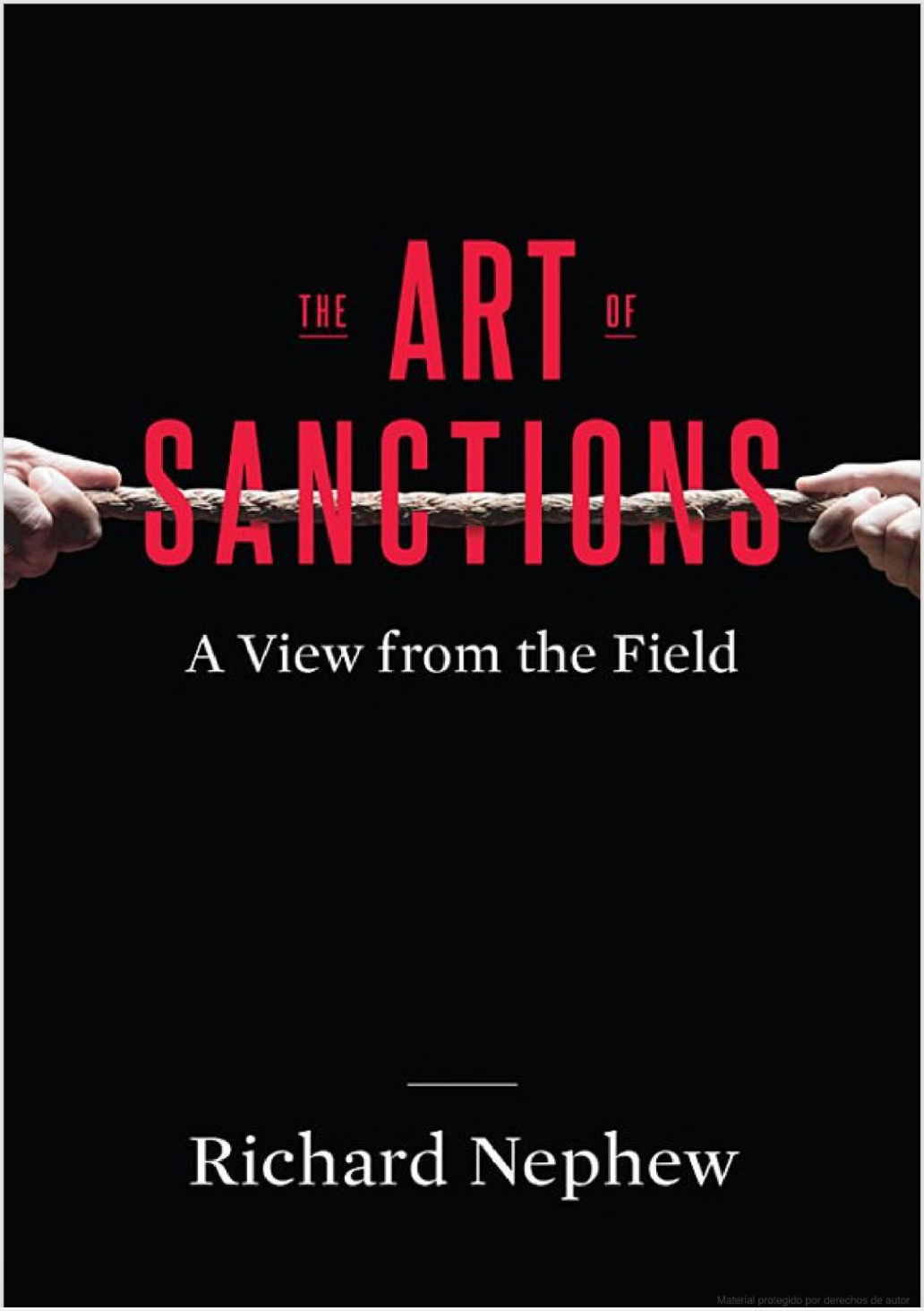
[Richard Nephew, The Art of Sanctions. A View from the Field. Columbia University Press. Chichester. New York, 2018. 216 p.]
review / Emili J. Blasco
 |
International sanctions often arouse a lively discussion between those who defend them as a legitimate instrument of interaction between States and those who consider that their application has hardly been more effective than that of increasing the suffering of entire populations through no fault of their own.
To the question of whether these sanctions, which can be of various kinds but are mainly of an economic nature, are of any use, Richard Nephew replies that it depends. And it is not an evasion, but in the end the defense of his own tools by a mechanic of American diplomacy (Nephew was director for Iran in the committee National Security Agency and Deputy Coordinator for Sanctions of the department "Sanctions do not fail or succeed. Rather, sanctions help or do not help to achieve the desired result the end of a sanctioning state (...) Tools can only perform well when they are used with the right strategy; The saw cannot be blamed if it fails to perform the work of a screwdriver."
Nephew is not a sanctions theorist, but a "practitioner"; the content of his book comes from experience ("A View from the Field" is the subtitle of the work). That experience makes him convinced of the usefulness of such measures provided that they are properly implemented. Basically, he gives the example of two cases: that of Iraq, where sanctions did not achieve the goal sought due to a misguided approach to international pressure, which finally led to war in 2003, and that of Iran, where the regime of punitive measures on the Islamic Republic had its effect and in 2015 a treaty was signed. agreement to curb Iran's nuclear program.
An active participant in the Iran sanctions architecture, Nephew expands especially on the case of the negotiations with Tehran, after first briefly addressing the Iraq chapter. From all this, it draws conclusions and presents its own decalogues on how sanctions must be addressed in order to be effective. In the last pages, he tries to advise on how to conduct a new package of sanctions on Iran, to control its missile program and contain its activity abroad through proxies, but without breaking the agreement achieved (JCPOA) as the Trump Administration has done; how to manage the pressure on Russia in relation to Ukraine, and how to confront North Korea's attitude. It does not address situations other than the discussion on sanctions, such as Trump's harshness towards Cuba, in the framework of a decades-long embargo that has produced no changes on the island, or the siege on Nicolás Maduro in Venezuela.
Rules for Successful Sanctioning
Nephew's main conclusion is that "the knowledge of one's opponent, their tolerances and vulnerabilities, is the most important predictor about the chances of success of a strategy that focuses on sanctions. In fact, for sanctions to work, one really has to know the enemy better than the enemy knows himself."
That's what, in his opinion, went wrong in Iraq. Sanctions were certainly effective, in that they prevented Saddam Hussein from returning to a weapons of mass destruction program, but they did not prevent war. And this is because the psychology of the president, who was ready for anything, was not taken into account subject of suffering – which he passed on to the population, without fear that they could take power away from him – rather than admit that he did not have the powerful arsenal that supposedly elevated him among the regional leaders. The international community did not understand how important it was for him to maintain this pretense, in his pretense of credibility and prestige, above the pressure of any package of sanctions.
In addition, there were other shortcomings in the Iraqi process, according to Nephew: maximum sanctions were applied from the beginning, with no room for an incremental policy, and over time there was a variation in the goal, going from wanting to prevent the rearmament of the regime to proposing a change of the regime itself (even if Saddam Hussein had accepted the conditions put before him, Washington would not have admitted his continuation in power).
Those errors led to a greater understanding of the mechanisms at play, which were refined in the attention with Iran. Mr. Nephew said that in order to get to know the country subject to potential sanctions, one should take into account its political institutions, its macroeconomic and financial system, its trade relations, its cultural values, its recent history, its demographics and the population's access to external sources of information. This will make it possible to identify the vulnerabilities and the pain threshold that the government of the day is willing to absorb. Therefore, both the sanctions and the assumptions themselves must be continuously recalibrated, following a well-defined strategy. It is also important that the State targeted by the sanctions be clearly presented with the conditions necessary for the pressure to be lifted, in the context of the framework of a negotiation of clear terms. Finally, we must be willing to help the state that is pressuring itself to get out of a labyrinth whose way out it may not perceive, or even to accept lower goals if these are a problem. result also reasonable.
The author states that the three most common causes of the failure of a sanctions regime are: falling short, overdoing it, and confusing objectives. These labels can easily be applied to past processes, but it is not so simple to fix the steps of a coercive diplomacy of this one. subject in ongoing conflicts or that may occur in the future.
Thus, Nephew himself would not have full guarantees of success with the sanctions he suggests for a new negotiation with Iran in order to limit its missile program and its action through groups such as Hezbollah. At odds with the Trump Administration, he would have preferred to keep the agreement on the 2015 nuclear program (known by its acronym JCPOA) and the consequent lifting of the previously applied sanctions regime, to move on to other sanctions that seek that other goal. It is true that the usefulness of Trump's move remains to be seen, but it is hard to believe that Tehran will renounce these other actions because of pressure that would in no case be so international (China and Russia only lent themselves to a front against Iran because it was at stake that this country would become a nuclear power).
By blocking some candidates, the European Parliament seeks the prominence denied by the failure of the proclamation of the Spitzenkandidat
![Ursula von der Leyen, at the plenary session of the European Parliament in which she defended her candidacy [European Commission]](/documents/10174/16849987/comision-europea-blog.jpg "Ursula von der Leyen, at the plenary session of the European Parliament in which she defended her candidacy [European Commission]")
▲ Ursula von der Leyen, at the plenary session of the European Parliament in which she defended her candidacy [European Commission]
ANALYSIS / Jokin de Carlos
In 1963, the Elysée Treaty was signed between President Charles de Gaulle and Chancellor Konrad Adenauer, ending centuries of Franco-German rivalry and beginning the friendship between the two countries. Over the next few decades, France and Germany, as the leading economies of the Union, would largely mark the diary political and economic. Even in times of crisis, both leading countries avoided giving an image of confrontation.
However, after the European elections last May, there was a public tussle between Berlin and Paris over who should replace Jean-Claude Juncker as head of the European Commission. On the one hand, led by Angela Merkel, there were those leaders who defended the nomination of the Bavarian Manfred Weber, Spitzenkandidat of the European People's Party, made up of conservative formations; on the other hand, led by Emmanuel Macron, there were those who, of liberal or social democratic tendencies, opposed this nomination in preference to the Dutchman Frans Timmermans or the Danish Margrathe Vestager.
After weeks of negotiation and diplomatic tension, Weber's candidacy was withdrawn, in part because of Merkel's political weakness in Germany and the momentary defenestration of Sebastian Kurz in Austria due to Ibizagate. But the position it was not for Vestager or Timmermans but for Ursula von der Leyen, Germany's defense minister and Merkel's Christian Democrat colleague, originally from Hanover and from an aristocratic family.
And so ends the summer of our discontent, with this Hanoverian sun.
Election
One of the main problems facing the new president of the Commission is going to be how to achieve consensus among the leaders in the committee and between parties in Parliament.
Von der Leyen was unanimously elected in the committee, however, his election to the European Parliament was the closest in history, with only nine votes above the required majority. This vote had several surprises, such as the favorable vote of the Italian 5-Star Movement or the Polish PiS and the rejection of the SPD or the totality of the Greens.
Composition of the Commission
On 9 September, von der Leyen announced her nominees for the new Commission, which is made up of 28 members in the 28 member countries, although the United Kingdom Withdrawal to have a site for its scheduled departure from the Union on October 31.
The von der Leyen Commission has been organised in the form of pillars, each led by a Vice-President and composed of one or more Commissioners with specific portfolios. There are five pillars: (a) agreement European Green, which will cover topics such as energy, transport and agriculture; (b) a Europe ready for the digital age, for issues such as innovation and skill; (c) protecting our European way of life, which will encompass the areas of immigration and security; (d) one Economics to work for the people, destined for commerce, work and finance, and (e) a strong Europe in the world, which will include issues such as international relations or crisis management.
For the composition of this Commission, von der Leyen has tried to integrate two of the Spitzenkandidat who were discarded for the presidency. Socialist Frans Timmermans, a former Dutch deputy prime minister, will remain as vice-president and lead the pillar of the agreement the European Greens, while the liberal Margrethe Vestager, former Danish Deputy Prime Minister, having been Commissioner for skill in the previous Commission, he will lead the pillar of A Europe Ready for the Digital Age. These are two of the most popular Commissioners in the Juncker Commission; in the case of Vestager for her fight against tax evasion by several large American technology companies, such as Google, Amazon or Apple.
Of the rest of the vice-presidents, three will head the other three pillars: the new High Representative of the Union Josep Borrell, former Spanish minister in several portfolios and former president of the European Parliament, will lead A Strong Europe in the World; Christian Democrat and former Latvian premier Valdis Dombrovskis will lead the economic pillar, and Greek conservative Margaritis Schinas will lead the pillar of protecting the European way of life.
Three other vice-presidencies, with smaller areas, will go to the Czech Republic's Verá Jorubá (Values and Transparency), Slovakia's Maroš Šefčovič (Interinstitutional Relations) and Croatia's Dubravka Šuica (Democracy and Demography).
Among the nominees for commissioners are prestigious people who have held important positions in their respective countries, as well as in previous European commissions: Paolo Gentiloni, former Italian premier, will be commissioner of Economics, and Didier Reynders, former Minister of Defence, Finance and Foreign Affairs in Belgium, will be in charge of Justice.
Analysis
There are two characteristics that can be highlighted about this Commission proposal: (1) The first is its more political character and (2) the second is a marked Francophilia.
(1) On previous occasions the commissioners used to show a profile and in many cases a preference for staying in the shadows. In a way, they could have been considered the secretariat of the committee European. However, the selection made by Von der Leyen seems to want to put an end to this tradition, by opting for more well-known names. Thus, Gentiloni or Dombrovskis have previously governed their countries, while others such as Vestager, Timmermans or Reynders have had a certain previous prominence. It seems that the interest of EU politicians is no longer so much to create the European Federation as soon as possible as to bring Brussels closer to the people. Whether this strategy works or not, time will tell.
(2) The second characteristic of this new Commission is a clear pro-French direction, to the satisfaction of Emmanuel Macron. Many of the members of the Commission are political allies of the French President; the clearest is the case of Ursula von der Leyen herself, despite having been part of Merkel's cabinet and being a co-religionist of hers. It should be remembered that it was Macron who proposed it for the position after the veto of Weber, who was the candidate Merkel's initial. But that's not all. Both Timmermans and Vestager are political allies of Macron (Vestager had been his first choice to chair the Commission). Josep Borrell is also a well-known Francophile, and Didier Reynerds is a French-speaking Belgian whose party is allied with Macron's, as is the Italian commissioner Paolo Gentiloni. So this is a mostly Francophile Commission, which could increase Macron's weight on the Union and advance his vision of Europe.
Outside the Commission, the other officials nominated by the committee They were Christine Lagarde, a former French finance minister, who has stepped down from leading the IMF to head the European Central Bank, and Charles Michell, the French-speaking prime minister of Belgium and Macron's liberal colleague, the new president of the European Central Bank. committee European.
These nominations have also sought to meet a series of objectives:
i) The first and clearest is that the aim is to put an end to the possible alienation of the countries of Central and Southern Europe. Out of eight vice-presidents, four are from Central Europe, in charge of such important areas as the economic pillar or justice issues; two others are from the South, with responsibility for immigration and foreign policy issues.
ii) An attempt has also been made to reach out to groups that may have doubts about von der Leyen or directly voted against her in the parliamentary session. Looking at the greens, the portfolio agreement European Green aims to reduce carbon emissions by 55% from their 1990 levels by 2030 and make Europe the first zero-carbon continent by 2050. The pillar on immigration, called Protecting our European way of life, seems to want to augur a stricter immigration policy with the aim of promoting a more sustainable immigration policy. goal to maintain the support of Poland's PiS and Hungary's Fidesz.
iii) Briefly, it should also be mentioned that the nomination of Gentiloni to the economic portfolio seems to be a way of rewarding Italy for the training of a pro-Brussels government. While the nomination of a left-wing Italian to Economics It seems that the nomination of Austrian conservative Johannes Hahn to the Budget Committee has been made to balance that of Gentiloni.
Challenges and potential complications
The four main challenges facing this new Commission seem to be ecology, Economics, immigration and the construction of a common foreign policy.
As has been said before, the nomination of Borrell and other commissioners may lead to a foreign policy that follows French lines, which at times can lead to conflicts with Poland, the Baltic States or even Germany if tensions between France and the United States lead Washington to question its commitments to NATO and Russia.
Immigration looks set to remain a major issue for the Commission, although not as much as in recent years, largely because the issue The number of people arriving in Europe has dropped drastically. From more than one million in 2015 to less than 150,000 in 2018. Everything seems to indicate that the line on illegal immigration is going to be tougher than in previous years, although an attempt will be made to avoid populist rhetoric. However, the very name of the portfolio, Protecting our European Way of Life, has already come under fire from certain political sectors and civil society in Western Europe.
The Economics will be another element core topic. With a Brexit that could damage the Economics or cause a slowdown.
Another major problem is going to be related to Timmermans and his position. As the head of the pillar agreement The Dutch will be in charge of dealing with countries to reduce their carbon emissions. The countries of Central Europe, especially Poland, are still very dependent on the coal sector, which employs a significant portion of the workforce. Timmermans showed some clumsiness when it came to dealing with Poland and Hungary on justice issues as Juncker's vice-president, so it remains to be seen how he deals with the energy issue.
In relation to the nominations, there has been concern about Parliament's blocking of the commissioners from Romania, Hungary and France, who were rejected for various reasons. In the case of the Hungarian nominee, the veto was attributed to his relationship with a law firm, and in the case of the French nominee, to his relationship with an American think tank . However, the general analysis seems to indicate that these rejections, especially in the case of the French nominee, appear to be a reprisal by Parliament for having been section in the decision on the presidency of the Commission – since the proclamation of the Spitzenkandidat with the most votes was disregarded – by the committee European, especially Emmanuel Macron. The Fall of the Romanian Government and the Establishment of a Government provisional until the 2020 legislative elections may delay the training of the Commission. According to High Representative Josep Borrell, it is to be expected that the training of the von der Leyen Commission is delayed until 1 December.
Conclusion
To say that the von der Leyen Commission is going to be continuist, as many claim, would be partially incorrect. Although the ideology seems to be the same, the objectives set are very different and much more political. It seems that some of the mistakes made by the Juncker Commission want to be solved and it is trying to respond to some of the demands that citizens make to Brussels, on issues such as environmental care, economic improvement, the correct integration of Central Europe, border control, the development of the environment, and the development of the European Union. development of a common international policy and the rapprochement of Brussels with the Europeans.
Whether this will be a failure or a victory, on verra.

▲ Container stacks [Pixabay].
COMMENTARY / N.Álvarez, E.J.Blasco
Experts reflecting on the new world order could basically be divided into two groups: those who believe that China will replace the United States as the hegemonic power, at least the main one, and those who think that, despite China's obvious potential, Beijing will find limits that force it to lower its expectations and accept a multipolar scenario in which Washington can continue to have great strength.
One way of assessing the prospects for China's rise, in addition, of course, to looking at the big macroeconomic figures and other indicators on development, is to examine how Degree the New Silk Road, the great land and maritime communications platform through which China is to ensure its expansion as a superpower in the Eastern Hemisphere, is becoming a reality. Two recent books offer different, if not opposing, visions.
One, by Portuguese diplomat Bruno Maçães, warns that China ˝is realizing that it alone cannot provide the necessary financial resources for the ambitious project˝. The other, by British historian Peter Frankopan, takes the basics of the initiative for granted: ˝The Silk Roads are everywhere, not just in Central Asia, but crossing all of Asia, Africa, Europe and the Americas˝. The former sample greater skepticism about the Chinese deployment, while the latter, while also including critical aspects, deems it practically inevitable.
Belt & Road. A Chinese World Order, by Maçães(read review), focuses especially on the role of India. The author gives this country the character of core topic of vault in the project integrating Eurasia. If India decides not to participate in the New Silk Road, then the Chinese design will not reach the dimension desired by Beijing, from agreement with Maçães. For the latter, the fact that China has ˝ignored and disdained˝ India's interests may end up being ˝a major Chinese miscalculation˝. It is not that he does not believe in the advances that Beijing's drive will bring to broad regions, but he believes that in the end Chinese influence will necessarily end up being lax, in an order of great autonomy for each country, as for decades has been the Western order captained by Washington.
The New Silk Roads. The present and the future of the World, by Frankopan(read review), believes that the globalizing dynamics of the world are moving in the same direction as China's strategy, in the face of the isolationism of the West, both in the European Union, where there is a rise of nationalism, and in the United States, governed by an Administration that is aggressive towards its allies and very restrictive in terms of immigration subject . Frankopan recognizes that China is not acting out of altruism, but following its own interests: the need to obtain natural resources, such as those coming from Africa, and to protect its own trade routes. He also points out the risks posed by the indebtedness of various countries as a result of China's easy credit . However, this is the century of Asia, and Asia is inevitably being shaped by China.
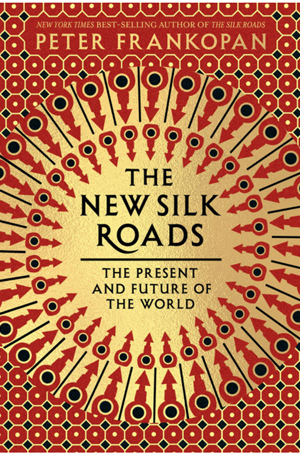
[Peter Frankopan, The New Silk Roads. The present and the future or the World, Alfred A. Knopf. New York, 2019, 285 p.]
review / Nerea Álvarez
 |
The concept of the New Silk Road, with its English names of OneBeltOne Road (OBOR) or Belt and Road Initiative (BRI), has already settled among the international community. In a short time the project launched by Xi Jinping in 2013 has been established and all its foundations have been unfolding.
Peter Frankopan's book gives a detailed account of the countries participating in this global project and the economic, political and social aspects of the main initiatives that make it up. Although there are those who are still waiting for some developments to take place in order to assess whether the original Chinese idea has really taken shape, Frankopan considers it to be substantially underway, reaching a large part of the planet: "The Silk Roads (always in the plural) are everywhere, not only in Central Asia, but crossing the whole of Asia, Africa, Europe and the Americas".
The young British historian does not focus on a single area of the globe, but addresses all those countries that have opened their doors to the project most ambitious communication networks of mankind. He begins by giving a brief history of the world economic development until globalization has reached all nations, and then analyzes the exceptional growth experienced by China between 1990 and 2017. With that we finally get into the strategy final of this global scale plan.
The New Silk Roads has a message to convey: the world is changing, and it is changing very fast. Part of Europe has been driven to the extreme right, migratory movements have caused a rise in nationalism and the Union is breaking up. The United States is adopting increasingly aggressive measures towards allied countries and has also closed its borders to citizens from Iran, Syria, Iraq, Libya, Somalia, Sudan and Yemen. The isolationism and fragmentation of the West is in alarming contrast to China's "win-win" path of cooperation and attendance mutual cooperation. And it is not just about cooperation with China. Asia is coming together, as evidenced by the cooperation projects between Uzbekistan and Kazakhstan, Afghanistan and Tajikistan, and especially the Azerbaijan-Eastern Europe pipeline. Afghanistan, Russia, China, Turkey, Iran and Pakistan have already come together to collaborate in the future in the fight against extremism, terrorism, organized crime and drug trafficking.
However, Frankopan warns that this growing Asian union is sometimes based on promises that are not kept, due to logistical difficulties or to the economic, political and social weaknesses of the countries in the region. The problem of water scarcity, for example, which is a resource of great need in Central Asia, has caused various conflicts both nationally (Iran in 2018) and internationally (India and Pakistan).
"The roads to Beijing", the third chapter of the book, focuses on China as the orchestrator of this strategy, presented by Xi as international cooperation to promote friendship between nations and create a better future together. While, on the one hand, OBOR is seen as a product of rapid Chinese evolution, on the other hand, the incredible impact it has had nationally for all other countries is perceived. Frankopan pauses to analyze the impact within society itself, which truly sees a new future in the construction of so many infrastructure works.
One of the most interesting analyses offered by the author concerns China's real role in Africa. How does this giant invest in the continent? The "five-no" policy is what has given it the greatest cooperation in Africa: no interference, no imposition of wills or political conditions and no unfair profits from investments in African countries. It is worth mentioning the great communication work being carried out by China in this part of the world, much more efficient than what the bureaucratic European Union can offer.
Routes to rivalry
Now that the Silk Roads are beginning to become a material fact, the discussion about the new world order and the hegemony of the United States is more present than ever. It is not surprising that the American power has always looked askance at China, and this is exposed in the book.
President Trump's moves on Asia have provoked widespread criticism, such as his rejection of the Trans-Pacific association Treaty at the beginning of his term in office. Behind this agreement there is much at stake: the choice between two sides, major investments and a shift in forces in the region, cornering the red dragon or making it easier for it to have new outlets to the sea and greater access to natural resources. Every country counts in turning the balance. The existence of various regional organizations does not financial aid advance integration. If a merger of these organizations were to result in something like an Asian European Union, which would be in favor of China, the expansion of the OBOR would be simple. The big problem is India, the big neutral piece that is not in favor of either of the two adversaries, although it is more sympathetic to American protection. Frankopan evaluates the possibility of a project not so focused on China and its interests, in order to attract the Indians, an idea that other authors have also considered in recent years. However, India remains very alert to how China acts, and will not wait to be cornered. There have been a number of frictions between China and India, especially over the ocean outlet and agreements with countries such as Pakistan and the Maldives.
This major work offers a broad and detailed vision of the world panorama with respect to China's strategy. Critical of the isolationism of the West, which gives it a less relevant future, and enthusiastic about the idea of globalization in the world's communication channels, Frankopan does not allow himself to be carried away by appearances. He warns the reader that the Chinese are pursuing their own interests: the need to obtain natural resources, such as those from Africa, and to protect their trade routes are just some of the reasons that prompted them to take the Silk Roads a step further. The British historian is not fooled by unconditional loans to insolvent countries, nor does he turn a deaf ear to China's desire to expand its own worldview and become the leader of the new order. We are already in the century of Asia, and so China prepares us for the future.
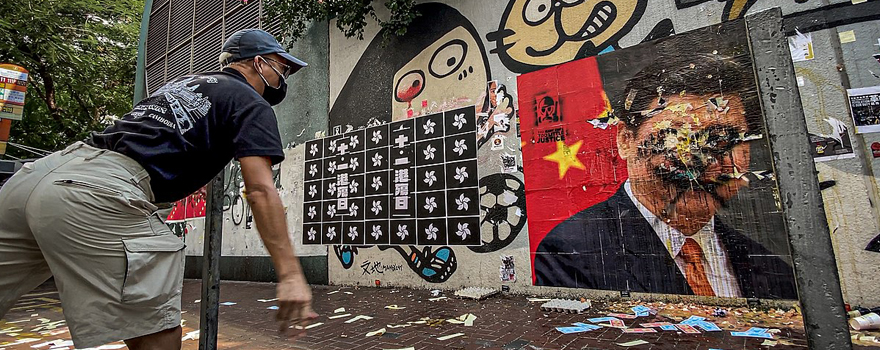
▲ Protester throwing eggs at the image of President Xi Jinping during China's National Day [Studio Incendo, Wikipedia].
COMMENT / Albert Vidal
After spending a few weeks in the "Pearl of the Orient", one begins to realize how complex status is and the seemingly irreconcilable positions of the government and the protesters. Sadly, what started as a series of peaceful mass protests has turned, especially in the last few days, into pitched battles with police, looting of stores and public transport and clashes between mainlanders and protesters that has paralyzed the city and is seriously damaging much of the Economics of Hong Kong.
Images of protesters clearing the way for ambulances and picking up trash are no longer so common, and those chants in shopping malls are now accompanied by flag burning and vandalizing stores that (allegedly) have ties to people in the Hong Kong government or the Chinese Communist Party. Why have the protests evolved in this way?
-
The government's apparent passivity in the face of peaceful demands has contributed to this radicalization. Many think that, if peaceful demonstrations do not yield result, there is no choice but to resort to violence (a rather questionable conclusion).
-
Abuses by police and protesters have accelerated this escalation. In addition, clipped videos of police resorting to force, accompanied by powerful propaganda posters and hashtags have portrayed, and often exaggerated, the measures taken by the police.
-
Other factors include the celebration of the 70th anniversary of the People's Republic of China (October 1, 2019) and the recently introduced EmergencyRegulationsOrdinance:ProhibitiononFaceCoveringRegulation, under which masks are prohibited at protests (with fines of USD 3,188 and 1 year imprisonment for those who violate it).
I think it may be useful to understand why people are protesting in Hong Kong. The mass demonstrations started in June 2019, as a movement initially opposing the project extradition law (Anti-ExtraditionLawAmendment Bill - ELAB). But it would be a mistake to fixate on that alone; the extradition bill was the straw that broke the camel's back. The glass was already quite full, before the summer of 2019.
I am going to refer to three causes that do not usually gain so much attention in the media. First, the price of housing in Hong Kong is exorbitant. A two-bedroom apartment sells for an average of HKD$6 million, or almost 1 million euros. No ordinary student is able to afford anything like that when they finish programs of study, and that means they can't leave home, get married and start a family. Or if they decide to do so, they go into debt for life. So many decide to rent government-subsidized apartments, but that's not such a pleasant option and usually causes quite a bit of stress because, after all, you don't live in your own property.
Second, many Hong Kong citizens are fed up with the slow pace of democratic reforms. The 2014 umbrella movement is intrinsically related to these frustrations.
Thirdly, many fear a date that is inexorably approaching: 2047. No one knows what will happen, but what is certain is that Hong Kong will lose its special status achieved in 1997. That means that China could absorb Hong Kong in its entirety, and there are people who fear a possible loss of freedoms and rights with the change of system. The vast majority of young people do not want that future, and understand that change will happen now, or never.
As for short-term future scenarios, different options are being considered. Some say that, given the economic impact the protests are having, many will eventually tire. Hotels are at rock-bottom levels, as are restaurants and Disneyland. Hong Kong relies heavily on the revenue that tourism brings in, so it is said that the protests will die on their own. I believe that, while the older people may eventually tire, the young people will not, because their future is at stake. There are surveys that say that up to 40% of students support the violent protests, and 90% view the central government with bad eyes.
Others say the violence will continue, especially after the escalation of October 1. That would invite an intervention by the Chinese army or the elite police (People'sArmedPolice), stationed in Shenzhen. This would be the solution "the hard way". In my opinion, it is unlikely that the army would intervene, as the Chinese Communist Party would be too discredited with "another Tiananmen". But the People'sArmedPolice is likely to intervene, as it is an elite and therefore non-lethal anti-riot force.
The third option is to divide the protesters. Carrie Lam conceded one of the five demands by withdrawing final the extradition law in September, and at the same time invited civil society representatives to voice their grievances in a series of ad hoc meetings. I believe this is a tool to separate the peaceful protesters, who would prefer dialogue with Lam. Meanwhile, the small group of radical protesters would lose the support of civil society, and the police would not have so many problems in repressing them, they would almost have carte blanche. This option is gaining relevance, especially after the blockade of the public transport system (MTR) for the first time in its 40 years of operation. Around 5 million people use it every day (Hong Kong has 7 million inhabitants), and the city has been literally paralyzed. This could even divide the protesters: those who prefer stability may begin to change their attitude and even confront the more radical ones.
Finally, it is important to avoid being a passive recipient of the media. From what I understand, the speech in China is that the U.S. and other Western countries are funding protesters to destabilize Hong Kong, especially to negotiate from a position of strength in the face of the trade war. I don't think it's entirely false that Western countries are funding some groups of protesters. But to say that this is the root of the protest seems to me to be an exaggeration. Of course, such an explanation is simple and attractive to uninformed people.
Regarding the Western point of view, it seems to me that emphasis is often placed on police violence and threats from China, preferring to ignore (not always!) the abuses committed by many protesters. Again, this is a biased view, and we should not accept it simply because it feels good. The real status is complex and more nuanced.
Despite the projections made, it is necessary to continue working on alternative solutions that will stop this chaos and present opportunities for dialogue and reconciliation among the actors involved: the government, the students, the violent and moderate protesters, the police and civil society in general. Patience, concessions and forgiveness: all this and much more will be necessary to rebuild this broken and fragmented society. Fortunately, it is never too late to start again.
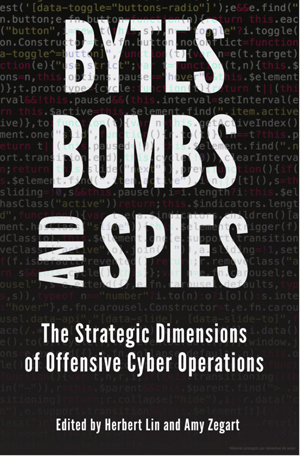
[Hebert Lin & Amy Zegart, eds. Bytes, Bombs, and Spies. The strategic dimensions of offensive cyber operations. The Brookings Institution. Washington, 2019. 438 p. ] REVIEW / Albert Vidal
review / Pablo Arbuniés
 Just as in the second half of the 20th century the world experienced the degree program nuclear weapons between the US and the USSR for world hegemony, everything seems to indicate that the degree program that will mark the 21st century is that of cyberspace. Ever since the department The inclusion of cyberspace as the fifth domain of the country's military operations (along with land, sea, air, and space) has made clear the paramount importance of its role in global security.
However, the very nature of cyberspace makes it a completely different field from what we might call kinetic security fields. The only constant in cyberspace is change, so any study and strategic approach must be able to adapt quickly to changing conditions without losing efficiency and maintaining enormous precision. This is a real challenge for all actors operating in cyberspace, both national and private. At the national level, the incorporation of cyber operations into the U.S. national security strategy (NSS) and the development of a cyberwarfare doctrine by the department are the two main pillars on which the new degree program through cyberspace.
"Bytes, Bombs, and Spies" explores the big questions posed by this new challenge, presenting very different approaches to different situations. Probably the greatest value offered by the book is precisely the different ways of dealing with the same problem defended by the more than twenty authors who have participated in its elaboration, coordinated by Herbert Lin and Amy Zegart. These authors collaborate in the 15 essays that make up the book. They do it with the idea of turning a topic as complex as offensive cyber operations into something achievable for non-expert readers. topic, but without sacrificing the depth and detail of an academic work.
Throughout the volume, the authors not only propose what the approach of the framework theoretical. They also assess the U.S. government's policies in the field of offensive cyber operations and propose what the points should be core topic in the development of new policies and adaptation of previous ones to the changing cyber environment.
The book tries to answer the big questions asked about cyberspace. From the use of offensive cyber operations in a framework from conflict to the role of the private sector, through the escalation dynamics and the role of deterrence in cyberspace or the intelligence capabilities needed to carry out effective cyber operations.
One of the main issues is how cyber operations are included in the framework of the dynamics of a scale of conflict. Is it permissible to respond to a cyberattack with kinetic force? And with nuclear weapons? The U.S. government's current cyber-doctrine leaves both doors open, facing a response based on the effects of the attack over the means. This idea is described as incomplete by Henry Farrell and Charles L. Glaser in their chapter, in which they argue for the need to take into account more factors, such as the perception of the threat and attack by other actors, as well as public opinion and the international community.
Continuing with the theoretical approaches, the main question raised by this book is whether it is sensible to apply the same principles in the strategic study of cyberspace that were applied to nuclear weapons during the cold war to answer the questions posed above. And since this is a relatively new field in which global hegemony and stability can be at stake from the outset, how this question is answered can mean the difference between stability or absolute chaos.
This is precisely what David Aucsmith proposes in his chapter. In it, he argues that cyberspace is so different from classical strategic disciplines that its strategic dimensions must be rethought from scratch. The disintermediation of governments, incapable of encompassing all of cyberspace, opens up a niche for private companies specializing in cybersecurity, but even these will not be able to completely fill what the government does in other domains. For his part, Lucas Kello tries to fill the sovereignty gap in cyberspace with the aforementioned private participation, proposing the convergence between governments and citizens (through the private sector) in cyberspace.
In conclusion, "Bytes, Bombs, and Spies" tries to answer all the main questions posed by cyberspace, without being unattainable to an audience that is not an expert in cyberspace. topic, but maintaining rigor, precision, and depth in its analysis. .
![View of Doha, the capital of Qatar, from its Islamic Museum [Pixabay].](/documents/10174/16849987/qatar-blog.jpg "View of Doha, the capital of Qatar, from its Islamic Museum [Pixabay].")
▲ View of Doha, the capital of Qatar, from its Islamic Museum [Pixabay].
essay / Sebastián Bruzzone Martínez
I. Introduction. Qatar, emirate of the Persian Gulf
In ancient times, the territory was inhabited by the Canaanites. From the 7th century AD onwards, Islam settled in the Qatari peninsula. As in the United Arab Emirates, piracy and attacks on the merchant ships of powers sailing along the Persian Gulf coast were frequent. Qatar was ruled by the Al Khalifa family from Kuwait until 1868, when at the request of the Qatari sheikhs and with financial aid from the British, the Al Thani dynasty was established. In 1871, the Ottoman Empire occupied the country and the Qatari dynasty recognised Turkish authority. In 1913, Qatar gained autonomy; three years later, Amir Abdullah bin Jassim Al Thani signed a treaty with the UK to establish a British military protectorate in the region, while maintaining the amir's absolute monarchy.
In 1968, the UK withdrew its military force, and the Truce States (UAE, Qatar and Bahrain) organised the Federation of the Emirates of the Persian Gulf. Qatar, like Bahrain, gained independence from the Federation in 1971, proclaimed a constitution provisional, signed a treaty of friendship with the UK and joined the Arab League and the UN.
The Constitution provisional was replaced by the 2003 Constitution of 150 articles, submitted to a referendum and supported by 98% of the electorate. It entered into force as the fundamental rule on 9 April 2004. It recognises Islam as the official religion of the state and Sharia law as source of law (art. 1); the provision for adherence to and respect for international treaties, covenants and agreements signed by the Emirate of Qatar (art. 6); hereditary rule by the Al Thani family (art. 8); executive institutions such as the committee of Ministers and legislative-consultative institutions such as the committee Al Shoura or committee of the Ruling Family. Also included are the possibility of regency through the Trustee Council (arts. 13-16), the institution of the prime minister appointed by the emir (art. 72), the emir as head of state and representative of the state in Interior, Foreign Affairs and International Office (arts. 64-66), a sovereign wealth fund (Qatar Investment Company; art. 17), judicial institutions such as local courts and the Supreme Judicial committee , and its control over the unconstitutionality of laws (137-140)[1], among other aspects.
It also recognises rights such as private property (art. 27), equality of rights and duties (art. 34), equality of persons before the law without discrimination on grounds of sex, race, language or religion (art. 35), freedom of expression (art. 47), freedom of the press (art. 48), impartiality of justice and effective judicial protection (134-136), among others.
These rights recognised in the Qatari Constitution must be consistent with Islamic law, and thus their application is different from what is observed in Europe or the United States. For example, although article 1 recognises democracy as the state's political system, political parties do not exist, and trade unions are banned, although the right of association is recognised by the Constitution. Similarly, 80% of the country's population is foreign, with these constitutional rights applying to Qatari citizens, who make up the remaining 20%.
Like the other countries in the region, oil has been a transforming factor in Qatar's Economics . Today, Qatar has a high standard of living and one of the highest per capita GDPs in the world[2], and is an attractive destination for foreign investors and luxury tourism. However, in recent years Qatar has been experiencing a diplomatic crisis[3] with its Persian Gulf neighbours due to a number of factors that have condemned the Arab country to regional isolation.
II. The instability of the al thani family
The government of the Emirate of Qatar has suffered great instability due to internal disputes within the Al Thani family. Peter Salisbury, Middle East expert at Chatham House, the Royal high school of International Affairs in London, spoke of the Al Thanis in an interview for the BBC: "It's a family that initially (before finding oil) ruled a small, insignificant piece of land, often seen as a small province of Saudi Arabia. But it managed to carve out a position for itself in this region of giants". [4]
In 1972, in a coup d'état, Ahmed Al Thani was deposed by his cousin Khalifa Al Thani, with whom Qatar pursued an international policy of non-intervention and the search for internal peace, and maintained a good relationship with Saudi Arabia. He remained in power until 1995, when his son Hamad Al Thani dethroned him while he was away on a trip to Switzerland. The Saudi government saw this as a bad example for other countries in the region also ruled by family dynasties. Hamad boosted exports of liquefied natural gas and oil, and dismantled an alleged Saudi plan to reinstate his father Khalifa. The countries of the region began to see the 'little brother' grow economically and internationally very fast under the new emir and his foreign minister Hamam Al Thani.
The family is structured around Hamad and his wife Mozah bint Nasser Al-Missned, who has become an icon of fashion and female prestige among the international nobility, on a par with Rania of Jordan, Kate Middleton and Queen Letizia (the couple is close to the Spanish royal family).
Hamad abdicated to his son Tamim Al Thani in 2013. The latter's ascension was a short-lived breath of hope for the international Arab community. Tamim adopted a very similar international policy stance to his father, strengthening rapprochement and economic cooperation with Iran, and increasing tension with Saudi Arabia, which proceeded to close Qatar's only land border. Similarly, according to a WikiLeaks leak in 2009, Sheikh Mohammed bin Zayed Al Nahyan accused Tamim of belonging to the Muslim Brotherhood. On the other hand, the economic, political, social and even staff rivalry between Qatar's Al Thani and Saudi Arabia's Al Saud goes back decades.
In my view, stability and family hierarchy in dynastic nations is a crucial factor to avoid internal power struggles that consequently have great negative effects on the country's society. Each person has different political, economic and social ideas that take time to implement. Frequent changes without an objective culmination end up being a terribly destabilising factor. Internationally, the country's political credibility and rigidity can be undermined when the emir's son stages a coup while his father is on holiday. Qatar, aware of this, sought legislative security and rigidity in article 148 of its constitution by prohibiting the amendment of any article within ten years of its coming into force entrance .
In 1976, Qatar claimed sovereignty over the Hawar Islands, controlled by the Bahraini royal family, which became a focus of conflict between the two nations. The same happened with the artificial island of Fasht Ad Dibal, which prompted the Qatari military to raid the island in 1986. It was abandoned by Qatar in a peace deal with Bahrain agreement .
III. Alleged support to terrorist groups
This is the main reason why neighbouring states have isolated Qatar. Egypt, the United Arab Emirates, Saudi Arabia, Bahrain, Libya and the Maldives, among others, cut diplomatic and trade relations with Qatar in June 2017 over its alleged funding and support for the Muslim Brotherhood, which it considers a terrorist organisation. In 2010, WikiLeaks leaked a diplomatic grade in which the US called Qatar the "worst in the region in subject cooperation to eliminate funding for terrorist groups."
The Muslim Brotherhood, which originated in 1928 with Hassan Al Bana in Egypt, is a political activist and Islamic movement, with principles based on nationalism, social justice and anti-colonialism. However, within the movement there are various strands, some more rigorous than others. The founders of the Muslim Brotherhood see the Education of society as the tool most effective way to achieve state power. For this reason, the movement's indoctrinators or evangelists are the most persecuted by the authorities in countries that condemn membership of group. It has a well-defined internal structure, headed by the supreme guide Murchid, assisted by an executive body, a committee and an assembly.
From 1940 onwards, the paramilitary activity of group began clandestinely with Nizzam Al Khas, whose initial intention was to achieve Egyptian independence and expel the Zionists from Palestine. They carried out attacks such as the assassination of Egyptian Prime Minister Mahmoud An Nukrashi. The creation of this special section sentenced final the reputation and violent character of the Muslim Brotherhood, which continued its expansion around the world in the form of Tanzim Al Dawli, its international structure.[5]
Khaled Mashal,[6] a former leader of the militant organisation Hamas, is in exile in Qatar's capital, Doha, and the Taliban of Afghanistan has a political office. Importantly, most Qatari citizens are followers of Wahhabism, a puritanical version of Islam that seeks the literal interpretation of the Qur'an and Sunnah, founded by Mohammad ibn Abd Al Wahhab.
During the post-Arab Spring political crisis in 2011, Qatar supported the Muslim Brotherhood's electoral efforts in North African countries. The Islamist movement saw the revolution as a useful means to gain access to governments, taking advantage of the power vacuum. In Egypt, Mohamed Mursi, linked to the movement, became president in 2013, although he was overthrown by the military. The United Arab Emirates and Bahrain negatively characterised the support and saw it as a destabilising Islamist element. In those countries where it was unsuccessful, its members were expelled and many took refuge in Qatar. Meanwhile, in neighbouring countries in the region, alarms were raised and every pro-Islamist move by the Qatari government was closely followed.
Similarly, Dutch sources and human rights lawyer Liesbeth Zegveld accused Qatar of financing the Al Nusra Front[7], the Syrian branch of Al Qaeda involved in the war against Al Assad, declared a terrorist organisation by the United States and the UN. The Dutch lawyer claimed in 2018 to have the necessary evidence to prove the flow of Qatari money to Al Nusra through companies based in the country and to hold Qatar judicially responsible before the court in The Hague for the victims of the war in Syria. It is important to know that, in 2015, Doha obtained the release of 15 Lebanese soldiers, but in exchange for the release of 13 detained terrorists. Other sources claim that Qatar paid 20 million euros for the release of 45 Fijian blue helmets kidnapped by Al-Nusra in the Golan Heights.
According to the BBC, in December 2015, Kataeb Hezbollah or the Islamic Resistance Movement of Iraq, recognised as a terrorist organisation by the United Arab Emirates and the United States, among others, kidnapped a group group of Qataris who went hunting in Iraq. [8] Among the hunters on the group were two members of the Qatari royal family, the cousin and uncle of Mohammed bin Abdulrahman Al Thani, Qatar's foreign minister since 2016. After 16 months of negotiations, the hijackers demanded a chilling $1 billion from the Qatari ambassador to Iraq to free the hostages. According to Qatar Airways officials, in April 2017 a Qatar Airways plane flew to Baghdad with the money to be delivered to the Iraqi government, which would act as an intermediary between Hezbollah and Qatar. However, business has never commented on the facts. The official version of the Qatari government is that the terrorists were never paid and the release of the hostages was achieved through a joint diplomatic negotiation between Qatar and Iraq.
Qatar's funding of the armed Hamas group in the Gaza Strip is a fact of life. In November 2018, according to Israeli sources, Qatar paid fifteen million dollars in cash as part of a agreement with Israel negotiated by Egypt and the UN, which would cover a total of ninety million dollars split into several payments[9], with the intention of seeking peace and reconciliation between the political parties Fatah and Hamas, considered group terrorist by the United States.
IV. Qatar's relationship with Iran
Qatar has good diplomatic and commercial relations with Iran, which is mainly Shiite, and this is not to the liking of the Quartet (Egypt, Saudi Arabia, UAE, and Bahrain), which is mainly Sunni, especially Saudi Arabia, with whom it has an obvious confrontation - subsidiary, not direct - over the predominant political and economic influence in the Persian region. In 2017, in his last visit to Riyadh ( visit ), Donald Trump called on the countries of the region to isolate Iran because of the military and nuclear tension it is experiencing with the United States. Qatar acts as an intermediary and turning point between the US and Iran, trying to open the way for dialogue in relation to the sanctions implemented by the American president.
Doha and Tehran have a strong economic relationship around the oil and gas industry, sharing the world's largest gas field, the South Pars-North Dame, while Saudi Arabia and the United Arab Emirates have followed the US lead in their foreign policy agendas towards Iran. One of the Quartet's conditions for Qatar to lift the economic and diplomatic blockade is the cessation of bilateral relations with Iran, which were reinstated in 2016, and the establishment of trade conduct with Iran in accordance with US sanctions.
V. Al Jazeera television network
Founded in 1996 by Hamad Al Thani, Al Jazeera has become the most influential digital media in the Middle East. It positioned itself as a promoter of the Arab Spring and was present in the climates of violence in different countries. As a result, it has been criticised by Qatar's antagonists for its positions close to Islamist movements, for acting as a mouthpiece for the fundamentalist messages of the Muslim Brotherhood and for being a vehicle for Qatari diplomacy. Its closure was one of the requirements requests made by the Quartet to Qatar to lift the economic blockade, the transit of people and the opening of airspace.
The US accuses the network of being the mouthpiece of extremist Islamic groups since the former head of Al Qaeda, Osama bin Laden, began to disseminate his communiqués through it; of being anti-Semitic in nature; and of adopting a position favourable to the armed Hamas group in the Israeli-Palestinian conflict.
In 2003, Saudi Arabia, after several failed attempts to cause the closure of the Qatari television network, decided to create a competing television station, Al Arabiya TV, initiating a disinformation war and vying over which of the two has the most reliable information.
VI. Washington and London's position
On the one hand, the United States seeks to have a good relationship with Qatar, as it has the large military base of Al-Udeid, which has an excellent strategic position in the Persian Gulf and more than ten thousand troops. In April 2018, the Qatari emir visited Donald Trump at the White House, who said that the relationship between the two countries "works extremely well" and considers Tamim a "great friend" and "a great gentleman". Tamim Al Thani has stressed that Qatar will not tolerate people who finance terrorism and confirmed that Doha will cooperate with Washington to stop the financing of terrorist groups.
The contradiction is clear: Qatar confirms its commitment to fighting the financing of terrorist groups, but its track record does not back it up. So far, the small country has demonstrably helped these groups in one way or another, through political asylum and protection of its members, direct or indirect funding through controversial negotiation techniques, or by promoting political interests that have not been to the liking of its great geopolitical rival, Saudi Arabia.
The United States is the great mediator and impediment to direct confrontation in the tension between Saudi Arabia and Qatar. Both countries are members of the United Nations and allies of the US. Europe and American presidents have been aware that a direct confrontation between the two countries could prove fatal for the region and their commercial interests related to oil and the Strait of Hormuz.
On the other hand, the UK government has remained aloof in taking a position on the Qatar diplomatic crisis. Emir Tamim Al Thani owns 95 per cent of The Shard building, eight per cent of the London Stock Exchange and Barclays bank, as well as flats, stocks and shares in companies in the UK capital. Qatari investments in the UK capital total around $60 billion.
In 2016, former British Prime Minister David Cameron showed his concern about the future when the London mayoralty was occupied by Sadiq Khan, a Muslim who has appeared on more than one occasion alongside Sulaiman Gani, an imam who supports the Islamic State and the Muslim Brotherhood.[10]
VII. Civil war in Yemen
Since foreign military intervention in Yemen's civil war began in 2015, at the request of Yemeni President Rabbu Mansur Al Hadi, Qatar has aligned itself with the states of the committee Cooperation for the Arab States of the Gulf (Bahrain, Kuwait, Oman, Qatar, Saudi Arabia and the United Arab Emirates), backed by the United States, the United Kingdom and France, Saudi Arabia and the United Arab Emirates), backed by the US, the UK and France, to create an international coalition to help restore Al Hadi's legitimate power, which has been under siege since the coup d'état by Houthis and forces loyal to former president Ali Abdala Saleh. However, Qatar has been accused of clandestinely supporting the Houthi rebels[11], and the rest of the committee countries view its actions with great caution.
Today, the Yemeni civil war has become the largest humanitarian crisis since 1945.[12] On 11 August 2019, South Yemeni separatists, backed by the United Arab Emirates, which initially supports al-Hadi's government, seized the port city of Aden, storming the presidential palace and the military instructions . The president, in exile in Riyadh, has described the attack by his allies as a coup against the institutions of the legitimate state, and has received direct support from Saudi Arabia. After days of tension, the Southern Movement separatists left the city.
The Emirates and Saudi Arabia, along with other neighbouring states such as Bahrain and Kuwait, of Sunni belief, seek to halt the advance of the Houthis, who dominate the capital, Sana'a, and a possible expansion of Shi'ism promoted by Iran through the conflict in Yemen. Similarly, there is a strong geopolitical interest in the Strait of Bab el Mandeb, which connects the Red Sea with the Arabian Sea and is a major alternative to the flow of trade in the Strait of Hormuz, off the coast of Iran. This interest is shared by France and the US, which seeks to eliminate the presence of ISIS and Al Qaeda in the region.
The day after the capture of Aden, and in the midst of Eid Al-Adha celebrations, Abu Dhabi Crown Prince Mohammed bin Zayed met in Mecca with Saudi King Salman bin Abdelaziz and Saudi Crown Prince Mohammed bin Salman, in an apparent effort to downplay the significance of the event, call on the warring parties in the city to safeguard Yemen's interests, and reaffirm regional cooperation and unity of interest between the UAE and Saudi Arabia. [13] The Crown Prince of Abu Dhabi has posted on his official Twitter accounts comments and photographs from meeting in which a positive attitude can be seen on the faces of the leaders.
Conversely, if the partnership and understanding on the Yemen issue between the two countries were complete, as they claimed, there would be no need to create an apparently 'ideal' image through official communications from the Abu Dhabi government and the publication of images on social media.
Although the UAE supports the separatists, the latest developments have caused a sense of mistrust, raising the possibility that the southern militias are disregarding Emirati directives and starting to run a diary of their own to suit their own particular interests. Foreign sources are also beginning to speak of a civil war within a civil war. Meanwhile, Qatar remains close to Iran and cautious about status in the southwest of the Arabian Peninsula.
[John J. Mearsheimer, The Great Delusion: Liberal Dreams and International Realities, Yale University Press, September 2018, 328 p.]
REVIEW / Albert Vidal
 |
"For better or for worse, liberal hegemony is history". With such a statement, John J. Mearsheimer concluded his talk about his recently published book "The Great Delusion: Liberal Dreams and International Realities" at SOAS University of London.
In this book, Mearsheimer argues that the foreign policy of liberal hegemony, which was adopted by the US at the end of the Cold War, failed miserably. He explains that it happened because nationalism and realism always overrun liberalism.
In the first part of the book he defines liberalism, nationalism and liberal hegemony. He then explains why the US pursued liberal hegemony, and what is its track record. Finally, he reveals why liberal hegemony failed, and what can we expect in the future. Let's take a more detailed look into it.
Liberalism
Mearsheimer casts light on liberalism's two fundamental assumptions underpinning human nature: first, it assumes that the individual takes precedence over the group; second, liberalism assumes that individuals cannot reach universal agreement over first principles, and such differences often lead to violence.
In order to deal with this potential for violence, liberalism offers a solution that includes three parts: everybody has individual rights that are inalienable; tolerance receives a special emphasis, and a state becomes necessary to limit the threat of those who do not respect other people's rights. Such features make liberalism a universalistic theory, which is what turned the US into a crusader state.
Nationalism
According to the author, nationalism has its own core assumptions: first, humans are naturally social animals; second, group loyalty is more important than individualism, and third, aside from the family, the most important group is the nation. He then goes on to say that nations (bodies of individuals that have certain features that make them distinct from other groups) want their own states.
After that, Mearsheimer says that nationalism beats liberalism because human beings are primarily social animals. To show this, he recalls that the entire planet is covered with nation states, and liberal democracies do not even comprise a 50% of those nation-states.
Liberal hegemony
This is just an attempt to remake the world in America's image and has several components: to spread liberal democracy across the planet, to integrate more countries into the open international economy and into international institutions. In theory, this would be extremely beneficial, since it would eliminate significant human rights violations (here the author assumes that liberal democracies do not engage in great human rights violations), it would make for a peaceful world (following the democratic peace theory) and it would eliminate the threat of foreign support to those who want to overthrow liberal democracy at home.
Why did the US pursue liberal hegemony?
After the Cold War, a moment of unipolarity made it possible, says Mearsheimer, for the US to ignore balance of power politics and pursue a liberal foreign policy. To this we need to add that the US is a liberal country, which oftentimes thinks itself as exceptional. This clearly prompted the US to try to remake the world into its image.
In this part of the book, Mearsheimer shows different failures of the US foreign policy. The first one is the Bush Doctrine and the Greater Middle East, which was a plan to turn the Middle East into a sea of democracies. The result was a total disaster. The second example is the awful relations between the US and Russia and the Ukraine crisis, which were the result of NATO's expansion. Thirdly, Mearsheimer criticizes the way the US has engaged with China, helping it grow quicker while naively thinking that it would eventually become a liberal democracy.
Why did liberal hegemony fail?
The reason is that the power of nationalism and realism always overrun liberalism; in words of Mearsheimer: "the idea that the US can go around the world trying to establish democracies and doing social engineering is a prescription for trouble". Countries will resist to foreign interference. Also, in large parts of the world, people prefer security before liberal democracy, even if that security has to be provided by a soft authoritarianism.
Liberal hegemony is finished, because the world is no longer a unipolar place. Now the US needs to worry about other powers.
A critique of his theory
Although Mearsheimer's thesis seems solid, several critiques have been formulated; most of these are directed toward issues that contradict some of Mearsheimer's arguments and assumptions and that have been left unaddressed.
1) In his introduction, Mearsheimer argues that individuals cannot reach an agreement over first principles. I believe that is an over-statement, since some values tend to be appreciated in most societies. Some examples would be the value of life, the importance of the family for the continuation of society and the education of the upcoming generations, the importance of truth and honesty, and many others.
2) When he describes the US foreign policy since the 1990s as liberal hegemony, Mearsheimer chooses to ignore some evident exceptions, such as the alliance with Saudi Arabia and other authoritarian regimes which do not respect the most basic human rights.
3) Many of the failures of the US foreign policy since the 1990s do not actually seem to derive from the liberal policies themselves, but from the failure of properly implementing them. That is, those failures happened because the US deviated from its liberal foreign policy. A clear example is what happened in Iraq: although the intervention was publicly backed by a liberal rhetoric, many doubt that Washington was truly committed to bring stability and development to Iraq. A commonly pointed example is that the only Ministry effectively protected was the Oil Ministry. The rest were abandoned to the looters. A true liberal policy would have sought to restore the education and health systems, state institutions and infrastructure, which never really happened. So blaming the failure to the liberal policy might not be adequate.
4) Although Mearsheimer proves the urge to intervene that comes with liberal hegemony, he doesn't show how a hegemon following realist principles would restrain itself and intervene in fewer occasions and with moderation. The necessity to protect human rights would simply become a willingness to protect vital interests, which serves as an excuse for any type of intervention (unlike human rights, even if they have sometimes been the origin of a disastrous intervention).
As a final thought, this book suggests a clear alternative to the mainstream views of most of today's foreign policy, especially in Western Europe and in the United States. Even if we disagree with some (or most) of its tenets, it is nevertheless helpful in understanding many of the current dynamics, particularly in relation to the everlasting tension between nationalism and universalism. We might even need to rethink our foreign policies and instead of blindly praising liberalism, we should accept that sometimes, liberalism isn't able to solve every problem that we face.
![Almagro's remarks at the opening of the 49th OAS General Assembly, in Medellín, Colombia, in June 2019 [OAS]](/documents/10174/16849987/reeleccion-almagro-blog.jpg "Almagro's remarks at the opening of the 49th OAS General Assembly, in Medellín, Colombia, in June 2019 [OAS]")
▲ Almagro's remarks at the opening of the 49th OAS General Assembly, in Medellín, Colombia, in June 2019 [OAS]
COMMENTARY / Ignacio Yárnoz
At the General Assembly of the Organization of American States (OAS) held in Medellín last June, the tensions and division that currently exist within this international organization were confirmed. In the first place, these discrepancies were evident in the question of the Venezuelan question, an issue that was the protagonist of the meeting with the presentation of migration reports, criticism of the Bolivarian regime and the presence of the Venezuelan delegation representing the Government of Guaidó led by Ambassador Gustavo Tarre.
These events were met with the rejection of a large part of the Caribbean countries, who abandoned the conference room In the presentation and declared their refusal to comply with any OAS resolution that the Venezuelan delegation voted in favor of. In the opinion of Caribbean countries, Venezuela formally left the organization in March and the presence of Guaidó's delegation as the legitimate representative of Venezuela contravenes international law and the principles of the OAS Charter, since it represents a government without effective control of the territory or legal legitimacy. But the Caricom countries were not the only ones to express their protest, the delegation of Uruguay also left the meeting. conference room and that of Mexico expressed its displeasure with the Venezuelan opposition presence as a delegation of plenary session of the Executive Council right.
The controversy, however, not only revealed the discrepancies on how to deal with the Venezuelan crisis, but also reflected another underlying reality, and that is that the candidacy of Luis Almagro to be re-elected as president of the Bolivarian Republic of Venezuela. University Secretary of the organization hangs in the balance.
In December of last year, Uruguay's Almagro formally announced that, at the request of Colombia and the United States, he had decided to run for re-election with the certainty of having the necessary votes. Since then, however, the landscape of re-election has darkened. Voting will take place on the first semester Almagro needs at least 18 votes from the 35 countries of the OAS (if we include Cuba, even if he does not actively participate).
Variables
The future of Almagro, who arrived at the position In May 2015, it depends on several factors that will be developed this year. Mainly, the general elections in Argentina, Canada, Uruguay and Bolivia, which will be held between October and November. However, there are other variables that can also affect your re-election, such as the support you get from the countries of the United States. group or the possible division among CARICOM members on the matter. Below, we will review these assumptions one by one.
In the case of the Bolivian elections, Almagro has already played his cards and has been accused of having used a double standard by harshly criticizing the Maduro regime, but then not being critical of the possibility of Evo Morales being re-elected for a third time. Such re-election is supposedly not legal according to the Bolivian Constitution and was vetoed by the population in a referendum, but President Evo Morales has ignored it under the pretext that it prevents him from being elected. candidate once again, it goes against human rights, an argument later endorsed by the Supreme Court of Bolivia. The administrative office General of the OAS, despite not being in the agreement with the "right to be re-elected", he did not raise any criticism or position himself against said election supposedly because of Bolivia's possible vote in favor of Almagro, something that could happen if Evo Morales is finally re-elected but that is not completely certain either. Otherwise, however, he has already earned the animosity of the candidates of the civil service examination such as Carlos Mesa or Óscar Ortiz and the opposition leader Samuel Doria Medina who, if elected, would not vote in favor of him.
Regarding Guatemala, the first round of the presidential elections gave victory to Sandra Torres (22.08% of the votes) and Alejandro Giammattei (12.06% of the votes), who will face each other in the second round on Sunday, August 11. In the event that Torres is elected, she may align her position with that of Mexico, adopting a less interventionist policy towards Venezuela and therefore against Almagro. In the event of the victory of Giammattei, a center-right politician, it is likely that he will align his positions with Almagro and vote in favor of him. Guatemala has always been aligned with U.S. positions, so it is doubtful that the country will vote against a U.S.-backed candidacy, though not impossible.
As for Argentina and Canada, the position will depend on whether the candidate The winner in their respective elections is either conservative or progressive. Even in the case of Canada, the possibility of a rejection of Almagro is open regardless of the political orientation of the new government, since while Canada has been critical of the Maduro regime, it has also criticized the internal organization of the OAS under the command of the current one University Secretary. As far as Argentina is concerned, there is a clear difference between the presidential candidates: while Mauricio Macri would represent continuity in support for Almagro, the Alberto Fernández-Cristina Kirchner ticket would clearly be a rejection.
Uruguay represents a curious case of how internal politics and political games affect even members of the same party. We must not forget that Luis Almagro was a minister in the government of Pepe Mujica and that his first candidacy for University Secretary was submitted by Uruguay. However, given the division in the training The policy to which he belonged, Frente Amplio, won some enemies such as those of the current government of Tabaré Vázquez. That is why Uruguay has been so critical of Luis Almagro despite being a compatriot and party colleague. However, we should not doubt that he will also have his friends in the party who will change Uruguay's stance. If so, it wouldn't matter what the candidate (Luis Lacalle Pou for the National Party or Daniel Martinez for the Broad Front) that Almagro would be assured of the vote: that of the right wing of the National Party by having some thesis more critical of Maduro (in fact, they recognized Guaidó's government as a party and criticized Uruguay's neutrality), or that of the left of the Frente Amplio because of the contacts that Almagro may have, although the latter is still a hypothesis given that the most extreme wing of the party is the one that still has the majority of votes within the Frente Amplio.
Another Challenger
However, Almagro's chances for re-election could be thwarted if another candidate who could win the sympathy of the government presents his candidacy. group of Lima, created in August 2017 and made up of a dozen countries in the Americas to coordinate their strategy in relation to Venezuela. Peru sounds like the one that is likely to present a candidate: Hugo de Zela, a 42-year-old Peruvian diplomat degree program who in April was appointed Peru's ambassador to Washington and who has played a very important role within the group of Lima as coordinator. In addition, De Zela knows the structure of the OAS since he has served as chief of staff of the administrative office General on two occasions: first, between 1989 and 1994, when the head of the agency was the Brazilian Joao Clemente Baena Soares; and then between 2011 and 2015, with the Chilean José Miguel Insulza. This candidate, apart from his extensive political experience, has as his trump card the fact that he has been a coordinator of the group of Lima, which could provide assurances about the partnership between that group and the OAS on the Venezuelan question.
If De Zela were to decide to run, the group Lima could split its votes, which could favor the interests of the 14 Caribbean Community (CARICOM) countries, which usually vote as a bloc and have been unhappy with the management on the Venezuelan crisis. In fact, Caricom is already thinking about introducing a candidate that takes into account the interests of those countries, mainly climate change. The names that sound among the members of Caricom are the ambassador to the OAS of Antigua and Barbuda, Ronald Sanders, or the representative of Barbados to the UN, Liz Thompson.
However, there remains hope in the Caricom community for Almagro. Saint Lucia, Haiti, Jamaica and the Bahamas broke ranks at the time of voting on the admission of Ambassador Gustavo Tarre appointed by the Guaidó government to represent Venezuela at the OAS (although technically what they supported is that he be designated as "designated permanent representative of the National Assembly, pending new elections and the appointment of a democratically elected government"). These four countries, although with a more moderate position than that of the group of Lima, joined his position by accepting the appointment of such a representative with the aforementioned qualification. This is the third time so far this year that they have broken ranks in Caricom in the topic Venezuelan. This could give the University Secretary A trump card with which to be able to play in order to achieve the support of one of these four countries, although it will require skillful negotiation techniques and to give something in return to these countries, whether they are put in the position of the administrative office benefits in new programs and scholarships from development or climate change, for example.
In conclusion, in the best possible scenario for Almagro and assuming that no country in the group of Lima will present a candidate alternatively, the candidacy for re-election of the current University Secretary it would have 12 votes secured, 4 negotiable from Saint Lucia, Jamaica, Haiti and the Bahamas and 5 pending elections (Guatemala, Canada, Uruguay, Argentina and Bolivia). It is clear that Mexico, a large part of Caricom (Antigua and Barbuda, Barbados, Belize, Dominica, Grenada, Guyana, Saint Kitts and Nevis, Saint Vincent and the Grenadines, Suriname, Trinidad and Tobago) and Nicaragua will vote against. In addition, we must add the fact that any candidacy can be submitted up to 10 minutes before the extraordinary General Assembly, which gives rise even more to shadow political games and last-minute surprises. As we can see, it's a status very difficult for him University Secretary And it's surely going to be more than one headache in this arithmetic of votes to get the position. Without a doubt, a fight for the position that will give a lot to talk about between now and February 2020.
[I. H. Daalder & James M. Lindsay, The Empty Throne. America's Abdication of Global Leadership. Public Affairs. New York, 2018. 256 p.]
review / Salvador Sánchez Tapia
 |
The arrival of Donald Trump to the presidency of the United States in January 2017 has unleashed a significant flow of publishing house that continues to this day, and in which numerous pens question, in substance and form, the new occupant of the White House from different angles.
In this case, two authors from the field of American think tanks , close to Barack Obama – one of them served during his presidency as US ambassador to NATO – offer us a very critical view of President Trump and his management at the head of the U.S. executive branch. With the solid support of numerous quotes, statements and testimonies collected from the media, and in an agile and attractive language, they compose the portrait of an erratic, ignorant president – in one passage his "ignorance on many issues, his unwillingness to accept the advice of others, his impulsiveness, and his lack of critical thinking capacity" are unmitigated. arrogant and irresponsible.
The authors of The Empty Throne argue that President Trump's actions and words show how he has broken with the traditional line of U.S. foreign policy since Franklin Delano Roosevelt, based on the exercise of leadership oriented to collective security, the opening of global markets and the promotion of democracy. of human rights and the rule of law, and that it has result very beneficial for the United States. Trump, they argue, would have abdicated that leadership, embracing instead another purely transactional policy, made out of a simple calculation of self-interest.
This new way of conceiving international politics, based on the logic of competition and domination, would be justified by the Trump administration with the argument that the old one has been highly pernicious for the United States, since it has led to friends and allies obtaining significant profits at the expense of American prosperity.
Paraphrasing Trump's campaign slogan America First, the authors argue that this new policy will result in an America Alone, and that it will benefit China instead, assuming that it will be China that nations look to for a new leader.
To support your thesis , the authors take a look at the management of Donald Trump in the year and a half between his inauguration in early 2017 and the book's publication date in 2018. In their arguments, they review the management of the presidents the nation has had since the end of World War II, and compare it to the internship by the Trump administration.
An important part of the criticism is directed at the controversial presidential style deployed by Donald Trump, exhibited even before the elections, and which is evident in events such as the withdrawal of the label accustomed in the world of international relations, especially hurtful in its relations with friends and allies; the lack of interest shown in coordinating with the Obama administration an orderly transition, or the making of certain decisions against its national security team or even without consulting its members.
Not acknowledging these facts would be to deny the evidence and call into question the inescapable reality of the uneasiness that this new way of treating nations with which North America shares so many interests and values, such as those of the European Union, or others such as Japan, Canada or Australia, firm allies of the United States for decades, produces for many. There is, however, some criticism of the arguments.
First of all, and leaving aside the lack of time perspective to make a evaluation final of Trump's presidency, the authors make a comparison between the first year and a half of the current president's term and those of all his predecessors since the end of World War II to demonstrate Trump's return to the America First policy that prevailed until Roosevelt. This contrast requires certain nuances because, based on the common denominator of the international leadership strategy that all of Trump's predecessors practiced, the country experienced during this time moments of greater unilateralism such as that of George W. Bush's first term, along with others of less global presence of the country such as, perhaps, those of the Eisenhower presidencies. Ford, Carter, and even Obama.
In the case of Obama, moreover, the fundamental differences with Trump are not as many as they seem. Both presidents are trying to manage, in order to mitigate it, the loss of relative American power caused by the long years of military presence in the Middle East and the rise of China. It's not that Trump believes the U.S. should abandon ideas of global leadership and multinational interaction; in fact, while he is accused of leaving traditional allies to their fate, he is reproached for his rapprochement, almost complicity, with others such as Saudi Arabia and Israel. Rather, what he intends is to exercise leadership, but, yes, dictating his conditions so that they are favorable to the United States. From inspirational leadership to leadership by imposition.
The question would be: is it possible to maintain leadership under these conditions? According to the authors, no. In fact, as a consequence of this U.S. "abdication of leadership," they offer two scenarios: a return to a world in which no nation leads, or the irruption of another nation – China, of course – that will fill the vacuum created by that abdication.
The authors do not consider a third option: that of traditional allies adapting to the new style of leadership, even if it is reluctantly, out of necessity, and in the confidence that one day, Trump's presidency will be history. This idea would be consistent with the premise set forth in the book, and with which we agree, that American leadership continues to be essential, and with the very acknowledgment made at the end of it, that there is some basis in the grievances that Trump presents and that the president's attitude is leading many of America's friends and allies to reconsider their defense spending. to rethink the rules of international trade to make them more palatable to North America, and to take a more active role in solving the most important global challenges.
Time will tell which of the three options will prevail. Even considering the challenges involved in the attention With the current head of the White House, the United States continues to be united with its traditional partners and allies by a dense network of common interests and, above all, shared values that transcend people and that will endure beyond them.