
Entries with tag .
Some U.S. and Canadian diplomats who were in Havana between 2016 and 2018 are still not fully recovered from ailments they suffered
![U.S. Embassy building in Cuba [department de Estado] [ de Estado]](/documents/10174/16849987/ataques-sonicos-blog.jpg "U.S. Embassy building in Cuba [department de Estado] [ de Estado]")
▲ Building of the U.S. Embassy in Cuba [department de Estado].
ANALYSIS / Eduardo Villa Corta
Three years ago, staff U.S. diplomats stationed in Cuba began to feel physical discomfort supposedly caused by strange sounds to which they had apparently been exposed; Washington spoke of a "sonic attack. However, although the symptoms suffered by those affected have been determined to be anomalous, it has not been possible to establish what caused them. Was it really an attack? Who was behind it? We review here the main hypotheses and conjectures that have been made, and point out their weaknesses.
In late 2016 and early 2017, several U.S. diplomats stationed in Havana, as well as members of their families, reported suffering from dizziness, vertigo and sharp pains in their ears that could be caused by strange sounds to which they had been exposed. According to their testimonies, the sounds came from a specific direction, and they had heard them in their own residences or, in some cases, in hotel rooms, while people staying in neighboring houses or adjoining rooms had not heard any special sounds. The phenomenon also affected Canadian diplomats in the Cuban capital. In all, some forty people were treated for these symptoms.
Acoustic attack
Echoing the facts reported by its staff in Cuba, in mid-2017 the U.S. State department stated that the symptoms could have been caused by a sonic attack by the Cuban government directed against diplomats and their families. In October 2017, President Donald Trump directly accused Havana: "I believe Cuba is manager; yes, I do."
At the beginning of 2018 the department of State issued a statement alert not to travel to Cuba due to a possible health crisis and withdrew a good part of the staff of the mission statement diplomatic in Havana, reducing the activity of this to the minimum possible. At that time, a total of 24 Americans had been affected.
At the time, the Canadian government also indicated that its diplomats had experienced similar discomfort. Ottawa decided to evacuate the families of its employees in Cuba and in early 2019 proceeded to reduce the staff of the embassy in the face of what appeared to be the appearance of a fourteenth case.
The Cuban government denied from the outset being involved in any harassment operation against the U.S. or Canada. ˝There is no test about the cause of the reported ailments, nor is there any evidence to suggest that these health problems have been caused by an attack of any kind˝, Havana assured. Raul Castro's government offered its cooperation in the research of the facts, with nothing coming to light that could explain the case. No devices that could have provoked the sounds appeared.
Adding confusion to the status, at least two US diplomats stationed in China, busy at the consulate general in Guangzhou, the largest that the US has in the country, presented in early 2018 also the symptoms already described. Washington evacuated them and issued a health warning about missions in mainland China.
The Associated Press published in October 2017 a recording of the alleged sounds causing the reported ailment, and indicated that government agencies had been unable to determine the nature of the noise and explain its relationship to the bodily disorders caused. Months later, he noted that internal FBI reports did not even establish that there had been an "attack". Other media highlighted the poor cooperation in the research, due to jurisdictional zeal, between the department of State, the FBI and the CIA.
Symptoms of "Havana syndrome".
A medical team from the University of Pennsylvania, at the request of the U.S. Government, examined 21 people affected by what the press began to call "Havana syndrome". The research, initially published in March 2018 in the Journal of the American Medical Association (JAMA), indicated that most of the patients reported problems with report, concentration, and balance, and determined that they appeared to have suffered injuries to extensive brain networks.
data Further MRI scans of the same team extended to 40 patients, released in July 2019, led to the conclusion that the diplomats had experienced some craniocerebral trauma. The results of the MRI scans, compared with those of a group of healthy people, showed differences in the volume of the white and gray substances of the brain, in the integrity of the cerebellar microstructures and in the functional connectivity of the subnetworks for hearing and spatial vision, but not for executive functions.
This report concluded that the staff diplomat had been physically injured, although it could not determine the cause. He also noted that patients do not experience a usual recovery, as they are not recovering quickly from symptoms, as is the case in other cases of similar "concussions" or ear problems.
IF IT WASN'T AN ATTACK, WHAT WAS IT?
As no clear cause has been established as to what caused the ailments suffered by the US and Canadian diplomatic staff and some members of their families, the very reality of an attack has been called into question. Although various alternative explanations have been put forward, none of them are fully convincing.
1) Collective hysteria
Formulation. Some neurologists and sociologists, such as Robert Bartholomew, have suggested that it could be a case of mass hysteria. Given the pressure to which some of the diplomats working in very unfriendly environments are subjected, and the endogamic relationship in which they live, living almost exclusively among themselves, it could explain a mutual conviction of an external attack that even has somatic consequences.
Weak spot. Both the research of the University of Pennsylvania and the doctor of the department of State, Charles Rosenfarb, who appeared before the committee of Foreign Relations of the Senate, came to rule out that the symptoms suffered by the diplomats were due to a mere mental mechanism. It is very difficult that about sixty people, including Americans and Canadians, convinced each other of an aggression of this kind subject and then almost all of them developed the same brain lesions.
2) Microwave
Formulation. The researcher team at the University of Pennsylvania, while not pointing to any possible cause of the ailments, did not rule out certain assumptions, such as that of microwave affectation. This aspect was insisted upon by a research published in 2018 in the journal Neural Computation, which considered the symptoms consistent with exhibition to electromagnetic microwave (RF/MW) radiation.
Weak point. Not all the symptoms shown by patients could be a consequence of the exhibition of such a radiation subject, which also has a diverging literature on its effects on the human body. In addition, there is no known microwave weapon that can affect the brain.
3) Ultrasound
Formulation. A team of computer experts at the University of Michigan suggested in 2018 that it could be a case of exhibition to some subject ultrasound, perhaps coming from malfunctioning listening equipment mixing multiple ultrasonic signals.
Weak point. The recording of one of the sound episodes - the sample broadcast by AP - is not sufficient to be able to determine its nature. It is also possible that the sound was somewhat different in other cases.
4) Crickets
Formulation. A research from the Universities of California-Berkeley and Lincoln, from the existing sound sample , considered in January 2019 that the possible cause of the attacks was made by cricketsThe study, specifically crickets Anurogryllus muticus. The research was a comparative study between the sound emitted by that variant of crickets and the sample of one of the Havana acoustic episodes.
Weak point. The sound perceived by the diplomats was directional, so it was not heard by neighboring people. If they had been crickets in their natural environment, the sound would have spread around.
5) Neurotoxins
Formulation. A joint study by two Canadian research centers in May 2019 attributed the symptoms suffered by diplomats to exhibition to neurotoxins from pesticides used to spray mosquitoes, a internship common occurrence in embassy buildings.
Weak point. The diplomats affected related the beginning of their physical discomfort to situations experienced in their own residences or in hotel rooms, where there was no fumigation.
IF IT WAS AN ATTACK, WHO DID IT?
Given that the previous explanations do not seem entirely solid, the US Government maintains the hypothesis of an attack. If it really happened, who was behind it? Here, too, there are various conjectures.
1) Castro regime
The first option considered, assumed in principle by the US given the public accusations made from Washington, has been to attribute the alleged attacks to the Cuban regime itself. With them, Havana would try to maintain pressure on the Americans, in spite of the formal reestablishment of diplomatic relations, with the goal to mark each other's territory.
Weak point. The incidents began to occur during the Obama Administration, in a context of a ˝honeymoon˝ marked by the reopening of embassies and the visit of Barack Obama to Havana. The normal thing is that at the end of 2016, in view of the U.S. elections, the Castro regime would not want to give reasons to the next U.S. president to twist the diplomatic line opened by Obama. It could make sense that after Donald Tump's later revocation of the previous openness measures, Cuba would want to punish the new Administration, but not before seeing the direction it would take; in any case, the attacks would only justify the hard line followed by Trump, which does not benefit the island.
2) A sector of Castroism
Fidel Castro was attributed with an unaccommodating attitude towards his brother Raul's decision to reestablish diplomatic relations with the United States. Although he died in November 2016, people around him might have tried to torpedo that rapprochement, convinced that hostility with Washington was the best way to ensure the survival of the regime as conceived by its founder.
Weak point. Although Fidel Castro's reluctance towards rapprochement with the U.S. is true, it is difficult to think that the most conservative sector within Castroism would dare to boycott so directly Raul Castro's fundamental political line. It is another thing that, after he handed over the presidency of Cuba to Miguel Díaz-Canel in April 2018, some sectors within the regime could make internal movements to send certain messages, but the changeover occurred when most of the acoustic episodes had already taken place.
3) A third country (Russia, China)
The third option would be that a third country generated the attacks. American intelligence indicates that the most viable option in this case would be Russia. Moscow has been keen to return to operating in the Caribbean, as in the Cold War, and aggression against U.S. diplomats in Cuba would fit in with its strategy. It has also been suggested that China might want to repay Washington in its backyard with the same harassment that the Chinese believe they feel from the US in their nearest seas.
Weak point. The return of Russia to the Caribbean is certainly documented, and it is conceivable that Moscow could have promoted a punctual action against some specific goal , but it seems difficult that it would have sustained over time an operation that harms Cuba's sovereignty. As for China's presence in the US neighborhood, it is a less confrontational move than the one carried out by Russia. Moreover, if Beijing had chosen foreign soil in order to better erase the traces of an action against US diplomats, then the cases recorded in Guangzhou would not have occurred.
The text attempts to avoid stagnation, but does not open the door to decisive transformation
Cubans will vote in referendum next February 24 on the project of the new Constitution C by the National Assembly in December after a period of enquiry popular. In the preamble of the project the reference letter was introduced at the last minute to the goal communist which already existed in the 1976 Constitution, but which had not been initially incorporated in the draft, so that the final text is even less novel.
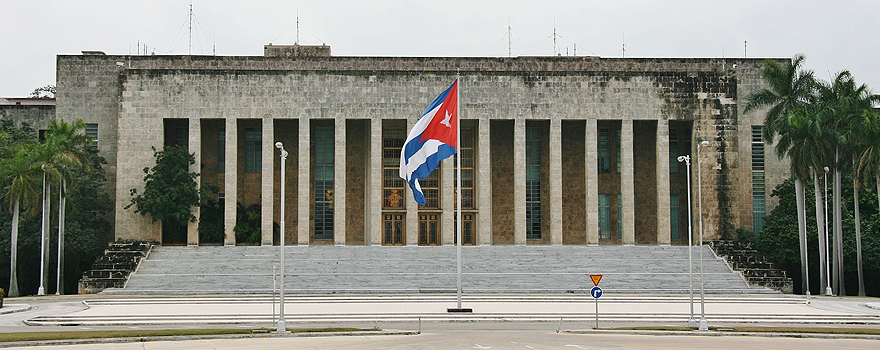
▲ Building of the committee Central of the Communist Party of Cuba [framework Zanferrari].
article / Alex Puigrefagut
Six decades after the Revolution, Cuba leaves behind the surname Castro, with the arrival in April 2018 of Miguel Díaz-Canel as head of state, and is preparing to approve a new Constitution, which will replace the one promulgated in 1976, to symbolize this new time. This new Magna Carta, whose initial text was C by the National Assembly in July 2018, then submitted to three months of popular enquiry for the presentation of amendments and finally C as by the deputies on December 22, has as its goal main objective to seek the modernization of the Cuban State and the sustainable development of the same, without losing the essence and the main ideals of the socialist ideology of the State.
entrance At the end of the Castro era at the helm of Cuba, the State has found it necessary to include in the new essay the socioeconomic transformations carried out in the country since the previous Constitution came into force, as well as to partially modify the State structure to make it more functional. It is also worth mentioning the willingness to recognize more rights for citizens, although with limitations.
When examining the constitutional project , four aspects are particularly noteworthy: the specification of the ideology of the State, the figures and Structures of the State and the government, the question of private property and finally the redefinition of citizens' rights.
Maintenance of socialism
The text C initially by the National Assembly did not include the reference letter at goal to reach a communist society, a fundamental point that was present in the previous Constitution. The article 5 of the 1976 Magna Carta established that society "organizes and orients common efforts towards the high goals of the construction of socialism and the advance towards a communist society".
The omission of this point was really only a change of language, since at no time was the idea of socialism abandoned, in fact, the socialist character of the Cuban State was ratified. In the words of Esteban Lazo, president of the National Assembly, this new Constitution "does not mean that we are renouncing our ideas, but rather that in our vision we are thinking of a socialist, sovereign, independent, prosperous and sustainable country". However, in case there were any doubts, after the period of popular deliberation, the Assembly introduced as an amendment the express accredited specialization to communism in the preamble of the final text, given the alleged pressure from the most immobilist sectors.
The new Constitution reaffirms the socialist character of the Cuban regime, both in the economic and social spheres, giving a leading role to the Communist Party of Cuba (PCC) as the highest power in society. The socialist nature of the Cuban State is underscored by the maintenance of the single-party system.
Presidential limits
The new Constitution includes some changes in the state structure. The most outstanding characteristic is that the Antillean country will have a president of the republic as head of state and a prime minister as head of government, in contrast with the current status of the same position for both functions: president of the committee of State and of Ministers. Everything indicates that this distinction will result more in a distribution of work than in a division of powers between the two positions, so this change will not be transcendental, given the control that will continue to be exercised from the PCC.
Another transformation in the political system is the elimination of the provincial assemblies for the creation of provincial governorships, with the goal to give a greater decentralization to the administrative power and a greater dependence of the legislative command on the executive.
As for the presidential term, the new Constitution limits it to five years, with the option of a single reelection for the same period. This change is important since it should lead to a rotation of members, and it is assumed that with this there would also be a renewal of ideas both within the Party and the Executive. The purpose is to avoid the stagnation of a historic generation without new ideas.
Finally, the president will be elected directly by the deputies of the National Assembly; in other words, Cuba does not give entrance to the direct election of its leaders, but maintains the indirect election system.
Private property
The document includes several forms of property, among them socialist property, mixed property and private property. The accredited specialization to the latter does not imply its formal recognition, but the confirmation of a internship whose extension the new Constitution endorses. This implies, therefore, the recognition of the market, a deeper participation of private property and the welcome to more foreign investment to enliven the country's Economics .
This need to reflect in the Constitution the greater participation of private property has occurred because, in many cases, the contribution of property and foreign investments have exceeded in the internship what was established in the previous constitutional framework . But this step will also lead to greater control in this area.
These changes in the economic sphere are aimed at goal to support the adjustments initiated by Raúl Castro a decade ago to boost economic growth and counteract the embargo established by the United States more than fifty years ago; in addition to fixing some of the country's labor force in the private sector as self-employed workers, especially in micro and small enterprises.
Citizen's rights
Finally, regarding the redefinition of citizens' rights, the constitutional project establishes a new functioning in the interaction of the State with the population through the flexibilization of economic, legal and civil rights. From the approval of the new text, the Cuban State must guarantee citizens the extension of Human Rights, although only in accordance with the international treaties ratified by the Caribbean country.
This, which despite this limitation could be seen as an opportunity for citizens, in reality has little of an opening, because although Cuba has signed United Nations agreements on political, cultural, civil and economic rights, it has not actually ratified them. Thus, in principle, Cuba should not be obliged to recognize these rights.
Another highlight of the relaxation introduced is article 40, which criminalizes discrimination "on grounds of sex, gender, sexual orientation, gender identity, ethnic origin, skin color, religious belief, disability, national origin or any other distinction harmful to human dignity". In the initial text that went to instructions , the recognition of same-sex marriage was introduced, but citizen rejection led to an amendment that finally withdrew the express protection of same-sex marriage.
After analyzing the main novelties of the constitutional project , it can be determined that the Cuban regime perceives a certain need for change and renewal. The new Constitution goes somewhat in that direction, but although it tries to avoid stagnation, it does not open the door to a decisive transformation either: neither complete continuity -although there is more of this- nor revolution within the system. It is clear that the new generation of leaders, with Miguel Díaz-Canel at the helm, can be seen as a continuity of the Castro regime, for the simple fact that the Castros directly determined the successor, in addition to the fact that many of their ideals are the same as those of the generation that made the revolution. But on the other hand, Cuba is certainly forced to slightly modify its course in order to be more present in the international system and to seek a more functional state and government.
(Updated January 3, 2019)
Trump has maintained several of the measures passed by Obama, but has conditioned their implementation
Donald Trump has not closed the embassy opened by Barack Obama in Havana and has kept to the letter of the rules allowing only certain travel by Americans to the island. However, his imposition of not establishing commercial or financial relations with companies controlled by the Cuban military-police apparatus has affected the volume of exchanges. But it has been above all his anti-Castro rhetoric that has brought the relationship almost back to the Cold War.
![Barack Obama and Raúl Castro, at the baseball game they attended during the U.S. president's 2016 visit to Cuba visit [Pete Souza/White House].](/documents/10174/16849987/eeuu-cuba-blog.jpg "Barack Obama and Raúl Castro, at the baseball game they attended during the U.S. president's 2016 visit to Cuba visit [Pete Souza/White House].")
▲Barack Obama and Raúl Castro, at the baseball game they attended during the U.S. president's 2016 visit to Cuba [Pete Souza/White House].
article / Valeria Vásquez
For more than half a century, relations between the United States and Cuba were marked by political tensions. The last years of Barack Obama's presidency marked a significant change with the historic reestablishment of diplomatic relations between the two countries and the approval of certain measures of U.S. openness toward Cuba. The White House then hoped that the climate of growing cooperation would boost the modest economic reforms that Havana had begun to implement earlier and that all this would eventually bring political transformations to the island.
The Cuban government's lack of concessions on subject regarding freedoms and human rights, however, was used by Donald Trump to reverse, upon his arrival to power, several of the measures approved by his predecessor, although it has been above all his anti-Castro rhetoric that has created a new hostile environment between Washington and Havana.
Obama era: détente
In his second term, Barack Obama began secret negotiations with Cuba that culminated with the advertisement in December 2014 of a agreement for the reestablishment of diplomatic relations between the two countries. The respective embassies were reopened in July 2015, thus overcoming an anomaly dating back to 1961, when the Eisenhower Administration decided to break relations with the West Indian neighbor in view of the communist orientation of the Cuban Revolution. In March 2016, Obama became the first U.S. president to visit Cuba in 88 years.
Beyond the diplomatic sphere, Obama also sought an economic opening towards the island. Given that lifting the embargo established by the US for decades required the approval of the congress, where he faced a Republican majority, Obama introduced certain liberalizing measures by means of presidential decrees. Thus, he eased travel restrictions (he hardly changed the letter of the law, but he did relax his internship) and authorized an increase in the volume of purchases that Americans could make in Cuba.
For Obama, the economic embargo was a failed policy, as it had not achieved its purpose goal of ending the Cuban dictatorship and, consequently, had prolonged it. For this reason, he was betting on a change of strategy, in the hope that the normalization of relations -diplomatic and, progressively, economic- would help to improve Cuba's social status and contribute, in the medium or long term deadline, to the change that the economic embargo had failed to bring about. According to Obama, the embargo had had a negative impact, since issues such as the limitation of tourism or the lack of foreign direct investment had affected the Cuban people more than the Castro nomenklatura.
A new economic relationship
Faced with the impossibility of lifting the economic embargo on Cuba, Obama opted for presidential decrees that opened up trade relations between the two countries. Several measures were aimed at facilitating better access to the Internet for Cubans, which should help to promote democratizing demands in the country. Thus, Washington authorized U.S. telecommunications companies to establish business in Cuba.
In the financial field, the United States allowed its banks to open accounts in Cuba, which facilitated transactions. In addition, Cuban citizens residing on the island could receive payments in the U.S. and send them back to their country.
Another of the measures adopted was the lifting of some of the travel restrictions. As required by U.S. legislation, Obama maintained the restriction that Americans can only travel to Cuba under various circumstances, all linked to certain missions: academic, humanitarian, religious support trips.... Although purely tourist trips were still excluded, the lack of control that the U.S. authorities deliberately stopped applying meant a considerable opening of the hand.
In addition to authorizing banking transactions related to such travel, to meet the anticipated increase in tourists, it was announced that several U.S. carriers such as JetBlue and American Airlines had received approval to fly to Cuba. For the first time in 50 years, in late November 2016 a U.S. commercial aircraft landed in Havana.
The U.S. president also eliminated the limit of expense that U.S. visitors had on the purchase of products for use staff (particularly cigars and rum). Likewise, he promoted the partnership in the medical research and approved the importation of medicines produced in Cuba.
In addition, Obama repealed the "wet foot, dry foot" policy, whereby Cubans arriving on U.S. soil were automatically granted political asylum, while only those intercepted by Cuba at sea were returned to the island.
Trump's review
Since his electoral campaign, Donald Trump showed clear signals about the direction his relations with Cuba would take if he became president. Trump announced that he would reverse the opening towards Cuba carried out by Obama, and as soon as he arrived at the White House he began to strengthen the anti-Castro speech in Washington. The new president said he was willing to negotiate a "better agreement" with the island, but on the condition that the Cuban government showed concrete progress towards the democratization of the country and respect for human rights. Trump raised the prospect of free elections and the release of political prisoners, knowing that the Cuban regime would not accede to these requests. In the absence of a response from Havana, Trump insisted on his previous proposals: maintenance of the embargo (which in any case the Republican majority in the congress is not willing to lift) and reversal of some of Obama's decisions.
In reality, Trump has formally maintained several of his predecessor' s measures, although the ban on doing business with companies controlled by the Revolutionary Armed Forces (FAR), which dominate a good part of Cuban economic life, and the respect for the letter in travel restrictions have reduced the contact between the US and Cuba that had begun to occur at the end of the Obama era.
Trump has ratified the repeal of the "wet foot, dry foot" policy decided by Obama and has maintained the diplomatic relations reestablished by Obama (although he has paralyzed the appointment of an ambassador). It has also respected the timid commercial and financial opening operated by the Democratic president, but as long as the economic transactions do not take place with companies linked to the Cuban Army, intelligence and security services. In this regard, the department of the Treasury published on November 8, 2017 a list of companies in those sectors with which no subject of contact US fits.
Regarding travel, the restricted assumptions for American travel to the island are maintained, but in contrast to the blind eye adopted by the Obama Administration, the Trump Administration requires that Americans who want to go to Cuba must do so on tours conducted by American companies, accompanied by a representative of the group sponsor and with the obligation to communicate the details of their activities. The Treasury's rules and regulations requires that stays be in private hostels (casas particulares), meals in restaurants run by individuals (paladares) and shopping in stores run by citizens (cuentapropistas), with the purpose to "channel funds" away from the Cuban army and weaken communist policy.
Reduced tourist expectations led already at the end of 2017 to the fact that several US airlines had cancelled all their flights to the Caribbean island. The Cuban Economics had counted on a large increase in US tourists and yet now had to face, without higher revenues, the serious problem of falling shipments of cheap oil from Venezuela.
Future of diplomatic relations
The greatest tension between Washington and Havana, however, has not been in the commercial or economic sphere, but in the diplomatic sphere. Following a series of apparent "sonic attacks" on U.S. diplomats in Cuba, the U.S. recalled much of its staff in Cuba and expelled 15 diplomats from the Cuban embassy in Washington. In addition, the department of State made a recommendation not to travel to the island. Although the origin of these alleged attacks, which the Cuban authorities deny having carried out, has not been clarified, it could be the accidental side effect of an espionage attempt, which would have eventually caused brain damage to the people being monitored.
The future of relations between the two countries will depend on the direction taken by Trump's policies and the pace of reforms that the new Cuban president may establish. Given that not many changes are foreseen in Miguel Díaz-Canel's management , at least as long as Raúl Castro lives, Havana's immobility in the political and economic fields would probably continue to run up against Trump's anti-revolutionary rhetoric.
Examination of the reformulation of Castro's economic model attempted by Fidel's successor
Next April, a year and a half after Fidel Castro's death, his brother Raúl plans to leave the presidency of Cuba, where he has been for a decade. His bequest is an attempt to lengthen the Castro regime by forcing the island's economic recovery. But the restrictions of the reforms themselves, the slow pace of their implementation and the fact that they are not accompanied by greater political freedom, have limited the effect of the changes. Nevertheless, they may be a good starting point for the next president if he really wants to move towards full openness.
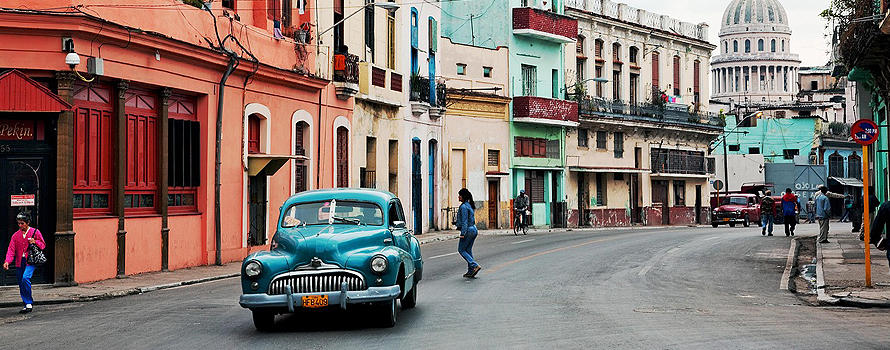
article / Valeria Vásquez
Raúl Castro replaced his brother Fidel as president of Cuba's state committee in 2008. Since then, the island has undergone changes in its organisation, although without abandoning its communist structure or the revolutionary principles set in motion in 1959. On coming to power, Castro decided to embark on a path of structural reforms in order to "update" Cuba's socio-economic model and emerge from the serious economic crisis.
As part of this programme, Raúl Castro approved a series of social and economic reforms of a "transformative" nature, which tended towards the introduction of market mechanisms, while maintaining adherence to socialist principles based on centralised planning (and without accompanying these changes with political liberalisation). Revitalisation was the main goal of the reforms in the economic sphere, turning around what had been a fully socialist approach policy and rejecting free market reforms.
Ten years after the changeover between the Castros brothers, the Cuban regime is preparing for the arrival in April of the first president from outside the family. Although it has not yet been confirmed who the new president will be, it is expected that the current vice-president, Miguel Díaz-Canel, will be appointed as part of a continuity of power.
The country is currently at a disadvantageous status , with political uncertainty over the new phase that is opening up, the serious economic difficulties that Venezuela (the island's main benefactor for more than a decade) is going through, and the truncated foreign expectations that the arrival of Donald Trump in the White House a year ago brought with it.
update from model economic
Since 1959, Cuba's economic model has been based on revolutionary socialist principles. Since Raúl Castro came to power, however, a process of transformation has been undertaken, considered necessary to move forward a Economics that was stagnating and immersed in a serious crisis.
In reality, there was no substantial modification of the economic model , but rather a update of it, maintaining the predominance of central state planning and state ownership over the laws of the free market. The goal of this process has been to guarantee the continuity and irreversibility of socialism, as the Cuban authorities have declared, as well as to promote the country's economic development and improve the standard of living of the population.
The framework reforms were approved at the VI congress of the Cuban Communist Party, held in 2011. Among other points, the approved agreements established the submission of a usufruct to peasants and cooperatives, and opened the door to the mass dismissal of hundreds of state employees. The reform guidelines, however, did not set out the specific role that the state and state-owned sector should play in the Economics.
The so-called update of Cuba's model has led to the expansion of the market and non-state ownership, but in a Economics that is still conditioned by state planning this measure is still inefficient, as it was in China or Vietnam. While the state business still prevails (in a more decentralised form, through self-financing and without fiscal subsidies), the private sector has become more flexible, but heavy taxation of the private sector still hampers development.
Land in usufruct
One of the main pillars of the Castro government's reforms was the submission usufruct of idle state land to peasants and cooperatives, with the purpose aim of reducing imports and increasing production. The usufructuaries have obtained the right to cultivate the land and to keep what they harvest, but the state retains ownership and can terminate the contract for reasons of public interest.
Regulation was carried out through two laws: a first, in 2008, subject to many restrictions and actually disadvantageous for farmers; and a second, in 2012, more flexible, whereby the government expanded the size of the plot (from 13 to 67 hectares), approved the planting of orchards and forests, and also allowed the construction of houses next to the land (previously forbidden).
In March 2011, the government reported that 128,000 usufructs, totalling 1.2 million hectares, had already been handed over. However, although the 2012 law was less restrictive than the previous one, as mentioned above, it still included certain hurdles that discouraged farmers from getting involved: farmers made gains, but only after overcoming various obstacles.
Mass dismissal of civil servants and self-employment
At the beginning of 2011, the state payroll presented an "inflated" rate, with millions of state employees in precarious positions and conditions at work . For this reason, Raúl Castro promoted the dismissal of 500,000 surplus state workers between October 2010 and March 2011, which raised the unemployment rate to 12%. To counteract this measure, 250,000 self-employed jobs were initially created and other private activities were also promoted.
This was necessary to raise labour productivity, reduce costs and increase wages. The agreements of the CCP's VI congress allowed for the approval of 178 self-employed activities: many of them were very specific and unskilled (such as forklift drivers or bath attendants), and a few were skilled (such as translators or insurance agents). This made the private work more flexible.
Thus, in a country with a labour force of 5 million people, out of the total of 11.2 million people living on the island, a total of 4.2 million of those working are state employees and the rest are in the non-state sector, consisting of agricultural cooperatives, private farmers and the self-employed [1]. The latter now number 500,000 people. Despite this development of what is known in Cuba as "cuestapropismo", there are restrictions that prevent most professionals from working on their own in their profession, and this reduces the human capital available to boost the country's Economics .
Openness to foreign investment
The flow of investment from abroad has not accompanied the reforms promoted by Raúl Castro, which has been one of the biggest obstacles to the desired success. In order to attract foreign investment, the Special Zone of development Mariel (ZEDM) was inaugurated in 2013. The port of Mariel, located 45 kilometres west of Havana, was allocated a 465.4 square kilometre industrial zone and an advanced ship terminal. entrance The purpose was to convert the ZEDM, through the existence of incentives to attract investment, into the main gateway for foreign trade and the largest industrial structure in Cuba [2]. However, four years after its inauguration, the results have not been as expected. In an administrative process that has followed an extraordinarily slow pace, today only 33 companies have been set up at C , a far cry from the 2.5 billion dollars that the ZEDM was intended to attract annually.
The restoration of diplomatic relations with Washington at the end of the Obama administration has not accelerated investment from the US or other Western countries. In addition to the US embargo remaining in place, the Trump administration has reversed provisions passed by his predecessor that opened a timid door to greater economic engagement.
status economic
Raúl Castro's reform plan has not been as successful as expected, mainly because of the restrictive Degree that regulates them. The lack of the intended economic revitalisation has manifested itself in the poor performance of Cuba's Economics in recent years. In 2016, Cuba fell into recession, with an economic decline of 0.9%. In 2017, it was able to recover slightly (figures that have not yet been finalised speak of a 1.6% increase in GDP) thanks to a boom in tourism and better agricultural results.
In the last decade, tourism has been precisely one of the assets of the Cuban Economics . agreement According to an ECLACreport , tourism to the island grew by 11.9% in 2017, with 4.7 million visitors. This increase accounts for the largest issue of visits from the United States, made possible by the elimination of restrictions approved by Obama, but which Trump has reimposed.
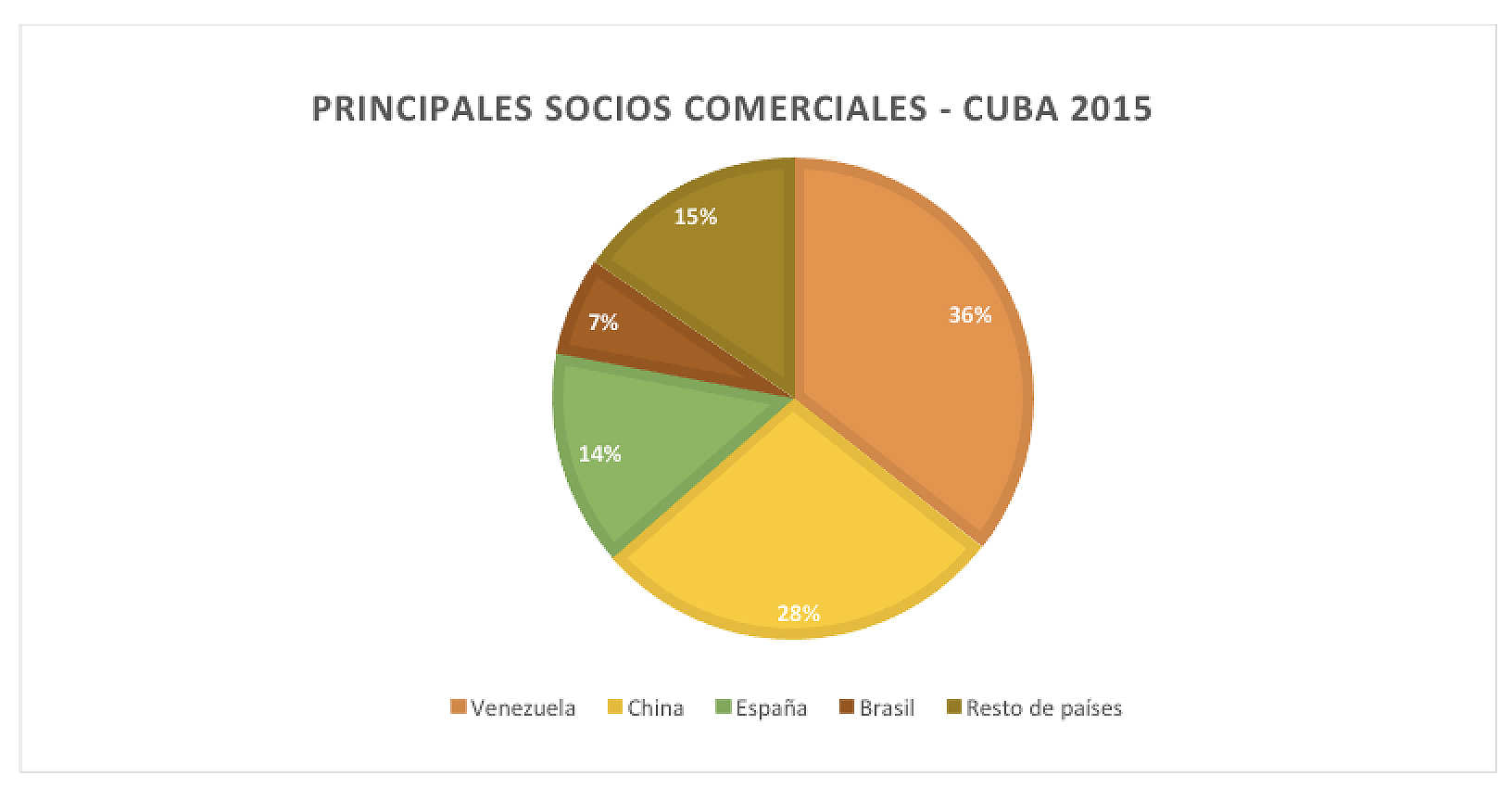
On the other hand, Cuba maintains its chronic trade deficit. Although in 2016 it managed to reduce it to 9.6 per cent of GDP, the outlook is not good, given Venezuela's difficulties in continuing to supply oil, practically on a non-repayable basis. In 2015, Venezuela was Cuba's main trade partner , with which it maintains 36% of its foreign trade, in a exchange valued at 4 billion dollars. It is followed by China, with 28%, a country that sells under soft credit conditions to the island.
|
sourceSOURCE: ONEI. yearbook Estadístico de Cuba 2015, external sector. |
bequest and new challenges
As Raúl Castro's presidency draws to a close, Cuba finds itself in an unfavourable status , with a Economics that is struggling to emerge from stagnation and with a programme of structural reforms that have been insufficient to resolve the problems accumulated over more than 60 years of centralised state socialism. partner-economic problems. The timid nature and slow pace of economic reforms have not helped to revive Economics.
However, during his decade in power, Castro has led changes in the management of model, something that should be taken into account even though in the political sphere he has perpetuated the lack of freedom and the persecution of opposition activity, without undervaluing the moral guilt of the dictatorship. Among the changes that have taken place are the opening up to foreign investment, new diplomatic relations, participation in Latin American forums and the immersion of Cubans in work on their own account.
Probably forced by circumstances, Raúl Castro was able to break down some of the obstacles and ideological barriers that his brother Fidel had implemented on the island for more than 40 years in power. The outgoing president's bequest marks some progress, but it will be the actions of the incoming president that will indicate whether Cuba is truly moving towards the economic - and political - opening that Cubans have longed for.
[1] VIDAL, P. and PÉREZ Villanueva, Omar E. "Se extiende el cuentrapropismo en Cuba". Espacio Laical, vol. 6, n. 3 (2010), p. 53-58.
[2] HERSHBERG, E., & LEOGRANDE, W. M. (2016). A new chapter in US-Cuba relations: social, political, and economic implications. New York: Palgrave Macmillan.
The neighbors of the United States in the Western Hemisphere find it difficult to interpret the first year of the new administration
Donald Trump reaches his first anniversary as president of the United States having caused some recent fires in Latin America. His rude disregard for El Salvador and Haiti, due to the high figures of refugees sheltered in the U.S., and his harsh treatment of Colombia, for the increase in cocaine production, had damaged relations. Although they were already complicated in the case of Mexico, throughout the year they had some good times, such as the presidents' dinner that Trump summoned in September in New York in which a united action was drawn on Venezuela.
▲Trump in his first 100 days as president [White House].
ARTICLE / Garhem O. Padilla [English version] [Spanish version].
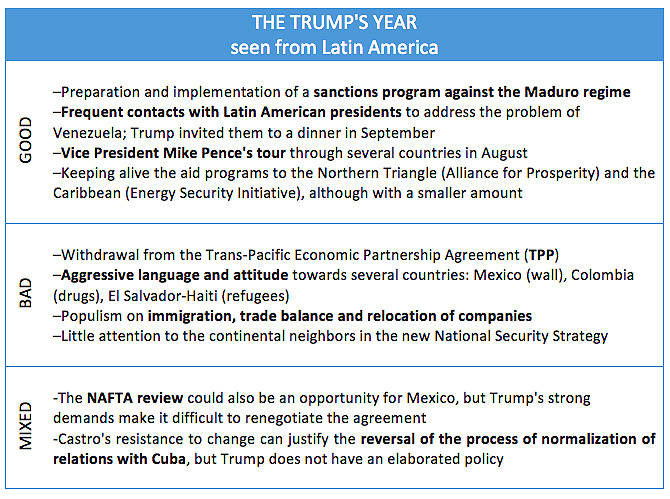
One year after the inauguration of the 45th President of the United States of America, Donald John Trump (the ceremony was on January 20), the controversy dominates the balance of the new administration, both in his domestic as well as international performance. The continental neighbors of the United States, in particular, show bewilderment about Trump's policies towards the hemisphere. On the one hand, they regret the American disinterest in commitments of economic development and multilateral integration; on the other hand, they note some activity in relation to some regional problems, such as the Venezuelan one. The actual balance is mixed, although there is unanimity that the language and many of Trump's forms threaten relationships.
From the TPP to NAFTA
In the economic field, the Trump era started with the definitive withdrawal of the United States from the Trans-Pacific Strategic Economic Partnership Agreement (TPP), on January 23, 2017. This made it impossible to enter into force since the United States is the market through which above all, this agreement emerged. The U.S. withdrawal affected the perspectives of the Latin American countries participating in the initiative.
Then, the renegotiation of the North American Free Trade Agreement (NAFTA), demanded by Trump, was opened. The doubts about the future of the NAFTA, signed in 1994 and that Trump has described as "disaster", have stood out in what is going of the administration. Some of its demands, which Mexico and Canada oppose, are to increase the share of products manufactured in the United States, and the "sunset" clause, which would force the treaty to be reviewed methodically every five years and suspend it if any of its three members did not agree. All this, arises from the idea of the U.S. president to suspend the treaty if it is not favorable for his country.
Cuba and Venezuela
If the quarrels with Mexico have not yet reached to an end, in the case of Cuba, Trump has already retaliated against the Castro regime, with the expulsion in October of 15 Cuban diplomats from the Cuban Embassy in Washington in response to"the sonic attacks" that affected 24 U.S. diplomats on the island. The White House, in addition, has revoked some conciliatory measures of the Obama administration because the Castro regime is not responding with open-ended concessions.
As far as Venezuela is concerned, Trump has made strong efforts in terms of introducing measures and sanctions against corrupt officials, in addition to addressing the political situation with other countries, so that they support those efforts aimed at eradicating the Venezuelan crisis, thus generating multilateralism between American countries. However, this policy has detractors, who believe that the sanctions are not intended to achieve a long-term objective, and it is not clear how they would promote Venezuelan stability.
Although in those actions on Cuba and Venezuela Trump has alluded to the democratic principles violated by the governors of Havana and Caracas, his administration has not insisted especially on the commitment to human rights, democracy and moral values, as being usual in the argumentation of the U.S. foreign policy. Some critics point out that the Trump administration is willing to promote human rights only when they meet its political objectives.
This could explain the worsening of the opinion that exists in Latin America about the United States and about the relations with that country. According to the Latinobarómetro survey 2017, the favorable opinion has fallen to 67%, seven points below that at the end of the Obama administration, which was 74%. This survey shows a significant difference for Mexico, one of the countries that, without a doubt, has the worst levels of favorable opinion towards the Trump administration: in 2017 it was 48%, which means a fall of 29 points in comparison with 2016, in which it was 77%.
 |
Immigration, withdrawal, decline
The restrictive immigration policies applied would also explain that rejection of the Trump administration by Latin American public opinion. In the immigration section the most recent is the decision not to renew the authorization to stay in the United States of thousands of Salvadorans and Haitians, who once entered the U.S. fleeing calamities in their countries.
We must also allude to Trump's efforts to achieve one of its main objectives since the beginning of his political campaign: to build a border wall with Mexico. The U.S. president has not had much success at this time, since although he has looked for ways to finance it, what he has managed to introduce in the budgets is very insignificant in relation to the estimated costs.
Trump's protectionism entails a withdrawal that may be accentuating the decline of the U.S. leadership in Latin America, especially against other powers. China has been increasing its economic and political performance in countries such as Argentina, Brazil, Chile, Peru and Venezuela. Russia, for its part, has strengthened diplomatic and security relations with Cuba. It could be said that, taking advantage of the conflicts between Cuba and the United States, Moscow has tried to keep the island in its orbit through a series of investments.
Threats to security
This leads us to mention the new National Security Strategy of the United States, announced in December. The document presented by Trump addresses the rivalry with China and Russia, and also refers to the challenge posed by the regimes of Cuba and Venezuela, by the supposed threats to security they represent and the support of Russia they receive. Trump expressed great desire to see Cuba and Venezuela join "shared freedom and prosperity" and called for "isolating governments that refuse to act as responsible partners in advancing hemispheric peace and prosperity."
Similarly, the new U.S. Security Strategy refers to other challenges in the region, such as transnational criminal organizations, which impede the stability of Central American countries, especially Honduras, Guatemala and El Salvador. All in all, the document only dedicates one page to Latin America, in line with Washington's traditional attention given to the areas of the world that most affect their interests and security.
An opportunity for the United States to approach the Latin American countries will be the Summit of the Americas, which will be held next March in Lima. However, nothing is predictable given the characteristic attitude of the president, which leaves a large open space for possible surprises.
Continental U.S. neighbors are having a hard time interpreting the first year of the new Administration.
Donald Trump arrives at his first anniversary as president having set some recent fires in Latin America. His rude disregard for El Salvador and Haiti, due to the volume of refugees welcomed in the United States, and his intemperate attention to Colombia for the increase in cocaine production worsen relations that, although already complicated in the case of Mexico, have had some good moments throughout the year, such as the dinner of presidents that Trump convened in September in New York in which a united action on Venezuela was outlined.
▲Trump, on completing 100 days as president [White House].
article / Garhem O. Padilla [English version].
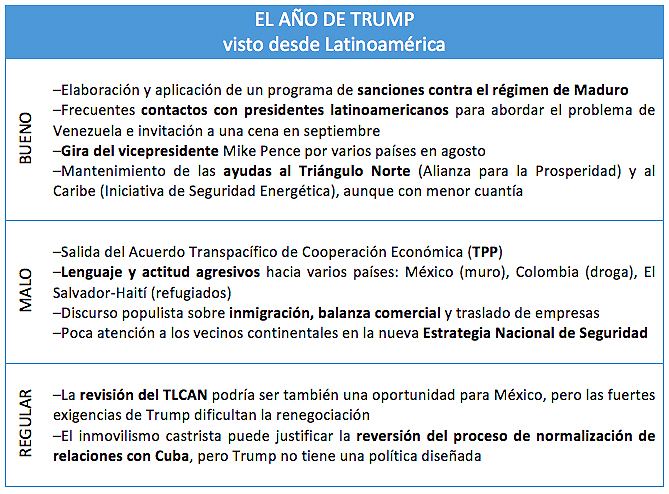
One year after the arrival of the 45th President of the United States of America, Donald John Trump, to the White House -the inauguration ceremony was on January 20-, controversy dominates the balance of the new Administration, both in its domestic and international performance. The continental neighbors of the U.S., in particular, show bewilderment over Trump's policies toward the hemisphere. On the one hand, they regret the U.S. disinterest in commitments to economicdevelopment and multilateral integration; on the other, they note some activity in relation to some regional problems, such as Venezuela. The balance for the moment is mixed, although there is unanimous agreement that Trump's language and many of his manners rather threaten relations.
From TPP to NAFTA
agreement In the economic field, the Trump era began with the withdrawal final of the United States from the Trans-Pacific Partnership (TPP) on January 23, 2017. This made it impossible for entrance to enter into force, as the United States is the market for which the TPP was created agreement, which has affected the prospects of the Latin American countries that participated in the initiative.
The renegotiation of the North American Free Trade Agreement (NAFTA), demanded by Trump, was immediately opened. Doubts about the future of NAFTA, signed in 1994 and which Trump has described as a "disaster", have been prominent so far in his administration. Some of his demands, which Mexico and Canada oppose, are to increase the quota for products manufactured in the United States and the "sunset" clause, which would oblige the treaty to be reviewed methodically every five years and would cause it to be suspended if any of its three members were not in agreement with agreement. All of this stems from the U.S. president's idea of fail the treaty if it is not favorable to his country.
Cuba and Venezuela
If the quarrels with Mexico have not yet reached a conclusion, in the case of Cuba Trump has already retaliated against the Castro regime, with the expulsion in October of 15 Cuban diplomats from the Cuban embassy in Washington as a response to the "sonic attacks" that affected 24 U.S. diplomats on the island. The White House has also reversed some of the Obama Administration's conciliatory measures, when it realized that Castroism is not responding with openness concessions.
As far as Venezuela is concerned, Trump has made forceful efforts to introduce measures and sanctions against corrupt officials, in addition to addressing the political status with other countries, so that they support those efforts aimed at eradicating the Venezuelan crisis, thus generating multilateralism among American countries. However, this policy has its detractors, who believe that the sanctions are not intended to achieve a long-term goal deadline , and it is unclear how they would promote Venezuelan stability.
Although in these actions on Cuba and Venezuela Trump has alluded to the democratic principles violated by the rulers of Havana and Caracas, his Administration has not particularly insisted on the commitment to human rights, democracy and moral values, as had been usual in the argumentation of U.S. foreign policy. Some critics point out that the Trump Administration is willing to promote human rights only when they fit its political objectives.
This could explain the worsening opinion in Latin America about the United States and relations with that country. From agreement with the survey Latinobarómetro 2017, the favorable opinion has fallen to 67%, seven points below the one at the end of the Obama Administration, which was 74%. Said survey sample a relevant difference for Mexico, one of the countries that, without a doubt, has the worst levels of favorable opinion towards the Trump Administration: in 2017 it was 48%, a drop of 29 points compared to 2016, when it was 77%.
 |
Immigration, withdrawal, decline
The restrictive immigration policies applied would also explain the rejection of the Trump Administration by Latin American public opinion. In the immigration section the most recent is the decision not to renew the authorization to stay in the United States of thousands of Salvadorans and Haitians, who once arrived fleeing calamities in their countries.
It is also worth mentioning Trump's efforts to achieve one of his main objectives since the beginning of his political campaign: to build a border wall with Mexico. The U.S. president has not been very successful so far in this goal, since despite having sought ways to finance it, what he has managed to introduce in the budgets is very insignificant in relation to the estimated costs. On the other hand, his decision
Trump's protectionism entails a retreat that may be accentuating the decline of the United States as a leader in Latin America, especially vis-à-vis other powers. China has been increasing its economic and political engagement in countries such as Argentina, Brazil, Chile, Peru and Venezuela. Russia, for its part, has strengthened its diplomatic and security relations with Cuba. It could be said that, taking advantage of the conflicts between the island and the United States, Moscow has sought to keep it in its orbit through a series of investments.
Security threats
This leads us to mention the new US National Security Strategy, announced in December. The document, presented by Trump, addresses the rivalry with China and Russia, and also refers to challenge the Cuban and Venezuelan regimes, for the alleged security threats they pose and the Russian support they receive. Trump expressed a strong desire to see Cuba and Venezuela join in "shared freedom and prosperity" and called to "isolate governments that refuse to act as responsible partners in advancing hemispheric peace and prosperity."
Similarly, the new U.S. Security Strategy alludes to other challenges in the region, such as transnational criminal organizations, which impede the stability of Central American countries, especially Honduras, Guatemala and El Salvador. However, the document devotes only one page to Latin America, in line with Washington's traditional focus on the areas of the world that most affect its interests and security.
An opportunity for the United States to get closer to Latin American countries will be the Summit of the Americas, to be held next March in Lima. However, nothing is predictable given the President's characteristic attitude, which leaves a great deal of room for possible surprises.