Against a backdrop of growing populism, the battle between Brussels and Rome is decisive for the future of the EU.
In a measure without parallel in the history of the Union, the European Commission has rejected the national budgets presented by the populist Italian government for not meeting the deficit targets set. Neither Brussels nor Rome seem to have any intention of abandoning their positions, so that an institutional confrontation threatens the European horizon.
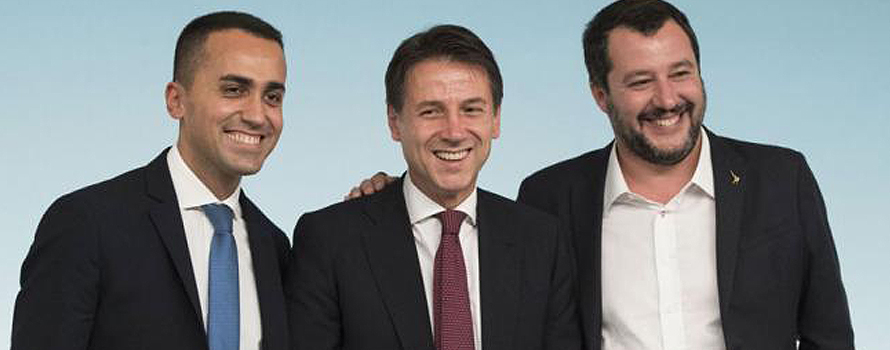
▲ Giuseppe Conte, President of the Italian Government, with Vice-Presidents Luigi di Maio (left), leader of the 5 Star Movement, and Mateo Salvini (right), leader of the Northern League. [Gov. of Italy]
article / Manuel Lamela
After seven months in government, the coalition formed by the 5 Star Movement and the Northern League have fulfilled their promises and, with the presentation of the Italian Republic's budget , have initiated a process of confrontation and defiance with the European Union (EU). The Brussels authorities accuse Italy of breaking, with its irresponsibilities, the bonds of trust that forge and give meaning to the European project .
On October 16, Giuseppe Conte's government presented a budget with a deficit forecast of 2.4%; although it is true that the figure is below the 3% limit set by the European rules and regulations , it is three times what was previously agreed between Rome and the EU. Moreover, if Italy's public debt is 131% of GDP, which makes it the second highest in the monetary Union, only surpassed by Greece, the new budget will only increase it, as it intends to significantly increase public expense .
The increase in the expense seems to obey the populist interests of the Northern League leader and Minister of the Interior, Mateo Salvini, who has made no secret of his intention to seek support from the most fractured sectors of Italian society. Cultivating victimhood vis-à-vis Europe may give a certain political gain, but the example of Greece sample us that such attitudes tend to end in tragedy, weakening the State in the face of another possible debt crisis.
At the end of October, the European Commission rejected the Italian draft budget refund refunding the budget of a Member State was an unprecedented act -and urged Rome to send a revised version within a maximum of three weeks. The decision does not close the door to dialogue and negotiations, as the Commissioner for Economic Affairs, Pierre Moscovici, explains in his explanation of what happened: "The opinion adopted today should not come as a surprise to anyone, as the Italian government's project budget represents a clear and intentional departure from the commitments made by Italy last July. However, our door is not closed. We want to continue our constructive dialogue with the Italian authorities. I welcome the commitment of the Minister of Finance, Giovanni Tria, to this end and we must move forward in this spirit in the coming weeks."
But Conte's government assures that there is no plan B and that there is no possibility that Italy will take a step back. Both Mateo Salvini and the leader of the 5 Star Movement, Luigi di Maio, both vice-presidents of the Government, defended the Italian position and attacked Brussels, claiming that it is normal for Brussels to be unhappy, since it is the first time that Italy is free from the clutches of the Eurogroup when it comes to deciding its economic policy. They also stated that, with its response, the high school of Commissioners is directly attacking the Italian people. And they accused Commission President Jean-Claude Juncker of "only talking to inebriated people", something that certainly sample little respect for the institutions.
The tactic of simulating strength and determinism, which both Italian political formations used during the election campaign, is being matched by the rest of European leaders with an exercise of real power. The request of the Italian Minister of Finance, Giovanni Tria, for Italy to enjoy the same opportunity that Portugal had in the past, when Brussels accepted that the Portuguese Prime Minister, Antonio Costa, did not apply the cuts Issue desired by the Commission, will be drowned out by the reckless ways used by the political leaders of the Italian Republic.
If Italy refuses to follow the recommendations given by the EU, the Commission may consider imposing fines, up to 0.2% of GDP, for non-compliance with the Stability and Growth Pact. But apart from sanctions, the EU does not have the right to veto, nor does it have any other skill to prevent the entrance into force of the Italian budget . As several experts indicate, it will be the pressure of the markets that will make the Italian measure be corrected, thus avoiding a direct confrontation between Rome and Brussels that would damage both parties equally. Goldman Sachs analysts predict that "Italian debt must worsen to exert adequate pressure and force the government to opt for a different rhetoric".
Even if the European Commission manages to avoid a confrontation with Italy, it may be exposed to the campaign of victimhood of the Italian populist groups, a tactic they successfully employed in the last elections. This is a tactic that is not of Italian creation, as since the crisis of 2008 various groupings and parties have emerged with a clearly anti-Brussels stance, accusing the EU institutions of all the ills suffered by European societies. There are several examples; perhaps Brexit is the most resounding given its relevance at European and international level, but we should not forget the rise of formations such as the National Front in France, the Freedom Party in Austria or Podemos in Spain, the latter party having had its great public launch following the 2015 European Parliament elections.
So far, Europe has not been able to find a way to avoid or neutralize the demagogy campaigns that proliferate in today's Europe. Although some progress is being made in terms of the EU's communicative power, it is incomprehensible that Brussels has not been able to explain the European project effectively to the citizens of the Union. This is a shortcoming that the European project has had since its inception and that has been the cause of many of the ills that have affected regional unity in recent decades. In this case, Europe has to provide data that are easy to understand for the average Italian citizen and that make them see that the measures adopted by their government will be harmful to Italian society in the near future, even if they are sweetened by messages that respond to empty promises and messianic policies.
Another factor of concern within the Commission is the risk of contagion of the virus generated within the EU's third largest Economics (excluding the United Kingdom). At first it may seem possible that other member states will be attracted to follow in Italy's footsteps; however, European authorities say they firmly believe that their tough response to Rome will strengthen monetary union and even increase integrity in areas such as banking unity. Externally, the decision will show that EU budgetary rigor is being enforced, generating confidence and security in the markets, and finally demonstrating that there is no respite for populist formations within Europe.