You may be interested in:
Science and religion
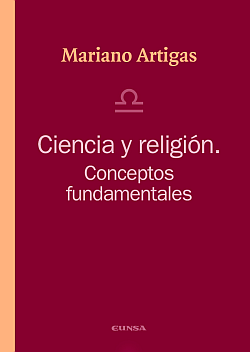
Author: Mariano Artigas
Published in: posthumous work by Mariano Artigas Ciencia y religión (Pamplona, Eunsa, 2007).
Publication date: 2007
review by Guillermo Juan Morado on the Religion in freedomblog
review by Guillermo Juan Morado
If one habit of mind determines our way of thinking and living in today's society, it is science. Rigour, precision and the ability to predict results make up a field of knowledge, science, whose practical applications we benefit from on a daily basis.
Science and religion are sometimes seen as rival camps or at skill. If science explains much - it is sometimes believed - then religion would have little left to explain. Already Comte, the champion of positivism, foresaw the replacement of religion by metaphysics and, later, of metaphysics by science.
But the conflict, or incompatibility, between science and religion is more apparent than real. Science, in itself, does not exclude religion. It may perhaps be tempted to exclude it if science drifts towards a scientistic ideology, according to which the only valid knowledge would be the scientific knowledge and the only reality would be that part of reality that can be circumscribed within the perimeter of the scientific research .
On this binomial, "science-religion", I would like to recommend a book, which I found extremely interesting to read. It is a work by Mariano Artigas, entitled "Ciencia y religión. Conceptos fundamentales" (EUNSA, Pamplona, 2007, 422 pages).
The author, now deceased, is a solvent thinker, with a PhD in Physical Sciences and at Philosophy. A previous book of his, "The Mind of the Universe", had already struck me as enormously suggestive. Artigas combines, like good teachers, seriousness with clarity.
This book deals with twenty-five topics involving science and religion. Topics from subject epistemological, which clarify the characteristics and scope of both knowledge: "Science and knowledge ordinary", "science and Philosophy", "science and religion", "scientism", "scientific language", etc. Historical subject topics, such as a brilliant chapter on "Galileo and the Church". Or more systematic approach issues such as those devoted to the "soul", "creationism", "God" or the relationship between "evolutionism and Christian faith".
This book also has the advantage that it does not have to be read in one sitting. Each of the chapters retains its own autonomy. If you haven't read it, do so. You will enjoy it.
review from the back cover
Man seeks to attain a unitary vision of the world and to find the meaning of his own existence. In this difficult task, Philosophy and faith have come up against meeting . At the present time, many scientific publications of an informative nature seem to defend the idea that science is the only one capable of providing answers to all human questions, making the religious and sapiential knowledge superfluous.
Is science capable of answering all of man's questions and concerns? What does it say about the great issues of faith such as God or the soul? What perspectives can the most recent scientific discoveries offer to faith? How do science and faith relate to each other? Do they contradict or complement each other?
Prof. Mariano Artigas devoted many years of his life to researching and clarifying the relationship between science and faith, and closely followed the great debates that arise between the two perspectives, such as, for example, those raised by evolution or the origin of the universe. This book presents a list of twenty-five topics that he considered to be the most current and crucial in the scientific-cultural discussion .
Each chapter forms a unit that can be read independently of the others. Its length and the language employee have been designed so that every subject reader can obtain a comprehensive and at the same time accessible overview of the fundamental questions arising from the relationship between science and religion. In addition, an extensive subject index provides access to many other borderline issues that are not explicitly listed in the table of contents.
Mariano Artigas finished this book shortly before his death and offers a mature synthesis of his thinking. The text can be a good financial aid for those who want to take a critical look at the most important questions raised by the relationship between modern science and religion.
Mariano Artigas (Zaragoza, 1938 – Pamplona, 2006). A Doctor of Physical Sciences and Philosophy, he was the first Dean the Ecclesiastical School of Philosophy Full Professor Philosophy of Science and Nature at the University of Navarra from 1987 until his death. He published eighteen books and numerous scholarly and popular articles on the relationships between science, philosophy, and theology. He was a full member of the International Academy of Philosophy of Science in Brussels and the Pontifical Academy of St. Thomas in the Vatican; consultant committee for Dialogue with Non-Believers and a guest of the Pontifical Academy of Sciences; and Visiting Professor several universities in Spain and other countries. He was honored with the award from the University of Navarra in 2002. He also received an award several research grants research the Templeton Foundation in the United States.