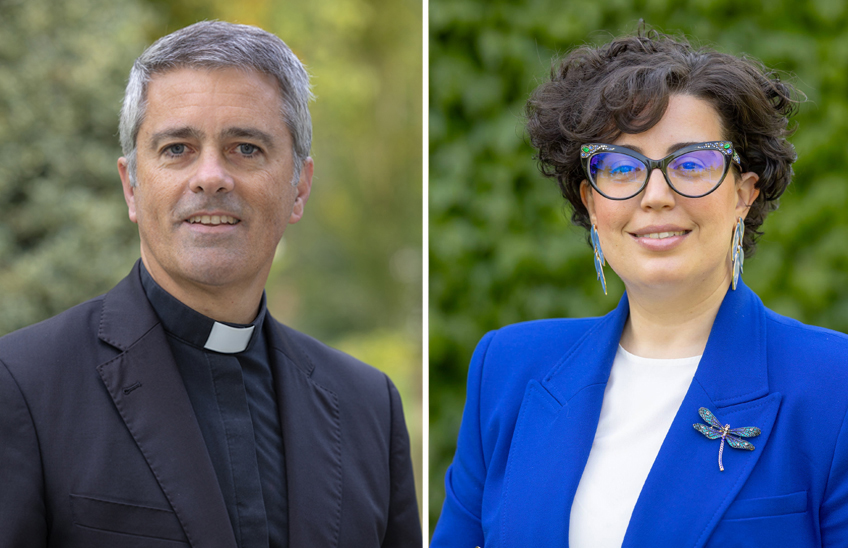
Ángel Rodríguez Luño: "Moral truth cannot depend solely on culture or history."
The Full Professor of the Pontifical University of the Holy Cross (Rome) gave the lecture patron saint day patron saint the Schools Theology and Ecclesiastical Philosophy the University of Navarra.

PhotoManuelCastells/Professor Ángel Rodríguez Luño focused his lecture "The image of God in man as a fundamental principle of research ."
06 | 02 | 2026
In the framework the patron saint Day patron saint the Schools Theology and Ecclesiastical Philosophy at the University of Navarra, Professor Ángel Rodríguez Luño, Full Professor of the Pontifical University of the Holy Cross (Rome), argued that "moral truth cannot be left at the mercy of cultural fads or historical changes," and warned of the risk of a modern voluntarism that absolutizes freedom by detaching it from any real foundation. These ideas were articulated in his lecture image of God in man as a fundamental principle of research , research which brought together more than 300 people.
Rodríguez Luño explained that the biblical assertion that human beings were created "in the image and likeness of God" means that qualities such as intelligence, freedom, justice, and fidelity are not mere social constructs, but imperfect reflections of the divine being. He also pointed out that this analogy allows us to access stable moral truths and understand God based on created reality: "Without that image, it would be impossible to speak of a truth that remains, beyond opinions or circumstances."
The professor recalled that this concept has been core topic Christian tradition, from St. Augustine to St. Thomas Aquinas, for whom knowledge participates in divine light. He affirmed that thanks to this, it is possible to recognize principles of justice, goodness, and truth that do not change with the passage of history.
A moment during lecture . Rodríguez lecture . He is accompanied at the table by Gregorio Guitián and Santiago Collado, deans of the Schools Theology and Ecclesiastical Philosophy .
"If we leave a void, other currents will fill it."
In the second part of his speech, Rodríguez Luño analyzed the effect of various modern philosophical trends that have tended to weaken this view. Some of these currents, which are also influential in contemporary theology, present freedom as an School capable of deciding even its own essence. In response to this approach, he warned that institutions such as marriage, the family, or the priesthood may end up being interpreted solely on the basis of criteria of staff autonomy staff cultural sensitivity.
"When freedom is placed above any objective truth, everything is reduced to changing decisions," he emphasized. As he explained, this approach to speak of natural justice or divine law capable of guiding the moral and legal life of the Church.
Faced with this trend, he defended the importance of integrating the contributions of modernity, such as the recognition of subjectivity, without losing sight of the fact that freedom needs to be grounded in the truth of human beings. He stated: "If we leave a void, other currents will fill it."