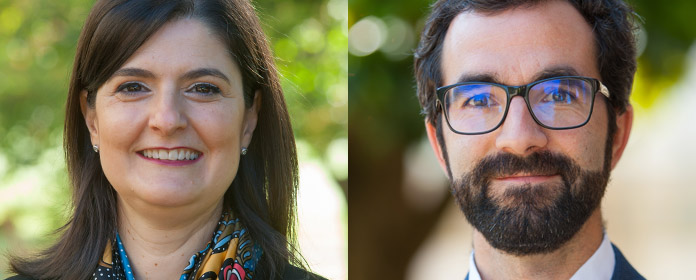
Interview with Ismael Sanz and David Cervera
Experts in Innovation Programs speak on the occasion of the next International Clil+ Science congress


On June 17 and 18, the School of Education and Psychology will hold the internationalcongress Clil+ Science, in which national and international experts will address the teaching of Science and Technology through Content and Language Integrated Learning (CLIL).
To learn about the benefits of CLIL and its relationship with Science, we interviewed Ismael Sanz, Director General of Innovation, Scholarships and Grants of Education of Comunidad de Madrid and David Cervera, Deputy Director of Innovation Programs.
The competences at 15 years of age of Spanish students in mathematics, reading and science (according to data of report PISA) are, in general, below the average of the OECD countries and the EU itself. Is the system educational ready to talk about CLIL or are there, before, some critical competences that should be solved?
If we make a quick reading of report PISA we see that Spain is below the OECD and EU average. But if we analyze in more detail we observe that our students show similar characteristics to those of the countries that are in the top positions. The percentage of students in the intermediate levels in Spain is approximately the same as in the countries that appear in the top positions. The difference is that in Spain we have few students at the level of excellence and a higher number at the lower levels. Moreover, in the specific case of Madrid, the PISA results for this community are above the OECD and EU averages.
The educational system is CLIL-ready. The competencies analyzed by PISA are reading comprehension, mathematics skill and science skill . Of these three competencies, students only study science in another language , so that the effect, even if we pay attention to those who say that students have lost knowledge, would only be limited to some subjects. In Spain, which has traditionally been a country that has been considered "bad for languages", this perception is changing. After 12 years of the Bilingual Program in the Community of Madrid, the first class of students who started this adventure in the 1st year of Primary School, this year 2016 are in the 2nd year of Primary School, with an exceptional level in English and a very good level in the 2nd year of Primary School. high school diplomaThis year they have an exceptional level in English and with equally positive results in the rest of the subjects. Undoubtedly one more test to verify that these students have not been harmed by studying in another language will be the test of university entrance exam. On the other hand, this is what we have achieved in 12 years, no one questions it in Singapore, where for 50 years students have been learning and studying all subjects in English.
CLIL is based on the premise that in school contexts there is greater success in learning foreign languages through common subjects. This methodology, which works in other countries and which in our country can be "groundbreaking" with a more traditional model from teaching , implies dismantling learning barriers... What advantages and disadvantages, if any, would you point out in both cases?
What the evidence shows is that a greater contact with the language makes it known and mastered to a greater extent. In the European Study of skill Linguistic, carried out in non-bilingual centers throughout Spain (given that at that time they had not yet reached the 4th year of ESO) and in the rest of the participating countries, the patron saint in the use of language in three skills was sample , being different for Spain than for the rest of the countries. The participating countries show a higher performance in the skill of oral comprehension than in reading comprehension and written expression, patron saint which is the inverse in Spain. One interpretation of these data is that the school does a lot for language learning, but above all in reading comprehension and writing skills. On the other hand, the exhibition at language as a consequence of not dubbing the movies makes oral comprehension improve notably and in turn contributes to the other two skills. In Spain this does not happen and the input that has been introduced in bilingual centers corrects it to a certain extent, but it would be of great importance to financial aid the commitment of families and society to have a greater immersion in language.
As you know, the School has organized an international congress Clil+ Science on June 17 and 18. In your opinion, what are the advantages of studying Science in English?
To mention one advantage, many of the words used in science and technology have their origin in new English words that are incorporated and adapted to the rest of the languages. For this reason, it is not a great difficulty to add vocabulary, sometimes very technical, to the usual language that students use at subject. In any case, whether in Science or in other subjects in which ClIL is used, the great advantage is that student gets used to writing, expressing, debating, defending a position in this language and this makes them develop techniques and skills that will undoubtedly be very useful in their future professional life, in which they will have meetings with people of different nationalities, where they will have to communicate through videoconferences, etc. What learning in another language brings is mainly agility and communication skills, subject is important but in its right measure.
There are some reports that point out and relate the low performance of students with a certain lack of motivation. Could this subject of learning - CLIL - be a way to combat it?
The student 's demotivation is one of the core topic for their failure in the educational system. In order to combat demotivation in some students, CLIL methodology can be effective, since it allows them a greater capacity to understand information, for example through the Internet, video games, songs, etc. But I do not believe that this is the driving force for change to avoid student demotivation. The training of the faculty and their experience in dealing with different types of students, working in coordination with other teachers, working through projects and other techniques and alternatives are the ones that can get students hooked that in a more traditional system could be lost. Undoubtedly, the professional skill of teachers are decisive in motivating students.
The logical relationship between higher skill levels - greater employability options and access to better jobs at work is being questioned. How can we recover that sequence when we have a not small sector of the population that is hyper-qualified and has to leave the country to work?
It is true that the high qualification allows making future decisions with an international projection in the search for employment outside the borders of our country. This has already happened in other historical moments and not precisely with the most qualified population, nor with a high management in the language. I believe that we must look for an answer in the change of the labor market, in the new positions of work, in the mobility of the people. On the other hand, there are many who acquire experience and training abroad and then return and develop their professional activity from our country but with an international scope.
Should we, as a country, make a social reflection about the role we give to Education as an engine of progress?
Undoubtedly, Education is an engine of progress. The Education allows a better adaptation to new work situations. Today we do not know what jobs will be like in 20 years. The PIAAC study sample shows that Spain is the country with the second highest progress educational when we compare the population of older generations (55 - 65 years old) and younger generations (16 - 24 years old). We still have a long way to go but it is very interesting to look at the status from which Spain comes 50 years ago and what has been achieved in these decades.