The University obtains €2 million in financial aid to research new ways to combat Alzheimer's disease.
Maite Solas has received an scholarship Consolidator Grant scholarship to study the role of brain metabolism in the early stages of the disease.

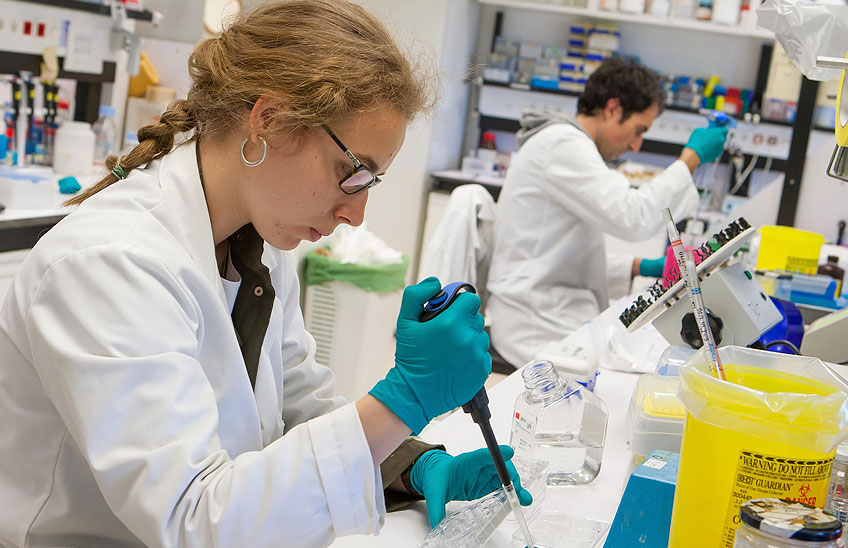
PhotoManuelCastells/Researcher Maite Solas.
09 | 12 | 2025
Maite Solas, a researcher at the School Pharmacy and Nutrition at the University of Navarra, has been awarded an ERC Consolidator Grant, one of the most competitive European grants for promoting scientific projects of excellence. Awarded by the committee research committee research endowed with two million euros, it will enable the development of HyperAstroMet, an project that proposes a paradigm shift in the study of Alzheimer's by focusing on the metabolism of astrocytes—cells essential for brain function—and their role in the early onset and progression of the disease.
"Alzheimer's disease continues to grow worldwide and still lacks truly effective treatments. Our project looking at the brain from a approach by analyzing how astrocytes manage energy and how this altered metabolism can trigger report loss report neuronal dysfunction," explains Solas. "Obtaining an ERC grant is a decisive boost that will allow us to explore a little-studied avenue with enormous potential that could transform our understanding of the disease," he says.
Astrocytes and brain energy: an innovative line of research
HyperAstroMet focuses for the first time on early metabolic changes in astrocytes, cells responsible for supplying energy to neurons. project hypothesis project that, in the very early stages of Alzheimer's, astrocytes undergo abnormal metabolic reprogramming; that is, they begin to "function differently" in the way they manage the brain's energy. Because of these alterations, these cells may consume more glucose than normal, store glycogen—their main reservation less efficiently, or respond incorrectly to signals such as insulin. These imbalances, although small at first, could trigger a domino effect that favors the onset and progression of Alzheimer's disease.
Preliminary research by group suggests that modulating astrocyte metabolism could protect the report improve cognitive function, opening the door to new therapeutic strategies. To this end, the team will use state-of-the-art technologies such as spatial mapping of genes and metabolites, miniaturized microscopes for live imaging of the brain, and human-mouse chimeric models. "This approach will allow approach to study early metabolic processes in human astrocytes with unprecedented resolution and evaluate therapeutic strategies more realistically than with traditional animal models," explains Solas.
A project potential social impact
Understanding how the brain manages its own energy is not only a challenge : it has enormous potential for social impact. This knowledge influence the prevention of Alzheimer's core topic, the design drugs that act on core topic metabolic pathways, the development nutritional interventions that support brain health, and the creation of public health strategies focused on early detection.
HyperAstroMet's advances could open the door to new drug targets based on astrocyte metabolism, enable the development early biomarkers capable of identifying alterations before symptoms appear, and promote health policies that focus on brain energy modulation. "If we can intervene in the early stages of Alzheimer's, we could preserve report improve patients' quality of life, as well as alleviate the burden on families, health systems, and society," Solas points out.
Navarre as a scientific benchmark
The project collaborations with reference letter centers and institutions such as the Achucarro Basque Center for Neuroscience, CIC biomaGUNE, and Harvard School , among other groups.
For Solas, the recognition also highlights the strength of the researcher ecosystem researcher : "This project thanks to the support of the School Pharmacy and Nutrition at the University of Navarra, shows that Navarre is capable of conducting research at the highest level. We want it to inspire new generations of scientists and help attract talent and advanced technology to our region as a leader in research neurodegeneration and brain metabolism," she concludes.
The scholarship Grant scholarship is one of the most prestigious grants awarded by the European Union and is intended for researchers with outstanding careers and innovative projects that address core topic challenges core topic science and society. In this edition, 3,121 applications were submitted, of which 349 projects were selected, 26 of them from Spanish researchers.