International workshop in London examines the challenges of schooling Muslims in Europe
It was organized by Daniel Moulin, researcher of the project 'Religion and Civil Society' of the ICS, and Farid Panjwani, director of the Centre for the research and assessment on Education Muslim of University College London.
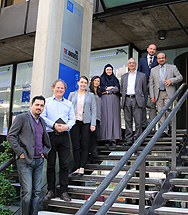
Experts from academic centers in the UK, USA and Spain analyzed the challenges of schooling Muslims in Europe at an international workshop held in London. It took place at high school of Education of University College London, which is ranked first in the QS World University Ranking of Education.
The activity was organized by Daniel Moulin, researcher of the project 'Religion and Civil Society' of the Institute for Culture and Society (ICS) of the University of Navarra, and by Farid Panjwani, director of the Centre for the research and assessment on Education Muslim of University College London. The activity took place in this British campus and was funded by The Spalding Trust.
Other speakers included Kirsten Yoder Wesselhoeft, professor of religion at Vassar College in New York (U.S.); Shiraz Thobani, from the programs of study Institute of programs of study in London (United Kingdom); Reza Gholami, professor of Sociology of Education the School of Science and Public Policy at Keele University (United Kingdom); and Robert Bowie, president of the association University Professors of Religion and Education senior lecturer in the Faculty of Childhood and Education Sciences Education Canterbury Christ Church University (United Kingdom).
Número especial en <i>Oxford Review of Education</i>The papers will be published in a special issue in the Oxford Review of Education, a prestigious international scientific journal on Education. Drs. Panjwani and Moulin will be the guest editors.
The workshop was held at goal to critically analyze current controversies about the Education of Muslims in Europe. A central issue was the increasing identification of Muslim populations in Western contexts with religious identity rather than with varied perspectives of ethnic or national attributions, as was the case in the past.
In this sense, the activity addressed whether this fact has been beneficial or detrimental in terms of promoting citizenship, what new possibilities have been opened and which have been Closed, and how to ensure that people with Muslim heritage are portrayed with all their complexity, diversity and historical trajectory.
The speakers focused on dimensions such as policies, the Public discourse, book texts and student perspectives, in order to analyze their impact and chart a path towards a more complex and socially grounded praxis and engagement with people of Muslim heritage.