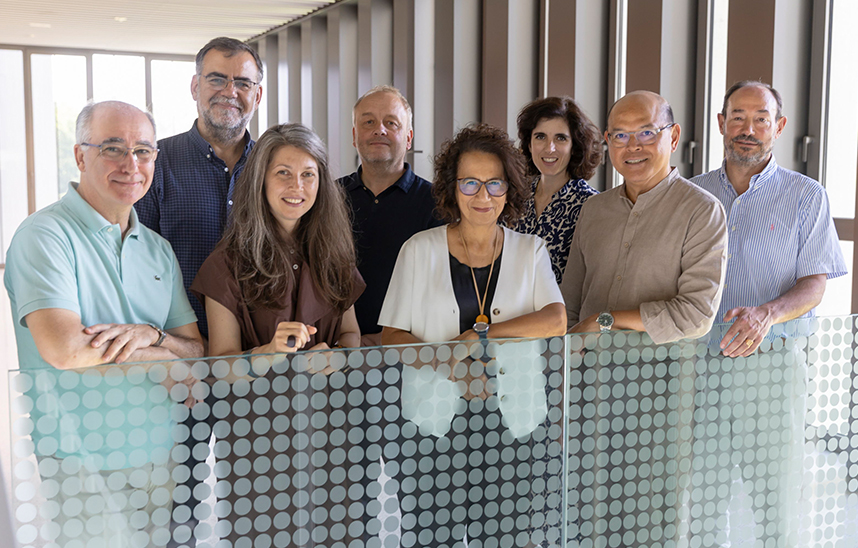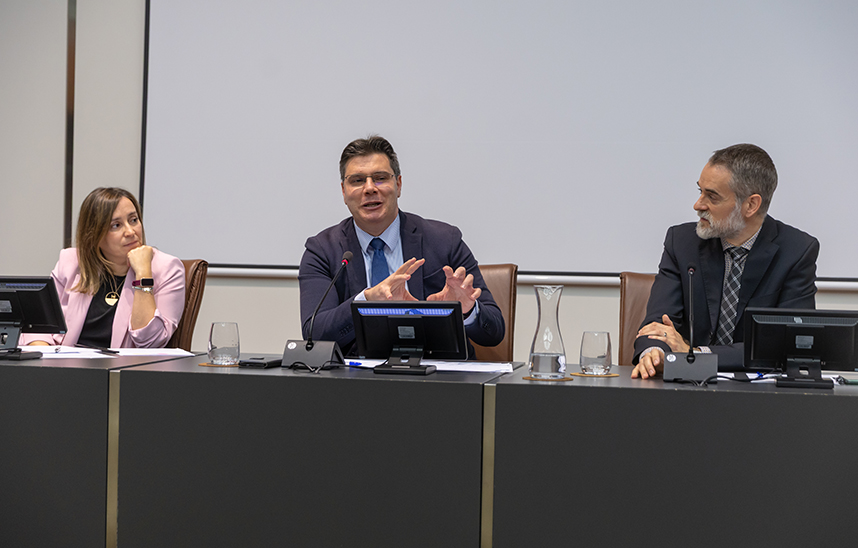
Alberto García Galindo, Mikel Hernáez Arrazola and Matías Ávila Clemente, winners of the DATAI Awards 2024-25
These awards recognize the most relevant scientific contributions in the field of data Science and Artificial Intelligence, rewarding originality, innovation and contribution to knowledge.

PhotoManuelCastells/Alberto García Galindo, Mikel Hernáez Arrazola and Matías Ávila Clemente.
28 | 10 | 2025
The data Science and Artificial Intelligence Institute (DATAI) has already announced the winners of the DATAI Awards 2024-2025, awards that have the dual goal of encouraging research in this field and promote its projection in society.
The award best methodological contribution goes to Alberto García Galindo, with the article Fair prediction sets through multi-objective hyperparameter optimization. In it, sample approach using modeled prediction techniques and multi-objective optimization to adjust hyperparameters and balance efficiency and fairness. It is a article , with data code and data , and rigorous experimentation. The innovation lies in the use of the tools, not in their development.
The award best applied contribution was shared between Mikel Hernáez Arrazola and Matías Ávila Clemente. The article Towards a more inductive world for drug repurposing approaches, withMikel Hernáez Arrazola as the winner. In this article, the authors propose moving from a approach to an inductive paradigm that leverages representations learned by machine learning to discover new drug-target interactions (DTI). They also introduce the use of "negative edge subsampling" for in silico validation, which allows previously unidentified interactions to be detected. It is a good conceptual idea, published in a Q1 AI journal (IF 23.9), with 7 citations despite its recent publication in 2025.
The article Matías Ávila Clemente, Modeling time series with multiple seasonalities: an application to hourly NO2 pollution levels, in which the authors discuss a study on time series with multiple seasonalities that analyzes 15 years of data in Madrid. It is a good article , easy to read, with exhaustive experimentation and results that can be transferred to other applications.
The jury was composed of Amparo Alonso Betanzos (Universidade da Coruña), Enrique del Castillo (The Pennsylvania State University) and John Stufken (George Mason University), all of whom are members of the DATAI Scientific committee .