Telecommunication Engineering, underway next year at the university
The new degree program will present three specialties: Communication, Electronics and Telematics.
The technical school of Engineering of the University of Navarra, on the San Sebastian campus , will offer a degree program in Telecommunications Engineering in the 2000-2001 academic year. The new degree program will be based on the synergy between the School and the CEIT (Centro de programs of study e Investigaciones Técnicas de Gipuzkoa).
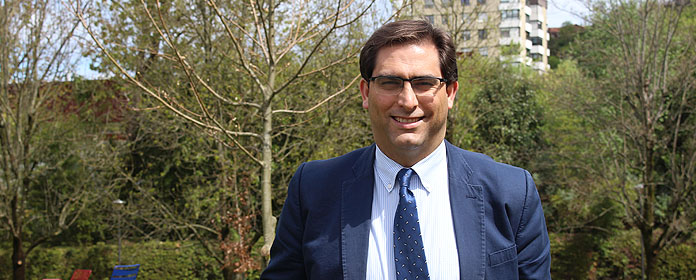
In the words of Carlos Bastero de Eleizalde, director of the technical school of engineers, "this new official degree program arises from the growing demand of companies for professionals specialized in communication technologies and electronics and information technology applied to communications".
Telecommunications Engineering joins the Industrial Engineering, Materials, Industrial Organization, and Industrial Automation and Electronics, which already exist at the School. "This is another step forward in the project educational that we had planned since the beginning of the reform of the university programs of study ," adds the director.
For more than a decade CEIT has been working in areas related to telecommunications, such as digital signal processing, integrated circuit design , information systems, mobile communications systems, microsystems and optoelectronics.
Likewise, the department of Electrical, Electronic and Automatic Engineering of the School of Engineering of the University of Navarra promotes the training of scientific staff and professor in this field. In this sense, the director of this department, Andrés García-Alonso, highlights the high issue of alumni who have reached positions of responsibility in the area of telecommunications.
On the other hand, he underlines how the School of Engineers has launched an ambitious program for the incorporation of doctors in the field of telecommunications in which they have prestigious researchers from CEIT. He also recalls that it has an outstanding IT and laboratory infrastructure.
Support from European and American companies and universitiesFinally, Andrés García Alonso points to the support of European and American companies, universities and research institutes with which they have signed various agreements. Among the universities are Shefield, Cambridge and Manchester, in England; Princeton and Delaware, in the United States, and Erlangen-Nuremberg, in Germany. Among the companies quotation Jazztel, SGT, IKUSI or Siemens ATD. "There is also an important partnership with the network of Fraunhöfer Institutes in Germany," he adds.
The intervention of Professors Pedro Crespo Bofill and Antonio Núñez Ordóñez has been decisive in the preparation of the Study program. Professor Crespo holds a PhD from the University of Southern California, is a researcher at Bell Laboratories and CEIT, external evaluator of the E.T.S. of Telecommunications Engineers of Madrid and Barcelona, and director of Technology Planning at Jazztel. Professor Núñez is Full Professor of Electronic Technology and promoter of Atlantic Telecom and other companies. He was also the first director of the ETSIT in Las Palmas.
The first version of the Telecommunication Study program was proposed in October 1998. After review by the Electricity and Electronics professors and approval by the Office of Student Affairs of the technical school of Engineering, the faculty approved it on January 18, 2000. The result of this process," says the School's director , "is a solid and coherent Study program , in line with the real needs of the business, which guarantees the effectiveness of our graduates in the professional world. For its final approval, the University of Navarra itself has yet to formally approve the program, which will be resolved in the next few days.
The new degree program will consist of 375 credits and will have three specialties: Communication, Electronics and Telematics. For 2000-2001 the maximum issue of students to be admitted in the first year will be sixty and the degree program will be implemented year by year.
Those interested in enrolling in Telecommunications Engineering or Industrial Engineering will take the same admission exam. Once the degree program begins, students will not be able to switch from one degree program to the other. In this regard, Professor Bastero clarifies that "they are degree programs with very different curricula from the first courses".