
New materials for the restoration of cultural heritage are being studied.
The research developed at the University of Navarra proposes the incorporation of sustainable additives to lime mortars.
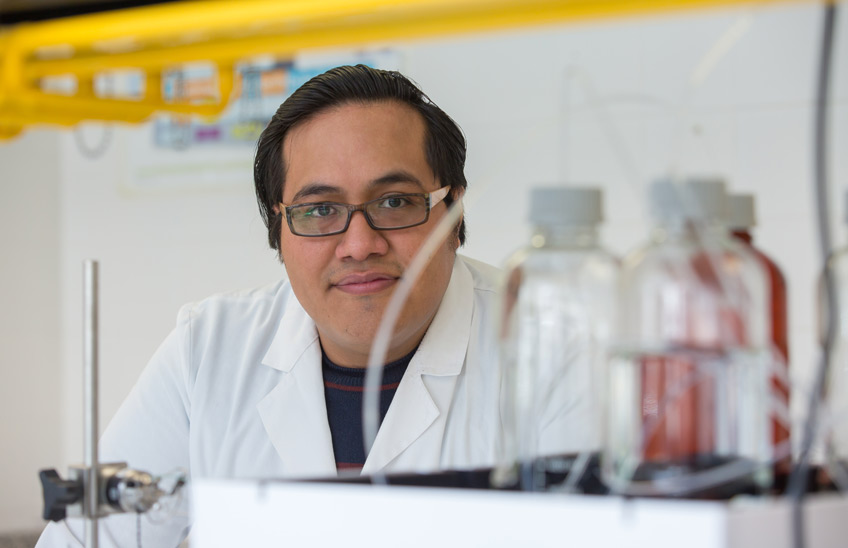
PhotoManuelCastells/Jesús Fidel González
26 | 07 | 2021
Jesús Fidel González (Mexico, age 31) is a chemical engineer and has completed his thesis at the School of Science at the University of Navarra. His research focused on incorporating additives into lime mortars, proposing new formulations with improved and environmentally sustainable properties so that they can be used in the restoration of cultural heritage.
The research carried out in this field to date has focused on adding a single additive to lime mortars to improve some of their properties. As a novelty, in this research more than two components have been added to the mortars, whose properties contribute to improve the work restoration of cultural heritage and also protect the natural environment.
financial aid As an example of this study, Dr. Gonzalez has added nanometer-sized pozzolans to a mortar mix to increase mortar strength; sodium oleate to repel water from the mortar and to slow the wear caused by aggressive weather conditions such as ice or acid rain; and titanium oxide (TiO2) to help make the mortar a self-cleaning material.
"I have also studied extremely interesting materials such as TiO2 nanoparticles, which is a photocatalyst that, when incorporated into these mortars, kills nitrogen oxide and carbon monoxide, which are harmful to the atmosphere and to living beings."
In order to expand this field of study, Dr. Gonzalez suggests the possibility of studying materials for new construction in order to "help the environment by using the properties of lime as a construction material".
According to the young man, researcher , both the specialized literature and the centers dedicated to the restoration of works of historical and artistic interest are pointing out the importance of using materials that do not harm the environment and that are as close as possible to the originals. "Lime is one of the oldest chemicals used by man and it hardly produces environmental impact, improves hygiene and has good insulating capacity, both thermal and acoustic, so it produces a lower energy demand with the consequent economic savings for the inhabitants and toxic emissions to the atmosphere," he concludes.
Jesús Fidel González is currently working in Mexico developing lime mortars using nanoparticles, with the intention of using them not only in restoration but also in new construction. The researcher is developing the materials needed to restore the 16th century church "El Calvario" in Zimapán, Hidalgo, Mexico.
Bibliographical references
- J.F. González-Sánchez, B. Taşci, J.M. Fernández, Í. Navarro-Blasco, J.I. Alvarez, Combination of polymeric superplasticizers, water repellents and pozzolanic agents to improve air lime-based grouts for historic masonry repair, Polymers (Basel). 12 (2020). https://doi.org/10.3390/POLYM12040887.
- J.F. González-Sánchez, B. Taşcı, J.M. Fernández, Navarro-Blasco, J.I. Alvarez, Improvement of the depolluting and self-cleaning abilities of air lime mortars with dispersing admixtures, J. Clean. Prod. 292 (2021). https://doi.org/10.1016/j.jclepro.2021.126069.