“The hallways of a hospital are full of medical wisdom”

17 | 06 | 2026
Exactly ten years ago, she was at that very same event, saying goodbye to five years of training at the Clínica Universidad de Navarra. At that time, she was there as a fifth-year resident, not as a guest lecturer.
Despite all the changes that have taken place since then, she admits that the passion she felt as she completed her residency program prepared to begin her career as a resident physician back in May 2016 is exactly the same as the passion she feels today as she returns to the university. “That hasn’t changed one bit.”
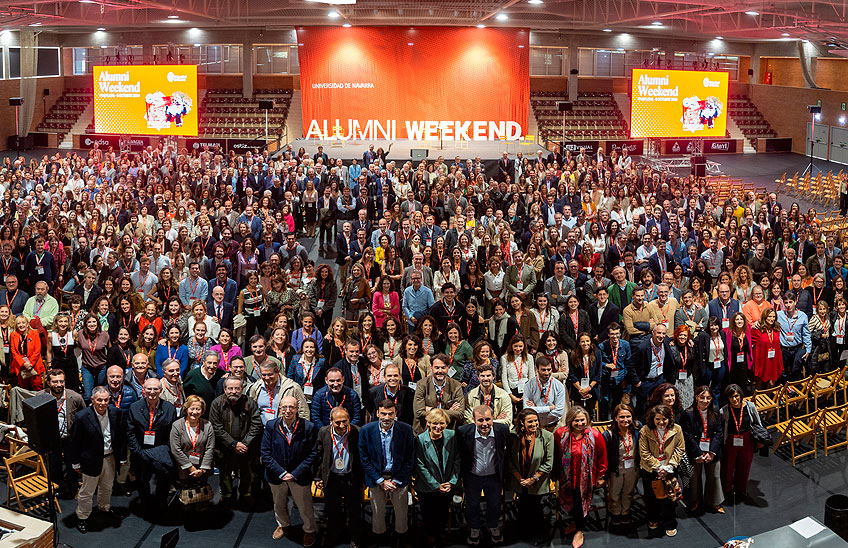
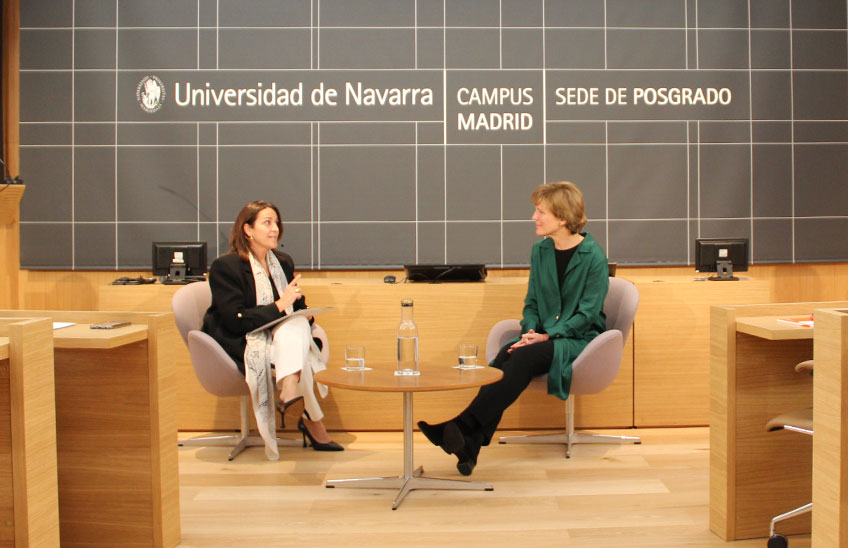
Leyre Zubiri is currently a medical oncologist at the Mass General Brigham Cancer Institute and a professor of medicine at Harvard Medical School. On May 11, she attended the farewell ceremony for the Clinic’s residents in Pamplona.
Ten years after completing your residency program, how has your understanding of medicine changed?
I still feel that medicine is a vast field. After working in different hospitals and countries, I still don’t know which system is the best. And, despite the years, I continue to approach each patient as if they were the first: with the caution of someone who knows that human lives are in our hands, the respect of someone who is aware of the immense responsibility entrusted to us, and the humility of someone who never forgets that in medicine, we are always learning.
How do you experience the professor aspect professor medicine, which is so characteristic of the university?
Medicine is, without a doubt, an infinite science, and that requires us to accept that we never stop learning. Added to this is the fact that the human body is complex: it is often incomprehensible, just as often unpredictable; at times it is deceptive, and it is certainly never simple. In this regard, I believe the role of mentors is fundamental: we must listen to them and pay close attention to what they do, why they do it, and how they do it. Even when they make mistakes, we learn valuable lessons. The value of their judgment is immense, because it is backed by experience. But I also believe that as doctors, we must always keep in mind where we came from, how we got our start—the beginning of our never-ending journey—and remember that we, too, were once residents. Hence the importance of teaching those who come after us and seizing every moment to impart a small lesson. It doesn’t always have to be a formal lecture. The hallways are full of pearls of medical wisdom found in casual conversations.
Amid the current AI boom, your main recommendation to the residents was that they pay more attention to patients than to technology…
Medical history and physical examination. These have been the ABCs of medicine since the time of Hippocrates. And they remain so today, in the age of digitalization and artificial intelligence. Because nothing makes sense without the patient’s history. It is the patient’s account that must guide our clinical reasoning, the physical examination, and the tests we decide apply for. Not the other way around. I believe our greatest value lies in listening to the patient, sitting at their bedside, and giving them our full attention. We should spend more time looking into their eyes than at a screen, without letting bureaucracy and the increasing technification of our profession replace a thorough history-taking or a detailed physical examination. We must not forget that the value of contact , the clinical examination, and closeness to the patient constitute the essence of medical practice.
What do you consider to be one of the biggest risks for a doctor today?
Confidence is a doctor’s greatest enemy. A doctor must never stop doubting, must keep their curiosity alive, and must question everything. It is essential to review every piece of data and personally verify the information: check the lab results, examine the X-ray with our own eyes, and confirm the medical history by speaking directly with the patient. In medicine, being skeptical often means making fewer mistakes. And the same is true of teamwork. Working together always adds value, even when you think it might get in the way. The benefits of work always outweigh the risks. Two minds are better than one: they catch more mistakes, cover a broader range of possibilities, generate more ideas, and complement each other. I’ve found that the synergies born of united teams lead to great achievements.
What quality would you say is essential to being a good doctor?
I would highlight two: humility (as I mentioned earlier) in the face of the enormous responsibility of our profession, and compassion—always, above all else, and in the face of everything. Putting yourself in the other person’s shoes and understanding the patient, their status uncertainty. Empathizing with them. Trying to understand them, listening to them, or simply being there for them in silence can achieve more than any treatment.