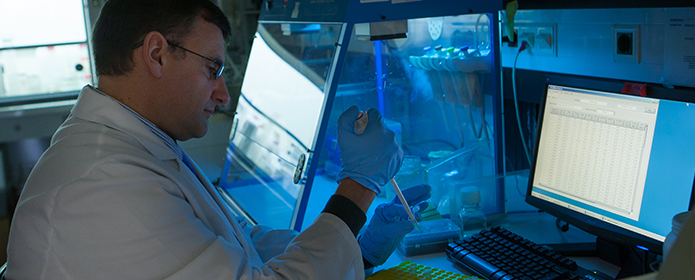
The CIMA and the MTorres Foundation collaborate in the study of new therapies for liver diseases.
The work identifies a molecule with protective and regenerative effects in fatty liver disease.

Scientists at the research center Applied Medicine (CIMA) of the University of Navarra have designed a molecule that demonstrates protective and regenerative effects on the fatty liver. The work, published in the scientific journal Gut, has been carried out, in part, thanks to funding from the MTorres Foundation, business Navarra's leading aeronautics company. The results open up new avenues in the approach to liver surgery and the treatment of acute liver damage.
Fatty liver, or steatosis, is a pathology that is reaching an alarming incidence, being associated with the obesity epidemic affecting Western countries and at development. Fatty liver not only contributes to hepatic deterioration and the appearance of cirrhosis and tumors, but also to the development of cardiovascular diseases and diabetes.
The work performed at CIMA analyzes a growth factor, FGF15/19, which is involved in fat metabolism. Its absence in the body alters liver regeneration after partial liver resection. "In our laboratory we have studied this protein in animal models of feeding with a fat-rich per diem expenses and we have found that it plays a very important role in lipid metabolism, contributing to prevent the appearance of fatty liver," explain professors Matías Ávila and Carmen Berasain, from the Hepatology Program at CIMA. "For this study we have counted on the essential partnership of Gloria Alvarez and Iker Uriarte, researchers of the research center Biomedical at network in the area of Liver and Digestive Diseases (CIBERehd), attached to the Hepatology Program, as well as Dr. Pedro Berraondo, researcher of the Immunology and Immunotherapy Program of CIMA".
Hepatoprotective and proregenerative effects.Moreover, the researchers have designed a new chimeric molecule based on FGF15/19, called Fibapo, which demonstrates pharmacological properties in fatty liver regeneration. "Specifically, Fibapo retains the activity of this growth factor on fat metabolism and sample potent hepatoprotective and proregenerative effects, with a better pharmacokinetic profile than FGF15/19 itself."
The results published in Gut suggest a new approach for the prevention or treatment of patients with fatty liver requiring liver resection. "The use of molecules based on this growth factor could improve liver regeneration after resection or transplantation," says Dr. Avila, director of the Hepatology Program at CIMA.
The MTorres Foundation has been collaborating with the research of CIMA since 2014. According to Yolanda Torres, patron of the foundation, "the goal is to support the research in any of its fields and contribute to the advancement of medical science, for the benefit of society".