The Pontifical University of the Holy Cross is hosting the second workshop project
The researchers shared the findings from the second phase of project, emphasizing that the identity of design be understood without the theoretical and educational framework developed, largely by architects, during the 20th century

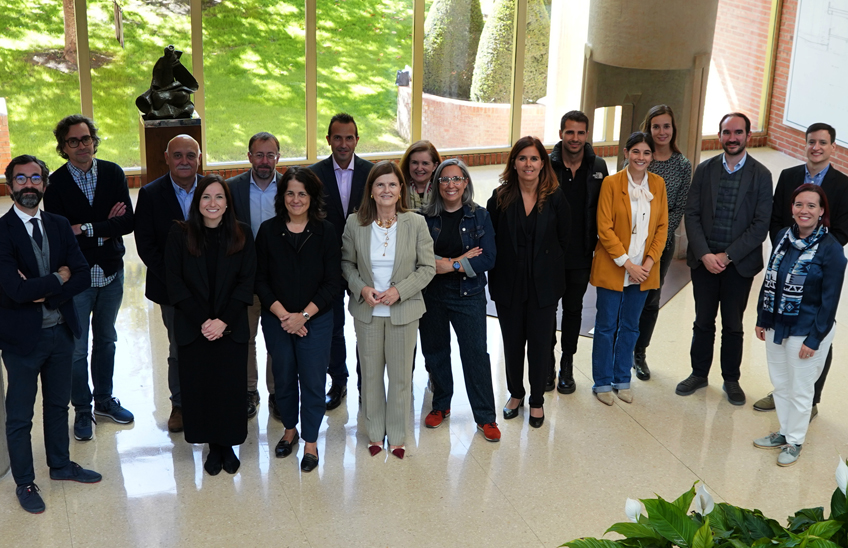
Photo courtesy of DomitillaDardi, design historian design international curator; and Héctor García-Diego, professor at the School of Architecture
18 | 03 | 2026
On March 9, Rome hosted the second research workshop research group , dedicated to furthering research the contributions of architects to design. Participants included Mariano González, María Villanueva, Héctor García-Diego, Pablo Arza, Andrés Tabera, Javier Sáez, and Marta García, researchers and professors at the School of Architecture at the University of Navarra. The workshop also workshop María Eugenia Josa, a professor at CEU San Pablo University, and Domitilla Dardi, a design historian design international curator.
This second meeting on the theoretical and educational aspects of the discipline, examining how publications and exhibitions of the time served as key drivers in the consolidation of design the national level. Domitilla Dardi opened the workshop an analysis of Castiglioni, Magistretti, Aulenti, and Anastasio—artists and designers who developed their work using pre-existing objects or components.
Mariano González then discussed the factors that led the architect to transition design , drawing on key figures in the history of art and architecture, such as William Morris, Adolf Loos, and Le Corbusier.
A documentary trail
María Villanueva and Héctor García-Diego presented the results of their research Spanish architecture journals from 1940 to 1975. Using charts and documents, their study demonstrated the emergence of a speech and an explicit desire to establish a solid framework for design Spain.
Along the same lines, Pablo Arza examined how the Spanish publication MD served as a bridge for disseminating international design content design the national context. For his part, Andrés Tabera broadened the focus to include non-disciplinary publications, analyzing the magazine Blanco y Negro.
An international and gender-focused perspective
The workshop focused on public outreach through exhibitions. Marta García analyzed the period between 1950 and 1975, showing how design itself became a vehicle for spreading the ideas of modernity. Complementing this international perspective, Javier Sáez presented his study on foreign theoretical texts that were imported into Spain during the period 1925–1975, tracing the influence of global theory on internship .
One of the most notable sessions was the one dedicated to the gender perspective, led by María Eugenia Josa and María Villanueva. While Josa provided data and qualitative data on the first women to enroll programs of study Spanish architecture schools, Villanueva analyzed their presence in specialized journals from 1925 to 1975, documenting how women gradually assumed a growing professional role over the half-century under study.
The workshop with a roundtable , during which the speakers shared their final thoughts on the topics covered.
*project PID2023-153253NA-I00, funded by MCIN/AEI/10.13039/501100011033 and by FEDER, EU.