“Only by objectively assessing responsibility can we know what we need to do”

29 | 04 | 2026
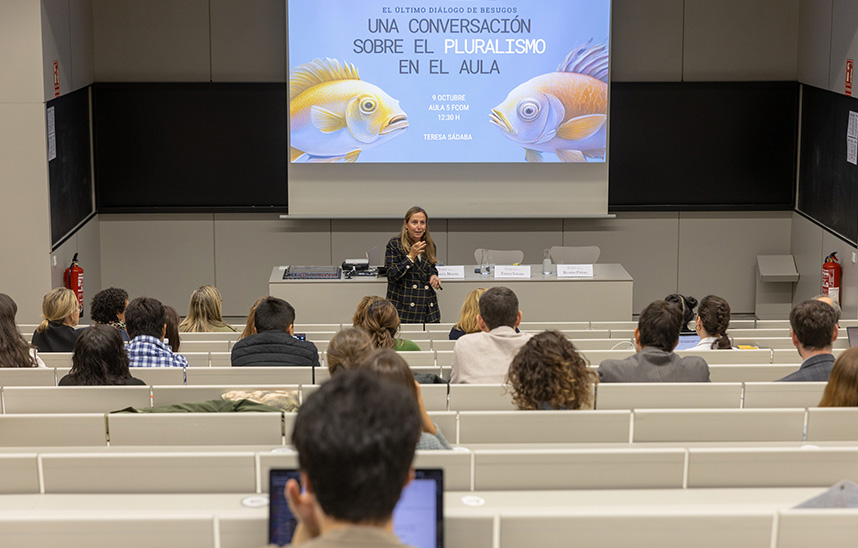
Professor Alfredo Cruz spoke at the 5th seminar Professional Ethics organized by the Core Curriculum Institute as framework the University’s 25/30 Strategy. During his exhibition, the professor critically analyzed some contemporary trends in the understanding of ethics. In particular, he pointed out two misguided tendencies from his perspective: “on the one hand, a legalistic view that reduces morality to compliance with external norms; and on the other, an approach that disconnects moral action from the concrete contexts in which people live and act.”
As he explained, ethics cannot be understood solely as obedience to the law or as a mere expression of emotional states. “Only in a world structured around distinct contexts can we establish a standard for our responsibility,” he stated. In this regard, he emphasized that determining what we should do requires knowing what we are truly responsible for, thereby preventing that responsibility from becoming diluted or extending indefinitely or subjectively. “We never act as an isolated individual, but rather as someone who occupies a specific place within a specific context,” he noted.
One's profession as part of one's identity
In his remarks, Cruz also addressed the relationship between ethics and the profession. Challenging the notion that professional ethics is a separate or ancillary field, he argued that it is part of ethics in plenary session of the Executive Council sense, insofar as the profession constitutes an essential element of staff identity.
In this regard, he stated that the demands of professional practice are not merely technical skills, but aspects that directly affect a person’s moral character. “In the way I carry out my role, I am putting myself on the line,” he noted.
The speaker also speaker that truly understanding the profession means seeing it as more than just a job: it is a way of “declaring who I am” to others. Therefore, the question of action—what to do in each statusis, ultimately written request a question about oneself.