Turning schoolyards into tree-lined green spaces can lower their temperature by ten Degrees
The project , led by the University, is studying the effects of renaturalization at 15 European schools, including CEIP Rochapea and CEIP San Jorge

03 | 07 | 2026
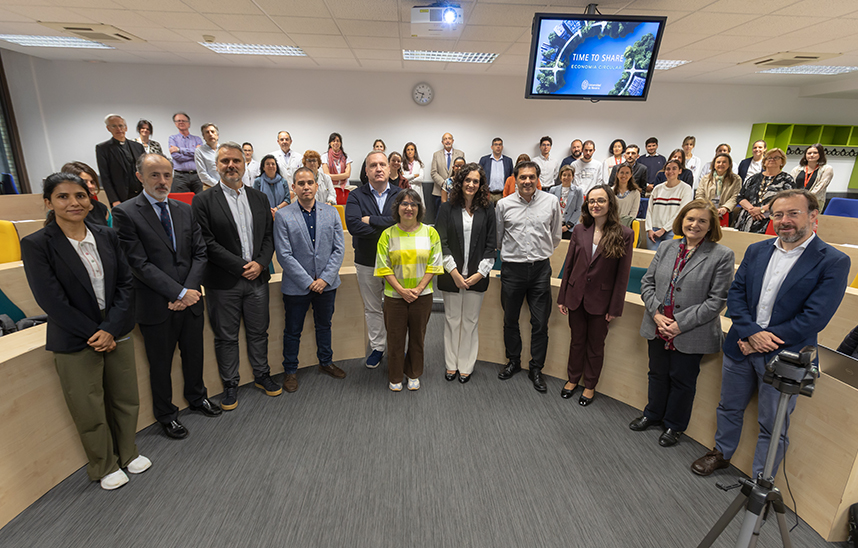
The rise in temperatures in May and June has highlighted the impact of heat waves on health, underscoring the vulnerability of children, especially in schools. This challenge was analyzed within the framework the international EU Green Week COL3NATUR event, organized by the University of Navarra and held at both the School of Architecture of the university and at Bayona City Hall.
About thirty researchers have highlighted the need for financial investment to improve educational environments. “Unfortunately, many school playgrounds in Navarre and Spain are completely paved, with hardly any shade, trees, or vegetation, or even benches or playground equipment for children,” explains Aurora Monge, a professor at the University of Navarre’s School of Architecture and a researcher at the Bioma Institute and the project .
The goal this research to address adaptation to climate change through the renaturalization of school buildings, playgrounds, and walkways. Transforming schoolyards into green spaces with trees reduces the UTCI (a measure of health-related outdoor thermal stress) by about 10°C. “This allows children to play outside during periods of extreme heat, while also lowering indoor temperatures,” Monge notes.
Resilient, welcoming, and inclusive courtyards
The project demonstrate the effectiveness of naturalization with the support of digital tools and pilot projects designed to accelerate the process. To this end, 15 schools across Europe are being studied: “Some are evaluated before and after the renovation work, as is the case with CEIP Rochapea; others are examples of best practices, such as CEIP San Jorge, a playground that has already been renaturalized where there used to be a paved parking lot.” In both cases, the projects incorporate trees, permeable paving, playground equipment for children, and involve the school community.
In addition to mitigating temperature conditions, these measures improve children’s health and well-being, as well as encouraging more play, reducing conflicts, and promoting a more equitable use of the playground. “With regard to the environment, the indicators include overheating, the impact on air quality, and the improvement of biodiversity in the surrounding area, demonstrating the multidisciplinary nature of project, projectexplains the researcher. “Playgrounds should be designed with year-round use in mind. Furthermore, we must consider their relationship with the neighborhood in which they are located—and even with the city as a whole—as they serve as living laboratories for territorial resilience and ecological transition,” notes the professor.
Researchers from the University of Seville, the University of Minho, the Center for Energy, Environmental, and Technological Research, and the University of Navarra participated in the international EU Green Week COL3NATUR event alongside institutions such as the Pamplona City Council, the Bayonne City Council, the Municipality of Vila Nova de Famalicão, PETR Pays Tolosan, and the firms Eslava y Tejada Arquitectos SL and Larraby.