The Relevance of St. John Henry Newman’s Thought for Forming “Good Members of Society”
Paul Shrimpton, a teacher at Magdalen College School (Oxford), discussed liberal “ Education ,” the tutorial system, and the “ training ” of character in the thought of St. John Henry Newman at the First Newmanian “ workshop ”

05 | 11 | 2026
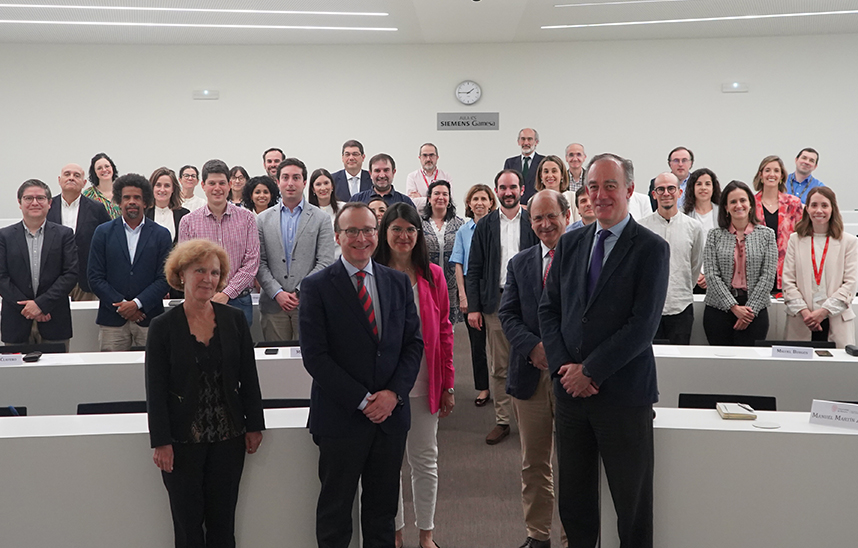
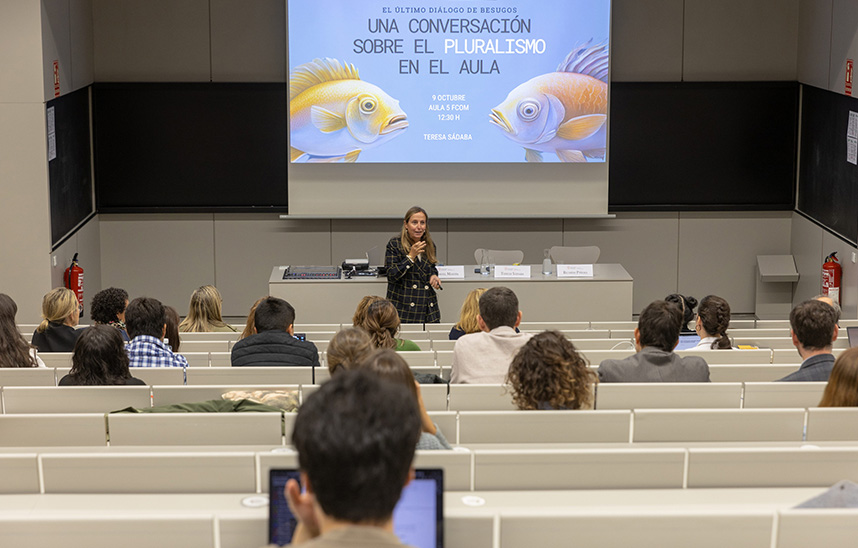
Pamplona, October 29, 2026. “Newman said that we tend to assume that our subject answers all the world’s questions. We need one another. We need other disciplines. We need to be with other people.” This was one of the ideas that Paul Shrimpton, a teacher at Magdalen College School (Oxford, England), shared in his “ lecture ” during the University’s First Newmanian “ workshop ,” which took place last Thursday, October 29, in the Magna classroom of the Central Building.
Organized by the Core Curriculum Institute and Friends of Newman, the “ workshop ” focused on St. John Henry Newman as a thinker and academic, with the goal of helping attendees understand the relevance of Newman’s ideas today. The event was chaired by Rosalía Baena, Vice President of Estudiantes, and Péter Heltai, a student in the doctorate program at the School of Education , and Psychology and organizer of the event.
“There are surely many men and women around the world who have been deeply involved in founding schools and universities, some of whom also founded religious orders dedicated to the teaching. So why John Henry Newman? What did he do?” With this thought, the Oxford professor began his “ discussion paper,” titled “Newman’s Eminent Teaching on University Education, Yesterday and Today.” He highlighted Newman not only as an intellectual but also as “a man of action”: he was determined to do absolutely everything to bring to fruition the institution he had been entrusted to found, the Catholic University of Ireland (Dublin, 1854). “It is that interaction—that mutual influence between action in the world and thought—that gives his ideas added weight,” he explained.
A broad conception of the Education
According to Shrimpton, Newman had a very broad conception of “ Education,” as he resisted the tendency to reduce its meaning and narrow its scope. “Both then and now, there is a common mistake: to regard ‘ Education ’ simply as the transmission of knowledge, rather than as the training of the mind, the acquisition of habits, and the ‘ training ’ of character.” For this reason, he asserted that, for St. John Henry Newman, “ Education takes place not only in formal settings such as the classroom, the conference room of lectures, or the laboratory, but also in informal activities such as sports, music, theater, the discussion , and student journalism, and even in informal moments of relaxation and fun: parties, meals, and so on.”
He also emphasized that the Doctor of the Church played an important role in the reform of the University of Oxford, with which he was deeply connected for nearly 30 years, laying the groundwork for the modern tutorial system. “The college system and the tutorial teaching are the two things core topic that attract people to both Oxford and Cambridge.” For Newman, as Professor Shrimpton quoted him, “The professorial system fulfills the strict idea of a university and is sufficient for its existence, but it is not sufficient for its well-being. The colleges constitute the integrity of the university.”
Educating for This World and the Next
Shrimpton cautioned that reading Newman is not easy, even for those whose native language is English language ; however, he recalled that the cardinal believed that, to arrive at the truth of an idea, “it is necessary to view it from many angles, up close and from a distance, in different contexts and historical periods, and to keep the separate impressions one gains.” Newman maintained that the hallmark of an idea is its ability to harmonize contradictory and opposing aspects, “so that no single proposition determines it.”
From a human perspective, according to the thinker, the purpose of Education is to learn to think and to develop those strengths of character that we call ethos. “Its practical purpose,” Newman said, “is to form good members of society. Its art is the art of social life, and its end is the aptitude for the world. But from a supernatural point of view, all Education must be conducted on the principle that it uses means to an end, and that end is Christian holiness,” added the Oxford professor.
Along these lines, he argues that we must recognize that each discipline has its own starting points, its own ways of evaluating evidence, and its own methods for arriving at the truth. Shrimpton explains how “Newman said that we have a tendency to assume that our subject answers all the world’s questions.” And in doing so, he highlighted the need for multidisciplinarity, where it was important that all the Schools in the major fields of knowledge be represented at a university.
Later, Shrimpton also highlighted the saint’s idea of a liberal “ Education ,” in which he asserted that “ knowledge ” is an end in itself, worthy of pursuit, in contrast to growing utilitarian tendencies. He said that “a liberal Education s the mind in how to make judgments, and this makes a person better suited to take on any role.” In this regard, he noted that St. John Henry Newman considered Education to be a deeply relational activity, one that deals not with systems or knowledge but with individuals.
Toward the end of his remarks, Shrimpton recalled one of his favorite quotes from Newman: “An academic system without the staff influence of professors on students is an arctic winter.” With this, she explained that Newman described that “ status ” as the reign of law without influence and of the system without personality. “ staff influence is what gives dynamism to any system: the action of one mind upon another, of one personality upon another, of one heart upon another,” she noted.
That is why, he added, Newman viewed the young adult in terms of his or her radical individuality and stage of maturation, and prioritized the individual over systems.
Shrimpton concluded his * lecture * by presenting Newman as a “herald of hope.” His life, he recalled, was marked by great disappointments and failures, and for that reason he understood hope not as an optimism that takes for granted that everything will turn out well, but as a steadfast virtue that does not shy away from reality: “We triumph through failures. We walk toward heaven with our backs turned.” He thus echoed the words of Pope Leo XIV when commenting on Newman’s meditation *Hope in God*: at the heart of the * Education * there are not “abstract individuals, but real people,” called to be formed “so that they may shine like stars in all their dignity.”
This was followed bythe roundtable Education : Liberalism and the Future of the University, featuring professors Juan Luis Lorda (School of Theology), Concepción Naval ( Education , and Psychology), Joseph Milburn (School of Humanities and Social Sciences), and Ruth Gutiérrez (School of Communication), and moderated by Jorge Machín (School of Law). In addition, Professor Víctor García Ruiz (School of Humanities and Social Sciences) deliveredthe lecture From Failure to Failure: John Henry Newman’s Ideal of the University.
In the afternoon, the “ meeting ” featured the premiere of the documentary *Lead Kindly Light: The Story of Saint John Henry Newman*, followed by a “ colloquium ” among the students of Friends of Newman.