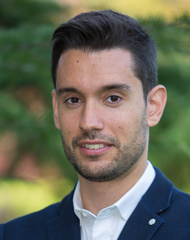
Professor and researcher Javier Sánchez Cañizares publishes "Universo singular".
The work was recognized in 2018 with the award Open Reason in the category of. research
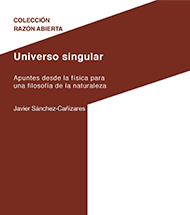
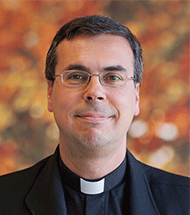
Javier Sánchez Cañizares, professor at the University of Navarra, has published Universo Singular, a book in which he has collected the work with which a few months ago he obtained the award Razón Abierta in the category of research.
Through this publication, the director of the group 'Science, Reason and Faith' (CRYF) and researcher of the group 'Mind-brain' of the Institute for Culture and Society (ICS) introduces the reader to the context of contemporary physics in order to unveil some singularities that occur in our knowledge of the universe. In his work he offers a basic starting point, rooted in science, from which to begin philosophical reflection on nature. Likewise, he justifies the use of an expanded reason as a necessity of the human knowledge .
The book is addressed to the public interested in the dialogue between science and Humanities, who wish to know the image of nature offered by contemporary physics. "But it is by no means a work for specialists. It is intended to serve both the scientist who wishes to broaden his or her horizon of understanding and the philosopher who is sensitive to the scientific knowledge ," says the author.
Javier Sánchez Cañizares (born in Córdoba in 1970) holds a Ph.D. in Physics from the Autonomous University of Madrid (1999) and a Ph.D. in Theology from the Pontifical University of the Holy Cross in Rome (2006). He has served as teaching assistant the department Theoretical and subject Physics at the Autonomous University of Madrid, Associate Professor Moral Theology at the School of Theology the University of Navarra, and is currently Professor the Ecclesiastical School of Philosophy that same university, where he directs the group , Reason, and Faith” (CRYF) group and is researcher group at Institute for Culture and Society. He is also publisher of the interdisciplinary journal Scientia et Fides. His main interests focus on the relationship between science and religion, the philosophy of nature, and the relevance of quantum mechanics to understanding human uniqueness in the universe.