researcher Aurell selects thirty "great history books" in his latest work
30 Great Books That Made History offers a journey through core topic historical titles core topic the five great civilizations: China, India, the West, Byzantium, and Islam.

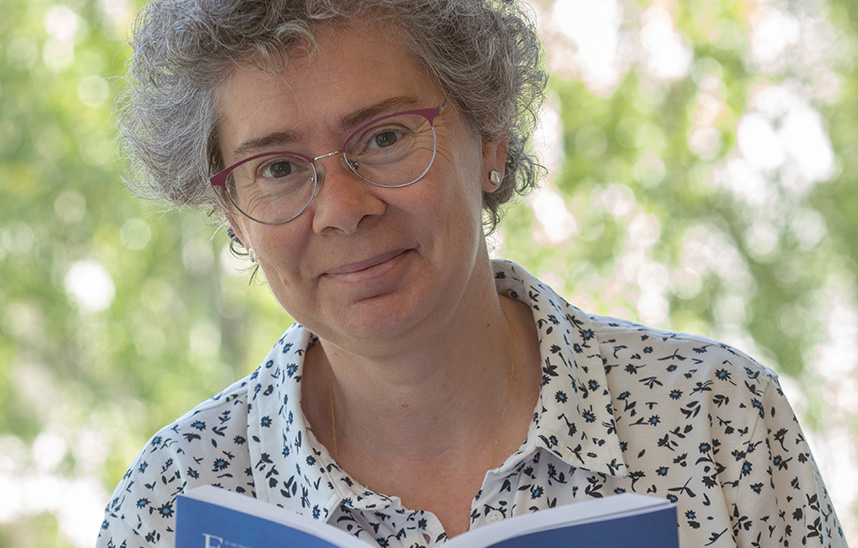
PhotoLeire researcher Aurell with his new book '30 Great Books That Made History'
19 | 01 | 2026
30 Great Books That Made History (Polity Press, 2025), a new book by historian Jaume Aurell, was born out of frustration. This is acknowledged by its author, researcher group Religion and Civil Society group Religion and Civil Society Institute for Culture and Society (ICS) and Full Professor Medieval History at the School Philosophy Letters at the University of Navarra. Unlike other disciplines, such as literature, art, or music, which have a multitude of universally recognized figures and works (Shakespeare, Michelangelo, Mozart...), the author noticed that, in the case of history, the public knows only two great names, the Greeks Herodotus and Thucydides. Can the same thing happen with history? Is it possible to establish a canon of historical works?
Starting from these questions and following the path he took in his previous book (What Is a Classic in History?, Cambridge University Press, 2024), he decided to select and analyze the 30 most representative books in history. The result this informative work that leads chronologically through core topic titles core topic the five great civilizations: China, India, the West, Byzantium, and Islam.
Among the historical classics chosen are The Peloponnesian War by Thucydides; the Bible; Meadows of Gold by Al-Masudi; The Decline and Fall of the Roman Empire by Edward Gibbon;An Outline of a Theory of Civilization by Fukuzawa Yukichi; The Mediterranean by Fernand Braudel; and Ranajit Guha (Pleasant Insurgency in Colonial India). Regarding the presence of female historians in the work, the researcher that they have been included as much as possible, since "women did not properly enter the discipline degree program discipline until they began to study degree program in the mid-20th century. Therefore, issue I introduce in the book, with the exception of the Byzantine princess Anna Comnena, are from this period, such as The Return of Martin Guerre, by Natalie Davis, andLandscape for a Good Woman, by Carolyn Steedman."
Despite the differences between the selected titles, Aurell points out qualities that unite them: "They are all history books that respond to an exhaustive documentary analysis of the documentation. But the great challenge historian is to turn it into something readable, so that people can not only read history, but also enjoy doing so through good storytelling. Furthermore, these are works that manage to represent realities that affect the deepest part of the human being and clearly structure the information they want to convey."
Canon, no ranking
Faced with the current trend of establishing rankings, Aurell stands apart and advocates for the canon: "The idea of the canon is widely discredited among my colleagues in Humanities the world. But I maintain that, while some things change, others remain, and this tells us that there are realities embedded in the human condition that prevail. It is not a question of whether a work is better or worse, but rather its historical relevance and its ability to touch on issues that interest us all," explains the author.
In any case, he acknowledges that many important books have been left out of this selection because he sought variety and balance between different periods. For example, he does not include works he considers "wonderful" such as The Culture of the Renaissance in Italy by Jacob Burckhardt, because choosing The Autumn of the Middle average by Johan Huizinga would result in too much overlap in terms of subject matter. Among the books chosen, there is only one Spanish work, El libro de las gestas, the autobiography of James I of Aragon. "If it were a book with a hundred works, there are four Spanish historians who deserve to be included: Ramón Menéndez Pidal, Claudio Sánchez Albornoz, Américo Castro, and Jaume Vicens Vives, "he notes.