Faculty and students from the University are teaching 60 farmers in Guatemala how to manage a solar power system
The project, developed by the Rode Foundation in collaboration with the University of San Carlos de Guatemala, has been funded by the Government of Navarra

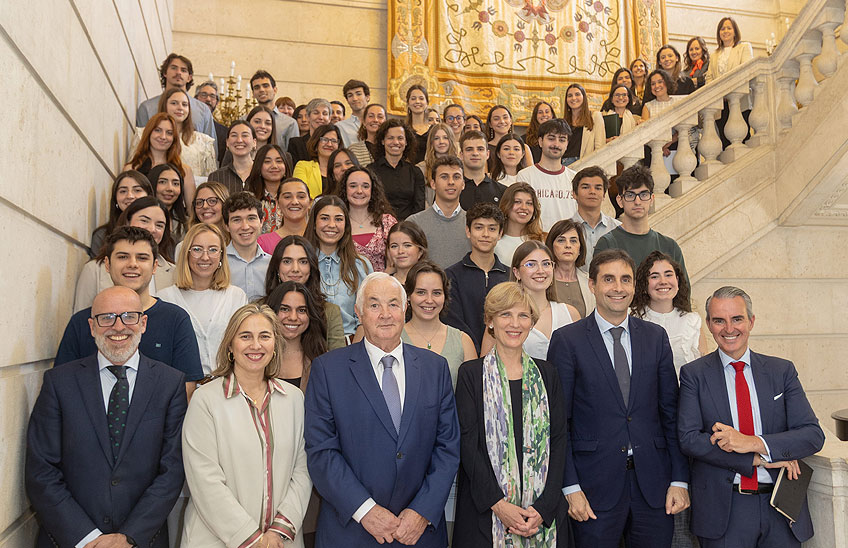
Photo Courtesyof / Teachers and students with the farmers involved in the project.
29 | 07 | 2026
Tecnun—the School of Engineering at the University of Navarra—has collaborated with the Rode Foundation on an internationalproject in Guatemala to train small-scale farmers in the management of a solar photovoltaic facility. The facility, funded by the Government of Navarra and spearheaded by the Rode Foundation in partnership with the University of San Carlos in Guatemala, supplies power to the agricultural pavilion where producers store, weigh, and preserve vegetables prior to distribution.
Tecnun's contribution has focused on training 60 producers from the mountain community of Tecpán, located at an altitude of more than 2,000 meters. Paz Morer, a professor in department Mechanical Engineering Tecnun, and José Macayo, a research technician research department Electrical and Electronic Engineering, who led the project, traveled to Guatemala along with students Elena García-Balibrea, María Jimena Zelaya, Celia Castillo, and Juan Martín to provide training to the farmers in the area.
"The main challenge has been adapting complex electrical concepts to people who had dropped out of school at a very young age or who could barely read and write. Seeing how they came to understand how the system works and overcame their fear of working with it was one of the greatest rewards of project," explains Macayo.
To facilitate learning, the team designed an internship methodology internship on models featuring small solar panels, batteries, and inverters. Thanks to these materials, participants learned how to make series and parallel connections, understand how the system works, and use the tools safely.
As Elena García-Balibrea, a fourth-year electrical engineering student, explains, until now farmers have relied on a highly unstable network that suffered outages lasting up to two days. “This forced them to shut down their cooling systems and caused significant losses in crops such as tomatoes and other vegetables. The new photovoltaic system provides a stable source to maintain production and reduce dependence on gasoline-powered generators,” she emphasizes.
To enable the local community to interact with this technology independently, the initiative was structured in two phases: an initial trip during Holy Week 2026 to lay the groundwork alongside the Rode Foundation, and a subsequent expedition in late May to conduct hands-on workshops in the field. María Jimena Zelaya, a Guatemalan student at Tecnun, also participated in this second phase and expressed her gratitude to the Rode Foundation for this opportunity: “Being able to return to Guatemala to share the knowledge from my degree program the people of my country has been a gift,” said the fourth-year student in Degree Electrical Degree . “The most exciting part was returning a few weeks later and seeing that many farmers had put what they’d learned into practice to start looking for equipment and developing their own projects. They also wanted to pass that knowledge on knowledge others in their communities.”