600 million liters of beer
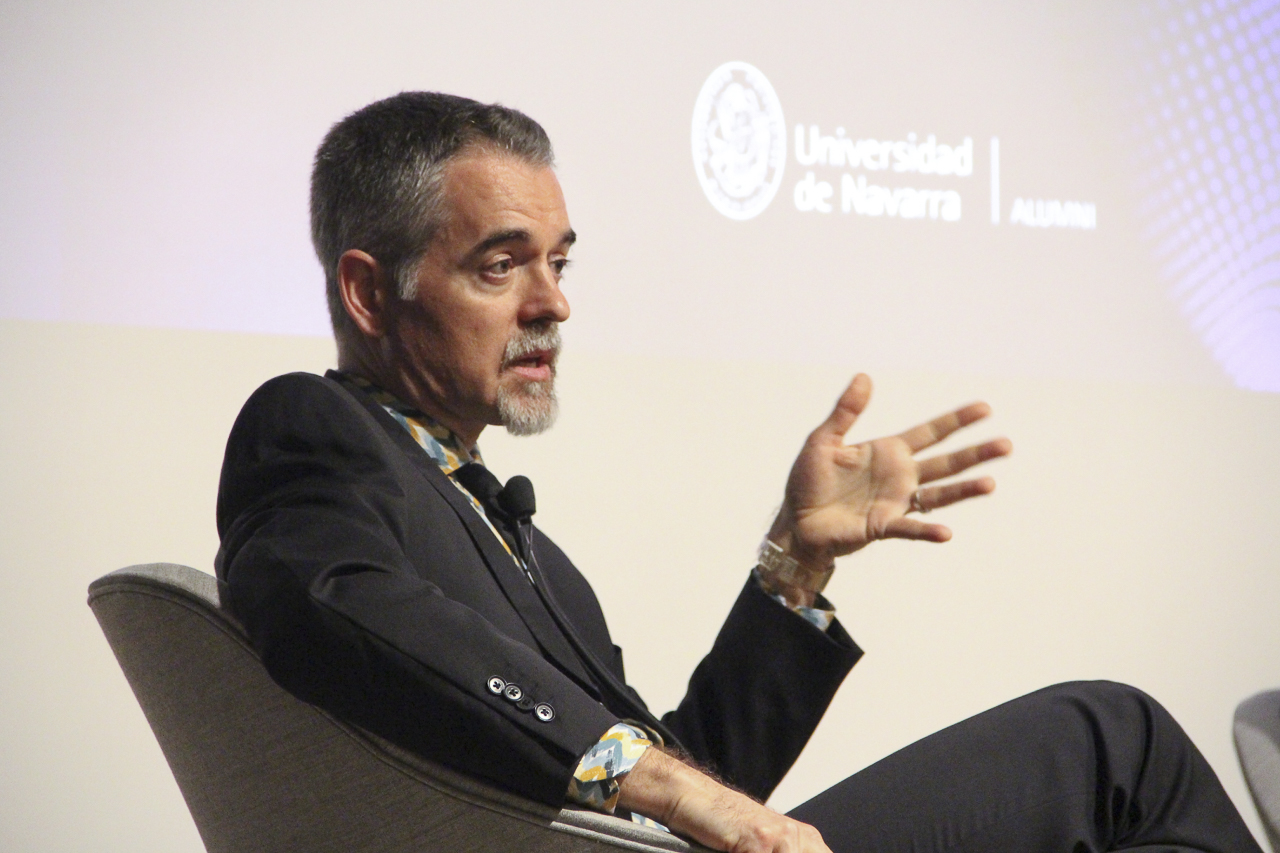
Jorge Montero, Strategy director at Hijos de Rivera, explained the key factors behind Estrella Galicia’s growth during a Tecnun Alumni “ meeting ” event in Madrid that brought together 76 attendees

03 | 11 | 2026
In a decade, Estrella Galicia has gone from having 80% of its business concentrated in Galicia to becoming one of Spain’s leading brewing groups. This was explained on Wednesday, October 21, by Jorge Montero, Strategy director at Hijos de Rivera, during a “ meeting ” event attended by 76 people and organized by Tecnun Alumni at the Faustino Gastroalumni Society in Madrid. Between 2011 and 2014, the company decided to expand into markets such as Madrid, Barcelona, and Seville. “We were clear that we didn’t want to compete on price, but rather to highlight the quality of our product and build a solid brand,” he noted.
The expansion was based on differentiation and on maintaining the company’s Galician identity. Montero recalled that, when he joined Hijos de Rivera, some consultants suggested removing the word “Galicia” from the brand. “They never worked with us again because, for business, origin has never been an obstacle to growth, but rather one of its key attributes.” This strategy was also reflected in its positioning relative to skill: while other groups have developed broad brand portfolios, Hijos de Rivera has so far focused its growth on Estrella Galicia and 1906.
“Currently, Hijos de Rivera ranks as Spain’s fourth-largest beer group , behind Mahou-San Miguel, Heineken (with Cruzcampo, Amstel, etc.), and Damm.” Furthermore, the geographic distribution of its sales has reversed: currently, 80% of its business is generated outside Galicia, and only 20% within the region—where, however, the brand maintains strong roots. “People don’t ask for a caña; they ask for an Estrella,” notes Montero. With all this, the company has managed to reach 140,000 points of sale in Spain and expects to sell some 600 million liters this year, compared to the 4,000 million liters sold by the sector as a whole in our country.
The next challenge is diversification and internationalization. “We are working to expand our portfolio with new products, such as bottled water, juices, wines, and snacks, while seeking to strengthen our presence abroad.” The company has already established subsidiaries in Germany and the United Kingdom, two markets where it aims to gain a foothold. “This is like trying to sell whiskey in Scotland, but we are very pleased with result,” he acknowledged.
A Commitment to Quality
“Our price is about 40% higher than the industry’ average , a difference we’ve maintained from the very beginning,” explained Montero. To justify this positioning, the company focused a large part of its strategy on explaining the product’s characteristics and promoting beer culture. “We wanted to convey that beer isn’t simply a soft drink, but that behind it lie raw materials, ingredients, and a brewing process.” Montero pointed out that, while it was common in the wine world to discuss grape varieties and production processes, the beer industry paid little attention to aspects such as malt or hops.
This commitment is also reflected in the brewing times. “We call ourselves artisans because we continue to brew beer the traditional way, paying close attention to every stage of the process.” While the industry s average s take about two weeks to produce, Estrella Galicia spends approximately one month brewing its beer.
Brand Building
“At first, we had limited resources, and we knew that to compete with the big breweries, we needed to do things differently,” he explained. A good example of this is Estrella Galicia’s presence in New Year’s Eve television broadcasts, where they’ve managed to get well-known personalities to toast with their beer instead of cava. “We’ve always tried to develop smart marketing, looking for ways to make a big impact without having to invest huge amounts of money.”
This philosophy is also reflected in the allocation of its communications budget . While its competitors—as highlighted in the Strategy director —devote approximately three-quarters of their resources to promoting their brands’ attributes, Hijos de Rivera dedicates only one-quarter to that goal. Its priority is to generate content and initiatives that make an impact on their own, such as its involvement in the worlds of motorsports and soccer.
Attendees had the opportunity to ask questions about the business and the challenges facing the beer industry. Among other topics, Montero discussed how changes in consumer habits are influencing the company’s strategy, particularly in light of the growing demand for non-alcoholic beers. He also reflected on the importance of Hijos de Rivera being a family- business , a characteristic that, as he explained, “allows us to make decisions with a longer-term perspective.”