Luis Montuenga: "The way each teacher lives their life is the best textbook and the best class professional ethics."
The 12th workshop University Identity sparked a discussion on ethical virtues, the common good, human flourishing, and the challenges posed by artificial intelligence in training

PhotoManuelCastells/
22 | 05 | 2026
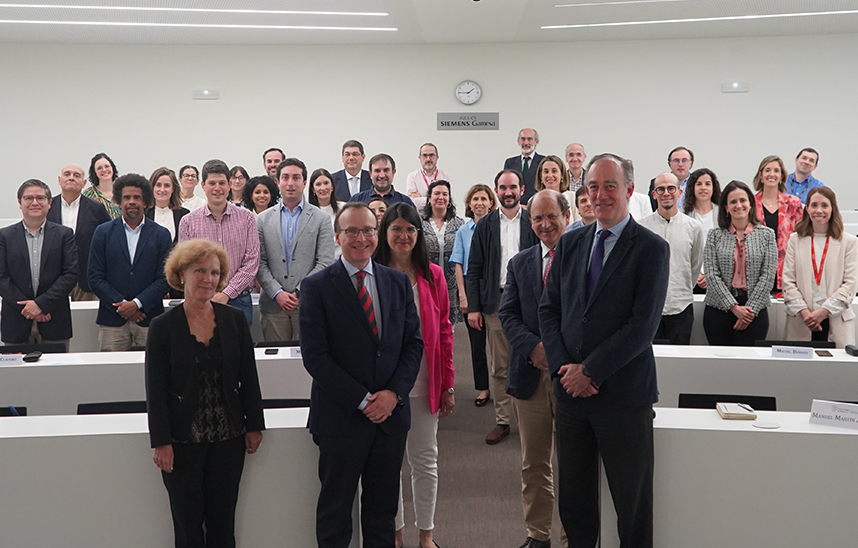
The Core Curriculum Institute Core Curriculum ICC) held its 12th workshop university identity, titled “Reflecting teaching the teaching Professional Ethics at the University.” Faculty members from various Schools, as well as experts from other institutions, discussed the integration of ethics into the training future professionals and agreed that ethics is a cornerstone of a training linked to human flourishing and the common good.
Throughout the workshop, topics such as professionalism, the social teachings of the Church, and the impact of artificial intelligence on Education were also discussed.
Professionalism and the profession
Xavier Symons, a professor at Australian Catholic University, delivered the lecture , in which he reflected on the concept of the profession and professionalism. He noted that practicing well means “orienting one’s professional life toward the good” and emphasized the importance of moral virtues in professional identity. For him, ethics “must be taught from the very first day of the degree program,” so that students understand that their professional decisions are part of a project of social improvement. In his remarks, he also emphasized that training must help build professionals of integrity, not merely technicians, always connecting professional work with the common good of society.
Next, during the roundtable Professional Ethics and Professionalism," Luis Montuenga, Full Professor the School of Science, explained that ethics is learned through everyday examples: “It’s not just about the big dilemmas, but about the decisions we make every day.” He also explained that a professor’s attention teaches more than theory. “Each professor’s way of life is the best textbook and the best class professional ethics,” he added. For her part, Professor Leire Arbea of the School of Medicine that professor internal consistency professor students” and that only those who “are authentic and transparent” can truly convey this. Finally, Gonzalo Alonso, a professor in the Faculty of Education Psychology, called for “greater coordination between instructors of ethics and professional ethics” to train students with strong ethical reasoning skills.
The Church's Social Teaching and Virtue training
The next panel explored professional ethics from the perspective of the Church’s Social Doctrine during a roundtable Ricardo Piñero (Full Professor Aesthetics and director ICC), Jordi Puig (Senior Associate Professor the School of Science), and Ricardo Calleja (Professor of Business Ethics, Negotiation, and Anthropology at IESE Business School). During the conversation, it was noted that the Catholic university is called to form professionals capable of integrating skill , moral responsibility, and service to the common good. The speakers highlighted the importance of anthropology and argued that professional ethics does not consist solely of resolving theoretical dilemmas, but rather of living each daily decision with consistency. As Professor Calleja summarized, ethics is “about life, the good, and a righteous heart,” and not just about correct action.
Finally, the workshop with a presentation the translation of the University of Birmingham’s Jubilee Centre’s work for a virtue-based professional ethics, featuring the director , Tom Harrison; Andrew Peterson (Head of the Department of Education and Social Justice (ESJ) at the University of Birmingham) ; and Javier Muñoz del Guayo (Chief Compliance Officer at Banco de Santander).