Protecting the European mink means protecting our river ecosystems.
In her thesis , Andrea Marín analyzes how the captive environment can mean the difference between life and death for the European mink.

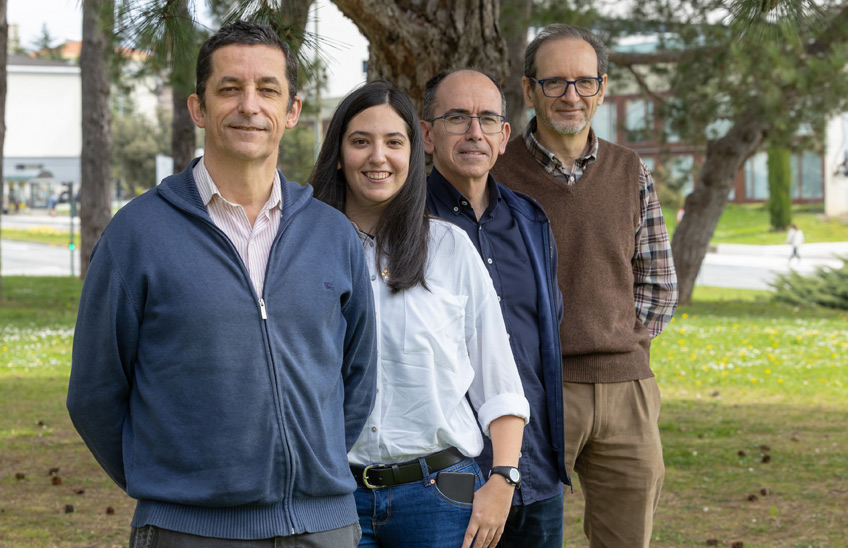
PhotoManuelCastells/Andrea Marín, on the campus the University of Navarra
23 | 01 | 2026
The European mink (Mustela lutreola) is on the brink of extinction. This small semi-aquatic mustelid, linked to clean rivers and wetlands, is now the most endangered mammal on the continent and one of the most vulnerable in the world. Its disappearance would mean not only the loss of a species, but also a serious deterioration of the river ecosystems on which it depends.
To prevent their extinction, several European countries have established captive breeding and reintroduction programs. However, these efforts face two core topic challenges. “Fewer than two-thirds of males born in captivity go on to reproduce, despite being physiologically ready,” explains researcher Andrea Marín Sierra, who holds a Ph.D. in Biology from the School of Science at the University of Navarra. Added to this is the fact that “less than 50% of released minks survive the first two months in the wild,” the most critical period, due primarily to predation and being hit by cars.”
Andrea Marín carried out her research work research the group Biodiversity Data Analytics and Environmental Quality group at the BIOMA Institute of the University of Navarra, and recently defended her thesis under the supervision of Dr. David Galicia Paredes (BIOMA Institute) and Dr . María Díez León (Royal Veterinary College, University of London). In her work, Andrea studied how captivity alters the reproductive and survival success of the European mink and demonstrated that one of the most effective tools to reverse this is environmental enrichment: introducing stimuli, smells, shelters, and challenges that make the environment more similar to the natural one.
" Environmental enrichment is core topic minks to express natural behaviors and make good reproductive decisions," says Andrea. To this end, she developed an integrated set of programs of study focused on conservation and applied them at the Foundation for research Ethology and Biodiversity (FIEB). Andrea did not limit herself to observing whether the minks reproduced or survived, but used an ethological methodology encompassing systematic observation, environmental manipulation, choice tests, social interaction analysis, and actual data .
His work that environmental enrichment not only improves well-being, but also profoundly changes the reproductive behavior of this mammal. For the first time, it has been demonstrated that minks use olfactory signals to choose mates and that, when living in poor environments, they can make maladaptive decisions. "In the absence of enrichment, minks chose relatives as potential reproductive partners, which could increase inbreeding," explains Marín.
written request a context of accelerated biodiversity loss, driven by habitat destruction, pollution, and climate change, work demonstrates that conservation depends not only on saving species, but also on understanding them. The European mink is an indicator of the health of rivers and wetlands, ecosystems core topic are core topic water quality, climate regulation, and human well-being. Protecting it ultimately means also protecting the natural systems on which our own lives depend.
The results of this research direct applications in breeding centers: they will improve mate selection, reduce conflicts, increase issue , and better prepare animals for life in the wild. This will not only benefit the European mink, but will also have a direct impact on the conservation of many other species that, like this small mammal, are threatened and depend on breeding and reintroduction programs.
Bibliographical references
· Marin-Sierra, A., Petrescu, C., Galicia, D., Díez-León, M. D., Maran, T., Nemvalts, K., & Aranda, M. C. (2025). Fostering as a conservation breeding tool: Lessons from three case studies in the critically endangered European mink (Mustela lutreola). Journal of Applied Animal Welfare Science, 1–11. DOI: 10.1080/10888705.2025.2481882
· Díez-León, M., Bowman, J., Bursian, S., Filion, H., Galicia, D., Kanefsky, J., Napolitano, A., Palme, R., Schulte-Hostedde, A., Scribner, K., & Mason, G. (2013). Environmentally enriched male mink gain more copulations than stereotypic, barren-reared competitors. PLoS ONE, 8(11), 1–11. https://doi.org/10.1371/journal.pone.0080494