Soil microorganisms are not just a supplement, but a central component of the agriculture of the future.
A study by the BIOMA Institute investigates how to curb the impact of climate change on grape quality by using consortia of mycorrhizal fungi and soil bacteria.

26 | 01 | 2026
Climate change is no longer a distant threat to vineyards: extreme heat waves and rising CO₂ levels are altering grape ripening and wine quality. Faced with this status, which affects both the wine sector and consumers, a team of researchers from Biodiversity and Environment Institute at the University of Navarra has shown that some biological tools could be found underground that would increase the resilience of this crop to climate change.
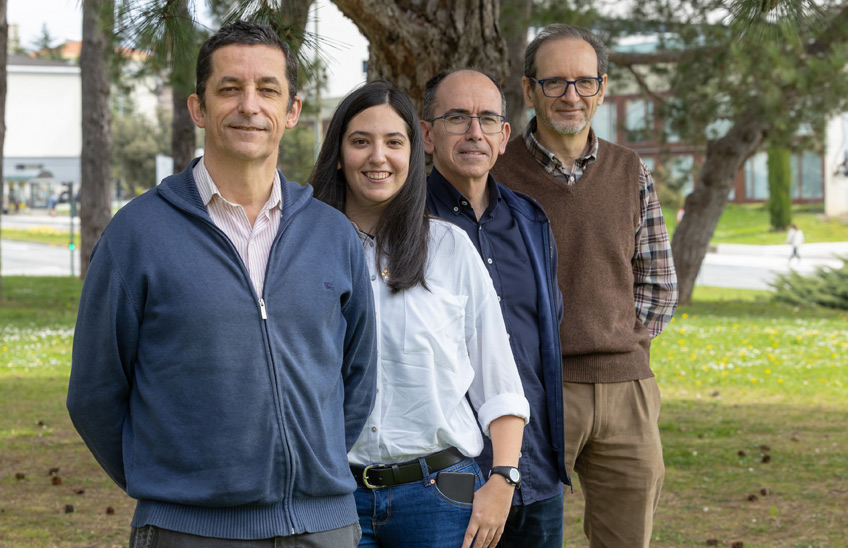
Daria Kozikova, a doctoral student at the BIOMA Institute, together with Inmaculada Pascual, Nieves Goicoechea, María del Carmen Antolín, and Johann Martínez-Lüscher, researchers at the BIOMA Institute, have published an article the scientific journal Food Research International in which they demonstrate that the combination of mycorrhizal fungi and beneficial soil bacteria allows young vines to better withstand extreme weather conditions and continue to produce high-quality grapes.
In a pioneering experiment, Cabernet Sauvignon grapevines were subjected to climatic scenarios that mimicked future weather conditions: temperatures 4°C higher, heat waves, and elevated CO₂ levels. The results showed that extreme heat reduces grape size, acidity, and the accumulation of anthocyanins, the pigments responsible for the color of red wine. It also alters the profile the grape, which is essential for fermentation and development .
Some of these effects are significantly mitigated when plants are associated with arbuscular mycorrhizal fungi and plant growth-promoting bacteria. "These associations improve nutrient uptake and strengthen plant physiology, which translates into greater stability in grape composition under stressful conditions," explains Daria Kozikova.
The study shows that vines grown with these microorganisms maintained better acidity, accumulated more total amino acids, and retained a more balanced profile than non-inoculated plants, even under extreme temperatures. In oenological terms, this means better nutrition for yeasts during fermentation and greater aromatic potential for the wine.
In addition, it was observed that mycorrhizal plants showed a much more stable response to changes in temperature and CO₂, indicating greater resilience to variable climate scenarios. "Soil microorganisms are not just a complement, but a central piece for the agriculture of the future," emphasizes Daria Kozikova. In a context where climate change threatens both crop yield and quality, this study opens the door to more sustainable management strategies.
This study is part of project RHIZOCLIMAVID research project (PID2020-118337RB-I00/AEI/10.130 39/501100011033), funded by the Spanish Ministry of Science and Innovation. J. Martínez-Lüscher is the recipient of an financial aid Talent Senior financial aid (2021) and D. Kozikova has a pre-doctoral contract from the association the University of Navarra association .
reference letter bibliographic
· Daria Kozikova, Johann Martínez-Lüscher, M. Carmen Antolín, Nieves Goicoechea, Inmaculada Pascual, A consortium of arbuscular mycorrhizal fungi and plant growth-promoting bacteria modulates wine grape ripening and composition under climate change conditions, Food Research International, Volume 225, 2026, 118027, ISSN 0963-9969, https://doi.org/10.1016/j.foodres.2025.118027.