El rector de la Universidad de Navarra apuesta por seguir fomentando centros de investigación sobre áreas específicas
The President of the University of Navarra is committed to continuing to promote research centers in specific areas
- Ángel J. Gómez Montoro expects construction of the new Contemporary Art Center to begin by the end of 2011.
"Along with the daily work of the library or the laboratory, which will always be the basis of all university research , we want to continue to promote some centers that bring together an important issue of researchers in specific areas". This was stated by the President of the University of Navarra, Ángel J. Gómez-Montoro, during the official opening ceremony of the academic year 2.
10-2011. "In that spirit, we are promoting the Centers for Bioengineering, Nutrigenomics, Neglected Diseases and the Institute for Culture and Society. Institute for Culture and Society"he pointed out in his speech.
These initiatives, he said, are the basis of the University's proposal to aspire to the accredited specialization of Campus of International Excellence, which last year deserved a special grade and an amount of three million euros. "We are convinced that the project deserves the accredited specialization of Campus of International Excellence and for this reason we have worked on its improvement and we have submitted it to this year's call, which will be resolved during the next quarter. We hope to once again count on the support of all the institutions and the Navarrese society, which will undoubtedly benefit from the new centers".
In this regard, he cited some of the advances in the projects of this proposal, such as the construction of the new building for Economics, Law and masters, the new parking lots or the bike lane, "all aimed at making the campus a more pleasant place, with as little traffic as possible, which can be enjoyed not only by our students, but also by so many Navarrese men and women.
He also referred to the progress of the Contemporary Art Center project . "Although the administrative procedures are still pending and there are still many steps to be taken for its financing, I dare to dream that it will be possible to begin its construction by the end of 2011".
Bologna: encouraging results
During the 2009-10 academic year, the University of Navarra carried out the process of implementing 32 new Degrees adapted to the European Higher Education Area, as well as a new academic calendar. The President thanked the academic community for its efforts to "make the changes introduced translate into real improvements in our professor activity" and added that "although it is too early to take stock, the results of this year are encouraging".
Regarding the challenges for this academic year, he spoke of the momentum of the Master's Degree programs of study : "In a few years, we have gone from 10 to 33 master's degrees, all of which have received official recognition. This has also allowed us to grow from 500 to more than a thousand students," he said.
On the other hand, Ángel J. Gómez Montoro mentioned the changes that have taken place this year in the governance and organization of the academic center. "The University has grown significantly in the last lustrums, with the consequent increase in complexity and work. For this reason, we have carried out a review of the general services, the current structure of our academic centers and the main procedures for action." The goal, he said, is "to gain in effectiveness and efficiency; to advance in the decentralization of competencies, in some cases, or to promote the partnership between the different centers and the general services, in others; as well as to deepen the professionalization of management".
50th Anniversary of the Friends association
In his speechIn his speech, the President also had a few words for the association of Friends of the University of Navarra, which is celebrating its 50th anniversary this year. "The association was directly promoted by the founder of the University and has proven to be an essential element for its development. Thanks to so many good Friends, and especially to the delegates who voluntarily and selflessly dedicate part of their time and effort to obtain economic resources, it has been possible to finance a good part of the buildings that make up the campus as well as a very important part of the research activity".
The President concluded his speech by welcoming the new students, whom he encouraged to be ambitious in their programs of study and "in all the possibilities that the University offers".
AUDIO: The President speaks about Bologna during the opening ceremony
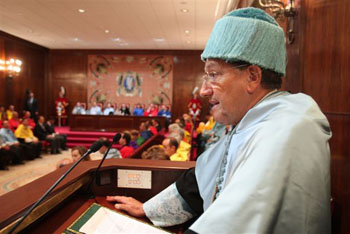 |
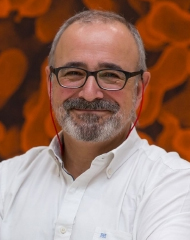
| Professor Rafael Alvira gave the inaugural lecture. |
| Photo: Manuel Castells |
Inaugural lesson on the meaning of time
The opening ceremony began with a Eucharistic concelebration presided over by the Archbishop of Pamplona and Bishop of Tudela, Francisco Pérez González. Then, after the academic parade of doctors, the ceremony began with a speech by the University Secretary, Gonzalo Robles, who summarized the most relevant research and teaching data of the academic report .
In the opening lecture of the 2010–2011 academic year, Professor Rafael Álvira of the Ecclesiastical School of Philosophy, pondered the meaning of time. "Among the many divisions that human ingenuity devises with regard to the human race itself, one is perhaps more prevalent today than ever before: it divides people into those who have time and those who do not. And the trend is becoming increasingly extreme: it is growing harder to find people who have even a little time."
AUDIO: Rafael Alvira speaks about time availability
Full Professor Rafael Alvira, also a professor at the School of Philosophy and Letters and the Institute of business and Humanism, said that "time is our capital par excellence. But only those without work have it properly at their disposal. Workers also have it, but they do not spend it to live, but to produce. In this sense, he pointed out that "turning one's life towards the result is the same as offering one's own life for the objects we produce".
In this way, he rejected the current conception of work: "Today we only take into account production and pleasure. The human being devotes himself to the one from Monday to Friday, and to the other on weekends. He cannot do both things at the same time, he cannot harmonize them internally".
Rafael Alvira pointed out that technification is the most characteristic feature of current knowledge and explained that the person who is guide by this mentality "hardly takes into account the past, neither 'transcendental' nor historical. But the future does not matter so much to him as to the result. His sense of time is marked by the vectors of harmonization of the times and accelerated use of them".
"The 'technological time,'" he continued, "is a paradox. It does not delve into one's past, nor is it aimed at a happy future, for mere results do not generate happiness, because they do not add to our being other than externally."
In the face of this, he opted for integrating the past and the future into eternity and recovering the authentic meaning of work: "Overcome the separation of the past that comes from nostalgia or forgetfulness. And the future can only be integrated if we believe in it, if we think that what we are going to do will be truly worthwhile, and that, therefore, working for the future makes sense. Loving the work is the truth of the future. This is well known in this University, since it is the very doctrine of its Founder".
AUDIO: Rafael Alvira talks about the integration of past and future in eternity