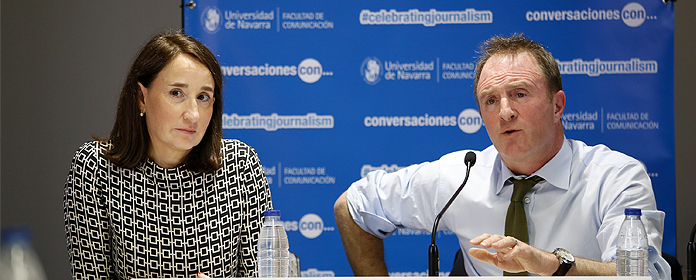
Luka Brajnovic asserted that "it is better to lose with the truth than to win with deception".
Interview of the professor of the University of Navarra in the newspaper essay in 1993.
On Thursday, the 8th, he passed away at the University Clinic Professor and journalist Luka Brajnovic passed away. Because of its interest, an interview with him published in essaya newspaper of the University of Navarra (Pamplona, 1993).
Don Luka manifested his first journalistic interests at the age of twelve, when he promoted a magazine for his high school. Years later, he would become the director of the weekly Hrvatska Straza.
About to be shot
Being a journalist saved his life in 1943...
- I did indeed. When I was director of the newspaper, I made a trip. The train in which I was traveling was derailed by bombs planted by Tito's communist guerrillas. With the shooting, I started to tear up all my documents, but I forgot to destroy the journalist ID card I had in my jacket pocket. I was sentenced to death, and when the firing squad was forming, I was pulled out of the line because I was a journalist, and I was held in concentration camps.
How did you spend your life in those camps?
- From March to August 1943, I was in the Kamensko and Vrhovine camps, which were Croatian territories occupied by the communists. They wanted me to talk on the radio; they tried to use me for propaganda in their favor, saying who I was and that I had voluntarily joined their side. In the end, I managed to escape from Vrhovine, together with another comrade, taking advantage of a bombing raid on the camp. So I was able to return to the newspaper in Zagreb, although shortly afterwards the fascist Croatian government banned it for publishing an article about a speech in which Pope Pius XII condemned this ideology.
When did you leave Croatia?
- In 1945, with the arrival of the communists to power. I left my country, where my family stayed, and I was living in allied refugee camps in Austria and Italy, where I began to produce a typewritten newsreel, Vijesti, which I posted on the bulletin boards in the barracks. My sources were the BBC and other European broadcasters that I listened to through the radio that a colleague had hidden, and sometimes a newspaper.
Teacher and friend
From those who know Mr. Luka, who was the director essay for almost twenty years, it is unanimously concluded that he is one of those teachers who have never had a bad face for a student. On the contrary, his good humor and sincere cordiality do not go unnoticed when dealing with him.
You arrived in Spain in 1947. When did you rejoin your family?
- I was twelve years away from my wife and eldest daughter. I had to go to Munich to join them in 1955. During my stay there I collaborated with the newspaper Münchener Merkur. But we returned to Madrid the following year.
How did you come to the University of Navarra?
- I knew Antonio Fontán from my years of partnership with the magazine La Actualidad española and the Higher committee for Scientific Research (CSIC). In 1959, Professor Fontán offered me to teach typography at the then Institute of Journalism. After the death of the professor, also Croatian, Anton Wurster, I took position his classes. After that, I took over the classes of Literature and Journalistic Ethics. At the same time, I continued my professional activity through collaborations with agencies, magazines and newspapers.
True to himself
Professor Brajnovic is also a Catholic with deep religious convictions, which lead him to extend his ever-smiling dialogue to people of any mentality. He assures that differences of thought have never been a barrier to making new friends.
Sometimes it is not easy for a journalist to remain faithful to principles. In this respect, what does your long experience tell you?
- Any journalist can make concessions to certain current circumstances, but it will weigh on his conscience for the rest of his life. I think it is much better to be demanding with one's own judgments and with oneself than to be a weather vane that moves according to the wind that blows.
Is this a reproach to journalists?
- No, it is a danger against which we must all be forewarned. If a personality says something idiotic, the journalist must say that it is idiotic, and not just repeat it. Otherwise, the journalist becomes the bearer of that nonsense. It is better to lose with the truth -which will only be temporary- than to win with a deception -which will only be a passing victory-.