"This course has helped me discover, among other things, that multidisciplinarity is not only necessary, but inevitable."
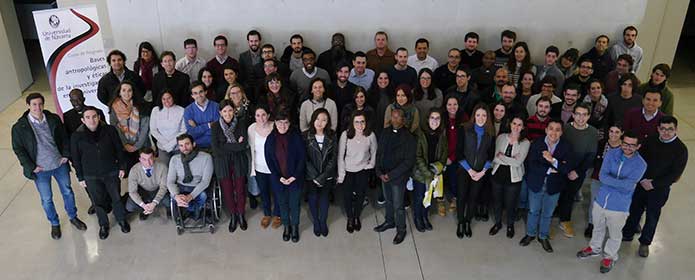
87 doctoral students participated in the doctoral course, "instructions anthropological and ethical of the research at the University", organized by the Institute Core Curriculum, earlier this month of May 2018

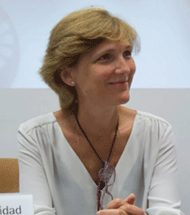
Sofía Brotons, a doctoral student in the Art and Humanities program, highlights the good experience for her work to raise issues such as multidisciplinarity, the characteristics of the good researcher or the role of religion in the research task.
What were your expectations for this course and have they been met?
With this course I wanted to broaden my knowledge of the ethics of researcher , and learn a little more about the duties of human beings, as such, when it comes to research. The truth is that not only have they been fulfilled, but they have also exceeded the expectations I had. result has been a very interesting course as it has brought to discussion many other issues that perhaps we had not considered (the multidisciplinarity, the role of religion, the need for humility in the research...).
During the course you have talked about researcher, the multidisciplinarity, the Christian identity, the dialogue between science and religion... after all this, how do you approach your research task and what have you learned from the course?
On the one hand, and perhaps what has served me the most, has been to make me even more aware of the importance of multidisciplinarity and what it means to be interdisciplinary. I have learned that it is not about knowing a little bit of everything, but about the ability to find the connection that everything has with each other by the mere fact of being real. Being interdisciplinary is not only necessary, but also inevitable as we live in a global world in which it is increasingly urgent to be open to other perspectives. In my doctoral thesis specifically attention issues that have to do with Philosophy, psychology and linguistics, so this part of the course has been particularly useful for me result .
I also found especially valuable the part of the course in which we talked about Christian identity and the mission statement of the university. This part motivated me even more to see the sense of service that all researchers should have towards society.
The last part of the course dealt with the university institution, its mission statement and social commitment. How does all this translate into the work of PhD student?
Basically, I believe that the fact of making the decision to carry out a doctoral thesis is already a commitment to the university where it is carried out. The university is the one that provides the instructions to make this research task possible, and each researcher is an important and irreplaceable part of this university research task. Specifically, the University of Navarra, with its mission statement, its identity of service and sense of work well done, does a great job, since researchers, being participants in these values, can achieve our goals more effectively and above all with a common goal.