Professional Identity and the Authority of Journalism: Ideology, Boundaries, and Crisis
A research explains the mechanisms through which the identity and credibility of journalism are built and maintained

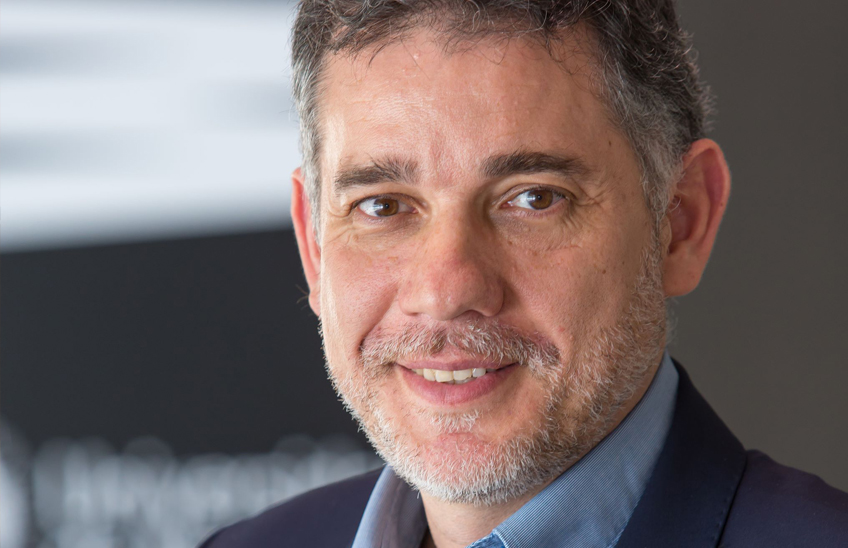
Photo byManuel Castells/Researchers Fernando López Pan and Álvaro Villagrán
07 | 05 | 2026
When a veteran journalist recalls the Watergate scandal in an essay, he is not merely evoking a historical episode: he is reminding his colleagues and audience what journalism is and what its role and place in society are. Gestures like this, seemingly anecdotal, are part of work ongoing work through which the journalistic institution defines its identity and legitimizes its authority as source knowledge.
This is according to a research the School of Communication at the University of Navarra, authored by Álvaro Villagrán Sánchez and Fernando López Pan and published in the journal Brazilian Journalism Research. The article an original framework , centered on the concept of professional ideology, to explain how journalists negotiate, defend, and reproduce their collective identity over time.
research particular significance at a time when the rise of social media, artificial intelligence, the boom in digitally native media, and the proliferation of new forms of storytelling are raising questions about the nature and limits of the profession: What is journalism? Who can call themselves a journalist? As López Pan argues: “What for decades seemed like a question with an obvious answer has become one of the major debates among academics and professionals.”
The starting point is that journalism is defined not only by what it does, but also by how it talks about itself: this is where the concept of professional ideology comes into play. The authors identify three core topic mechanisms core topic report , professional boundaries, and recovery from scandals—that enable the profession to maintain its internal cohesion and external credibility.
Myths That Shape Identity
Founding myths: every profession needs its heroes and its role models. In journalism, episodes such as the Watergate scandal, the Pentagon Papers, or the figure of Edward R. Murrow standing up to Senator McCarthy are not mere historical references: they serve as icons that embody the profession’s core values, such as the pursuit of truth, independence, and commitment to the public interest. They also serve as patron saint judge the internship .
Boundaries to define the profession
Journalism is also defined by contrast: by distinguishing themselves from other actors in their field—such as digital content creators, public relations professionals, or news influencers—journalists demarcate their domain and establish which practices they consider legitimate and which fall outside it. Through this demarcation of boundaries, journalism protects its authority as source of knowledge reality. In an increasingly fragmented news environment, this demarcation is central to establishing credibility.
Crises that reinforce the rules
When a journalist manipulates information or commits a serious error or violation, the typical reaction of the institution is not to question the system as a whole, but to isolate the case as an isolated incident. The "bad apples" narrative allows traditional journalistic standards to be preserved without undergoing a thorough review. In this way, the profession protects its public legitimacy even in situations where it has been discredited.
Risks associated with the mechanisms: an obstacle to renewal
However, when professional ideology becomes too rigid, it can become a tool distortion: collective myths can idealize a past that no longer meets the challenges of the present; professional boundaries can exclude legitimate forms of journalism that do not fit the traditional mold; and the tendency to pin mistakes on individuals can prevent the profession from learning from its more systemic failures. As Villagrán Sánchez points out: “Professional ideology is always a balance between the need for integration and identity—a shared narrative of ‘us’ versus ‘them’—and resistance to change. If the latter prevails, ideology becomes an obstacle to renewal.”
Given the proliferation of definitions—academic literature has identified more than 160 variations of the noun "journalism"—the study proposes a different approach. Rather than seeking a definitive definition, it proposes analyzing the mechanisms through which the profession itself constructs and defends a self-image.
reference letter article
Villagrán Sánchez, Á. and López Pan, F. (2026). Theorizing ideology as an integral framework for studying the sociological demarcation of journalism. Brazilian Journalism Research. DOI: 10.25200/BJR.v21n3.2025.1906