The University celebrates the first European doctorate Day
The workshop, organized by the doctorate School, brought together doctoral students and researchers to discuss mobility , employment opportunities the contribution of research to society

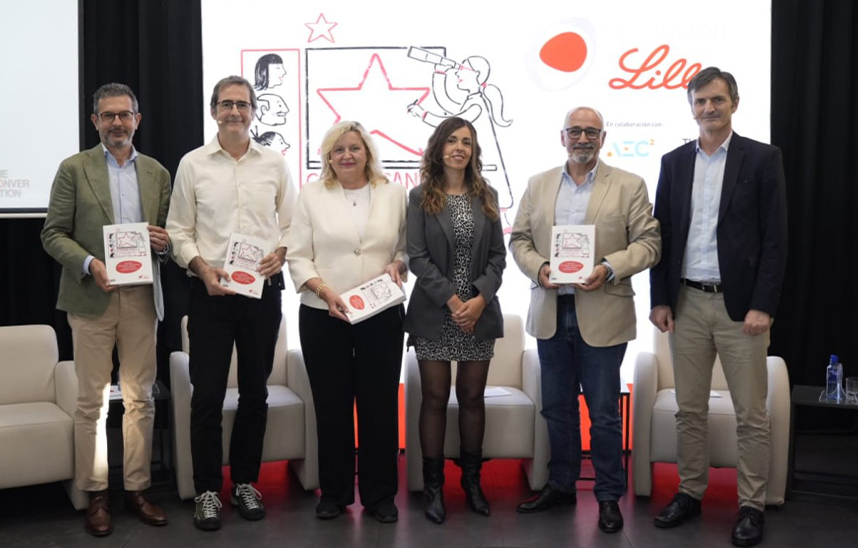
Photo by ManuelCastells/From right to left: Alberto García Galindo, Paola Ruiz López, Alonso García Schlatter, Enrique Aymerich, Paloma Grau, Javier Burguete, Iker Ausejo, Elena Ainzua Pérez, Ignacio Laguía Cassany.
14 | 05 | 2026
What does a thesis offer beyond the academic sphere? That was one of the questions that guided the meeting on May 13 in the classroom Gamesa classroom at Institute for Culture and Society ICS), as framework the first edition of European doctorate Day. Through two panel discussions, the session focused on the international dimension of doctorate, knowledge transfer knowledge the professional opportunities that arise during and after the thesis
The meeting with remarks by Javier Burguete, director the doctorate School, who highlighted the significance of this new European initiative. “It is an opportunity to recognize the value of knowledge during the thesis to consider how it can benefit society,” he noted. His remarks were followed by two panel discussions in which doctoral students and researchers shared their experiences related to mobility, research , knowledge transfer, and development .
One thesis many paths
The first roundtable focused on international stays as part of training . Four doctoral students participated, sharing their experiences at reference letter European institutions. Elena Ainzua Pérez, a doctoral student at the School of Science, explained that her stay at the William Harvey Research Institute at Queen Mary University of London allowed her to step outside her usual environment and experience a different researcher context. “I was surprised to see that, even though I was younger, I also had my place among more experienced researchers and could contribute ideas,” she noted.
For his part, Alberto García Galindo, PhD student the Institute of data Science data Artificial Intelligence (DATAI), highlighted the value of conferences and contact other research groups, since his opportunity to study at Jönköping University arose precisely from networking at an meeting . For Paola Ruiz López, a PhD student at the School of Humanities and Social Sciences, her stay at the Université Sorbonne Nouvelle allowed her to focus entirely on her thesis “When you go abroad for a few months, you’re there and you’re solely focused on that,” she said.
Drawing on his experience in Germany, Alonso García Schlatter, PhD student the School of Humanities and Social Sciences, emphasized the staff growth staff his stay at the Katholisch-Theologische Fakultät der Universität Erfurt, where he discovered “the importance of calm” for thinking and conducting research. Beyond the specific destination, all four agreed that going to another institution allows one to gain autonomy, focus on research understand the thesis a broader perspective.
From knowledge impact
The second roundtable explored the career paths available after earning doctorate three tracks related to academia, research , and entrepreneurship. Ignacio Laguía Cassany, professor at the School of Communication, shared his experience after recently defending his thesis animated film. “The thesis has helped thesis reflect on and delve deeper into the topics that interest me,” he noted.
For his part, Iker Ausejo, researcher Cima of Navarra and Director of PopCorn Therapeutics, explained how research in the laboratory be transformed into a business initiative aimed at reaching patients. The spin-off, created based on results generated at Cima, seeks to develop new cancer drugs using genetically modified viruses. “We believed it was the only way to truly reach patients,” he said.
Enrique Aymerich, researcher Ceit, shared his perspective on research from a technology center, where—he explained—his doctorate helped doctorate develop autonomy, adaptability, and a focus on technology transfer: “It’s not just about publishing; it’s about research the research .” In this vein, it was also highlighted how this research mindset remains very much alive in environments where knowledge with innovation and market transfer, thanks to initiatives driven by the University of Navarra such as Transfer Unav (Office of knowledge Technology Transfer. University of Navarra - Office of knowledge Technology Transfer ) and Innovation Factory Unav (Innovation Factory - Innovation Factory ), which support the development projects with the potential for social and business impact.
research the driving force behind the University
The workshop with remarks by Paloma Grau, Vice President research Sustainability at the University of Navarra, who thanked the doctoral students for their work and highlighted their role in research activities. research the driving force behind all our activities: teaching, technology transfer, business creation, and knowledge dissemination, knowledge disseminationshe stated. In this regard, she emphasized: “A doctorate more than just delving deeply into a topic; it is an experience of professional and staff growth staff contributes to development the university and society.”