The IBERIFIER observatory has secured renewed support from the European Commission and will monitor disinformation during the General Elections on November 29
In the third phase of the “ project ” initiative, the University will coordinate 13 organizations from Spain and Portugal to monitor disinformation campaigns during extraordinary crises and electoral processes

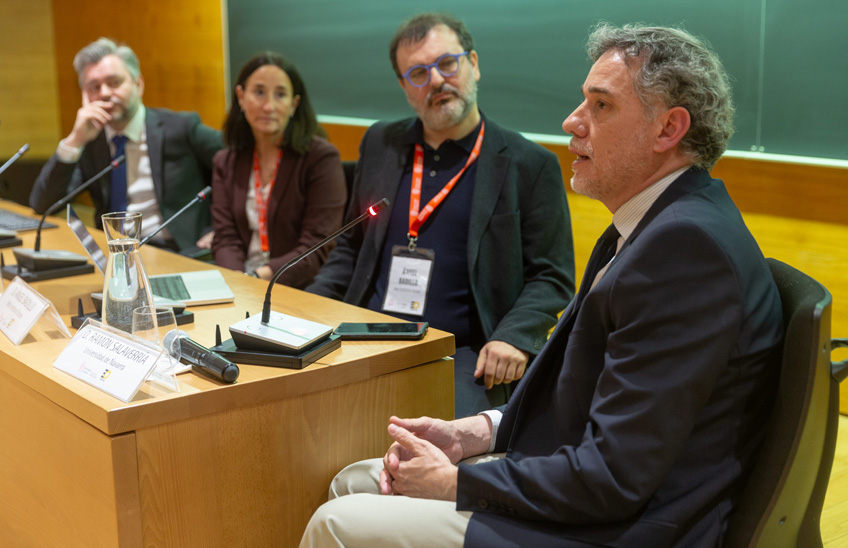
Photo byManuel Castells/Researchers from Iberifier 3 at the University of Navarra. From left to right: Anais Sánchez, Aurken Sierra, Charo Sádaba, and Ramón Salaverría
26 | 10 | 2026
The University of Navarra will coordinate IBERIFIER 3, the third phase of the Iberian Observatory on Digital Media, a European “ project ” that has been dedicated since 2021 to researching, detecting, and combating disinformation in Spain and Portugal. The initiative, funded by the European Commission, will once again be led by Ramón Salaverría, a Full Professor at the School of Communication academic center.
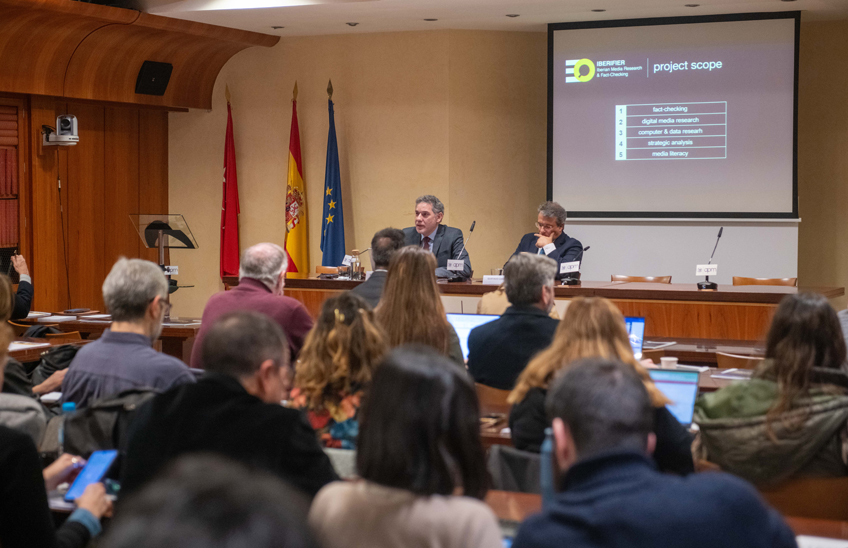
The new phase, which begins this November and will last through April 2028, will address misinformation that is spreading at an ever-increasing rate across platforms, countries, and languages, and that may include content manipulated using artificial intelligence or coordinated amplification campaigns. To tackle this, the Observatory will expand its shared archive fact-checking database with a tool that will classify tactics, called the RRS (Rapid Response System).
According to Ramón Salaverría, coordinator of project, the main new feature of IBERIFIER 3 is that “it will quickly identify strategies for manipulating information at critical moments—especially during information crises and electoral processes—in order to neutralize their effects as soon as possible. To this end, it will strengthen its technological tools and international coordination.” According to Salaverría, “as luck would have it, the start of the third phase coincides with the announcement of the general elections on November 29, so IBERIFIER will begin its new phase at full capacity.”
Early Warnings and the 2026 Elections
In addition to monitoring disinformation during electoral processes and in extraordinary situations—such as the 2024 Valencia storm or the summer migration crisis in Ceuta—IBERIFIER 3 will establish joint response procedures for its teams across the Iberian Peninsula. In Spain, ahead of November 29, it will reactivate “Comprobado,” a fact- partnership platform among fact-checking organizations that was previously activated during the 2019 and 2023 general elections.
The “ project ” plans to conduct hundreds of fact-checks and at least 10 in-depth investigations. In addition, it will publish a dozen “ status ” rapid reports and at least 30 early warnings, with a maximum response time of 24 hours during crises and 12 hours during peak election periods.
In the two previous phases, IBERIFIER has published more than 50 reports and programs of study on disinformation and the media ecosystem in Spain and Portugal. These documents are freely available at network .
Media Literacy and Communication
In the field of media literacy, the project will carry out five campaigns, training initiatives, or media literacy events aimed at citizens, journalists, and other communications professionals.
The consortium will consist of 13 organizations—eight Spanish and five Portuguese—including universities, news agencies, fact-checking organizations, and organizations specializing in media literacy. On the Spanish side, in addition to the University of Navarra, participants include Carlos III University of Madrid, the EFE News Agency, the Maldita.es Foundation, Newtral, Verificat, Infoveritas, and Learn to Check. On the Portuguese side, participants include Iscte – Instituto Universitário de Lisboa, the LUSA news agency, the fact-checking organization Polígrafo, Obercom, and CENJOR.
IBERIFIER 3 builds on the “ work ” initiative launched in September 2021 with IBERIFIER (2021–2024) and IBERIFIER Plus (2024–2026). As the “ reference letter ” center for Spain and Portugal, it is part of the “ network ” of 15 observatories promoted by the European Union across its 27 member states, under the overall coordination of the European Digital Media Observatory (EDMO).