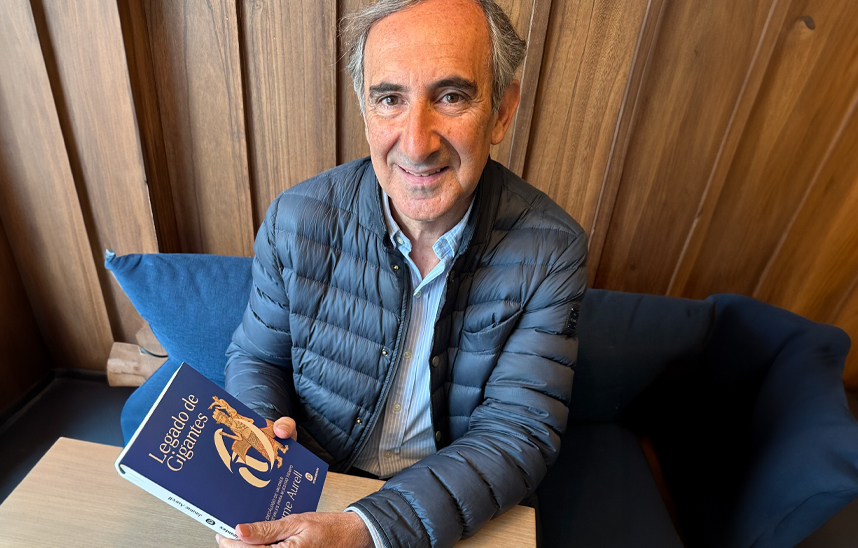
"The founding of the United States is the first time a country has been created based simply on one idea: every man is free."
A congress It analyzes the validity of the founding documents of the United States and the involvement of Spain in the independence of the 13 colonies.

Photo Leire Escalada/Santiago de Navascués (teacher of the School of Humanities and Social Sciences ), Scott Wishart (professor of the School of Law ), Miller Wells (president of the American Heritage Society) and Pablo Pérez López (head of the Chair Gustavo Cisneros)
30 | 03 | 2026
On the 250th anniversary of the Independence of the United States, the University of Navarra hosted the lecture ' The Declaration of the United States and the Constitution from a Global Perspective '. Organized by the American Heritage Society in conjunction with Chair Gustavo Cisneros and the School of Humanities and Social Sciences , this lecture He has explored the Declaration of Independence, the United States Constitution , and Spain's decisive contribution to American freedom.
According to Miller Wells , president of the American Heritage Society, the founding documents are not something to be viewed from afar but rather an ideal to live by. “Understanding the founding ideals of the creation of the United States involves recognizing that freedom is not a historical accident, but a deliberate architectural achievement , rooted in a specific understanding of human nature,” he explained. These documents represented a paradigm shift, moving from the 'I' to the collective responsibility of 'we,' radically transforming the Western world (' we the people of the United States '). These documents do not introduce new principles; they simply express the American mind, based on natural laws. “The founding of the United States is the first time a country was created based simply on an idea: that all men are free,” he emphasized. For Wells, understanding these origins reveals that our current freedoms are not self-sustaining and require constant attention through… Education and civic oversight. Looking back at these documents allows us to discern whether modern changes in governance represent true progress or regression.
For his part, Pablo Pérez López , Full Professor of History and director of the Chair Gustavo Cisneros contextualized the impact of the independence of the 13 American colonies within their historical moment. He recalled that the American Declaration of Independence, a serious challenge to British power, was the starting point of the Atlantic Revolutions , liberal in nature, which affected both sides of the ocean and changed the political landscape of numerous countries. "It generated a wave of emancipations that have largely shaped the current political map, especially in the Americas," he explained. He also pointed out that, after the Civil War, the United States of America was born, which became the world's hegemonic power in the 20th century. "The style and content of the Declaration have been imitated on many occasions by emancipation movements around the world," he added.
The Spanish involvement
During the congress The involvement of the Spanish Crown in the independence process of the 13 colonies has also been discussed. “Without the Spanish Crown, independence would not have been achieved,” Wells pointed out. According to Elisa Vargas ( Queen Sofía Spanish Institute ) and Rafael Torres Sánchez (University of Navarra), Spain was involved from a naval, political, and commercial perspective. First, the Spanish Empire was interested in controlling the Caribbean, whose gateways were guarded by British colonies. Thus, it became involved in the war of independence, joining forces with France and developing an offensive strategy that blocked 40% of the British naval force in the English Channel. Furthermore, the Spanish navy also escorted convoys to the Americas and sent up to 20,000 men to the American front. In this way, “the battle with Great Britain took place in the Atlantic, giving the Americans an opportunity,” Torres noted.
Also of interest is the support of Spanish merchants for the American rebels . Spanish merchants, especially those specializing in cod in Bilbao, had amassed great fortunes trading with the 13 colonies and were keen to maintain those relationships. The case of the Gardoqui family stands out; they carried cod on their merchant ships... financial aid ...arms and smuggled uniforms. Ultimately written request Diego Gardoqui ended up serving as 'ambassador' to the United States after independence was achieved, becoming a friend staff of George Washington and John Adams, presidents of the United States.