Family relationships and their impact on sustainable aging and life decisions, topic the 11th ICS Lecture
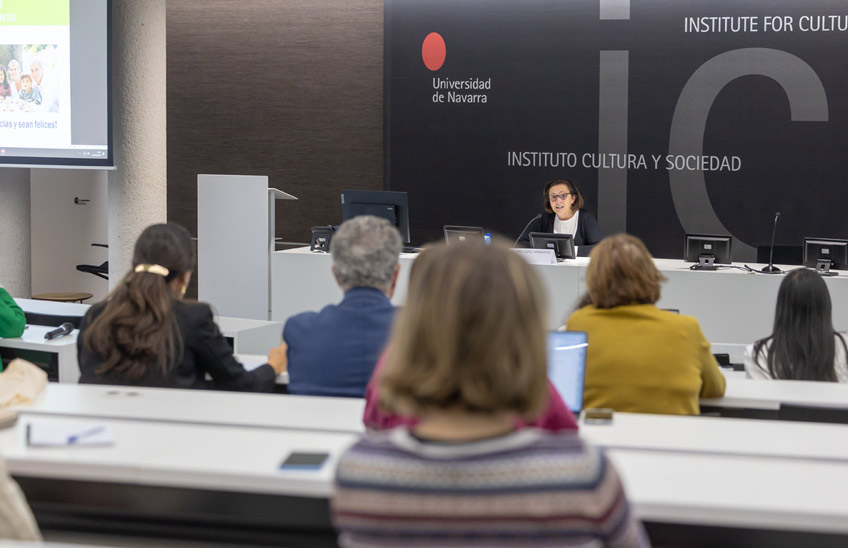
Pearl Dykstra, professor emerita of Empirical Sociology, gave a lecture by the Chair on New Longevities

Photo by ManuelCastells/Up to 150 people attended the lecture at the Institute for Culture and Society
01 | 04 | 2026
In response to the aging of the population over the past few decades, scholars have coined various concepts to address this phenomenon, though each has its shortcomings. The 11th ICS Lecture on Humanities and Social Sciences explored the innovative concept of“sustainable aging,”as well as the importance of strengthening intergenerational relationships, under the degree scroll Sustainable degree scroll : Recognizing the Interdependence Between Generations degree scroll This lecture delivered by Pearl Dykstra, professor emerita of Empirical Sociology at Erasmus University Rotterdam, and organized by the Chair on New Longevities, within the framework of the Institute for Culture and Society (ICS), and the IDEA Innovation Foundation.
The meeting, attended by nearly 150 people, featured Mª Carmen Maeztu, Minister of Social Affairs, Economics , and employment Government of Navarre; Ana Marta González, Director of the Chair on New Longevities; Rafael Sánchez Ostiz, President of the IDEA Foundation; Pablo Pérez, director of the ICS; and Carolina Montoro, professor at the School of Humanities and Social Sciences a collaborator with the Chair.
As Dykstra has pointed out, after several decades of research into how to address population aging, the new concept of “sustainable aging” has emerged in recent years. This notion represents a shift from previous paradigms, as aging is viewed as an opportunity (rather than through a negative lens), offering a comprehensive diary across multiple fields (Economics, health, technology, etc.), aligned with the development Goals (SDGs).
One of the key aspects of sustainable aging is that the focus is not only on older adults, but also on the various generations around them. “It’s not just about older adults growing older, but also about their relationships and coexistence with other generations,” he noted.
The Family as the Epicenter
Furthermore, Dykstra adds an intergenerational family perspective to the concept of “sustainable aging.” This perspective is of interest because, within the family, multiple generations coexist; the family average individuals and Structures , financial aid individual behavior. As the expert explained, family relationships prepare us to be citizens and influence decision-making. For example, it has been observed that intergenerational relationships encourage people to adopt the perspective of those of other ages, which translates into greater generosity, from everyday actions to voting.
The researcher also pointed out that there is intergenerational interdependence: financial (the family provides financial support to members who cannot support themselves), emotional (conversations, gestures, attention…), and responsibility (relatives are relied upon to provide financial aid, perform tasks…).According to the expert, these dynamics have a decisive impact on life decisions: people find it easier to have children if there is family support, they reconsider continuing to work if they have elderly parents, or they plan to retire early if there are grandchildren to care for.
Likewise, this interdependence is also influenced by public policy. Laws can enforce interdependence by, for example, requiring people to take responsibility for their children. They can hinder interdependence by restricting migration or promote it through parental leave. They can also facilitate or hinder it depending on the provision of goods and services (daycare centers, daycare facilities, social services, etc.) offered to citizens.
Dykstra has thus emphasized that sustainable aging is not just about older adults, but also enables people of all ages to start thinking about their future from a young age.
During the workshop , the awards for the second edition of the Chair Nuevas Longevidades Awards workshop presented, recognizing the best Degree Theses Degree TFG) and Master's Degree TFM) from the previous academic year. In the TFG category, Ana Karina Aloynaz, a design graduate design School of Architecture), was awarded for her work casa siempre se vuelve.” In modality , the project CENIT project knowledge , Networking, Innovation, Talent, project created by Luis Álvarez Atarés, Felipe Pérez, Alondra Olguin, and Inés Galindo, graduates of Master's Degree management Communication management at the School of Communication.