More than a hundred teachers are participating in the third edition of “The ‘ challenge ’ of Reading the ‘ classroom’,” an initiative promoting a humanistic and transformative “ Education ”
The course, held at the “ campus ” in Madrid, showcased pioneering projects related to reading and organized sessions on teaching methods for “Great Books” seminars.

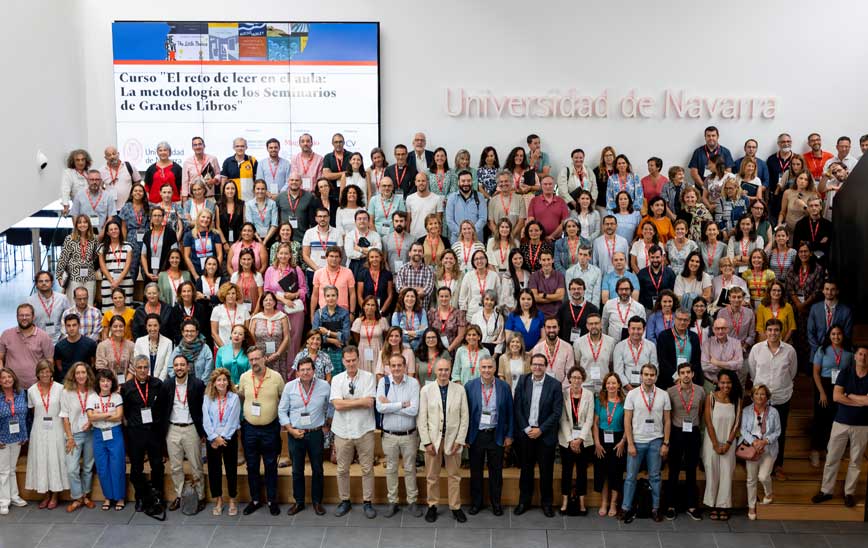
Photo by EstherLozano/Speakers and participants in the third edition of the course “The challenge of Reading in the classroom: The Methodology of the Great Books Seminars,” held at the University’s Campus in Madrid
03 | 09 | 2026
The third edition of the course“The ‘ challenge ’ of Reading at the ‘ classroom’” brought together more than a hundred teachers on August 27 and 28 at the“ Campus ” of the University of Navarra in Madrid, all with a common “ goal ”: to learn more about the “ educational ” and “transformative” power of reading and how to apply it in their classrooms. Through meetings with experts and hands-on workshops, the teachers had the opportunity to learn about pioneering projects in Spain and other European countries, share experiences, and experience firsthand the methodology of the Great Books Seminars.
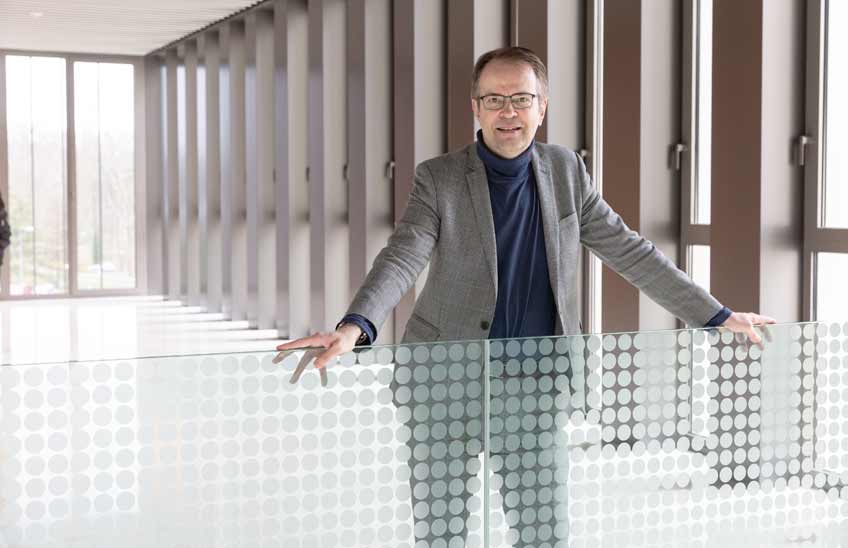
José María Torralba, director of the Center for Civic Humanism at the Institute for Culture and Society (ICS) at the University of Navarra—the organization hosting the course—speaks very highly of the third edition of the course and “the interest in bringing this approach— educational —to the classroom , where reading is not just another activity.” In this regard, she notes that the methodology of the Great Books Seminars, which originated in the United States, has a deep-rooted tradition spanning more than a century and represents much more than a mere method: “It embodies a certain vision of Education, Humanities , and reading directly linked to a person’s training in all its dimensions, which financial aid to asking the great questions of existence.”
Inspiring Encounters
In his “ discussion paper ” on Paul Ricoeur’s theory of reading and its relationship to this methodology, José Manuel Mora-Fandos, a professor at the School of Information Sciences ( School of Science ) at the Complutense University of Madrid, argued that “great books are not important merely because they have influenced the history of culture. They are important because they continue to offer possible worlds that, when inhabited, invite the reader to examine his or her own way of inhabiting the world.”
In addition, the course featured numerous initiatives that h internship the transformative power of literature. During the opening lecture , José Ángel Torijano, director at IES Lucía de Medrano (Salamanca), shared the transformation the school has undergone over the past decade and how reading is a core topic key component of its educational proposal . “We must put students back at the center, rely on them once again, and revitalize and foster enthusiasm for the profession professor,” he insisted.
Throughout the two conference , the following were also presented: project Argosproject, developed at 11 secondary schools and coordinated by the University of Navarra; the Pascal Institute (Netherlands) and the “Great Books” Master's Degree , organized in partnership with St. John’s College; and the project Erasmus+ REMAPhigh school (Reading for Meaning and Purpose), also led by the University of Navarra, with participation from the Bratislava International School of Liberal Arts, the University of Amsterdam, the University of Latvia, and the Ayalde High School.
For Bárbara Ramos, an elementary school teacher at the Montespiño “high school ” School in La Coruña, this was the second time she had participated in the course: “I really enjoyed the first experience and decided to do it again. Ever since I started working as a teacher, I’ve been concerned about how ‘ language ’ and literature are taught in elementary school. In my opinion, both literature and reading take a back seat at this stage, while much more emphasis is placed on grammar. That’s why I find this training very interesting—it’s a step toward changing that and focusing classes on reading and good books.”
The Classics, as a Community
One of the program’s key features is the seminars, in which participants—divided into groups and guided by a professor—explore together a classic text they have read in advance. Among the selected works are *Persuasion* by Jane Austen; *Confessions* by St. Augustine; *The Republic* by Plato; *The Road* by Cormac McCarthy; *The Southern Highway* by Cortázar; *The Death of Ivan Illich* by Tolstoy; and *The Abolition of Man* by C.S. Lewis.
“Accustomed to a very ‘magisterial’ or ‘linear’ approach to teaching , and the study of literature, I’ve felt very comfortable within the tradition of the great works, in that you can explore fundamental themes—whether explicit or implicit in the texts—in a very free manner,” explainedJavier Burguillo, professor of Golden Age and Contemporary Poetry at the University of Salamanca, who was participating in the course for the second time. He also noted that at these gatherings, “you can share some of your ideas with the other participants without academic formality and, at the same time, bring to light topics of human interest that we sometimes don’t address.”
For her part, María José Junquera, a philosophy teacher at the John Paul II “high school ” in Alcorcón (Madrid), emphasized that it is essential to “put theory into internship” and noted that “encountering such diverse profiles allows us to distill the essence of project.” She also stressed that the spirit of the Great Books Seminars must permeate the entire school educational: “It’s not just a project for the students. There must be a preliminary journey within the team itself professor and in the spirit of high school. In our case, it fits perfectly with our profile. I believe that all teachers need to be readers, regardless of our subject.”